18th Century Gustavian Sofa with Bow Carving. via 1st Dibs Auctions.




18th Century Gustavian Sofa with Bow Carving. via 1st Dibs Auctions.
1815 Blue Striped Dress, Norway. Empire style, or high-waisted, dress with short puffed sleeves over long straight sleeves and gold trim. I can picture Jane Austen and her female friends and family wearing this sort of dress to an evening event. via Nordiska Museet, Nordic Museum, Stockholm, Sweden. digitaltmuseum.se


1804 Royal Mint, Stamping Room, London, U.K. As Jane Austen would have known it. From Ackermann’s Microcosm of London by A.C. Pugin and Thomas Rowlandson.


“It is particularly incumbent on those who never change their opinion, to be secure of judging properly at first.” Jane Austen Pride and Prejudice (1813) .#JaneAusten #Regency #Quote


1798 Two ladies in Jane Austen style white walking dresses. Left: Dress has gold trim, white bonnet, green Parasol. Right: Stand up collar, short puffed sleeves, brown shawl and coiled head dresses, both with necklaces. via Rijks Museum, Amsterdam, Netherlands. rijksmuseum.nl

19th Century Early Green Silk Stockings With Gold Embroidery, French. via Metropolitan Museum, N.Y.C., U.S.A. metmuseum.org
In Jane Austen’s times, women, men, and children wore silk stockings, often embroidered in silk. In the Eighteenth Century, clocks had fallen out of fashion, but they were still being worn by wealthy aristocrats during the early 1800s.
In 1815, Rudolph Ackermann’s Repository Of Arts had an advertisement for silk stockings. ‘The cheapest and by far the largest stock ever produced by any one house now on Sale at the Manufacturer’s Warehouse, 51, Cheapside. The patterns are of the richest and most elegant description, beginning at the extraordinary low price of 8 shillings, usually sold for 10 shillings and 6 pence, to the very best and finest quality at 12 shillings 6 pence, usually sold for 16 shillings.’


“No, she was a very sober- minded young lady, sufficiently well-read in novels to supply her imagination with amusement, but not at all
unreasonably influenced by them.” Jane Austen ~ Sanditon (1817)


1860 Corset, American. Cotton, metal, and bone. Manufacturer: Langdon Batcheller and Company, American, founded 1865. Stamped Thompson’s Patent Glove Fitting Corset. via Metropolitan Museum NYC, U.S.A. metmuseum.org

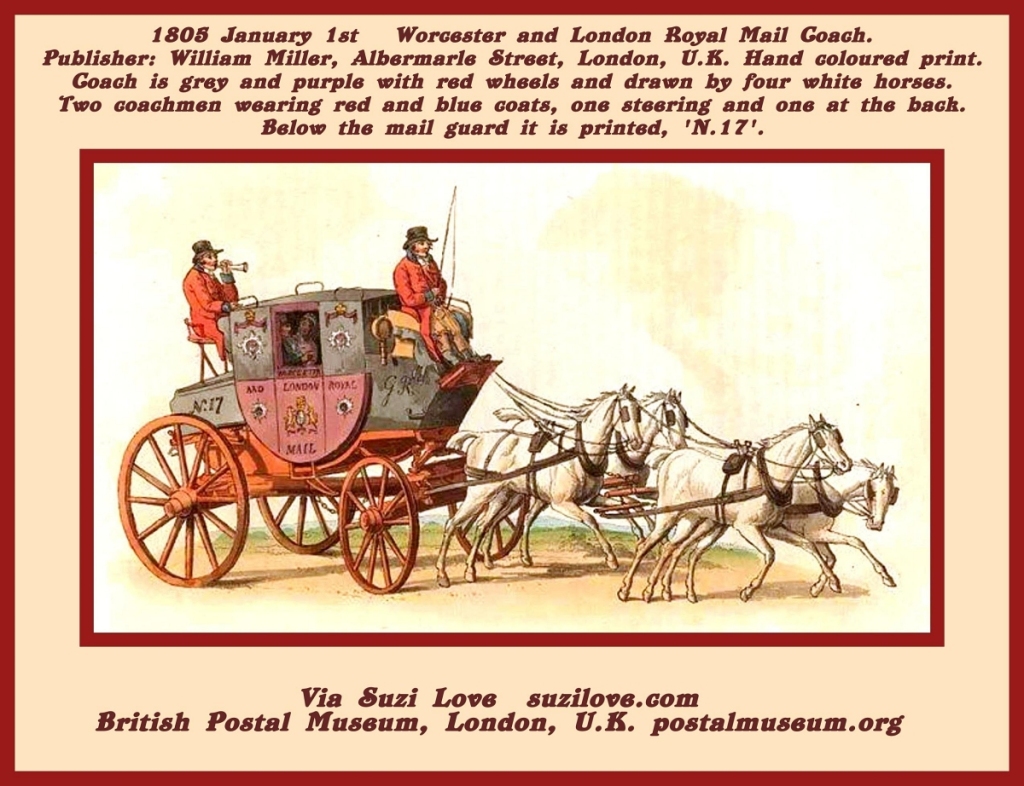
11805 January 1st Worcester and London Royal Mail Coach. The sort of mail coach that Jane Austen and famioy would have either ridden in or sent mail through. Publisher: William Miller, Albermarle Street, London, U.K. Hand colored print. Coach is grey and purple with red wheels and drawn by four white horses. Below the mail guard it is printed, ‘N.17’. Via British Postal Museum, London, U.K. postalmuseum.org

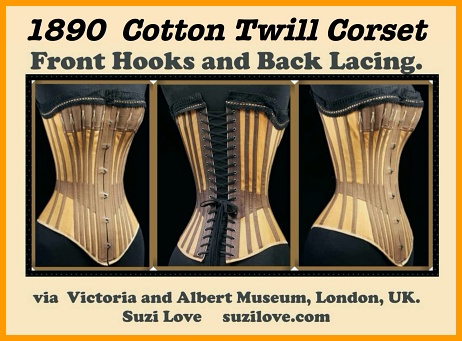
1890 Cotton Twill Corset, England or Germany. Machine stitched with front hooks and back lacing and made in two parts. Brown corset with the bones covered with a darker cotton twill, black fabric covered busks and a trimming of black machine-made cotton lace. Lined with white cotton twill and the top and bottom are bound with reddish brown tape.
The front fastens with a busk and the backs are provided with metal eyelets for a lace. The corset is hip length, curving to a rounded point in the front and less deeply at the back. The bones are close-set and splayed out at the bust and hips, and at the tops are trimmed with fancy stitching in cream. There is a band of dark brown cording at the top, covering the breasts. At the waist there is a V-shaped band in darker brown stitching. With metal fastenings. via http://collections.vam.ac.uk/item/O351699/corset-unknown/
Corsets 1880-1900 History Notes Book 20 This book shows how a fashionable silhouette became of paramount importance and how a well-fitted corset became a fashion essential. As well as a decorative fashion item, tight lacing gave a narrow waist and the desired feminine form under clothing. https://books2read.com/SuziLoveCorsetBook20