I'm an Australian author of contemporary and historical romances, plus history non-fiction.
My books range from sexy to erotic, late 1700s to the mid 1800s, and with a dash of Australia thrown into the mix. My heroes and heroines challenge tradition and my stories often expose the seamier levels of life.
I now live in a sunny part of Australia after spending many years in developing countries in the South Pacific. My greatest loves are traveling, anywhere and everywhere, meeting crazy characters, and visiting the Australian outback.
I hope my books bring history alive and you have fun adventuring with my roguish heroes and feisty heroines.
Pleasure House Ball Book 3 Irresistible Aristocrats. Love revealed at a courtesan’s ball. Brenton, Lord Mallory, attends his first courtesan’s ball in ten years to appease his concerned friends, though he’d rather stay home and read to his motherless daughters. books2read.com/suzilovePHB
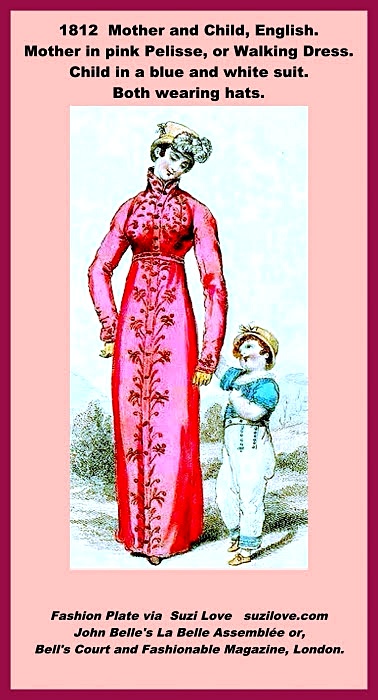
1812 December Mother and Child, English. Mother in a pink Pelisse, or Walking Dress, of Merino wool with an embroidered front and frogs and tassels to fasten it. Waist is of a moderate length and there is an elegant figured belt and tassels. Tight long sleeves finish at the cuff with embroidery, like the stand-up collar. York tan gloves and half-boots, small straw turned up hat with two short ostrich feathers. Child wears a blue and white suit and both wearing adorable hats.
Fashion Plate via John Belle’s La Belle Assemblée or, Bell’s Court and Fashionable Magazine, London. The child is not mentioned in the description. ‘This truly elegant and fashionable order of promenade costume was furnished by Mr. S. Clark, Ladies Pelisse and Habit Maker, No. 37 Golden Square, whose taste in articles of this description has been so generally admired.’
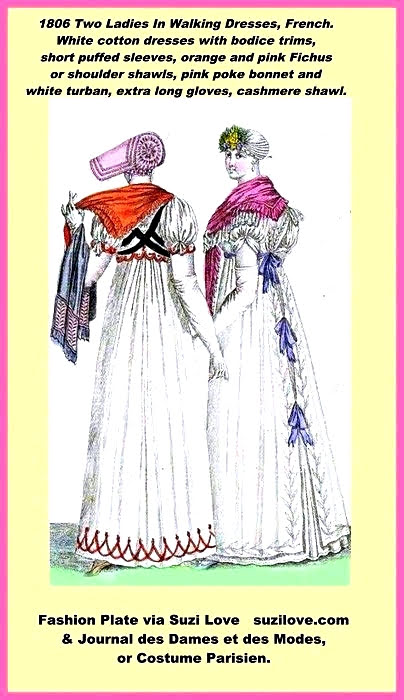
1806 Two Ladies In Walking Dresses, French. White cotton dresses with bodice trims, short puffed sleeves, orange and pink Fichus or shoulder shawls, pink poke bonnet and white turban, extra long gloves, cashmere shawl. Fashion Plate via Journal des Dames et des Modes, or Costume Parisien. These fashionable ensembles with a variety of fashionable and practical accessories would have been worn by Jane Austen and her family and friends during the day when out walking in the park or visiting village shops. Hats were a necessity to protect fair skin from the sun and scarfs and shawls added color and warmth to an outfit.
Definition Fichu: Draped scarf or shawl worn about shoulders and tied in knot at breast, with ends hanging down loosely. Word, meaning negligee or careless, first used to describe breaking away from stiff collar of the past.
Fashion Women 1805-1809 History Notes Book 26 What did Jane Austen and friends wear? https://books2read.com/SuziLoveFashionWomen1805-1809
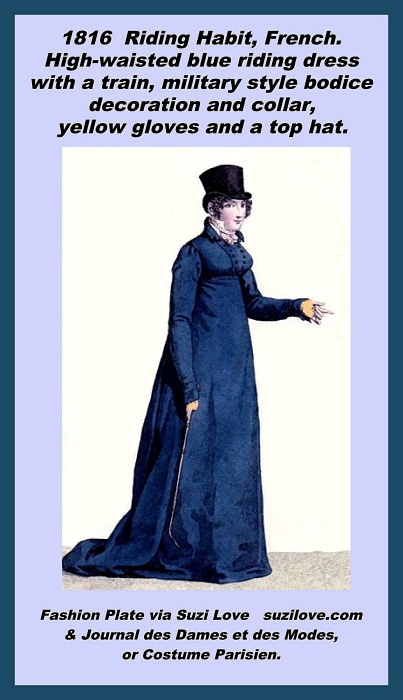
1816 Blue Riding Habit, French. High-waisted blue riding dress with a train, the long full skirt being necessary to cover a lady’s legs and preserve her modesty when riding side saddle. These riding habits were usually designed by men and were in two pieces, a jacket and a skirt, worn over a shirt. A military style bodice decoration, high pointed collar and a knotted pink dotted cravat worn underneath that imitate male styles, or even Dandy fashion. Sleeves are very long as was the trend in French riding habits. Yellow gloves and a masculine style beaver hat. This print was designed by Horace Vernet and engraved by Pierre Baquoy. Fashion Plate via Journal des Dames et des Modes, or Costume Parisien. Although, there are very similar riding habit fashion plates in other magazines.
The type of outfit Jane Austen and her friends would have worn when they went horse riding. https://books2read.com/SuziLoveFashionWomen1815-1819
Kelly’s Justice. I lived in Vanuatu, South Pacific, for 9 years and loved setting my book there.
Blurb: Kelly normally needs no help solving international security problems, but when someone from her past damages her reputation and threatens her life, she needs assistance. Joining forces with her old friend from the Australian army, now an expert on South Pacific politics, they destroy an island drug cartel and rescue kidnapped teenagers. https://books2read.com/SuziLoveKellysJustice
Excerpt
Working in tandem, Kelly and Grant hauled their captive up and supported him as they hop-walked him back towards the shed.
“Are the kids all there? All five of them?”
“I didn’t hang around to find out,” Grant said. “You screamed. I ran.”
Back at the shed, the rest of the team had things under control. The three most mobile hostages were climbing into the van and one of the girls was being supported by a tall young man who had his arms around her shoulders and was helping her move towards the vehicle.
Kelly and Grant looked inside the shed. The last girl was being carefully moved from the dirty mattress on the floor onto the folding stretcher they’d brought with them in the van.
They rushed forward to help as this girl looked battered and bruised, though she was being incredibly brave as they settled her on the stretcher. Four of them picked up the ends to carry her as carefully as they could to the sunshine outside. As they lifted the stretcher, she gave a pained moan and held her left arm to her chest. The edges of the stretcher had folded inwards and squeezed her arm, causing all color to drain from her face, so thankfully the distance to the van wasn’t far.
Looked like a dislocated shoulder and possibly broken bones in her forearm, but her other limbs looked okay and her only bleeding was from a gash on the side of her face where she’d obviously been struck, hard and repeatedly. No clothing appeared to be ripped or missing on this girl or the others, so though they had obviously suffered physical abuse, thankfully there was no outward evidence of sexual assault.
The other four teens squashed onto one seat, leaving one free to slide in the stretcher and ensure that the injured girl didn’t need to climb up, or to sit upright. Unfortunately, island roads were made of compacted coral and were notoriously full of potholes, so the poor girl would definitely suffer on the drive back to town thanks to the rocking and bouncing of the van.
Jacky was doctoring minor injuries on the boys with antibiotic cream and dosing them with water and pain killers, but overall the three boys appeared to have suffered less abuse than the two girls. Both girls looked teary, a combination of shock and relief at having been rescued before their abductors had administered any more beatings. Or had escalated the level of their abuse.
“What are your names?” Kelly asked. Even though she’d read the briefing notes, she wanted these kids to tell her their details themselves so she could list the kid’s injuries and have a full report to send back to Marci. Their anxious families would be relieved to hear the five teenagers were all alive and safe, but would want to know every detail of their children’s injuries.
She quickly jotted a list of the kid’s personal details.
Kimberley, 18, daughter of the American senator who had requested Marci’s help. Lacerations to face. Antibiotic ointment applied and was given pain killers. Probable dislocated shoulder and broken bone in forearm and put into a sling.
Brodie, 18, American.
Aaron, 17, American.
All three American college students who had volunteered to help rebuild four schools in different villages after their mini conference wrapped up.
Ryan, 18, Australian waiting to join the Air Force.
Catrina, 17, about to start training as a nurse.
List completed, Kelly started questioning the group to try and work out who had taken them, and more importantly, why. Their story seemed to be a case of wrong place, wrong time, more than a deliberate attack and kidnapping as four out of the five had no high profile or super rich parents.
The kids had decided to spend their day off from their community work by going by boat to the town of Port Vila, the main town on the most populated island. They’d hired a car and went exploring the local villages and beaches. At a coastal village, they’d bought local food for lunch and were driving to another beach to enjoy their lunch when they’d taken a wrong turn.
By the time they’d realized their mistake and were attempting to turn their rental car around, a vehicle full of men had driven up the dirt road behind them and blocked in their car. The new arrivals had yelled lots of demands, but the teenagers hadn’t understood the language being spoken and had signaled, by arm gestures and pointing down the road, that they would drive away.
After ten minutes of total confusion on the parts of both parties, the group of kids had been forced out of their rental car and marched, at gunpoint, up the track. Using guns rather than words, the newly arrived men had herded the group into the front section of the large shed, where they’d been held captive for the past few days.
Their captors had singled out the two girls as the weakest members of the group after the three young guys had tried to bluster their way past the men and their guns and get to the road. Unfortunately, every time they’d attempted an exit from the shed or a bolt for freedom, they’d been confronted by a line of men carrying weapons and forced back into the shed.
Broken English man had targeted the two girls, battering them repeatedly with a barrage of questions about who the girls were, where they’d come from, how many kids had been with them and why only five of them had driven down this road. Doing their best to explain with broken English and mimes, the girls had tried desperately to convince their captor that they’d turned their rental car around as soon as they’d sighted the shed. And that they knew nothing about what was happening at this remote shed. They were simply tourists looking for a swimming beach. Nothing had worked. Not their mimes, broken English or their begging.
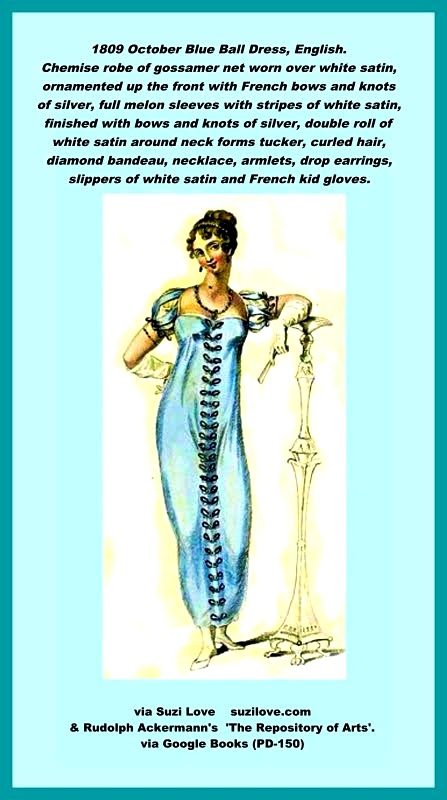
1809 October Blue Ball Dress, English. A light blue, or grey chemise robe, of gossamer net, imperial crape, worn over white satin, ornamented up the front with French bows and knots of silver. A full melon sleeve, formed of the same material as the dress, and alternate stripes of white satin, finished with bows and knots of silver. A double roll of white satin around the neck by way of a tucker. Hair falling in natural and irregular curls on the forehead, confined in a bow and curled ends, or in plaited braids, at the back of the head with a diamond comb. Diamond bandeau, with necklace, armlets, and drop earrings of the same. Slippers of white satin, with silver clasps, French kid gloves, just escaping the elbow. Fan of carved ivory. Fashion Plate via Rudolph Ackermann’s ‘The Repository of Arts’.
Definition Bandana Or Bandeau: Narrow strip or band worn around head to confine hair. Made of either twisted fabric, length of pearls, flowers, jewels or feathers. From the French word for “strip.
Fashion Women 1805-1809 History Notes Book 26 What did Jane Austen and friends wear? https://books2read.com/SuziLoveFashionWomen1805-1809
1800s Typical Cold Collation Dishes served during the 1800s. These are the sort of dishes Jane Austen’s family would have eaten on a regular basis. Pigeon Pie, Raised Game Pie, Cutlets and Peas, Prawn Bouquet, Creamed Chicken, Plover’s Eggs, Lamb Cutlets, Stuffed Larks, Piped Ham, Boned Capon. From: 1860 Mrs. Isabella Beeton’s Book of Household Management.
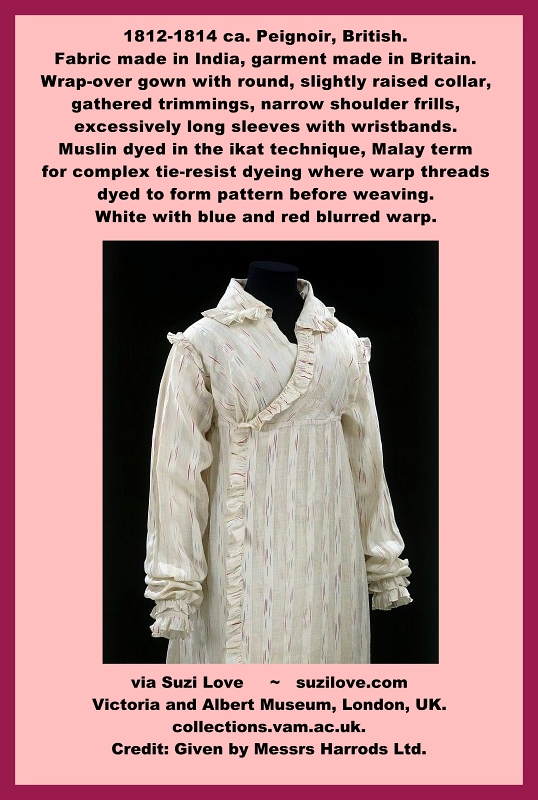
1812-1814 Ca. White Muslin Peignoir Or Dressing Gown, British. The sort of robe Jane Austen would have worn. Fabric made in India, Garment made in Britain. Wrap-over gown with round, slightly raised collar, gathered trimmings, narrow shoulder frills, excessively long sleeves with wristbands. Muslin dyed in the ikat technique, Malay term for complex tie-resist dyeing where warp threads dyed to form pattern before weaving. White with blue and red blurred warp.
via Victoria & Albert Museum, London, UK. collections.vam.ac.uk Credit: Given by Messrs Harrods Ltd.
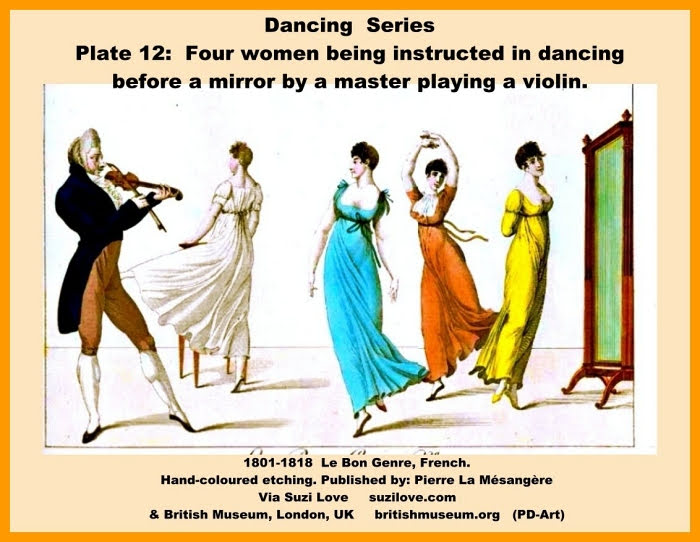
1802-1812 ca. Dancing Or La Dansomanie Series. Four women being instructed in dancing before a mirror by a master playing a violin. Le Bon Genre Description Plate 12. Via British Museum, London, UK. britishmuseum.org (PD-Art)
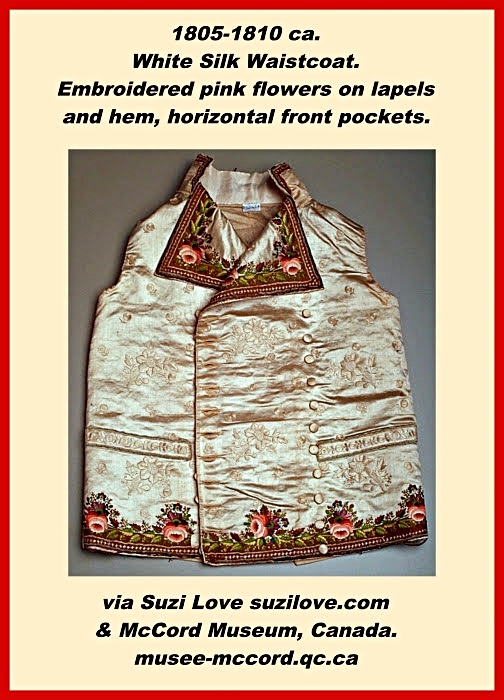
1805-1810 ca. White Silk Waistcoat. Embroidered pink flowers on lapels and hem, horizontal front pockets. via McCord Museum, Canada. musee-mccord.qc.ca
Typical of a gentleman’s waistcoat, or vest, worn during the early 1800s, or Regency Era, or Jane Austen’s times with a standing collar plus fold back collar, straight cut, front pockets, and heavily embroidered with a floral design to make it stand out.