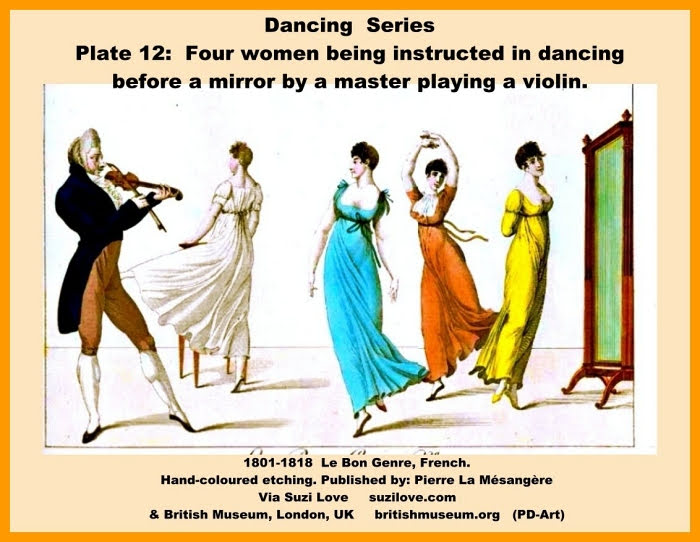
1802-1812 ca. Dancing Or La Dansomanie Series. Four women being instructed in dancing before a mirror by a master playing a violin. Le Bon Genre Description Plate 12. Via British Museum, London, UK. britishmuseum.org (PD-Art)



I'm an Australian author of contemporary and historical romances, plus history non-fiction. My books range from sexy to erotic, late 1700s to the mid 1800s, and with a dash of Australia thrown into the mix. My heroes and heroines challenge tradition and my stories often expose the seamier levels of life. I now live in a sunny part of Australia after spending many years in developing countries in the South Pacific. My greatest loves are traveling, anywhere and everywhere, meeting crazy characters, and visiting the Australian outback. I hope my books bring history alive and you have fun adventuring with my roguish heroes and feisty heroines.
1802-1812 ca. Dancing Or La Dansomanie Series. Four women being instructed in dancing before a mirror by a master playing a violin. Le Bon Genre Description Plate 12. Via British Museum, London, UK. britishmuseum.org (PD-Art)
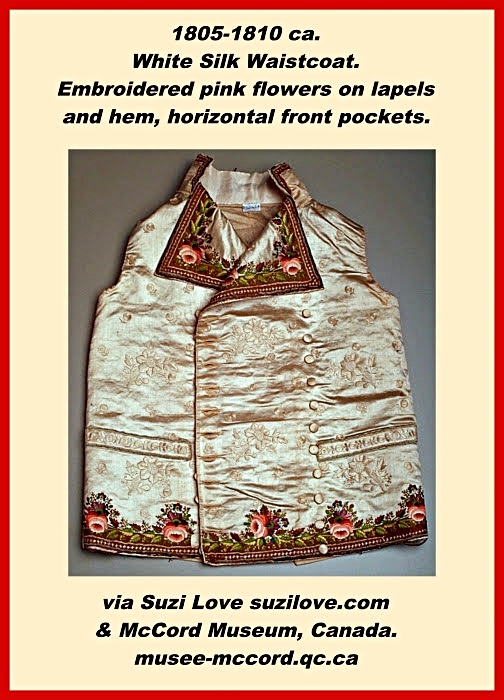
1805-1810 ca. White Silk Waistcoat. Embroidered pink flowers on lapels and hem, horizontal front pockets. via McCord Museum, Canada. musee-mccord.qc.ca
Typical of a gentleman’s waistcoat, or vest, worn during the early 1800s, or Regency Era, or Jane Austen’s times with a standing collar plus fold back collar, straight cut, front pockets, and heavily embroidered with a floral design to make it stand out.

19th Century Mid. The Music Room By George Goodwin Kilburne (1839-1924). Oil On Panel, 30.4 X 40.6cm. Via Wikimedia Commons commons.wikimedia.org (PD-ART)


Kelly’s Justice. I lived in Vanuatu, South Pacific, for 9 years and loved setting my book there.
Blurb: Kelly normally needs no help solving international security problems, but when someone from her past damages her reputation and threatens her life, she needs assistance. Joining forces with her old friend from the Australian army, now an expert on South Pacific politics, they destroy an island drug cartel and rescue kidnapped teenagers. https://books2read.com/SuziLoveKellysJustice
Excerpt
Kelly and Grant had guessed correctly that the other three kidnappers had no weapons because as soon a bullet was fired they turned and bolted around the shed, one on the left and two on the right. They sprinted towards them, but no-telephone-man quickly re-emerged through the shed door holding a weapon.
Kelly made a lightning change of direction and came at him from the side with a solid round house kick which knocked the rifle from his hands and the gun flew up into the air. She followed up with a chop to his neck, a knee to his groin and finished him off with a two-handed blow to his head. The man went down in a heap, screaming in pain, presumably from a burst ear drum.
Jacky’s voice called from one hundred meters down the road where she and Terry were closing in at a fast pace. “We’ve got this. Go after the runners.”
Kelly shot around the right of the buildings and sprinted after the two unarmed men who had crazily trampled their way through the undergrowth, giving her a clear path to follow them. She mentally thanked Marci and her grueling fitness course, because the long hours they’d all put in scrambling over and under obstacles and working out in the gym had honed her fitness so she wasn’t even puffing when she came up behind the pair of runaways. When she caught them up, they used their least bit of energy to try to run ahead with a desperate burst of speed.
Kelly kicked the feet out from the slower of the two and he hit the ground face down and slid, squalling like a baby as branches stripped skin from his face and ripped his clothing. When she lifted her foot to the side of his head, he squealed like a pig and covered his bleeding head with his arms. Quick as a flash, she took the chance to grab his arms and zip tie his hands behind his head. Planting her foot in the small of his back, she yelled, “Stay down or I’ll shoot.”
The quaking man might not have understood the language she spoke, but he sure as hell understood her gun digging into his temple and her finger pointing at the ground. The idiot frantically nodded, chanting something in his own language while his sobs increased and his chants became wails. He sounded like a two year old having a temper tantrum. Huh, not a trained operative then.
Jacky would only need to follow the wailing to find this one. Kelly took off again through the scrub, but the faster man had been so panicked he’d plowed through bushes and broken branches and left her an open trail to follow. She jumped broken bushes, weaved in and out of the dense scrub and sighted her prey just ahead.
“Stop or I’ll shoot,” she screamed in every language she knew. He fleetingly turned a frightened face to her, but then raced off again. “Shit,” she muttered, raising her pistol. They’d all practiced firing on the run at the compound, over and over. Even though it wasn’t Kelly’s best skill, Marci’s insistence on them being at least proficient at armed pursuit proved a blessing. She lifted her arm and fired. The guy screamed and fell to the ground, clutching his right leg as blood poured from his knee. Even with one leg out of action, he tried to shuffle backwards towards the scrub.
Kelly stood over him, her weapon now aimed at his groin, when Grant came rushing up. Bending over, hands to his knees, he sucked in some deep breaths.
“Christ, Kelly.” He struggled to catch his breath. “I heard the shot and thought it was you.” Ignoring the man groaning on the ground, he pulled her in for a hug, despite them both wearing bullet proof vests and layered clothing. “I swear my heart stopped,” he muttered onto the top of her head. The wounded man writhed on the ground, grasping his bent leg and moaning loudly. “Wow, Kel, good shooting there. Got his knee from behind while he was running.”
“Yeah, well,” Kelly muttered. “Marci, my boss, won’t be happy.”
“Really?” Grant held her away from him but kept his hands on her upper arms. “Why the hell not?”
“Because we trained hard for this, and I have one of the best hit rates.”
“So?” Grant said, looking puzzled.
“I was aiming for his lower leg, not his knee.”
Grant burst out laughing. “Then don’t tell her. Our secret.”
1817 December Black Walking Mourning Dress, English. Black bombazine dress with a black crepe hem, with tight bodice wrapping across to the right side, trimmed with a piping of black crape that looks like braiding and finished by rosettes of crape, in the center of each of which is a small jet ornament. Long sleeves trimmed similarly at the wrists, half-sleeve of a new form trimmed with crape, high standing collar displaying a mourning ruff. Claremont bonnet, named because it is the same shape as one worn by the Princess, whose home with her husband, Prince Leopold, was called Claremont. Black crape over black sarsnet and lined with double white crape. Low crown but large front and tastefully finished by black crape with a bunch of crape flowers on one side. Black shamois gloves, and black shoes. “We have again to acknowledge our obligations to the lady who favored us last month; and we understand that the dresses from which our prints this month have been taken were also purchased from Mrs. Bell of St. James’s-street.” Fashion Plate via Rudolph Ackermann’s ‘The Repository of Arts’.
Mrs. Bell ‘invented’ fashion plates and as well as publishing in La Belle assemblee, she also sold them to other magazines. Hence the crossover we often see where the same plate, or a similar version, appears in different magazines.


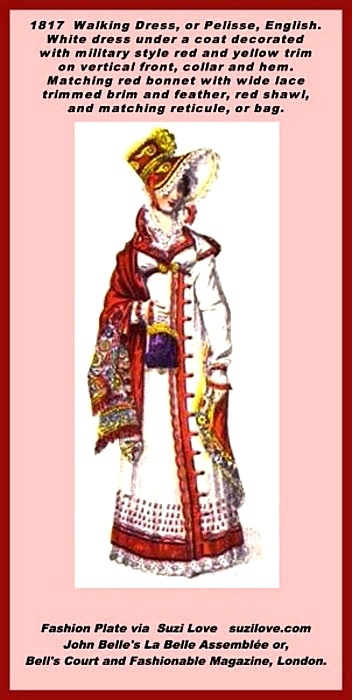
1817 November Autumnal Carriage Walking Dress or Pelisse, or Redingote, English. Pelisse of Cashmere with a white background, trimmed with vermillion red, vermillion belt and a gold and Ceylon ruby broach or clasp. Lyonese shawl with a rich border of various colors. Bonnet of vermillion satin, embossed with straw, decorated with straw colored ribbons and a bouquet of full blown damask rose, buds, and ears of ripe corn and edge of the bonnet finished by blond lace. White kid half-boots, Limerick gloves, vermillion satin ridicule, or bag, with gold tassels and spring. Fichu frilled with fine lace and left open at the throat. Fashion Plate via John Belle’s La Belle Assemblée or, Bell’s Court and Fashionable Magazine, London.
Jane Austen: This is a fashionable ensemble as would have been worn by Jane Austen and her family and friends. Walking dress such as this would have been worn when out shopping, walking in a park or the country estate. This sort of outfit needed to be presentable and warm but not overly accessorized with jewelry etc..
Definition Coat, or Redingote Or Pelisse: Long fitted outdoor coat worn over other garments for warmth. Redingote is the French word developed from English words for riding coat. Usually called Walking Dress Or Pelisse in English fashion plates.
Definition Reticule: Bag or purse, often with a drawstring to pull closed and usually made of cloth or covered cardboard and often decorated with beading or embroidery. A reticule, or purse, or handbag, was usually carried by a woman during the Regency period to carry all their daily necessities. Earlier, women used pockets that tied at the waistline and were hidden in the folds of their skirts. Empire style, or early 1800s, high-waisted dresses made it impossible to either sewn in a pocket or to tie on a pocket. So women began carrying small, decorated bags called Reticules, or ridicules, which generally pulled close at the top with a drawstring.
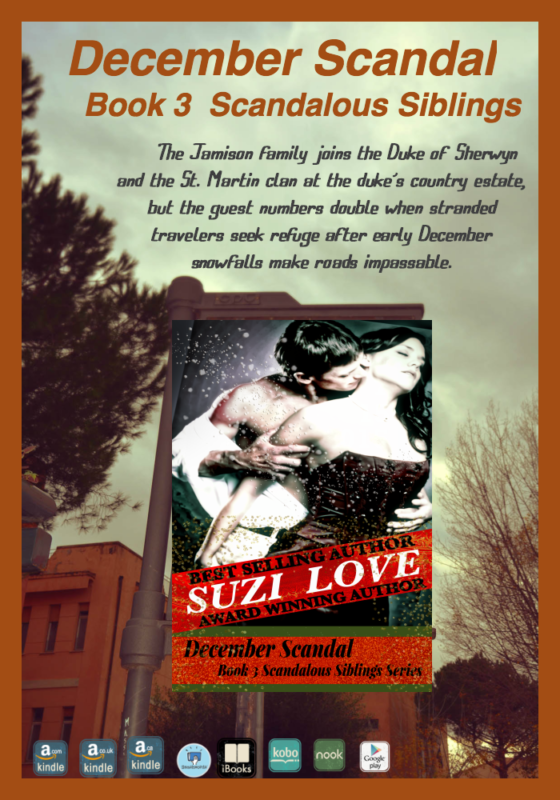
Drama and romance at the duke’s snowbound British country estate. Michael Brandon travels to introduce the woman he loves to family but is shocked when his missing brother arrives. December Scandal Book 3 Scandalous Siblings https://books2read.com/suziloveDS
Excerpt: 1844 Martin House, England.
Michael Brandon strolled after Cayle St. Martin, the Duke of Sherwyn, when the duke strode to the hallway to greet the latest group of travelers. They’d be, like him, grateful to accept the duke’s hospitality because they’d all become stranded after heavy snowfalls had led to rapidly rising water levels and an impassable local bridge.
He leaned on a wall and watched Mason, the efficient butler at Martin House, ease open the massive front door while three footmen braced their shoulders against the door to stop it blowing fully open. The house had already been full of family members gathered for Christmas, but with the addition of several groups of half-frozen travelers arriving every hour during the afternoon, the house’s walls must be groaning under the excess number of guests needing beds.
Several massive rooms in Martin House had been opened and warmed for the weary travelers who had descended on the duke and his family, but those large fires needed constant feeding with logs of wood. Therefore, Sherwyn couldn’t risk a barrage of snow and sleet blowing inside his house from the courtyard because, in such inclement weather, his footmen might not be able to collect more firewood for another week. Little wonder then that the duke hovered near the front entrance and supervised each subsequent arrival, his charming duchess by his side to add her won welcome.
Michael and his party had been the first to beg assistance from Sherwyn this afternoon, as he’d known that Sherwyn had left London a week earlier and would already be in residence at his country home. There had been a flurry of social events in London over the past two weeks before the Ton left the city and retreated to their country estates to wait out the colder months. Though this extreme weather had caught everyone by surprise.
It was barely mid December and the nearby bridge usually served the locals well through that month and into the New Year. Water levels normally only rose and covered the bridge after the snowstorms of January. Michael and Cayle were long time friends and so he knew Cayle had loathed this house, his family seat, when his father and stepmother had been in residence, but now that Cayle was the duke, and a married man, he had decided to turn this house into a more welcoming family gathering place. Even with the influx of visitors, invited or not, the staff here were jolly and efficient, a rare combination in the serving ranks.
https://books2read.com/suziloveDS December Scandal, Book 3, Scandalous Siblings.

1805 Breeches, part of the Royal Naval Uniform of surgeon Joshua Horwood , who served as surgeon’s mate in HMS ‘Prince’ at Trafalgar, and was promoted to surgeon in 1807. via Royal Museums Greenwich, London, U.K. collections.rmg.co.uk

19th Century Late. Sterling Silver Five Piece Writing or Desk Set, Peru (under German Company). Hinged cut crystal inkwell with beveled edges, wheel cut starburst at base, wax seal with blank matrix, blotter, dip pen and letter opener. Each with guilloche enamel featuring yellow rose with lush green leaves on pale blue background, trimmed with a lighter shade of blue enamel. Dip pen with allover pale blue guilloche enamel, pen nib marked 14k Gold Plated.
![19th Century Late SterlingSilverFivePieceWritingorDeskSetPeru_Dippenwithpaleblueguillocheenamel_pennib14kGoldPlatedbatch.jpg ]
19th Century Late. Sterling Silver Five Piece Writing or Desk Set, Peru (under German Company). Hinged cut crystal inkwell with beveled edges, wheel cut starburst at base, wax seal with blank matrix, blotter, dip pen and letter opener. Each with guilloche enamel featuring yellow rose with lush green leaves on pale blue background, trimmed with a lighter shade of blue enamel. Dip pen with allover pale blue guilloche enamel, pen nib marked 14k Gold Plated.](https://suzilove.files.wordpress.com/2021/06/writing_19th_century_late_writing-and-desk-setperu_lge-1_lge_sml.jpg?w=554)

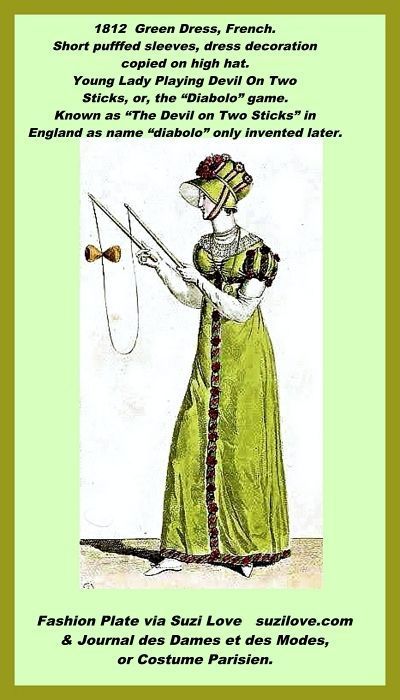
1812 Young Lady Playing Devil On Two Sticks, or, the “diabolo” game. The game was known as “The Devil on Two Sticks” in England at the time as the name “diabolo” was only invented later. Green dress with short puffed sleeves, dress decoration copied on high hat. Fashion Plate via Journal des Dames et des Modes, or Costume Parisien.