I'm an Australian author of contemporary and historical romances, plus history non-fiction.
My books range from sexy to erotic, late 1700s to the mid 1800s, and with a dash of Australia thrown into the mix. My heroes and heroines challenge tradition and my stories often expose the seamier levels of life.
I now live in a sunny part of Australia after spending many years in developing countries in the South Pacific. My greatest loves are traveling, anywhere and everywhere, meeting crazy characters, and visiting the Australian outback.
I hope my books bring history alive and you have fun adventuring with my roguish heroes and feisty heroines.
1805 ca. Leather Breeches, French. Buttoned and adjustable waist and narrow drop down front flap, back waist gusset for ease of movement, fitted cuffs on legs with many buttons to fasten and hold in place. via Metropolitan Museum New York City, U.S.A. metmuseum.org The style of men’s breeches worn by men at the end of the 1700s and early 1800s, or in Jane Austen’ lifetime.
1805 ca. Front Leather Breeches, French. Buttoned and adjustable waist, back waist gusset for ease of movement, front fall flap, two tone fitted cuffs on legs with many buttons to fasten and hold in place on the legs. via Metropolitan Museum New York City, U.S.A. metmuseum.org 1805 ca. Back Leather Breeches, French. Buttoned and adjustable waist, back waist gusset for ease of movement, front fall flap, two tone fitted cuffs on legs with many buttons to fasten and hold in place on the legs. via Metropolitan Museum New York City, U.S.A. metmuseum.org 1805 ca. Waist Fastening Leather Breeches, French. Buttoned and adjustable waist, back waist gusset for ease of movement, front fall flap, two tone fitted cuffs on legs with many buttons to fasten and hold in place on the legs. via Metropolitan Museum New York City, U.S.A. metmuseum.org 1805 ca. Front and Back Leather Breeches, French. Buttoned and adjustable waist, back waist gusset for ease of movement, front fall flap, two tone fitted cuffs on legs with many buttons to fasten and hold in place on the legs. via Metropolitan Museum New York City, U.S.A. metmuseum.org 1805 ca. Cuff Leather Breeches, French. Buttoned and adjustable waist, back waist gusset for ease of movement, front fall flap, two tone fitted cuffs on legs with many buttons to fasten and hold in place on the legs. via Metropolitan Museum New York City, U.S.A. metmuseum.org https://books2read.com/SuziLoveFashionMen1800-1819
1812 August. Ball Dress, English. Dress with lower waistline than normal in the Empire period, pink laced bodice, with decorative sleeves, skirt with pink hem decoration, pink hat with pretty plume, and yellow gloves. Fashion Plate via John Belle’s ‘La Belle Assemblee’, London. https://books2read.com/SuziLoveFashion1810-1814
Definition: Ball Gown or Dress: From the early 19th century onwards, ball gowns were regularly illustrated and described in women’s magazines as minute distinctions between ball, dinner, evening and opera gowns. Ball gowns were of expensive silk fabrics, light or heavy, decorated with lace, embroidery or beading, with low-cut bodice, short or no sleeves, and a full skirt.
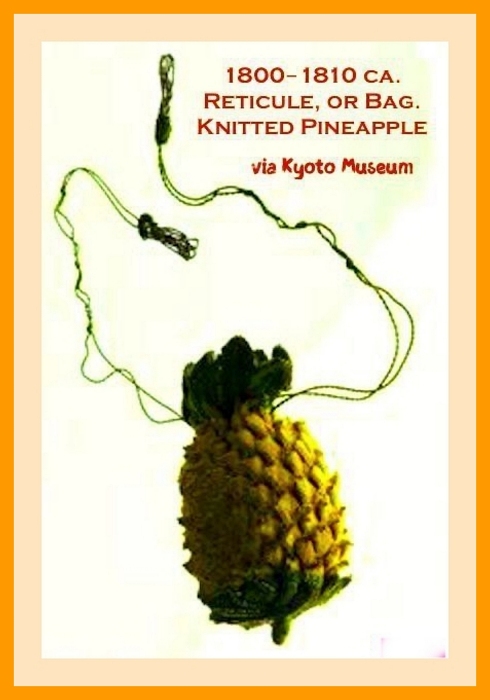
1800-1810 ca. Pineapple Reticule, or Bag. A knitted pineapple with long strings. In Jane Austen’s times, pineapples were a luxury imported item that most people in Great Britain had never seen, let alone tasted. When more pineapples were imported from hotter countries, or English gardeners started to grow some, pineapples became a much desired novelty and an exotic experience. Pineapple motifs appeared on dresses, furniture, household goods etc. Knitting pineapple reticules was part of this obsession with pineapples. via Kyoto Museum, Japan.
Definition Ridicule, Reticule, Indispensable, or Handbag: From the late 1700s, pockets could no longer be sewn into gowns, as skirts fell from just under the bust and were full and flowing. Instead, women began carrying small bags, known at first as ridicules and later as reticules, to keep necessary items on their person e.g. handkerchiefs, coins, vinaigrettes, calling cards, glasses etc. http://books2read.com/suziloveReticules
In the early nineteenth century, reticules started to look like future handbags as they were often made from rigid card or molded mâché or card into a variety of shapes. Early bags were circular and with a drawstring but as women wanted their reticules to look individual they could be made with two halves and a hinged metal closure or with concertina sides. Materials varied from silk, cotton and string and shapes were round, hexagonal or lozenge shapes with shell shaped bags becoming very popular during the Regency and Romantic Eras.
1800s magazines were written for well bred women who could read, so they gave plenty of ideas for how ladies could make and embellish reticules for their own use and as pretty gifts. Needlework was highly encouraged as a pastime for a lady so bags were frequently embroidered or decorated with beading. By the 1820s, reticules became more like our modern handbags using soft leather gathered at the top or hard leather with a rigid fastener and metal chain for carrying.
Light-Hearted look at an Older Lady’s Life In Jane Austen’s Times, or early 1800s. An easy to read overview of what an older lady did, wore, and how she lived in the early 19th Century. Information for history buffs and pictures for readers and writers of historical fiction.
The older lady’s day usually started with her toilette in her bedroom, where her maid helped her dress for the day and styled her hair. After that, she would join her family downstairs for breakfast unless she preferred a tray with either tea or hot chocolate in her bedroom as she prepared for her busy day. Her day would be made up of speaking with the housekeeper and the cook about the week’s menus, assuring that the servants were all available that day and no one was ill, and checking the list of foods needed. She would also enquire if the laundry was up to date and that they had enough good linen to make up all the beds before extended family members and guests arrived. If she was in the country and hosting a weekend house party, she would assign rooms to the guests on her lists and query that all was in readiness for their arrival.
1805 Typical Regency Era, or Early 1800s, Muslin Dress. Long sleeves, square neckline, and decorated with Palm Tree embroidery. via Whitaker Auction.
Definition Empire Style: Named after the First Empire in France, by 1800 Empire dresses had a very low décolleté, or neckline and a short narrow backed bodice attached to a separate skirt. Skirts started directly under the bust and flowed into the classical relaxed wide styles of Greece and Rome. This style of dress is associated with Jane Austen and her contemporaries as a simple cotton high-waisted dress was worn most days and accessorized according to the importance of the occasion.
Fashion Women 1805-1809 History Notes Book 26 What did Jane Austen and friends wear? https://books2read.com/SuziLoveFashionWomen1805-1809
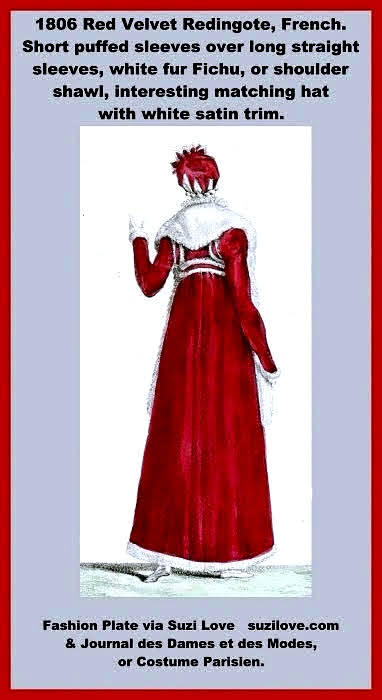
1806 Red Velvet Redingote, French. Short puffed sleeves over long straight sleeves, white fur Fichu, or shoulder shawl, interesting matching hat with white satin trim. Fashion Plate via Journal des Dames et des Modes, or Costume Parisien.
Redingotes or Pelisses were needed to cover the flimsy dresses made of lightweight fabrics of the Regency years to provide warmth and some protection from windy conditions when gowns might lift and cause modesty issues. Jane Austen and her contemporaries often walked to places and so would have needed the warmth of a Pelisse or coat in the cold British winters. https://books2read.com/SuziLoveFashionWomen1805-1809
Fashion Women 1805-1809 History Notes Book 26 What did Jane Austen and friends wear? https://books2read.com/SuziLoveFashionWomen1805-1809
1835-1840 ca. Man’s Gold Silk Banyan. Made from 18th century quilted gold patterned silk. A Banyan is an 18th century men’s garment often worn as a morning gown, dressing gown or informal coat. This banyan is like a fitted coat. 1835-1840 (garment); 1740-1790 (material) via American Textile History Museum. athm.org
Banyan: Also called a dressing gown, morning gown or Indian robe. Originated in India but adopted in England by the late 1600s. Informal wear, not night attire, and came in assorted shapes from loose kimono-style robes to more fitted robes. They were worn instead of a coat in informal situations, such as with family or for an evening at home with close friends, or for a country breakfast. Underneath a banyan, a man usually wore a shirt, matching waistcoat and breeches. During the Georgian Era, a matching cap was often worn instead of a wig, making the whole a fashionable outfit and not just a robe. Victorian smoking jackets were based on earlier banyans.
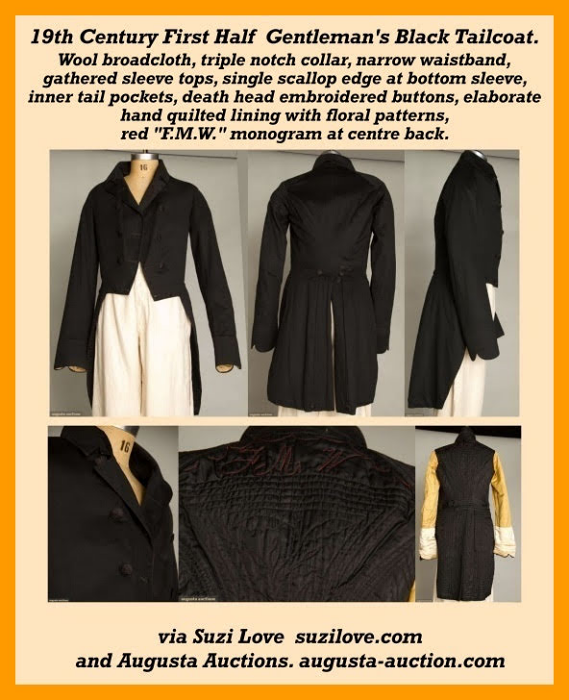
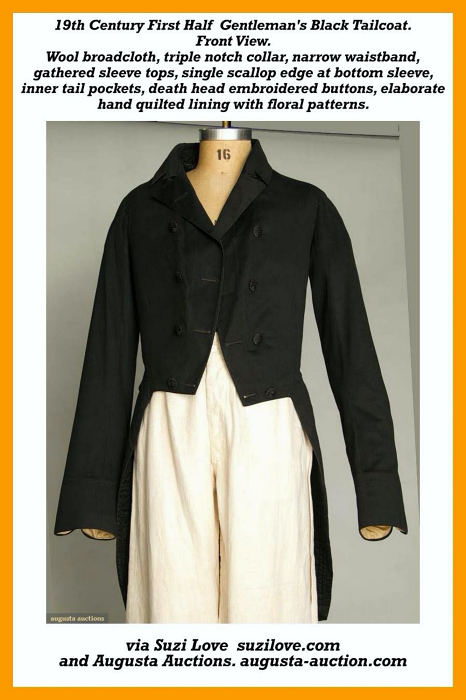
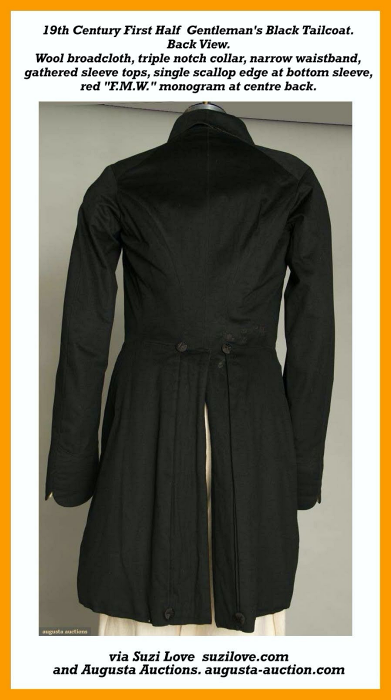
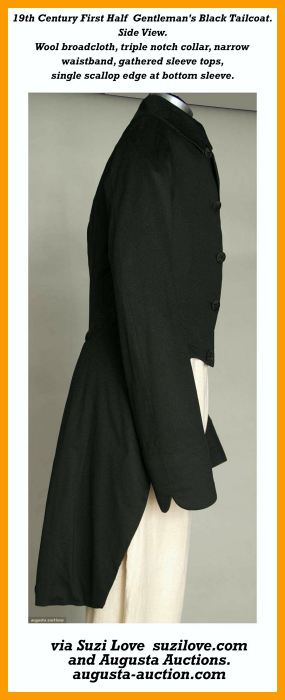
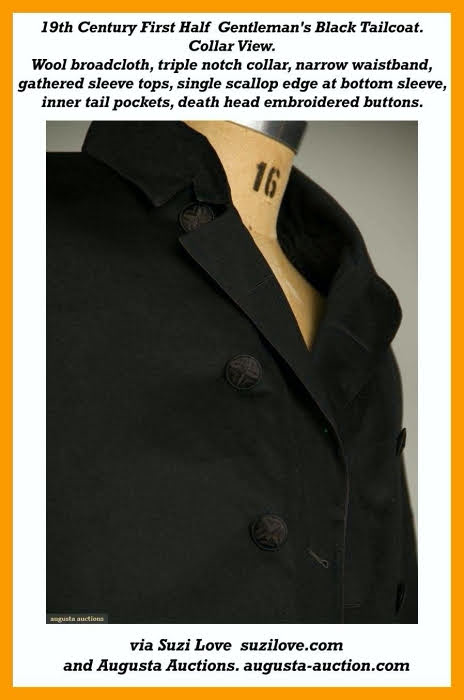
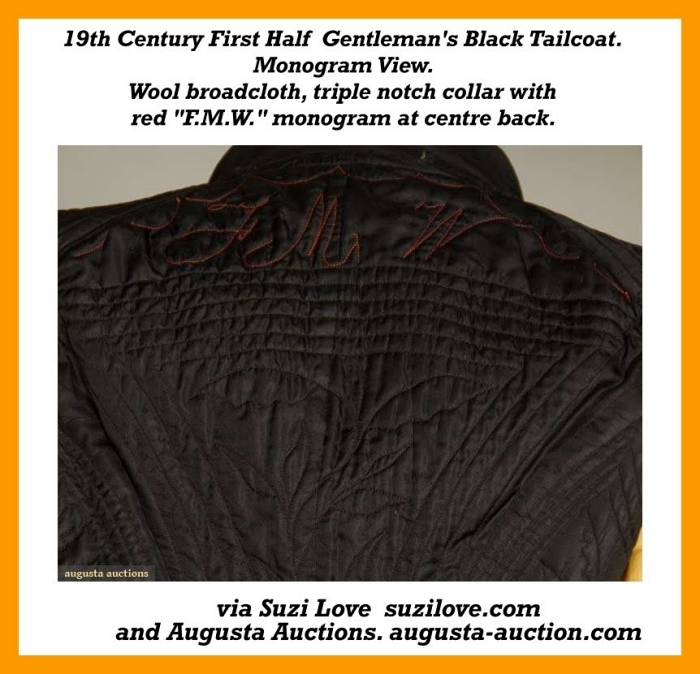
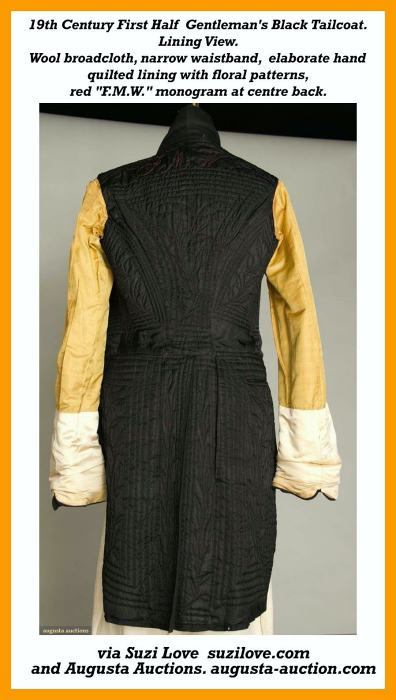
19th Century First Half Gentleman’s Black Tailcoat. Wool broadcloth, triple notch collar, narrow waistband, sleeve tops gathered and uniformly wide to single scallop edge at bottom sleeve, inner tail pockets, death head embroidered buttons, elaborate hand quilted lining with floral patterns in concentric square frames and a “F.M.W.” monogram embroidered at the centre back top in red. Via Augusta Auctions – augusta-auction.com
Tailcoat: A Regency Era, or early 1800s, gentleman was outfitted in more practical fabrics, such as wool, cotton and buckskin rather than the fussy brocades and silks of the late 1700s. The men in Jane Austen’s life would have worn a black tailcoat like this for everyday wear. https://books2read.com/SuziLoveFashionMen1800-1819
19th Century First Half Front View. 19th Century First Half Back View. 19th Century First Half. Side View. 19th Century First Half Collar View. 19th Century First Half Monogram View. 19th Century First Half Lining View. 23_d2d_fashionmen1800-1819
https://books2read.com/SuziLoveFashionMen1800-1819