I'm an Australian author of contemporary and historical romances, plus history non-fiction.
My books range from sexy to erotic, late 1700s to the mid 1800s, and with a dash of Australia thrown into the mix. My heroes and heroines challenge tradition and my stories often expose the seamier levels of life.
I now live in a sunny part of Australia after spending many years in developing countries in the South Pacific. My greatest loves are traveling, anywhere and everywhere, meeting crazy characters, and visiting the Australian outback.
I hope my books bring history alive and you have fun adventuring with my roguish heroes and feisty heroines.
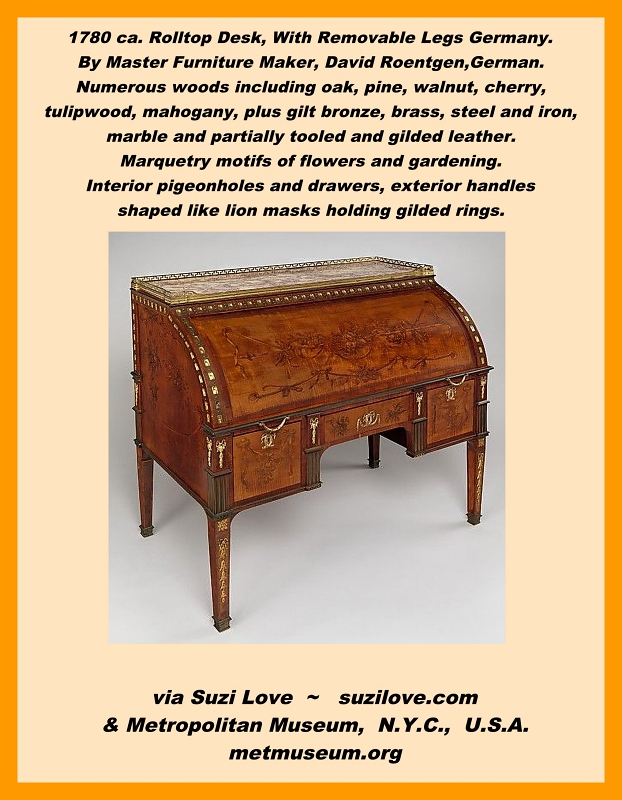
1780 Rolltop Desk, With Removable Legs Germany. By Master Furniture Maker, David Roentgen,German. Numerous woods including oak, pine, walnut, cherry, tulipwood, mahogany, plus gilt bronze, brass, steel and iron, marble and partially tooled and gilded leather. Marquetry motifs of flowers and gardening. Interior pigeonholes and drawers, exterior handles shaped like lion masks holding gilded rings. via Metropolitan Museum, N.Y.C., U.S.A. metmuseum.org
1800-1805 ca. White cotton petticoat of the sort worn by Jane Austen in the early 1800s. Worn under a sleeved, trained dress and over a loose knee length chemise and corset which covered the exposed bust area. The skirt of the petticoat has an apron front open down the side seams. Drawers were not commonly worn at the time. via The John Bright Collection. thejohnbrightcollection.co.uk
Petticoats were made to fit under the low cut bodices of the early 1800s fashions, and to not be seen under a wide and square bodice. This meant thin ribbons were sometimes attached at the shoulders so the petticoat would be virtually without a bodice.
1819 White Percale Dress, French. Deep hem of bubbly muslin, matching Percale Spencer or jacket, pink parasol and flowered straw hat. Spencer has short puffed sleeves over long straight sleeves and military style trimmings. Fashion Plate via Journal des Dames et des Modes, or Costume Parisien. Even though this a French fashion plate, this is typical of the outdoor outfit worn by Jane Austen and her contemporaries when going outside. An Empire style, or high-waisted white cotton dress worn under a Spencer, or jacket, for warmth and with a parasol to protect fair complexions from the sun.
Description Spencer: Short jackets worn for warmth over the high-waisted Empire style gowns that were popular after the French Revolution, where there was a shift away from opulence and decadence to simpler fashion. This jacket with very short bodice and long sleeves was known as a Spencer and was named after the male coat made famous by the Earl Spencer and said to have originated in accident to Lord Spencer in hunting when coat tails torn off and a cropped jacket was invented. The dresses in the early 1800s therefore became looser, lighter, and flowing and women became cold due to their very low cut and short bodices. Short fitted jackets that went easily over the dresses and provided extra modesty and some warmth. As Europe and many other parts of the world were deep in wars in the late 1700s and early 1800s, men in uniform were found everywhere. In support of these military men, fashions leaned towards military style shoulder paddings, shoulder embellishments, loops, buttons, and braids.
Definition Percale or Perkale: From the Persian word pargalah. Fine cotton fabric, or cambric muslin of good quality, originally from India, generally bleached, printed and finished without gloss. Contains more dressing than ordinary muslin, but without the glossy finish of cambric and is printed in fancy patterns on white and colored grounds. In May 1816, Percale was commented on in Rudolph Ackermann’ Repository Of Arts, “Perkale, as they call cambric muslin, is now almost the only thing worn in the morning costume: you must not, however, fancy that this proceeds from a wish to encourage English manufacture, but partly from a love for novelty, and partly because it is less expensive than cambric, and equally fashionable.”
Belatedly recalling that he was speaking to a British peer, McLeish pulled himself together and shrugged off his outburst. ‘Never mind that sordid story, my lord. How about another shot of my fine whiskey?’
Nearly choking on rising bile, Lord Alexander St. John forced himself to take his leave as politely as he would have from a London drawing room. ‘I thank you, sir, but as I sail on the morning tide so I must bid you farewell.’
He wanted to punch the bastard in his smug face after witnessing the disrespect he’d shown his daughter. He’d heard the stories of the man’s abuse of his daughter and his cruelty when dealing with his plantation laborers. If he’d remained in the same room as that vile man for another minute, he would not have been able to contain his rage. The only thing holding him back was knowing that McLeish’s moods were mercurial. Tonight, he had wanted his daughter to appear enticing but Alex feared the aftermath if he’d shown Lady Katharine any special attention. McLeish would do anything to leave these islands and return to London and becoming part of the St. John family would ensure he would be accepted back into London society, despite the cloud he departed under previously.
Relieved to escape the house without further conflict, he strode down the garden path lit by flares and walked away from the house. Once out of McLeish’s view, he turned into the gardens. When a soundless lips in a gesture of silence and beckoned Alex to follow. Wordlessly, they descended to the small cove where Tong Lee stopped and pointed. Alex could make out a huddled figure on the beach, staring fixedly out to the ocean. Not wanting to scare her, he cleared his throat softly to announce his approach. Nevertheless, she started in fright and fear.
‘It is only I, Alexander. Please do not fear me. I didn’t wish to alarm you, but I needed to be assured of your well-being before I sailed.’
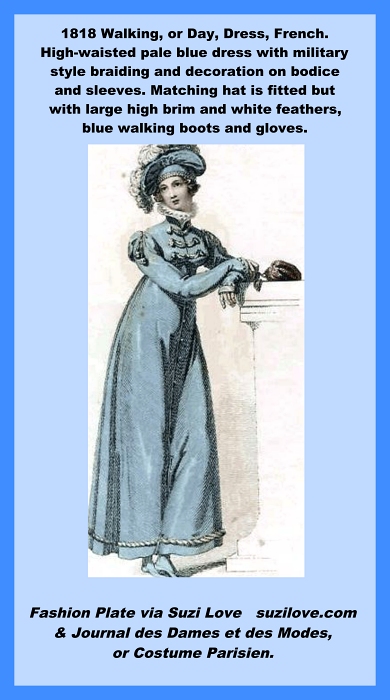
1818 Military style Redingote, or Coat,or Walking dress, French. High-waisted pale blue outdoors coat with military style braiding and decoration on bodice and sleeves. Matching hat is fitted to her head but with a large high brim and white feathers, or plume, blue walking boots and gloves. The type of outfit young Regency Era ladies would have worn if they were out shopping on Bond Street, walking in a park, or taking a carriage ride through Hyde Park. Fashion Plate via Journal des Dames et des Modes, or Costume Parisien. .
Definition Redingote Or Pelisse Or Walking Dress Or Coat: French word developed from English words, riding coat. Long fitted outdoor coat worn over other garments for warmth. Often left open at the front to show off the dress underneath. Sometimes cut away in front. Originally made with several capes and trimmed with large buttons. French fashion plates call these coats Redingotes and they are designed for women, men and children. English fashion plates call them a Pelisse, a walking dress, Promenade dress, or Carriage dress.
1887 Front View. Wedding Corset, American. Cotton twill, silk thread embroidery. Fully boned wedding corset with front hooks and back lacing. Every boning channel is flossed top and bottom. Via Chicago History Museum, U.S.A. digitalcollection.chicagohistory.org https://books2read.com/SuziLoveCorsetBook20
1887 Front View. 1877 Back Lacing View. 1877 Side View. 1877 Flossing View. HN_20_Corsets1880-1900 https://books2read.com/SuziLoveCorsetBook20
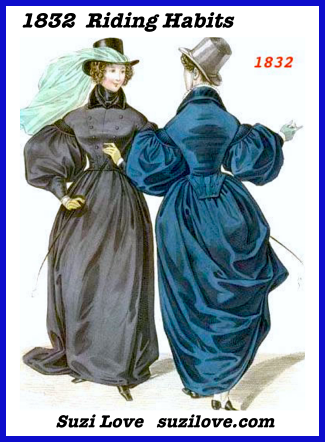
1832 Ladies Riding Habits. Grey and Blue with Bouffant, or puffed, sleeves and matching hats. via La Mode.
Definition Bouffant: Type of sleeve that fits close to the body at the shoulder and the lower edge and is wider in the middle, forming a round shape. Popular in the Romantic Era, or from 1815-1840 ca.
1840 ca. The York To London Royal Mail. By A. Anson Martin. Mailcoach in the village of Bedale, Yorkshire, U.K. Church at the end of the wide country road and thatched cottages behind the coach. Signed and Inscribed ‘(All Right)’. Via British Postal Museum, London, U.K. ~ postal museum.org
The dreadful condition of British roads caused great apprehension to all classes of travelers. Making a journey anywhere in the country was a big undertaking and often a gentleman composed his last will and testament before his departure. Traveling in vehicles was only possible during the day or on the nights with very bright moonlight with few vehicles attempting road travel in winter and any travel on a Sunday was frowned upon. books2read.com/SuziLoveTravel
Description of Stage Coach Travel in England. via 1815 Journal Tour of Great Britain. “The gentlemen coachmen, with half-a dozen great coats about them, immense capes, a large nosegay at the button-hole, high mounted on an elevated seat, with squared elbows, a prodigious whip, beautiful horses, four in hand, drive in a file to Salthill, a place about twenty miles from London, and return, stopping in the way at the several public-houses and gin-shops where stage-coachmen are in the habit of stopping for a dram, and for parcels and passengers on the top of the others as many as seventeen persons. These carriages are not suspended, but rest on steel springs, of a flattened oval shape, less easy than the old mode of leathern braces on springs. Some of these stage coaches carry their baggage below the level of the axletree.”
HN_10_D2D_RetailerBuyLink_Travel and Luggage By Suzi Love History Notes Book 10 #History #travel How did people travel in past centuries? What did they take with them to make their long journeys easier? books2read.com/SuziLoveTravel
1810-1820 ca. Double Breasted Red Hunting Coat, English.
1810-1820 ca. Red Hunting Coat, English. Hunting was both a popular sport and an essential part of social success. Double-breasted tailcoat of woolen superfine, lined with sateen and cotton, M-notch lapels, nine gold buttons with heraldic crest, cuffs with three smaller matching buttons. via Collection from Castle Howard, Yorkshire, U.K. Victoria and Albert Museum, London, UK. Hunting coats, or colors, often red coats called pinks, were worn by hunt masters and hunters. In Bridgerton and Jane Austen times, or the early 1800s, gentlemen wore red coats like this while riding to the hounds.
Historically, hunt members wore ‘colors’ to distinguish between types of hunters and their level of experience. Traditional red coats were worn by huntsmen, masters, former masters, whippers-in, regardless of sex, while other hunt staff members and male members invited by masters wore colors and hunt buttons as a mark of appreciation for their involvement in the organization and running of the hunt. After the Hunting Act in England and Wales, only Masters and Hunt Servants wore red coats or hunt livery. Gentleman subscribers usually wore black coats, with or without hunt buttons and in some countries, women wore colored collars on their black or navy coats to help them stand out from the rest of the field. Some hunts, including most harrier and beagle packs, wear green rather than red jackets, and some hunts wear other colors such as mustard.