1800-1815 ca. Fan of Bone and Silk, French. Jane Austen and her family and friends would have carried this style of fan when attending assemblies, musical evenings and balls. Metropolitan Museum New York City, U.S.A. metmuseum.org




I'm an Australian author of contemporary and historical romances, plus history non-fiction. My books range from sexy to erotic, late 1700s to the mid 1800s, and with a dash of Australia thrown into the mix. My heroes and heroines challenge tradition and my stories often expose the seamier levels of life. I now live in a sunny part of Australia after spending many years in developing countries in the South Pacific. My greatest loves are traveling, anywhere and everywhere, meeting crazy characters, and visiting the Australian outback. I hope my books bring history alive and you have fun adventuring with my roguish heroes and feisty heroines.
1800-1815 ca. Fan of Bone and Silk, French. Jane Austen and her family and friends would have carried this style of fan when attending assemblies, musical evenings and balls. Metropolitan Museum New York City, U.S.A. metmuseum.org
1808 January Trio In Half Dress Walking Ensembles, English. Lady on left wearing a pink dress and green coat and carrying a reticule. Lady on right in a white trained dress, long draping shawl and fitted hat. Gentleman in a blue tailcoat, white vest, extra high white cravat, knee breeches, shoes, and black top hat. Fashion Plate via Le Beau Monde. The sort of outfits ladies and gentlemen in Jane Austen’s times would have worn while out walking, shopping, or going to visit friends.


1813 The Theatre. From Poetical Sketches of Scarborough By Thomas Rowlandson. Aquatint was added by John Bluck and Joseph Stadler. The sketches by Green were made as souvenirs and not intended for publication. Via Suzi Love suzilove.com
& Wikimedia Commons commons.wikimedia.org (PD-ART)


18th Century Wool, Leather And Linen Front Lacing Stays. via digitalmuseum.norway
In the early 18th century, stays were basically quilted waistcoats, laced in the front and un-boned and to be worn on informal occasions. Mid century, the role of stays changed. They were then supposed to create a V shaped form and support a woman’s back, so baleen from whales was inserted into the garments and backs became longer.
Eyelet holes were stitched and staggered in spacing, so stays could be spiral laced. Stays were strapless or had straps attached in the back and tied at the front sides. Eyelet holes were stitched and staggered in spacing, so stays could be spiral laced. Later, they began to support the bust, give a fashionable conical shape, and draw shoulders back.
It was around the 1790s that the term corset started to be used as a refined name for stays. The Times of 24 June 1795 stated that: ‘corsettes about six inches long…are now the only defensive paraphernalia of our fashionable belle’.


1802 February, 15th. ‘Advantages of Wearing Muslin Dresses.’ during the Regency Era, or Jane Austen’s times. By James Gillray. Fat lady sitting with man and woman at tea table reacts in horror when hot poker from fire falls on her dress. Man sits helplessly while second woman upsets the table. Butler drops plate of muffins and cat scampers away from fire. Painting of Mt. Vesuvius hangs over fireplace. Via Wikimedia Commons commons.wikimedia.org (PD-ART)


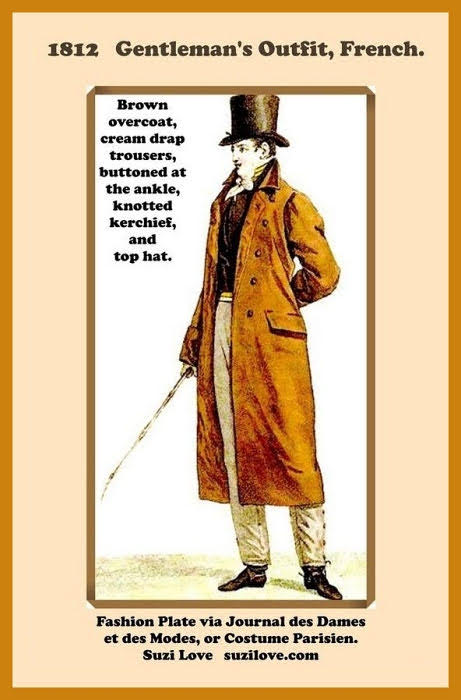
1812 Gentleman’s Outfit, French. Brown overcoat, or Redingote, with front pockets, cream Drap trousers buttoned at the ankle, knotted kerchief, top hat and holding a cane. Fashion Plate via suzilove.com and Journal des Dames et des Modes, or Costume Parisien. By 1812, men no longer wore complicated styles and extravagant fabrics. Men’s fashions had simplified and these practical and relaxed clothing items were the sort worn by Jane Austen’s male family and friends when out and about in town or on their daily excursions.
Definition Redingote Or Coat: French word developed from English words, riding coat. Long fitted outdoor coat worn over other garments for warmth. Originally made with several capes and trimmed with large buttons. French fashion plates call these coats Redingotes and they were worn by men, women, and children. English fashion plates call the coats a Pelisse, a Walking Dress, Promenade dress, or Carriage dress. Definition Drap: French equivalent for the English word cloth or stuff and generally applied to fabrics of wool or silk.

1800-1809 ca. Colorful Day Dresses, Designed by Jean-Francois Bony, France.
Though white was the most fashionable color, some designers, such as Jean-Francois, advocated greater use of color in women’s fashion. He was primarily a fabric designer and flower painter and his designs frequently made use of his ornate and colorful fabric designs.


1809 White Court Dress, French. Long train lavishly decorated with blue flowers, long white gloves and evening hairstyle. Fashion Plate via Journal des Dames et des Modes, or Costume Parisien.
Definition Court Dress: Usually, the difference between a court dress and a ball dress was in the quality of fabrics used, how elaborate the design, and the number and quality of the accessories. Plus, in England in the early 1800s court dresses were required by Queen Charlotte to have hoops and in France and other European countries court dresses a long train, usually expensively decorated. During the Regency Era, white cotton dresses were considered suitable for many evening events, but definitely not for an evening event in a palace.

1800s French Palais Royal Sewing Box and Twelve Mother of Pearl Enamel Tools. This is the style of sewing box Jane Austen and her family would have used in the early 1800s, or Regency years. via via suzilove.com and 1st Dibs Auctions 1stdibs.com
Definition: Palais Royal: Name of an area around the Royal Palace in Paris, France, that specialized in making small and exquisite works of art during the 18th and 19th centuries. Palais Royal sewing tools were elaborate and usually feature mother-of-pearl, often intricately carved or engraved. During the 19th century, workboxes were often works of art with engravings, carvings, mother-of-pearl, and elaborate gilt metal mounts. Most popular were scissors with steel blades and gilt mounts, thimbles and needle cases which were often shaped like animals or other natural forms. Workmanship was exceptional and the tools almost too fragile to use.

1815 July Walking Dress, English. Aqua blue walking dress with crossover straps at the back over a white bodice and with a cute sun hat with a scarf for decoration and with a matching shawl. Fashion Plate via The Lady’s Magazine Or Entertaining Companion for the Fair Sex.

