I'm an Australian author of contemporary and historical romances, plus history non-fiction.
My books range from sexy to erotic, late 1700s to the mid 1800s, and with a dash of Australia thrown into the mix. My heroes and heroines challenge tradition and my stories often expose the seamier levels of life.
I now live in a sunny part of Australia after spending many years in developing countries in the South Pacific. My greatest loves are traveling, anywhere and everywhere, meeting crazy characters, and visiting the Australian outback.
I hope my books bring history alive and you have fun adventuring with my roguish heroes and feisty heroines.
Writing and Publishing? Tips and Tricks in Self Publishing: Absolute Beginner’s Guide. Information, contacts, and checklists steer you towards professionally produced books. Helps both fiction and non-fiction authors and available in digital and paperback. Co-Authored by two Australians: multi-published Imogene Nix and best-selling and award winning Suzi Love. books2read.com/selfpublishing
D2D_SP_Contacts, lists, cheat sheets, and checklists to set goals and steer you towards professionally produced books. eBook and paperback #amwriting #nonfiction #selfpublishing books2read.com:selfpublishing
18th Century Snuff Boxes. Not only were boxes made to serve a purpose, but decorative boxes of all types were prized, especially in the 18th Century when everything decorative and extravagant was in vogue and taking a pinch of snuff was fashionable. Snuff is made from ground or pulverized tobacco leaves and is sniffed from a pinch of snuff placed on the back of the hand. Flavorings were added to the tobacco to give a fast hit of nicotine and a lasting scent. Snuff began in the Americas and was used in Europe by the 17th Century.
Snuff became popular from the mid 1600s to the mid 1800s and was more popular than smoking. Inhaling snuff, or snuffing, was first seen by a European missionary in 1493 in Christopher Columbus’s new world within Haiti’s indigenous Taino. Until then, tobacco had been unknown to Europeans, but its use spread quickly throughout Europe during the 1500s. By the second half of the 17th century, ornate boxes started being produced to keep the precious powder dry and an entire industry making accessories blossomed around the fashion of taking snuff. Noblemen, and some women, carried extravagantly decorated snuff boxes with them at all times and would offer a pinch of their own particular blend to friends and family. Therefore, these boxes were always on display and so it became a competition to see who could have the most bejeweled or expensive box possible. books2read.com/suziloveFashMen1700
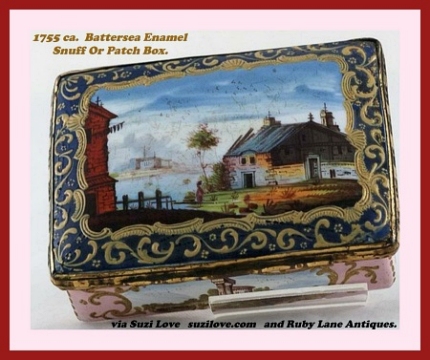
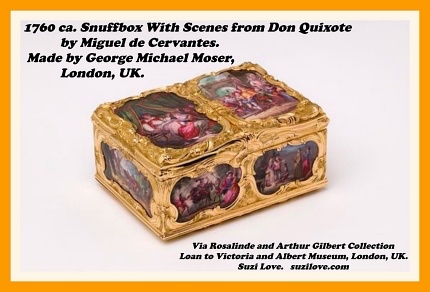
1770-1771 ca. Gold and Enamel Snuffbox 18th Century ca. Gold and Enamel Snuff Box, Europe.1759 Gold Snuff Box, English.1755 Battersea Enamel Snuff Or Patch Box. 1754-1755 ca. Gold Snuffbox, French. 1760 ca. Snuffbox With Scenes from Don Quixote 1760 ca. Gold Mounted Lapis Lazuli Snuff Box 1700s Portrait Miniature Snuff Box of Gold and Tortoiseshell1750 ca. Carved Agate Snuffbox, Germany. 1749-1750 ca. Double Snuff Box, French. 1728-1729 ca. Snuffbox With Dolphin and Ship,RL_2_D2D_RetailerBuyLink_RL_2
https://books2read.com/suziloveYGD
The Village Bus took us to The Doonan hotel for a wonderful lunch in the Noosa hinterland in the Sunshine Coast. “Set on 2 hectares and a stones throw from the famous local beaches — boasting indoor and outdoor dining, bars, beer gardens, a pizzeria, ice creamery, cellar door, multiple function spaces and an outdoor kids playground.” The food is amazing and the tables are scattered through the gardens and herb beds. So relaxing that we all want to go again. The Doonan Hotel, Sunshine Coast, Queensland, Australia.
The village bus took us for a lovely day out to Pelican Waters, Sunshine Coast, Queensland, Australia. First, a relaxing cruise around the canals to admire all the canal side mansions with boat moorings. Hard to pick just one that we’d like to live in as they all have magnificent views. Some channels and sand banks have moved since the ocean broke through the gap at Bribie Island but we saw wildlife and water activity as well as views to Moreton Bay and the channel where ships sail through to the Port of Brisbane. The sane people downstairs viewed the houses, boats and birds out of the wind while some intrepid travelers braved the elements to sit up top for a better view. Yummy lunch and drinks followed at Pelican Waters Tavern so the merry group was a lot quiter on the return trip. A great day out! Canal Cruise – Pelican Waters Tavern
“For the sake of propriety,” Lady Jamison informed the Earl. “I was ensuring your garments were intact. You’ve a reputation for disappearing into dark corners and re-emerging with your clothing askew.” https://books2read.com/suziloveSS The Earl says he has no time for their family friend and mad scientist, Lady Laura, yet when he’s with her, passion and desire explode. Can Richard resist Laura’s obvious charms and choose instead a passive and pleasing wife? Probably not!
SS_For the sake of propriety,” Lady Jamison informed the Earl. “I was ensuring your garments were intact. You’ve a reputation for disappearing into dark corners and re-emerging with your clothing askew.” https://books2read.com/suziloveSS
SS_D2D_
https://books2read.com/suziloveSS
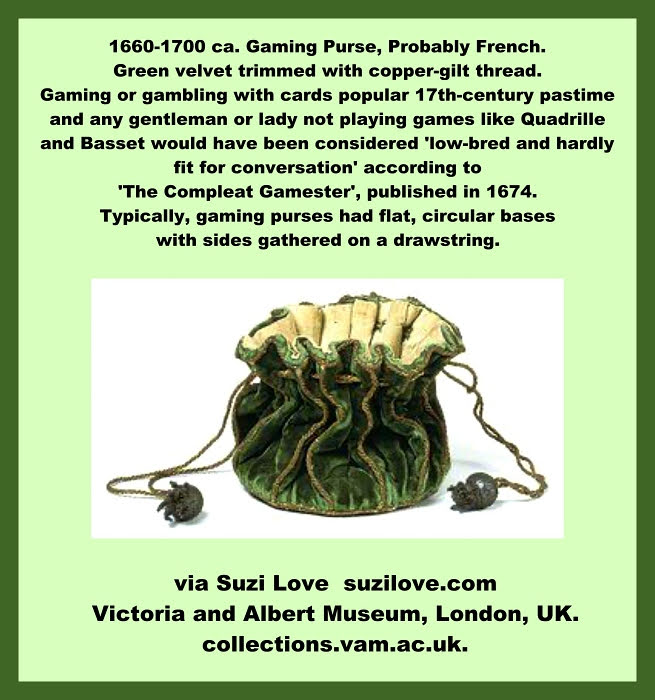
1660-1700 ca. Green Velvet Gaming Purse, Probably French. Trimmed with Copper-Gilt Thread, probably French. This purse was designed especially for gaming, or gambling, and would have held money, or counters, and is of a different design to other 17th-century purses. The base is a flat circle and the sides are gathered on a drawstring to stop money or gaming counters from spilling out, and to hide how much a gambler had in the purse. The bag’s plain look was probably a deliberate move to fool other gamblers into thinking the owner had little money.The purse is quite plain, with no embroidery and only a twist of copper gilt thread, gilt being a cheap substitute for gold or silver thread.
Playing and betting on card games was a socially acceptable pastime for the wealthy in the late 17th century. Along with dancing, riding and the theatre, it was an amusement for those classes that did not have to work. A gentleman or lady who did not participate in games such as ‘Quadrille’ and ‘Basset’ would have been considered ‘low-bred and hardly fit for conversation’ according to ‘The Compleat Gamester’, published in 1674. Victoria and Albert Museum, London, UK.
1660-1700-ca. Gaming Purse, probably French. Green velvet trimmed with copper gilt thread. Gaming or gambling with cards popular as a 17th Century Pastime and any gentleman or lady. D2D_RetailerBuyLink_HN_3 http://books2read.com/suziloveReticules
1806 Young French Gentleman. Brown Castorine Coat Over Blue Tailcoat, French. White cashmere breeches, white stockings, yellow gloves, black hat and a cane. Fashion Plate via Journal des Dames et des Modes, or Costume Parisien.
French fashions and Georgian and Regency Era fashions from Great Britain were copied around the world. This is the normal daily outfit for a gentleman in the early 1800s, or in the times of Jane Austen, for daily city and country life.
Le Beau Monde magazine made suggestions for men’s fashion in November 1806.
“The neckcloth should, by no means, be too greatly puffed out; but should be neatly united in front with a large unspread bow. Dark bottle green coats will be as generally worn this season, as those of brown colours were last winter.
“For morning dress frock coats will be prevalent: those of an olive hue, with a black velvet collar, will be the most universal. Fancied waistcoats of all manufactures may be worn with this kind of coat; but fashion ordains the invariable use of dark blue or light-coloured kerseymere pantaloons, and half-boots. The boots must rise somewhat higher in the leg than has recently been the custom, and the toes of them should be formed into a perfect semi-cirlce.
“Full dress coats will likewise be made of dark green cloth, double-breasted, and will possess the similar ornament of a black velvet collar. Single-breasted white waistcoats, and light-coloured kerseymere breeches will be in much estimation. Either flesh-coloured or now-white silk stockings fashion now considered as elegant.
“The hair, for morning dress, should be cut à la Titus; for full dress, it should be powdered. Buckles for the shoes are employed in full dress; but ribbands are allowed in afternoon or dinner dress.”
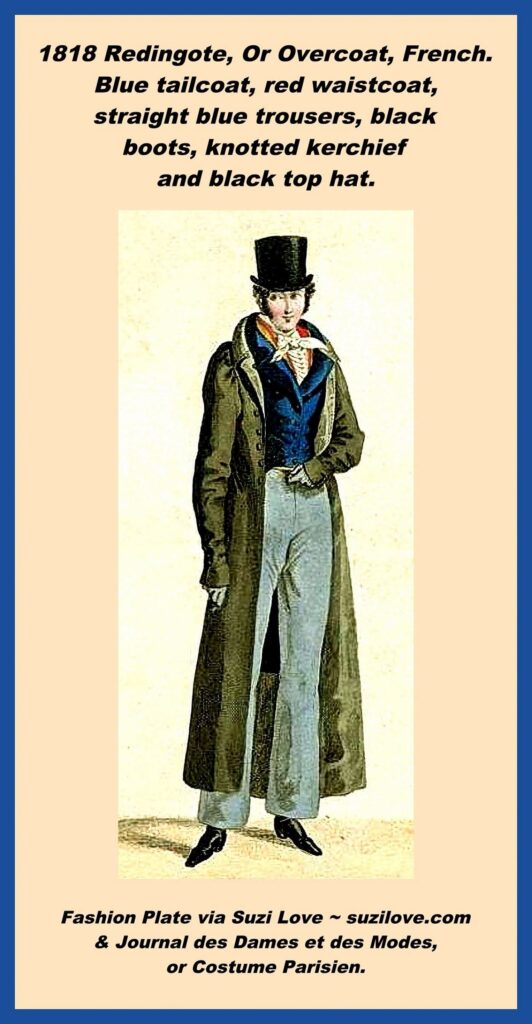
1818 Redingote Or Overcoat French. Blue tailcoat, red waistcoat, straight blue trousers, black boots, knotted kerchief and black top hat. Fashion Plate via Journal des Dames et des Modes, or Costume Parisien.
1818 Redingote Or Overcoat French. Blue tailcoat, red waistcoat, straight blue trousers, black boots, knotted kerchief and black top hat. Fashion Plate via Journal des Dames et des Modes, or Costume Parisien.HN_23_D2D_Fashion Men 1800-1819