↓
 

Suzi Love

Making history fun, one year at a time.

Header_
  • Home
  • Newsletter
  • Pre order form
  • Shop
    • Cart
    • Checkout
    • My account
    • Refund and Returns Policy
  • Blog
  • BOOKS
    • History Events
    • Kelly’s Justice
    • Irresistible Aristocrats
    • History Notes
    • Scandalous Siblings
    • Love After Waterloo
    • Regency Life Series
  • Privacy Policy
  • EVENTS
Home » Suzi Love » Suzi Love Books » History Of Christmases Past 1 2 >>

Category Archives: History Of Christmases Past

Post navigation

← Previous Post

Have You Read Suzi Love’s Books? Romance, Mystery, Military and History? #Romance #ReadARegency #HistoricalRomance #EroticRomance #Reading #Nonfiction

Suzi Love Posted on January 4, 2026 by Suzi LoveJanuary 3, 2026

Have you read Suzi Love’s Books? Romance, Mystery, Military and History. Regency, historical and contemporary romance. Plus non-fiction history and writing.

Amazon

Goodreads

BookBub

Have You Read Suzi Love's Books: Romance, Mystery, Military and History?https://www.amazon.com/stores/author/B00AFSU7JQ

The Viscount’s Pleasure House Book 1 Irresistible Aristocrats  Disenchanted Viscount tutoring three Regency Ladies. What could go wrong? #Regency Erotic https://books2read.com/suziloveTVPH

Four Times A Virgin Book 2 Irresistible Aristocrats: The countess will do anything to prevent her younger sisters being forced into sordid marriages like hers, even if it means joining forces with the Duke of Stirkton and revealing the horrors of their intertwined pasts. books2read.com/suziloveFTAV

Pleasure House Ball Book 3 Irresistible Aristocrats: Lord Mallory attends his first courtesan’s ball in ten years to appease his concerned friends, though he’d rather stay home and read to his motherless daughters. Though mortified that Brenton unmasks her at a scandalous ball, Lady Lillian Armstrong doesn’t regret their night together. books2read.com/suzilovePHB

Petunia and the Pearl Diver  Book 4 Irresistible Aristocrats Series: The pearl diver needs a working girl to rouse his body. Petunia needs money to save her family. A night at a London brothel could be the solution to both problems. But walking away is impossible when one night leaves them craving more…and more. https://books2read.com/suzilovePetPD

Loving Lady Katharine Book 5 Irresistible Atistocrats: When Lady Katharine Montgomery flees London after her scandalous husband was murdered, the Pacific islands of the New Hebrides (Vanuatu) become her haven. Her life changes when Lord Alexander St. John, British ship’s captain and trader, sails into Port Vila. https://books2read.com/suzi

Embracing Scandal Book 1 Scandalous Siblings: Lady Rebecca Jamison saves her family from financial ruin by investing in railways, but when a greedy syndicate murders her friend, Becca is forced to beg assistance from Cayle St. Martin, the new Duke of Sherwyn. https://books2read.com/suziloveES

Scenting Scandal Book 2 Scandalous Siblings Series: Richard, Earl of Winchester, may not know it yet, but he’s Lady Laura Jamison’s perfect match. Lady Laura Jamison believes her extraordinary olfactory senses will sniff out her perfect match, but will Richard prove her theory wrong? https://books2read.com/suziloveSS

December Scandal Book 3 Scandalous Siblings: The Jamison family joins the Duke of Sherwyn and the St. Martin clan at the duke’s country estate, but guest numbers double when early December snowfalls make roads impassable. #HistoricalRomance https://books2read.com/suziloveDS

Love After Waterloo: When Lady Melton and son join antagonistic Captain Belling and the last group of wounded British soldiers evacuating Waterloo, she anticipates hardship and trouble with deserters. Not her relationship with a belligerent Captain. #RegencyRomance #military books2read.com/suziloveLAW

Self Publishing: Absolute Beginner’s Guide.
Information, contacts, and checklists steer you towards professionally produced books. Helps both fiction and non-fiction authors and available in digital and paperback.
Co-Authored by two Australians: multi-published Imogene Nix and best-selling and award winning Suzi Love. http://books2read.com/selfpublishing

History Notes Books 1-28: Do you need more factual and visual information for your historical fiction? Non-fiction Series: Fashion, music and social manners in the 18th and 19th centuries books2read.com/suziloveFashWomen1700s

Regency Life Series Books 1-5: Historic images, historical information, and funny anecdotes give an overview of life in the early 1800s, or the Jane Austen and Bridgerton years. Information for history buffs and pictures to help readers and writers of historical fiction visualize the people and places of the long Regency period. https://books2read.com/suziloveROver
  books2read.com/suziloveROver books2read.com/suziloveYGD books2read.com/suziloveOGD

Have You Read Suzi Love's Books? Romance, Mystery, Military and History? #Romance #ReadARegency #HistoricalRomance #EroticRomance #Reading #Nonfiction https://www.bookbub.com/profile/suzi-love Share on X
Suzi Love Book Bub https://www.bookbub.com/profile/suzi-love
Posted in Australia, Bridgerton, Canada, England, Europe, History Notes, History Of Christmases Past, Irresistible Aristocrats, Jane Austen, Love After Waterloo, Regency Life Series, Royalty, Scandalous Siblings Series, Self Publishing, South Pacific, Suzi Love Books, U.S.A | Tagged 1700s Mens Fashion, 1700s Women's Fashion, 1800s men fashion, 1800s women's fashion, Bridgerton, Erotic Romance, fiction, Georgian era, Historical Mystery, historical romance, History Notes, Irresistible Aristocrats, Jane Austen, military romance, nonfiction, Regency Era, Regency Fashion, romance, Scandalous Siblings Series, Victorian Era

Christmas: Yule Log

Suzi Love Posted on December 24, 2025 by Suzi LoveDecember 24, 2025

Christmas: Yule Log

Pagans burned a great log and a mammoth candle on the 21st of December, the shortest day in the year, because it was seen as the turning-point in the conflict between the contending forces of winter and spring.

From Harpers Bazaaar “The Yule-block, or Christmas-log, with its warm welcome, extending even to the poor and the stranger as they gathered around the hospitable board is being gradually supplanted by the Christmas-tree.”

Formerly the Yule-log, a huge section of the birch, was cut from a tree selected on Candlemas-day, which so late as the time of Queen Elizabeth was the last day of the Christmas holidays. On the following Christmas-eve it was dragged in and placed upon the hearth with great ceremony, the merry-makers pulling with a will, and singing the while the modernized Christmas carol commencing,

“Come, bring with a noise,

My merrie, merrie boys,

The Christmas-log to the firing.”

It was then kindled with a brand from last year’s Christmas fire, which, if it was not thus kept continually burning, still linked the merrymaking of one Christmas-time to that of another.

In Ramsgate, Kent, and the Isle of Thanet, the custom styled “hodening” is still in vogue. The “hoden,” which appears to be a cross between the “white horse” and the Klapperbock of the Germans, is accompanied by a number of youths in fantastic dress, who go round from door to door ringing bells and singing Christmas carols.

Xmas_Yule Log
Christmas: Bring In the Yule Log #christmas #holidays #custom #tradition http://books2read.com/suziloveHOCP. Share on X
Posted in 1700s, 1800s, 1900s, Australia, Canada, Christmas, Customs & Manners, Edwardian Era, England, Europe, Georgian Era, History Of Christmases Past, Regency Era, Romantic Era, South Pacific, U.S.A, Victorian Era | Tagged Christmas, Customs and Traditions, holidays, household, Jane Austen, Regency Era

Christmas Three Wise Men Bringing Gifts. #Christmas #holidays #Traditions #Customs

Suzi Love Posted on December 23, 2025 by Suzi LoveDecember 20, 2025

Gifts From The Three Wise Men

The Star of Bethlehem, or Christmas Star appears in nativity story of Gospel of Matthew where wise men from the East, or Magi, follow the star and travel to Jerusalem. The Three Wise Men brought gold, frankincense and myrrh to the newborn king. Myrrh being commonly used as an anointing oil, frankincense as a perfume, and gold as a valuable.

Three Kings came riding from far away,

Melchior and Gaspar and Baltasar;

Three Wise Men out of the East were they,

And they travelled by night and they slept by day,

For their guide was a beautiful, wonderful star.

The Three Kings by Henry Wadsworth Longfellow

Gold, Frankincense and Myrrh were the three presents brought by the Wise Men to the Infant Christ, lying in the manger stall, at Bethlehem. Gold to Christ means that all the affluence of the world surrendered to Him and Gold paid the way for Joseph and Mary and the divine fugitive into Egypt. The gold for Christ, the silver for Christ, the jewels for Christ. The bright, round, beautiful jewel of a world set like a solitaire on the bosom of Christ. The wise men shook myrrh out of their sacks and the cattle snuffed at it but didn’t eat it because it was bitter. This pungent gum resin of Abyssinia was brought to the feet of Christ to show bitter betrayal, persecution, days of suffering and bitter nights. Myrrh was put into His cup when He was dying and put under His head in the wilderness and Myrrh was used on His from the cattle-pen in Bethlehem to the mausoleum. Frankincense means worship and was brought to temples, sprinkled over the living coals, and when they were ready to worship, the cover was lifted and perfumed smoke arose and filled the places of worship and altars.

In modern times, gifts are given on December 25th, or Christmas Day, in most countries but in others it is December 6th, or Saint Nicholas Day, and January 6th, or Epiphany. European countries generally follow the custom of giving each other presents on Christmas Eve.

Xmas_Three Wise Men
Xmas_Three Wise Men
Xmas_Three Wise Men
Xmas_Three Wise Men
Xmas_Three Wise Men
Xmas_Three Wise Men
Xmas_Three Wise Men
Xmas_Three Wise Men
Christmas Three Wise Men Bringing Gifts. #Christmas #holidays #Traditions #Customs https://books2read.com/suziloveHOCP Share on X

Posted in Australia, Canada, Christmas, Customs & Manners, England, Europe, History Of Christmases Past, Suzi Love Images, U.S.A | Tagged British history, Christmas, europe, History Of Christmases Past, religion, Suzi Love Images

Christmas: Lord Of Misrule #Christmas #holidays #Traditions #Customs

Suzi Love Posted on December 16, 2025 by Suzi LoveDecember 15, 2025

The Lord of Misrule was generally a peasant, or sub-deacon, and the revelries followed the Pagan tradition of Saturnalia and was a time of drunkenness and wild partying. The Church’s festival with a Boy Bishop, the leader of children’s festivities in choir schools, was similar, but was abolished by Henry VIII in 1541, restored by the Catholic Queen Mary, but again abolished by Protestant Elizabeth I. On the Continent, the Council of Basle suppressed it in 1431 but the custom was revived in some places from time to time, even as late as the eighteenth century. After the death of Edward VI in 1553, the English court stopped appointing a Lord of Misrule.

From A Survey of London by John Stow: Reprinted from the text of 1603.

‘…in the feaste of Christmas, there was in the kings house, wheresoeuer he was lodged, a Lord of Misrule, or Maister of merry disports, and the like had yee in the house of euery noble man, of honor, or good worshippe, were he spirituall or temporall.’

During the late medieval and early Tudor periods in England, Lord of Misrule, also called Abbot Of Misrule, or King Of Misrule, was appointed to manage the Christmas festivities held at court, in the houses of great noblemen, in the law schools of the Inns of Court, and in many of the colleges at the universities of Cambridge and Oxford.

His reign lasted anywhere from 12 days to 3 months and his role was to direct the masques, processions, plays, and feasts. Although this was mostly a British custom, in ancient Rome from the 17th to 23rd of December, a Lord of Misrule took on the guise of Saturn for the feast of Saturnalia and the ordinary rules were changed so that masters became slaves and the offices of state were held by slaves. The Lord of Misrule presided and could command anyone to do anything. Our contemporary Christmas holidays seem to have originated from this idea of festive holidays.

The custom began in December 1551 when the Duke of Somerset, Edward VI’s uncle Edward Seymour, was in the Tower of London awaiting execution. He sent a note to the Master of Revels to appoint George Ferrers as Lord of Misrule. Ferrers was a courtier and poet who later contributed to A Mirror for Magistrates, described by Scott Lucas as a “compendium of tragic monologues” by a series of historical personages.

Scotland had the Abbot of Unreason (suppressed in 1555) as their equivalent to the Lord of Misrule and scholars believe both ideas came from the “king” or “bishop” who presided over the earlier Feast of Fools.

Xmas_Lord Of Misrule
Christmas: Lord Of Misrule Custom #Christmas #holidays #Traditions #Customs. books2read.com/suziloveHOCP Share on X
Posted in Australia, Canada, Christmas, Customs & Manners, England, Europe, History Of Christmases Past, Suzi Love Images, U.S.A | Tagged Christmas, Customs and Traditions, History Of Christmases Past, pastimes

Christmas: Mistletoe and its long history. #Christmas #Holidays #Customs #BritishHistory

Suzi Love Posted on December 14, 2025 by Suzi LoveDecember 14, 2025

Another Christmas Tradition is kisisng under the Mistletoe. So have fun this Christmas and find someone to kiss. The problem in hotter climates is to find the Mistletoe, of course. Darn!

Mistletoe was used by Druid priests 200 years before the birth of Christ in their winter celebrations. They revered the plant since it had no roots yet remained green during the cold months of winter. The ancient Celtics believed mistletoe to have magical healing powers and used it as an antidote for poison, infertility, and to ward of evil spirits. The plant was also seen as a symbol of peace, and it is said that among Romans, enemies who met under mistletoe would lay down their weapons and embrace.

Scandanavians associated the plant with Frigga, their goddess of love, and it may be from this that we derive the custom of kissing under the mistletoe. Those who kissed under the mistletoe had the promise of happiness and good luck in the following year. Mistletoe was associated with Christmas as both a decoration under which lovers kiss, as well as a protection from witches and demons. Sounds romantic, although mistletoe is actually a parasitic plant that grows on other trees or plants and comes in many varieties.  

In Britain, mistletoe was mainly found in the western and southwestern parts, so the custom wasn’t even followed in all parts of England. But where the mistletoe custom was followed, it was hung in doorways and the greenery was watched by young gentlemen in hopes of catching a pretty girl to kiss, usually on the cheek.      

Traditionally, a man was allowed to kiss a woman who was standing underneath mistletoe and bad luck would befall any woman who refused. In some places, it was the custom to pick a berry for each kiss and when all the berries were gone, no more kisses could be taken.

Xmas_Mistletoe
Xmas_Mistletoe
Xmas_Mistletoe
cropped to image, recto, unframed
Xmas_Mistletoe
Xmas_Mistletoe
Christmas: Mistletoe and its long history. #Christmas #Holidays #Customs #BritishHistory https://books2read.com/suziloveHOCP Share on X
Posted in 1700s, 1800s, Australia, Christmas, Customs & Manners, dancing, England, Europe, Georgian Era, History Of Christmases Past, household, Regency Era, Romantic Era, Suzi Love Images, U.S.A, Victorian Era | Tagged British history, Christmas, Customs and Traditions, dancing, europe, Georgian era, History Of Christmases Past, Regency Era

Christmas: 1803 December The Bellman #Christmas #holidays #RegencyEra #Customs

Suzi Love Posted on December 11, 2025 by Suzi LoveDecember 10, 2025

Christmas Bells.

“Bells are musics laughter.” By Thomas Hood (1799-1845), British poet and humorist.

Bells hold a  long time association with Christmas. In Victorian times, carol singers used small handbells to play the tune of the carol. Sometimes there were bells without singing – Church bells are rung after sunset to signal the start of the Christmas Eve service, the first of Christmas. In England, the bellman goes round at midnight ringing his bell, and rattling off a stanza or two, for the gratuity which he confidently anticipates; while watchmen, firemen, rate-collectors, postmen, chimney-sweeps, street scavengers, the errand-boys of your baker, butcher, poultry merchant, and green-grocer, even to the hired singers in the churches all expect their Christmas-box. In Victorian times, carol singers used small hand bells to play the tune of the carol and sometimes there were bells without singing. Church bells are rung after sunset to signal the start of the Christmas Eve service, the first of Christmas.

The Bellman

The Bellman stands full face, shouting with wide-open mouth and ringing his hand-bell.

In his left hand he holds out his verses headed by a little figure of Napoleon wearing a huge tricorne and holding a gigantic sword:

 ‘This little Boney-says he’ll come At merry Christmas time,

But that I say is all a hum Or I no more will rhyme

Some say in Wooden house he’ll glide, Some say in air Balloon,

E’en those who airy schemes deride. Agree his coming soon.

Now honest people list to me, Though Income is but small, I’ll bet my Wig, to one Penney, He does not come at all.’ Hand-colored etching and aquatint.

Via British Museum

Christmas: 1803 December The Bellman #Christmas #holidays #RegencyEra #Customs books2read.com/suziloveHOCP Share on X
Posted in 1800s, Bridgerton, Christmas, Customs & Manners, England, History Of Christmases Past, Jane Austen, Music, Regency Era, Suzi Love Books, Suzi Love Images | Tagged Bridgerton, British history, Christmas, Customs and Traditions, England, History Of Christmases Past, Jane Austen, music, Regency Era, Suzi Love Books

Christmas: Candy Cane And It’s Fascinating History #Christmas #holidays #Traditions #Customs

Suzi Love Posted on December 11, 2025 by Suzi LoveDecember 10, 2025

Legend has it that during the 17th century, craftsmen created straight white sticks of candy in the shape of shepherds’ crooks at the suggestion of the choirmaster at the Cologne Cathedral in Germany. The treats were given to children to keep them quiet during ceremonies at the living creche, or Nativity scene, and the custom of passing out the crooks at such ceremonies soon spread throughout Europe.

‘The legends of the candy cane are many, including that the cane was shaped like a “J” for Jesus, the three red stripes symbolized the Holy Trinity, the hardness of the candy represented the Church’s foundation on solid rock and the peppermint flavor reflects the use of hyssop, an herb referred to in the Old Testament.’ via Encyclopedia Britannica

In celebrations of Saint Nicholas Day, candy canes are given to children as they are also said to represent the crosier of the Christian bishop, Saint Nicholas; crosiers themselves allude to the Good Shepherd, a title associated with Jesus. Some people explain the symbolism of a striped cane as white representing Christ’s purity, red the blood he shed, and the three red stripes the Holy Trinity.

In the mid 1600s, sugar roses were added but weren’t popular so plain white canes remained until red stripes were added around 1890. In 1847, a German immigrant living in Wooster, Ohio, U.S.A. looped candy canes that he brought with him from Europe over the boughs of his Christmas tree.

In 1919,  Bob McCormack of Albany, Georgia, made candy canes for family, friends and local shopkeepers. The canes were bent by hand as they came off the assembly line into the  ‘J’ shape of a shepherd’s crook, so breakage was often over 20 percent. In the 1920s, a cherubic child in a red-and-white hat sold peppermint candy cane to Albany natives in an advertisement for Bob’s candy company.  McCormack was the first manufacturer to wrap his candy in cellophane. Bobs moved to a larger facility in the 1930s so that it could expand its product lines and was one of the few candy companies to remain solvent during the Great Depression.

As the economy improved, people bought more sweet treats,  but Bobs Candy was then leveled by a tornado and, as the company had no tornado insurance, they had to rebuild on their own. By August 1940 the company was back in business and employed McCormack’s three children.

During World War II (1941-45), when sugar was rationed, coconuts were in short supply, and pecans were expensive, Bobs took advantage of a plentiful local product—the peanut—and sold peanut-butter crackers and vacuum-packed peanuts. During the 1950s, Bobs began making money with such innovations as break-proof packaging, moisture-proof candy wrappers.

In 1952, Bob McCormack’s brother-in-law, Catholic priest Gregory Keller, invented the Keller Machine which automated the process of twisting soft candy into spiral striping and then cutting them into precise lengths as candy canes.

Harding Keller invented the Keller Machine around 1950 for his brother-in-law Bob McCormack. The machine twisted and cut stick candy, allowing for the mass production of the company’s signature candy canes and other items. – Courtesy of Farley’s and Sathers Candy Company, Inc.

First, candy sticks cut to the desired length enter the machine. Each stick is bent individually, but the machine has a system of multiple grippers and rollers to continually bend the sticks, one after the other. As each stick enters the machine, it is positioned in a gripper which holds the straight portion of the cane with the part to be bent protruding out. Each gripper has on one side a curved die which the protruding end will be bent over. The candy stick is first bent to a right angle as it is moved past and put into contact with an inclined face. The patent application describes two potential versions of the mechanism which complete the bending process.

The first version of the mechanism has a chain around two sprockets on which are mounted bending rollers. Each bending roller is attached to a cam which rides along another inclined face to move the roller along the protruding surface of the cane to complete bending it around the die. In the second version, the chain and sprockets are replaced by a wheel on which the bending rollers are mounted. In modern candy cane production, the sticks are wrapped in cellophane before they are bent.

By the middle of the century, Bob’s company – originally the Famous Candy Company, then the Mills-McCormack Candy Company, and later Bobs Candies, had become one of the world’s leading candy cane producers.Bobs Candies was sold to Farley’s and Sathers in Spring 2005. Farley’s and Sathers merged with the Ferrara Candy Company which continues to make candy canes under the Bobs name.

By the middle of the century, Bob’s company – originally the Famous Candy Company, then the Mills-McCormack Candy Company, and later Bobs Candies, had become one of the world’s leading candy cane producers.

Xmas_Candy Cane
Xmas_Candy Cane
Xmas_Candy Cane
Christmas: Candy Cane And It's Fascinating History #Christmas #holidays #Traditions #Customs https://books2read.com/suziloveHOCP Share on X
Posted in 1800s, 1900s, Christmas, Customs & Manners, Edwardian Era, Food and Drink, History Of Christmases Past, Suzi Love Books, U.S.A, Victorian Era | Tagged Christmas, Customs and Traditions, Edwardian Era, Food, History Of Christmases Past, Suzi Love Images, Suzi Love Research, USA, Victorian Era

Christmas: How did they celebrate Christmas in Bridgerton and Jane Austen times? #Christmas #Christianity #Bridgerton #JaneAusten #holidays

Suzi Love Posted on December 10, 2025 by Suzi LoveDecember 9, 2025

How did they celebrate Christmas in Bridgerton and Jane Austen times? Historical information about the traditions of Christmas through the centuries, including the religious aspects, decorations, games, food and plays. History Of Christmases Past has lots of information and images about Christmas through the centuries, including religious aspects, decorations, games, food and plays. Historic images show how some traditions have changed while many have remained the same through the centuries. books2read.com/suziloveHOCP

How did they celebrate Christmas in Bridgerton and Jane Austen times? Historical information about the traditions of Christmas through the centuries, including the religious aspects, decorations, games, food and plays. #holidays #Christmas #Christianity #Bridgerton #JaneAusten http://books2read.com/suziloveHOCP
How did they celebrate Christmas in Bridgerton and Jane Austen times? Historical information about the traditions of Christmas. #holidays #Christmas #Christianity #Bridgerton #JaneAusten http://books2read.com/suziloveHOCP Share on X


Posted in 1700s, 1800s, 1900s, Australia, Bridgerton, Canada, Christmas, Customs & Manners, Edwardian Era, England, Europe, Events, Food and Drink, Georgian Era, History Of Christmases Past, household, Jane Austen, Music, Regency Era, Romantic Era, Royalty, South Pacific, Suzi Love Books, Suzi Love Images, U.S.A, Victorian Era | Tagged Book 1, Bridgerton, British history, Christmas, Customs and Traditions, drinks, Edwardian Era, Food, Georgian era, History Events, History Of Christmases Past, household, Jane Austen, music, Queen Victoria, Regency Era, Regency Royalty, Suzi Love Books, Victorian Era

Christmas: Typical Christmas Food Eaten By the Bridgerton and Jane Austen Families. #Christmas #Food #JaneAusten #Bridgerton

Suzi Love Posted on December 9, 2025 by Suzi LoveDecember 9, 2025

Christmas: Typical Christmas Food Eaten By the Bridgerton and Jane Austen Families. #Christmas #Food #JaneAusten #Bridgerton

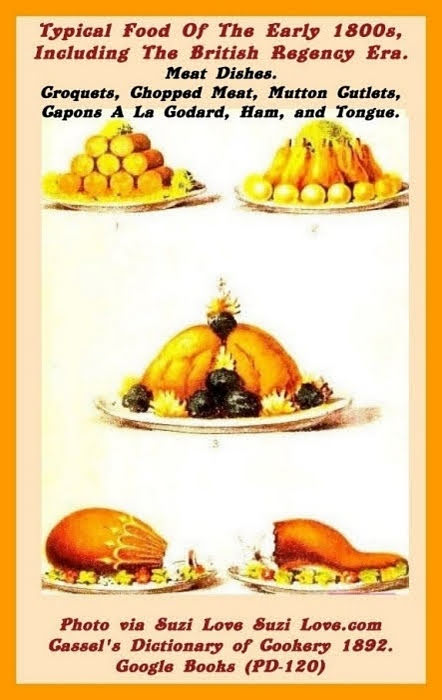
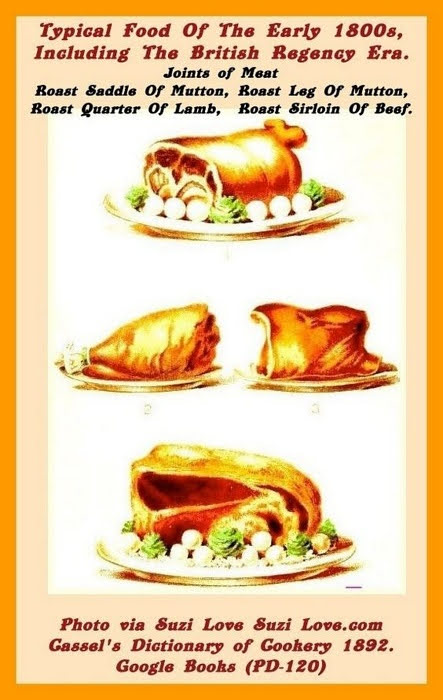
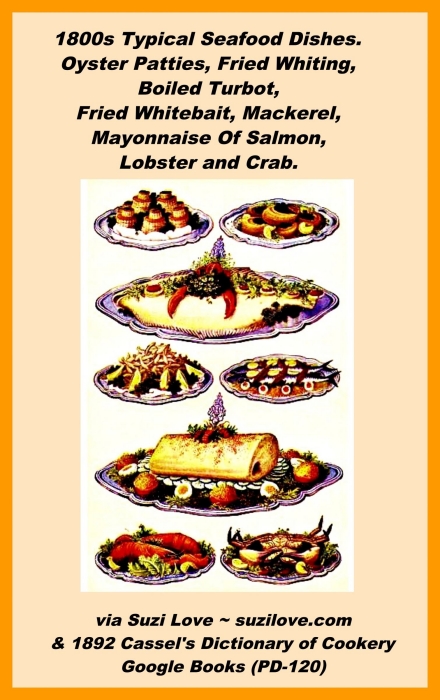
On the Christmas menu was generally mince pies and perhaps a goose or a piece of beef, depending on the family’s wealth and status. Mince pies were not made of fruit mince as we do now, but of offal or meat such as bullock’s tongue cooked with spices, orange peel, and wine and then used to fill pastry cases.

Another Christmas specialty was a Yorkshire Christmas pie which would be filled with turkey, goose, a hen, or perhaps woodcocks, partridge, or pigeons. And after the main courses, came the Plum Pudding, mixed on Stir-Up Sunday according to each family’s recipe and then boiled in a cloth.

Xmas_food_1800s_Typicalchristmasdesserts_1892cassells
Xmas_food_1800s_TypicalPies-and-Puddings_MrsBeeton
Food_1800s_Typical Food of the Early 1800s Including the British Regency Era. Meat Dishes- Croquettes, chopped meat, mutton cutlets, capons A la Godard, Ham and Tongue. 1892 Cassell_Sml
Food_1800s_Typical Food of the Early 1800s. Including the Regency Era. Joints Of Meat_Sml
food_1800s_Typical Historical Christmas Meal. Boars Head, Wassail Bowl, Punch Bowl, Roast Swan, Punch Jelly, Lamb_s Wool, and Truffles. Plate via Cassell_s Dictionary of Cookery_Sml
Food_1800s_TypicalFishDishes_OysterPattties_FriedWhiting_BoiledTurbot_friedWhitebait_Mackera=el_MayonaiseOfsalmon_Lobster_Crab_From1892Cassells
food_1800s_TypicalGame and Poultry (1). Snipe On Toast, Larks On Toast, Roast Pheasant, Roast Pigeons, Roast Fowl, Roast Goose, Roast Duck, Boiled Fowl, Roast Turkey_1860s_Mrs. Beeton_Sml
Food_1800s_TypicalJoints_SirloinofBeef, Boiled Beef, Leg Of Mutton, Roast Ribs Of Beef. From- 1861 Mrs. Beeton_Sml
Christmas: Typical Christmas Food Eaten By the Bridgerton and Jane Austen Families. #Christmas #Food #JaneAusten #Bridgerton https://books2read.com/suziloveHOCP Share on X
Posted in 1700s, 1800s, Australia, Bridgerton, Canada, Christmas, Customs & Manners, England, Europe, Food and Drink, Georgian Era, History, History Of Christmases Past, household, Jane Austen, Regency Era, Romantic Era, Suzi Love Images, U.S.A, Victorian Era | Tagged Bridgerton, British history, Christmas, europe, Food, google books, History Of Christmases Past, household, Jane Austen, Suzi Love Images

Christmas: Mince Pies #Christmas #holidays #Food #Traditions #Customs

Suzi Love Posted on December 9, 2025 by Suzi LoveDecember 8, 2025

Christmas Mince Pies.   

‘The following is a valued receipt that has been handed down in a Cornish family for many generations,
and the hand-writing of the receipt book will vouch for its antiquity.
‘A pound of beef-suet chopped fine;
a pound of raisins do. stoned.
A pound of currants cleaned dry.
A pound of apples chopped fine.
Two or three eggs.
Allspice beat very fine, and sugar to your taste.
A little salt, and as much brandy and wine as you like.
An ancient Cornish custom at Christmas.”
A small piece of citron in each pie is an improvement.’
From: 1833 Christmas Carols, Ancient and Modern by William Sandys.

Mince meat pies, or Christmas or Twelfth Night pies, were always part of Christmas feasts. Originally the mince pies were oblong or oval but in the 1600’s, the pies became circular, although were quite large and could weigh up to 20 lbs. In London, they could be brought out on Lord Mayor’s Day which was the 9th of November.

Timeline of Mince Pies via Minced Pie Club.

  • In the 13th century, crusaders returned from the Middle Eastern with recipes containing meat, fruit and spices mixed together, which helped preserve meat without having to smoke, dry or salt.
  • 1413 King Henry served a mincemeat pie at his coronation.
  • 1588 Good Hous-Wiues Treasurie by Edward Allde: meats were still cut up to be eaten with a spoon and combined with fruits and heavy spices. His recipe for Minst Pye had practically the same ingredients as modern mince pies.
  • 1657 Mince Pies were banned during the reign of Oliver Cromwell, along with other Christian traditions that were classed as gluttony.
  • 1659 Oliver Cromwell’s Puritan influence spread to the American British Colonies and many towns banned mincemeat pies at Christmas time.
  • When pies were reintroduced in Britain, they were a lot smaller and could be served individually to guests and were named Wayfarer pies.
  • 1832 Bill of Fare: no less than one hundred and eleven dishes of mince pies included.
Xmas_Christmas: Mince Pies
  • More Minced Pie Trivia
  • When the monarchy was restored in 1660, the law regarding Minced Pies was disregarded but apparently never repealed so Mince pies are still, supposedly, illegal.
  • Pastry crusts sink in the middle and are thought to resemble Jesus’ manger so sometimes a small pastry doll was put in the middle and these were called crib pies.
  • Pies could last up to two months in cold weather.
  • Recipes varied by region, but usually included beef, poultry and other meats, suet, sugar, raisins or currants, spices, orange and lemon peel, eggs, apples and brandy.
  • Minced-meat was only supposed to be stirred clockwise, otherwise the stirrer would have bad luck in the coming year. bring bad luck for the coming year.
  • Filling included cinnamon, cloves and nutmeg to represent the gifts of the Magi to the infant Jesus and the star shaped pastry on top represents the star of Bethlehem.
  • If you ate minced pie every day of the twelve days of Christmas you were supposed to have twelve months of happiness, especially if the pies were baked by the dozen and offered by friends.
Christmas: Mince Pies #Christmas #holidays #Food #Traditions #Customs https://books2read.com/suziloveHOCP Share on X
Posted in 1700s, 1800s, 1900s, Christmas, Customs & Manners, Edwardian Era, England, Europe, Food and Drink, Georgian Era, History Of Christmases Past, household, Regency Era, Romantic Era, Suzi Love Books, Victorian Era | Tagged British history, Christmas, Customs and Traditions, England, europe, Food, History Of Christmases Past

Post navigation

← Previous Post

SUBSCRIBE TO SUZI LOVE'S NEWSLETTER.

Recent Posts

  • Do You Know What A Half Parure Is? 1806 Muslin Dress With Train, Shawl and Half Parure Jewelry Set. #RegencyFashion #JaneAusten #HistoricalFashion
  • 1820-1850 ca. Chemise, Corset, Quilted Petticoat and Pocket, American. #Regency #Underclothing #RomanticEra
  • 1802 Bridgerton and Jane Austen Style Dress Bodices and Two Cute Bonnets. #Bridgertons#Regency #Hats #JaneAusten
  • Love After Waterloo: There’d been nowhere safe to hide a lady and her son at Waterloo. #HistoricalEroticRomance #MilitaryRomance #Waterloo #RegencyRomance #ReadARegency
  • “There is a stubbornness about me that never can bear to be frightened at the will of others. My courage always rises at every attempt to intimidate me.” Jane Austen Pride and Prejudice (1813) #JaneAusten #RegencyEra #Quote

Recent Comments

  1. Suzi Love on Book Hooks: Earl of Winchester has no time for mad scientist Lady Jamison yet when he’s with her, desire explodes. #HistoricalMystery #RomCom #VictorianRomance #RegencyRomance
  2. Suzi Love on Book Hooks: Earl of Winchester has no time for mad scientist Lady Jamison yet when he’s with her, desire explodes. #HistoricalMystery #RomCom #VictorianRomance #RegencyRomance
  3. Maggie Blackbird on Book Hooks: Earl of Winchester has no time for mad scientist Lady Jamison yet when he’s with her, desire explodes. #HistoricalMystery #RomCom #VictorianRomance #RegencyRomance
  4. Suzi Love on Book Hooks: Earl of Winchester has no time for mad scientist Lady Jamison yet when he’s with her, desire explodes. #HistoricalMystery #RomCom #VictorianRomance #RegencyRomance
  5. Jana Richards on Book Hooks: Earl of Winchester has no time for mad scientist Lady Jamison yet when he’s with her, desire explodes. #HistoricalMystery #RomCom #VictorianRomance #RegencyRomance

Login

  • Log in

Archives

  • May 2026
  • April 2026
  • March 2026
  • February 2026
  • January 2026
  • December 2025
  • November 2025
  • October 2025
  • September 2025
  • August 2025
  • July 2025
  • June 2025
  • May 2025
  • April 2025
  • March 2025
  • February 2025
  • January 2025
  • December 2024
  • November 2024
  • October 2024
  • September 2024
  • August 2024
  • July 2024
  • June 2024
  • May 2024
  • April 2024
  • March 2024
  • February 2024
  • January 2024
  • November 2023
  • October 2023
  • September 2023
  • August 2023
  • July 2023
  • June 2023
  • April 2023
  • March 2023
  • February 2023
  • June 2022
  • April 2022
  • March 2022

Categories

  • 1700s
  • 1700s Mens fashion
  • 1700s Womens Fashion
  • 1800s
  • 1800s Mens Fashions
  • 1800s women's fashion
  • 1900s
  • art
  • Australia
  • Bath
  • bedroom fashion
  • Book Hooks
  • Box Or Container
  • Bridgerton
  • Bus Trips
  • Canada
  • Carriage
  • cartoon
  • Celebrity
  • Chatelaine
  • children
  • Children
  • Christmas
  • Coat or Pelisse Or Redingote
  • Contemporary
  • Corset
  • Couple
  • Customs & Manners
  • dancing
  • December Scandal
  • Decorative Item
  • Dress Or Robe
  • Easter
  • Edwardian Era
  • Embracing Scandal
  • England
  • Ester In Images
  • Europe
  • Events
  • Fashion
  • fashion accessories
  • Food and Drink
  • Four Times A Virgin
  • France
  • furniture
  • Georgian Era
  • Georgian Fashion
  • Google Books
  • Grand Tour
  • Group
  • hats
  • History
  • History Events
  • History Notes
  • History Of Christmases Past
  • household
  • Hygiene
  • Irresistible Aristocrats
  • Jane Austen
  • Keanu Reeves
  • Kellys Justice
  • Legal
  • London
  • Love After Waterloo
  • Loving Lady Katharine
  • medical
  • military
  • money
  • mourning
  • Music
  • Outback Arrival
  • pants
  • Pastimes
  • peerage
  • People
  • Petunia and Pearl Diver
  • Places
  • Pleasure House Ball
  • postal
  • Queensland
  • Quotations
  • Regency Era
  • Regency Fashion
  • Regency Life Series
  • Reticule or Bag
  • riding
  • Romantic Era
  • Royalty
  • Russia
  • Scandalous Siblings Series
  • Scenting Scandal
  • Self Publishing
  • sewing
  • Shirt
  • shoes
  • South Pacific
  • Spencer
  • sports
  • Suit
  • Sunday Snippet
  • Suzi Love
  • Suzi Love Books
  • Suzi Love Images
  • Suzi Love Writing
  • Swain Cove
  • THe Viscount's Pleasure House
  • travel
  • U.S.A
  • underclothing
  • Vest or Waistcoat
  • Victorian Era
  • Victorian Fashion
  • weapons
  • weddings
  • Writing Tools

1800s men fashion 1800s women's fashion antiques Bridgerton British history Cartoons Corset cravat decorative Dress Or Gown England europe fashion accessories Fashion Plate France Georgian era Georgian Fashion gloves google books Hats And Hair historical romance History Notes household Jane Austen jewelry Journal des Dames et des Modes London Metropolitan Museum NYC pants Redingote Or Pelisse Or Coat Regency Era Regency Fashion Regency London Regency Men reticule or bag riding sewing shawls Shoes Suzi Love Books Suzi Love Images Tailcoat The Repository Of Arts underclothing Vest or Waistcoat

©2026 - Suzi Love - Weaver Xtreme Theme Privacy Policy
↑