1818 November ‘Fashionables Of 1818’ By George Cruikshank.Couple walk arm-in-arm with the man wearing Dandy costume of bell-shaped top-hat, trousers strapped under high-heeled boots without spurs and jauntily carried cane. Much shorter lady wears enormously high bonnet, striped over-dress over frilled white muslin, skirt above ankles, and carries a large ermine muff. Via British Museum, London, UK. britishmuseum.org (PD-Art)
These are the sort of outfits a couple would wear in Jane Austen’s times although these are exaggerated in caricatures to poke fun at the extremes of Regency fashion when women’s hats were so large and high that a lady was dwarfed by her devotion to fashion and a gentleman’s collar and neckcloth were so high he couldn’t turn his head to speak to the lady.
1818 November ‘Fashionables Of 1818’ By George Cruikshank.Couple walk arm-in-arm with the man wearing Dandy costume of bell-shaped top-hat, trousers strapped under high-heeled boots without spurs and jauntily carried cane.Much shorter lady wear enormously high bonnet, striped over-dress over frilled white muslin, skirt above ankles, and carries a large ermine muff. Via British Museum, London, UK. britishmuseum.org (PD-Art)23_d2d_fashionmen1800-1819https://books2read.com/SuziLoveFashionMen1800-1819
1800s French Palais Royal Sewing Box and Twelve Mother of Pearl Enamel Tools. This is the style of sewing box Jane Austen and her family would have used in the early 1800s, or Regency years. via via suzilove.com and 1st Dibs Auctions 1stdibs.com
Definition: Palais Royal: Name of an area around the Royal Palace in Paris, France, that specialized in making small and exquisite works of art during the 18th and 19th centuries. Palais Royal sewing tools were elaborate and usually feature mother-of-pearl, often intricately carved or engraved. During the 19th century, workboxes were often works of art with engravings, carvings, mother-of-pearl, and elaborate gilt metal mounts. Most popular were scissors with steel blades and gilt mounts, thimbles and needle cases which were often shaped like animals or other natural forms. Workmanship was exceptional and the tools almost too fragile to use.
1800s French Palais Royal Sewing Box and Twelve Mother of Pearl Enamel Tools. via via suzilove.com and 1st Dibs Auctions 1stdibs.com
1804 September Exhibition of Water Coloured Drawings, Old Bond Street, London, U.K. Designed and etched by Thomas Rowlandson. Via Wikimedia Commons commons.wikimedia.org (PD-ART)
1804 September Exhibition of Water Coloured Drawings, Old Bond Street, London, U.K. Designed and etched by Thomas Rowlandson. Via Suzi Love suzilove.com
& Wikimedia Commons commons.wikimedia.org (PD-ART)RL_1_D2D_Regency Overview RetailerLinks
https://books2read.com/suziloveROver
1660-1700 ca. Gaming Purse, Probably French. Green velvet trimmed with copper-gilt thread. Gaming or gambling with cards popular 17th-century pastime and any gentleman or lady not playing games like Quadrille and Basset would have been considered ‘low-bred and hardly fit for conversation’ according to ‘The Compleat Gamester’, published in 1674. Typically, gaming purses had flat, circular bases with sides gathered on a drawstring. via Victoria and Albert Museum, London, UK. collections.vam.ac.uk.
1826 Almack’s Revisited by Charles White. The ball of this evening passed off as all other balls at the same place, creating envy, jealousy, and hatred in the minds of many of those who have been unsuccessful in procuring tickets; affording real amusement to few, and disappointing a greater portion of those who, by dint of manoeuvring, petitioning, parliamentary interest, or presents, have been enabled to obtain the desired vouchers; and as this was one of the last balls of the season, and a general election already talked of, the mixture of company and the number was much greater than usual; and, consequently, it was what the most correct persons called, “horrid bad Almack’s!”
Almack’s or Willis’s Rooms, King Street, St James, London, UK. Almack’s Assembly Rooms, founded by William Almack at No. 26-28, were on the site of the present Almack House. The club was originally a gaming establishment but moved from Pall Mall. The Assembly rooms were on the South side of King Street in St James’s and were opened on February 12, 1765. At the time the subscription was ten guineas for which there was a ball and supper each week for the twelve weeks of the season.
1826 Almack’s Revisited by Charles White.: ‘It was what most correct persons called ‘horrid bad Almack’s’. #RegencyEra #London #BritishHistory
1805 Lady With Her Sketching Portfolio In Half Dress, French. White, At-Home, High-waisted, relaxed & flowing dress with white cap and pink flowers to match, long gloves, slippers. Fashion Plate via Journal des Dames et des Modes, or Costume Parisien. Definition Caps: Worn as morning caps, night caps, or under other hats. Jane Austen and her family and female friends would have worn caps like these, sometimes during the morning at home, to bed to keep their long hair from becoming knotted, or under a bonnet to hold a hairstyle in place. Caps sometimes had hanging ties, or tails, and were also called ‘follow me lads’, or ‘flirtation ribbons’. Or flaps covering theirs called Lappets. Magazine Journal des Dames et des Modes, or Costume Parisien, French. French fashion magazine published between 1797 and 1839 and second oldest fashion magazine published in France. Pierre de la Mesangere was editor and published every five days, which is why there is an abundance of French fashion plates from these years in France and internationally.
1805 Lady With Her Sketching Portfolio In Half Dress, French. White, At-Home, High-waisted, relaxed & flowing dress with white cap and pink flowers to match, long gloves, slippers. Fashion Plate via Journal des Dames et des Modes, or Costume Parisien.
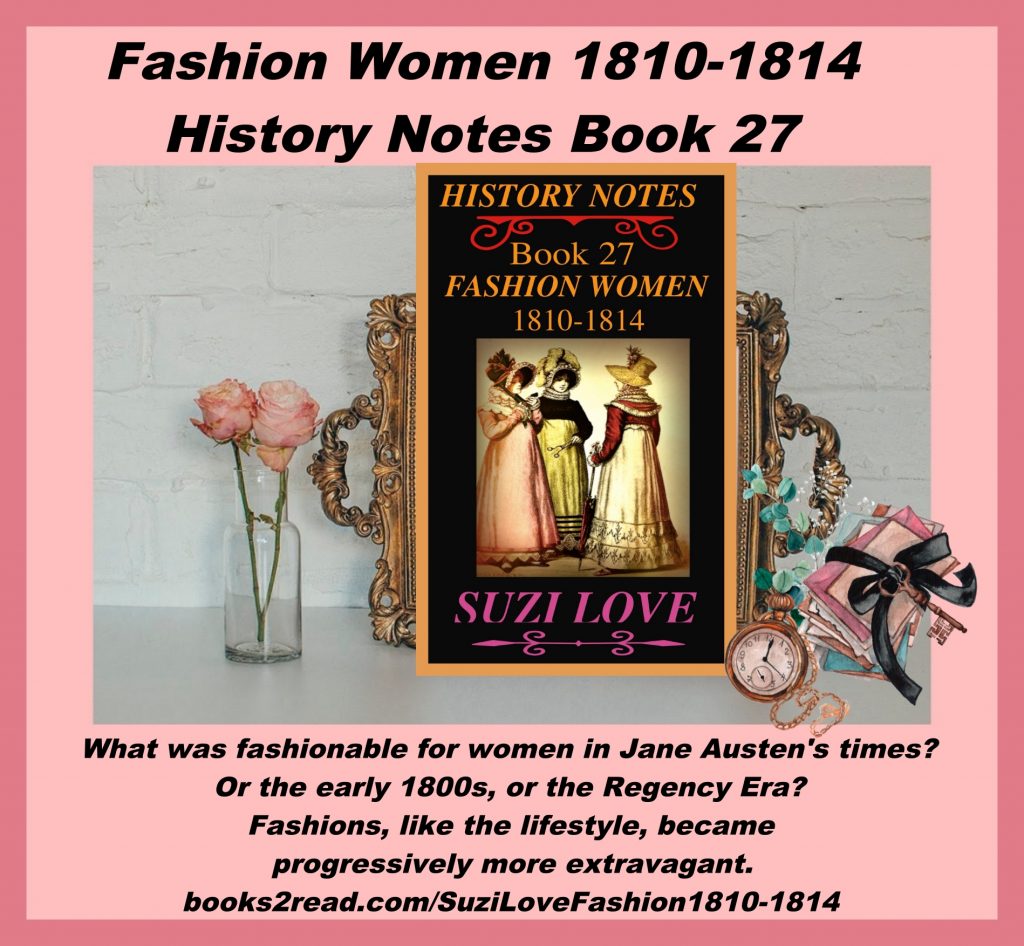
What was fashionable for women in Jane Austen’s times? Mourning, riding, daytime, evening clothing, plus underclothing, corsets and accessories. Fashion Women 1810-1814 History Notes Book 27 This book looks at what was fashionable for women in Jane Austen’s times, or the early 1800s, or the Regency Era in Britain. Wars were being fought around the globe so women’s fashion adopted a military look in support of soldiers. Fashions, like the lifestyle, became progressively more extravagant and accessories went from colorful to over-the-top. https://books2read.com/SuziLoveFashion1810-1814
The Lady’s Magazine said of the basis of women’s fashion that was popular for the first twenty years of the 1800s, ‘White is still the prevailing color for robes. For morning dresses, linen gowns, in large diamonds or squares, are fashionable. Indian muslins, plain or embroidered, are preferred to Florence and satins. The designs of embroidery for shawls are of infinite variety. Long gloves, which reach above the elbow, are not yet laid aside. Medallions are hung around the neck from crossed chains and some of these medallions are shaped like the bags, called ridicules. These reticules are of the lozenge or hexagon shape, with a small tassel at each angle. Reticules, or ridicules, are in lozenge or hexagon shapes with a small tassel at each angle. In capotes, or hats, and ribbands, the violet and dark green prevail over jonquil. Bracelets in hair, pear-shaped ear-rings, medallions on square plates, saltiers of colored stones, are still in fashion.’
1815 June White Carriage Dress, English. Lady reading a book in a high-waisted white satin Pelisse, or Walking Or Carriage dress in the relaxed Empire style as would have been worn at home in the early 1800s, or during Jane Austen’s time. Richly ornamented with clusters of leaves made in white twilled sarsnet, headed with tull. Open fronts, trimmed to the bottom of the waist with a superb shell trimming of white satin ribbon and tull, loose sleeves trimmed at the wrists. High hat of white satin and tull with a plume of feathers of the pomona green. Half-boots of similar color. Gloves en suite and a necklace. Lady is viewing paintings and the program in her hand says ‘British Institution’. In this issue of The Repository there is an article called ‘Exhibition of Paintings by the Flemish and Dutch Masters at the British Institution, Pall Mall.’ Fashion Plate via Rudolph Ackermann’s ‘The Repository of Arts’.
1815 June White Carriage Dress, English. Lady reading a book in a high-waisted white dress in the relaxed Empire style, frill on V-neckline, high flowered bonnet.long white gloves and a necklace. Fashion Plate via Rudolph Ackermann’s ‘The Repository of Arts’. Fashion Women 1815-1819 History Notes Book 28 What did Jane Austen wear? . D2D_HN_28_https://books2read.com/SuziLoveFashionWomen1815-1819
1800 ca. Pair of Flintlock Duelling Pistols. Owned by Captain William Waller (active 1794-1807). Walnut stock, chequered grips, rounded butts, fitted with two silver pipes containing ramrods. Silver trigger guards engraved and end in pineapple shaped finials, each with flintlock containing flints. Lock plates engraved with leaf design, octagonal barrels browned with narrow gold bands near lock. via Royal Museums Greenwich collections.rmg.co.uk
During the Regency Era and Jane Austen’s writing years, dueling was illegal, although secret duels still happened. Courts were made up of peers and they rarely charged another peer for anything illegal. Honor and gentlemanly behavior were the most important things to men so if there was an offense committed, a dawn duel was arranged with seconds to check the weapons used and a doctor in case of injuries.
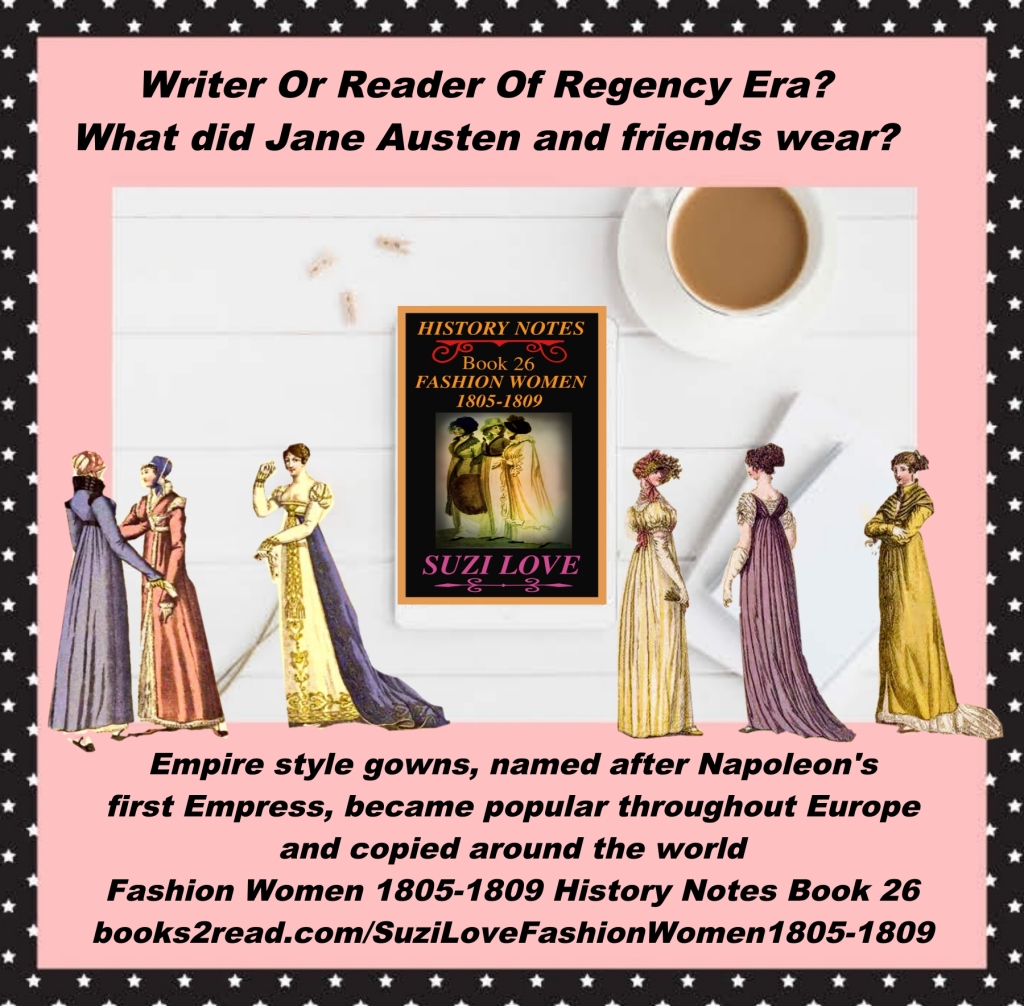
What did Jane Austen and friends wear? Early 1800s fashions were elegant and pretty with high waists and fabrics that were almost transparent. These Empire style gowns, named after Napoleon’s first Empress, became popular throughout Europe, and were then copied around the world. Colorful outwear was added to make an ensemble more attractive and warmer. History Notes Book 26 Fashion Women 1805-1809. https://books2read.com/SuziLoveFashionWomen1805-1809
What did Jane Austen and friends wear? Early 1800s fashions were elegant and pretty with high waists and fabrics that were almost transparent. These Empire style gowns, named after Napoleon’s first Empress, became popular throughout Europe, and were then copied around the world. Colorful outwear was added to make an ensemble more attractive and warmer.
https://books2read.com/SuziLoveFashionWomen1805-1809
Fashion Women 1805-1809 History Notes Book 26 What did Jane Austen and friends wear? https://books2read.com/SuziLoveFashionWomen1805-1809





![1805_HalfDress_WhiteAtHomeDress_LadywithSketchingPortfolio_CP_Lge.jpg ]](https://www.suzilove.com/wp-content/uploads/2022/11/1805_HalfDress_WhiteAtHokmeDress_LadywithSketchingPortfolio_CP_Sml.jpg)