↓
 

Suzi Love

Making history fun, one year at a time.

Header_
  • Home
  • Newsletter
  • Pre order form
  • Shop
    • Cart
    • Checkout
    • My account
    • Refund and Returns Policy
  • Blog
  • BOOKS
    • History Events
    • Kelly’s Justice
    • Irresistible Aristocrats
    • History Notes
    • Scandalous Siblings
    • Love After Waterloo
    • Regency Life Series
  • Privacy Policy
  • EVENTS
Home » History » Pastimes » Page 6 << 1 2 … 4 5 6 7 8 >>

Category Archives: Pastimes

Post navigation

← Previous Post
Next Post→
guitar_1780 ca. English Guitar, Lisbon, Portugal. Made by Jaco Vieira da Silva Pine back, sides and soundboards, with pine and wood purfling (bordering); brass openwork rose, framed with mother-of-pearl. The English guitar was a fashionable instrument from about 1750, considered easy to play and tuned in C major, although the player would use a capo, much like a modern folk-guitarist, in order to change the key. The tuning pegs were often small metallic pins that could be turned with a watch-key, to keep the strings in tune longer. This instrument was made in Portugal, a country with strong trading links with England, and its peg box is decorated with a paper ‘cameo’ in imitation of a jasper ware medallion, a motif made popular by Josiah Wedgwood (1730-1795) from about 1770. Victoria and Albert Museum, London, U.K.

1780 ca. English Guitar, Lisbon Made by Jaco Vieira da Silva. #Music #Guitar #Portugal #GeorgianEra

Suzi Love Posted on September 12, 2024 by Suzi LoveAugust 28, 2024

1780 ca. English Guitar, Lisbon Made by Jaco Vieira da Silva. Pine back, sides and soundboards, with pine and wood purfling or bordering, brass openwork rose, framed with mother-of-pearl. The English guitar was a fashionable instrument from about 1750, considered easy to play and tuned in C major, although the player would use a capo, much like a modern folk-guitarist, in order to change the key. The tuning pegs were often small metallic pins that could be turned with a watch-key, to keep the strings in tune longer. This instrument was made in Portugal, a country with strong trading links with England, and its peg box is decorated with a paper ‘cameo’ in imitation of a jasper ware medallion, a motif made popular by Josiah Wedgwood (1730-1795) from about 1770. Victoria and Albert Museum, London, U.K.  History Notes Book 6 Music General https://www.suzilove.com/wp-admin/books2read.com/suziloveMusicGeneral \

1780 ca. English Guitar, Lisbon, Portugal. Made by Jaco Vieira da Silva Pine back, sides and soundboards, with pine and wood purfling (bordering); brass openwork rose, framed with mother-of-pearl. The English guitar was a fashionable instrument from about 1750, considered easy to play and tuned in C major, although the player would use a capo, much like a modern folk-guitarist, in order to change the key. The tuning pegs were often small metallic pins that could be turned with a watch-key, to keep the strings in tune longer. This instrument was made in Portugal, a country with strong trading links with England, and its peg box is decorated with a paper ‘cameo’ in imitation of a jasper ware medallion, a motif made popular by Josiah Wedgwood (1730-1795) from about 1770. Victoria and Albert Museum, London, U.K.
.
1780 ca. English Guitar, Lisbon, Portugal. Made by Jaco Vieira da Silva Pine back, sides and soundboards, with pine and wood purfling (bordering); brass openwork rose, framed with mother-of-pearl. The English guitar was a fashionable instrument from about 1750, considered easy to play and tuned in C major, although the player would use a capo, much like a modern folk-guitarist, in order to change the key. The tuning pegs were often small metallic pins that could be turned with a watch-key, to keep the strings in tune longer. This instrument was made in Portugal, a country with strong trading links with England, and its peg box is decorated with a paper ‘cameo’ in imitation of a jasper ware medallion, a motif made popular by Josiah Wedgwood (1730-1795) from about 1770. Victoria and Albert Museum, London, U.K.
1780 ca. English Guitar, Lisbon Made by Jaco Vieira da Silva. #Music #Guitar #Portugal #GeorgianEra. https://www.books2read.com/suziloveMusicGeneral Share on X
HN_6_D2D_Music General_ books2read.com/suziloveMusicGeneral

Posted in 1700s, Decorative Item, Europe, Georgian Era, History, Music, Pastimes, Suzi Love Images | Tagged 1700s Or Georgian Era, europe, Georgian era, guitar, music, Victoria and Albert Museum | Leave a reply

1826 Almack’s Revisited by Charles White.: ‘It was what most correct persons called ‘horrid bad Almack’s’. #RegencyEra #London #BritishHistory

Suzi Love Posted on September 12, 2024 by Suzi LoveAugust 31, 2024

1826 Almack’s Revisited by Charles White. The ball of this evening passed off as all other balls at the same place, creating envy, jealousy, and hatred in the minds of many of those who have been unsuccessful in procuring tickets; affording real amusement to few, and disappointing a greater portion of those who, by dint of manoeuvring, petitioning, parliamentary interest, or presents, have been enabled to obtain the desired vouchers; and as this was one of the last balls of the season, and a general election already talked of, the mixture of company and the number was much greater than usual; and, consequently, it was what the most correct persons called, “horrid bad Almack’s!”

Almack’s or Willis’s Rooms, King Street, St James, London, UK. Almack’s Assembly Rooms, founded by William Almack at No. 26-28, were on the site of the present Almack House. The club was originally a gaming establishment but moved from Pall Mall. The Assembly rooms were on the South side of King Street in St James’s and were opened on February 12, 1765. At the time the subscription was ten guineas for which there was a ball and supper each week for the twelve weeks of the season.

1826 Almack's Revisited by Charles White.: 'It was what most correct persons called 'horrid bad Almack's'. #RegencyEra #London #BritishHistory
1826 Almack’s Revisited by Charles White.: ‘It was what most correct persons called ‘horrid bad Almack’s’. #RegencyEra #London #BritishHistory
1826 Almack's Revisited by Charles White.: 'It was what most correct persons called 'horrid bad Almack's'. #RegencyEra #London #BritishHistory  books2read.com/suziloveOLD  Share on X
RL_5_D2D_RetailerBuyLink_RL_5_2
https://books2read.com/suziloveOLD
Posted in 1800s, 1800s Mens Fashions, 1800s women's fashion, dancing, England, Google Books, History, London, Pastimes, Regency Era, Regency Fashion, Suzi Love Images | Tagged Almack's Assembly Rooms, Customs and Traditions, dancing, google books, Jane Austen, London, Regency Era, Regency London, Regency People | Leave a reply

1805 Lady wearing Jane Austen Style Half-dress with Sketching Portfolio, French. #RegencyEra #JaneAusten #HistoricalFashion

Suzi Love Posted on September 10, 2024 by Suzi LoveAugust 30, 2024

1805 Lady With Her Sketching Portfolio In Half Dress, French. White, At-Home, High-waisted, relaxed & flowing dress with white cap and pink flowers to match, long gloves, slippers. Fashion Plate via Journal des Dames et des Modes, or Costume Parisien. Definition Caps: Worn as morning caps, night caps, or under other hats. Jane Austen and her family and female friends would have worn caps like these, sometimes during the morning at home, to bed to keep their long hair from becoming knotted, or under a bonnet to hold a hairstyle in place. Caps sometimes had hanging ties, or tails, and were also called ‘follow me lads’, or ‘flirtation ribbons’. Or flaps covering theirs called Lappets. Magazine Journal des Dames et des Modes, or Costume Parisien, French. French fashion magazine published between 1797 and 1839 and second oldest fashion magazine published in France. Pierre de la Mesangere was editor and published every five days, which is why there is an abundance of French fashion plates from these years in France and internationally.

1805_HalfDress_WhiteAtHomeDress_LadywithSketchingPortfolio_CP_Lge.jpg ]
1805 Lady With Her Sketching Portfolio In Half Dress, French. White, At-Home, High-waisted, relaxed & flowing dress with white cap and pink flowers to match, long gloves, slippers. Fashion Plate via Journal des Dames et des Modes, or Costume Parisien.
1805 Lady wearing Jane Austen Style Half-dress with Sketching Portfolio, French. #RegencyEra #JaneAusten #HistoricalFashion https://books2read.com/SuziLoveFashionWomen1805-1809 Share on X
HN_26_D2D Fashion Women 1805-1809
https://books2read.com/SuziLoveFashionWomen1805-1809

Posted in 1800s, 1800s women's fashion, art, Dress Or Robe, England, Europe, fashion accessories, France, hats, household, Jane Austen, London, Pastimes, Regency Era, Regency Fashion, shoes, Suzi Love Images | Tagged 1800s women's fashion, art, Dress Or Gown, fashion accessories, Fashion Plate, gloves, Hats And Hair, Jane Austen, Journal des Dames et des Modes, pastimes, Regency Fashion, Shoes | Leave a reply

1809-1829 Magazine for the Bridgertons and Jane Austen: Rudolph Ackermann and ‘The Repository of Arts’, The Strand, London. #JaneAusten #Bridgerton #RegencyEra #London #History

Suzi Love Posted on August 28, 2024 by Suzi LoveAugust 24, 2024

A portrait from 1810-1814 of Rudolph Ackermann, shop owner and founder of ‘The Repository Of Arts’ magazine, The Strand, London. via National Portrait Gallery, London. Plus, an image of Ackermann’s premises in 1809. His ‘Repository of Arts, Literature, Fashion, Manufactures, etc.’ was published from 1809 to 1829 with images of Regency London, Regency furnishings and grand homes as well as beautiful fashion prints and descriptions every month. Ackermann originally supplied artists, amateur and professional, with supplies for watercolor painting. In 1799, he began manufacturing and selling his own watercolor paint blocks which were supplied by other colourmen, although at least three colors were his own mixture – Ackermann’s Green, White and Yellow. From 1817, his eldest son Rudolph Ackermann junior was responsible for the watercolor manufacturing. Ackermann also trained as a carriage designer. He began publishing prints and colour-plate books like ‘The Microcosm of London’ and ‘Doctor Syntax’ in the early 1800s.

The Repository of Arts was one the most popular magazines in Jane Austen’s time as it displayed everything ladies wanted to learn e.g. history, important country seats and houses in England, music, current events such as theatre plays, plus fashion plates and embroidery patterns. Ackermann’s shop in The Strand, London, was one of the fashionable places to shop during the Regency Era. The Repository also included poetry, travel reports, society reports and upcoming lectures. It also included serious subjects e.g. politics, legal matters, medicine and agriculture, a meteorological journal and details of the London markets. In 1817, the price of the magazine was 4 Shillings, so quite expensive for the time.

 In the first issue, published for January 1809, Ackermann included an ‘introduction to the history of the useful and polite arts’ which said: “It is universally admitted, that to cultivate a taste for the arts, and an acquaintance with the sciences, is a pleasure of the most refined nature; but to do this without regard to its influence upon the passions and affections, is to ‘tear a tree for its blossoms, which is capable of yielding the richest and most valuable fruit.’ The cultivation of this taste may and ought to be subservient to higher and more important purposes: it should dignify and exalt our affections, and elevate them to the admiration and love of that Being who is the author of every thing that is fair, sublime, and good in nature.”

1810-1814 Portrait of Rudolph Ackermann, shop owner and founder of The Repository Of Arts magazine. via National Portrait Gallery, London.
1809 January Ackermann's Repository of Arts, 101 Strand, London, U.K. Drawn by Augustus Pugin and Thomas Rowlandson. Published By Rudolph Ackermann. Etching and aquatint with hand coloring.
1809 January Ackermann’s Repository of Arts, 101 Strand, London, U.K. Drawn by Augustus Pugin and Thomas Rowlandson. Published By Rudolph Ackermann. Etching and aquatint with hand coloring.
1809-1829 Magazine for the Bridgertons and Jane Austen: Rudolph Ackermann and 'The Repository of Arts', The Strand, London. #JaneAusten #Bridgerton #RegencyEra #London #Historyhttps://books2read.com/suziloveYLD Share on X
D2D_RL_4_YLD_Young Lady's Day Regency Life Series Book 4 by Suzi Love. A light-hearted look at the longer Regency years and an easy to read view of what a young lady did, wore, and lived. https://books2read.com/suziloveYLD

D2D_RL_4_YLD_Young Lady's Day Regency Life Series Book 4 by Suzi Love. A light-hearted look at the longer Regency years and an easy to read view of what a young lady did, wore, and lived. https://books2read.com/suziloveYLD
Posted in 1800s, 1800s women's fashion, art, Bridgerton, Coat or Pelisse Or Redingote, Decorative Item, Dress Or Robe, England, fashion accessories, furniture, Google Books, hats, History, household, Jane Austen, London, mourning, Music, Pastimes, Regency Era, Regency Fashion, Reticule or Bag, sewing, shoes, Spencer, Suzi Love Images, travel, weddings | Tagged 1800s women's fashion, art, Dress Or Gown, fashion accessories, Fashion Plate, gloves, Hats And Hair, Jane Austen, London, magazines, music, pastimes, Regency Fashion, Regency Life, Regency London, Regency Women, Rudolph Ackermann, Shoes, shopping, The Repository Of Arts

What was fashionable in Bridgerton and Jane Austen times? Mourning, riding, daytime, evening fashions plus corsets and underclothing. #Bridgerton #RegencyFashion #JaneAusten

Suzi Love Posted on August 24, 2024 by Suzi LoveAugust 23, 2024

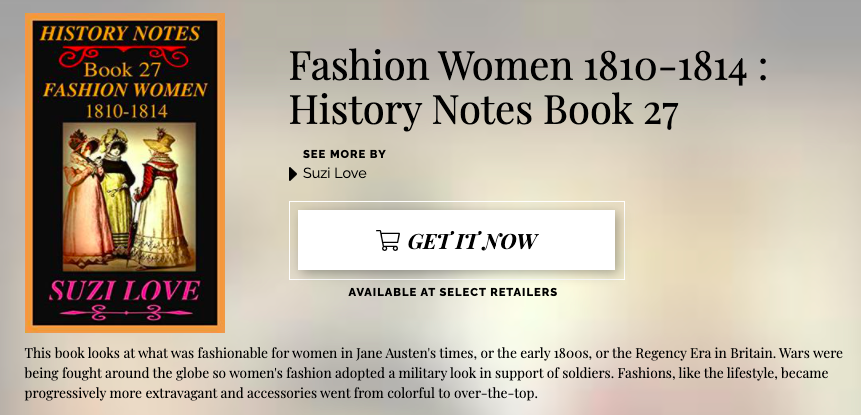
What was fashionable for women in Jane Austen’s times? Mourning, riding, daytime, evening clothing, plus underclothing, corsets and accessories. Fashion Women 1810-1814 History Notes Book 27 This book looks at what was fashionable for women in Jane Austen’s times, or the early 1800s, or the Regency Era in Britain. Wars were being fought around the globe so women’s fashion adopted a military look in support of soldiers. Fashions, like the lifestyle, became progressively more extravagant and accessories went from colorful to over-the-top. https://books2read.com/SuziLoveFashion1810-1814

The Lady’s Magazine said of the basis of women’s fashion that was popular for the first twenty years of the 1800s, ‘White is still the prevailing color for robes. For morning dresses, linen gowns, in large diamonds or squares, are fashionable. Indian muslins, plain or embroidered, are preferred to Florence and satins. The designs of embroidery for shawls are of infinite variety. Long gloves, which reach above the elbow, are not yet laid aside. Medallions are hung around the neck from crossed chains and some of these medallions are shaped like the bags, called ridicules. These reticules are of the lozenge or hexagon shape, with a small tassel at each angle. Reticules, or ridicules, are in lozenge or hexagon shapes with a small tassel at each angle. In capotes, or hats, and ribbands, the violet and dark green prevail over jonquil. Bracelets in hair, pear-shaped ear-rings, medallions on square plates, saltiers of colored stones, are still in fashion.’

HN_27_History Notes book 27 What was fashionable for women in Jane Austen's times? Mourning, riding, daytime, evening clothing, plus underclothing, corsets and accessories. Wars were being fought so women adopted military looks in support of soldiers. https://books2read.com/SuziLoveFashion1810-1814

https://books2read.com/SuziLoveFashion1810-1814
What was fashionable in Bridgerton and Jane Austen times? Mourning, riding, daytime, evening fashion plus corsets and underclothing. #Bridgerton #RegencyFashion #JaneAusten https://books2read.com/SuziLoveFashion1810-1814 Share on X
HN_27_D2D_FashWomen1810-1814

https://books2read.com/SuziLoveFashion1810-1814
27_D2D_FashWomen1810-1814
Posted in 1800s, 1800s women's fashion, art, Australia, bedroom fashion, Canada, cartoon, Coat or Pelisse Or Redingote, Corset, Customs & Manners, dancing, Decorative Item, Dress Or Robe, England, Europe, fashion accessories, France, hats, History, History Notes, Jane Austen, London, Music, Pastimes, peerage, Regency Era, Regency Fashion, Reticule or Bag, riding, Russia, sewing, shoes, Spencer, Suzi Love Books, Suzi Love Images, travel, U.S.A, underclothing, weddings | Tagged 1800s women's fashion, Book 28, Corset, Dress Or Gown, fans, fashion accessories, Fashion Plate, Fashions Of London and Paris, gloves, google books, Hats And Hair, History Notes, Jane Austen, jewelry, Journal des Dames et des Modes, La Belle Assemblee, mourning, parasol, Regency Fashion, reticule or bag, riding, shawls, Shoes, stockings, Suzi Love Books, The Lady's Magazine, The Lady's Monthly Museum, The Repository Of Arts, underclothing

1817 June Lady Reading Wearing Bridgerton Or Jane Austen Style Morning Dress and Marlborough Cap. #Bridgerton #RegencyEra #JaneAusten #HistoricalFashion

Suzi Love Posted on August 7, 2024 by Suzi LoveAugust 3, 2024

1817 June Morning Dress as worn in Bridgerton and Jane Austen’s times in England. A round dress composed of jaconet muslin; the bottom of the skirt is trimmed with an intermixture of tucks and embroidery. The body is perfectly novel, it is a three-quarter height, and displays the whole of the throat and a little of the neck: it is composed of the same material as the dress, and is formed to the shape, in a manner at once singular and becoming, by bands of letting-in lace; it is also profusely ornamented with lace, which is set on very full. Long full sleeve, the fullness confined by a tasteful cuff, which is finished by a lace ruffle. Head-dress the Marlborough cap, composed of white lace, ornamented with full-blown roses and blush colored satin ribbon. For the form of this elegant cap, which is perfectly in the English style, we refer our readers to our print. The hair is parted in front so as to display a little of the forehead, and curled lightly over the temples. Necklace and ear-rings white cornelian mixed with gold. White kid slippers and gloves. We are indebted to the elegant taste of Mrs. Marchant of 40, Gerrard-street, Soho, for both our dresses this month. Fashion Plate via Rudolph Ackermann’s ‘The Repository of Arts’.

Definition Morning or At-Home Dress: Loose and comfortable dress and soft lace cap to be worn at home for reading, painting, sewing or for walking in the garden. To be seen by family, servants and close friends. Not accessorized enough to be out in the wider public, although the pretty pink roses and trim on the cap suggest this outfit may have been worn for receiving visitors at home.

1817 June Morning Dress as worn in Jane Austen's times in England. A round dress composed of jaconet muslin; the bottom of the skirt is trimmed with an intermixture of tucks and embroidery. The body is perfectly novel, it is a three-quarter height, and displays the whole of the throat and a little of the neck: it is composed of the same material as the dress, and is formed to the shape, in a manner at once singular and becoming, by bands of letting-in lace; it is also profusely ornamented with lace, which is set on very full. Long full sleeve, the fullness confined by a tasteful cuff, which is finished by a lace ruffle. Head-dress the Marlborough cap, composed of white lace, ornamented with full-blown roses and blush colored satin ribbon. For the form of this elegant cap, which is perfectly in the English style, we refer our readers to our print. The hair is parted in front so as to display a little of the forehead, and curled lightly over the temples. Necklace and ear-rings white cornelian mixed with gold. White kid slippers and gloves. We are indebted to the elegant taste of Mrs. Marchant of 40, Gerrard-street, Soho, for both our dresses this month. Fashion Plate via Rudolph Ackermann's 'The Repository of Arts'.
https://books2read.com/SuziLoveFashionWomen1815-1819
1817 February Pelisse, or Redingote, English. Carriage dress of white poplin with a deep blond flounce. Blue levantine pelisse or walking dress, or Redingote in France, edged with floss silk, blonde lace neck ruff, ermine ruff and a pink shawl. Fashion Plate via John Belle’s La Belle Assemblée or, Bell’s Court and Fashionable Magazine, London.

1817 June Lady Reading Wearing Bridgerton Or Jane Austen Style Morning Dress and Marlborough Cap. #Bridgerton #RegencyEra #JaneAusten #HistoricalFashion https://books2read.com/SuziLoveFashionWomen1815-1819 Share on X
HN_28_D2D_Fashion Women 1815-1819
https://books2read.com/SuziLoveFashionWomen1815-1819
Fashion Women 1815-1819 History Notes Book 28 What did Jane Austen wear? . D2D_HN_28_https://books2read.com/SuziLoveFashionWomen1815-1819
Posted in 1800s, 1800s women's fashion, Bridgerton, Dress Or Robe, England, fashion accessories, hats, Jane Austen, London, Pastimes, Regency Era, Regency Fashion, sewing, shoes, Suzi Love Images | Tagged 1800s women's fashion, Bridgerton, Dress Or Gown, fashion accessories, Fashion Plate, Hats And Hair, Jane Austen, jewelry, muff, Regency Fashion, sewing, shawls, Shoes, Suzi Love Images, The Repository Of Arts

1815 June Lady Reading Book Wearing Jane Austen Style White Carriage Dress. #RegencyFashion #JaneAusten #HistoricalFashion

Suzi Love Posted on August 5, 2024 by Suzi LoveAugust 3, 2024

1815  June White Carriage Dress, English.  Lady reading a book in a high-waisted white satin Pelisse, or Walking Or Carriage dress in the relaxed Empire style as would have been worn at home in the early 1800s, or during Jane Austen’s time. Richly ornamented with clusters of leaves made in white twilled sarsnet, headed with tull. Open fronts, trimmed to the bottom of the waist with a superb shell trimming of white satin ribbon and tull, loose sleeves trimmed at the wrists. High hat of  white satin and tull with a plume of feathers of the pomona green. Half-boots of similar color. Gloves en suite and a necklace. Lady is viewing paintings and the program in her hand says ‘British Institution’. In this issue of The Repository there is an article called ‘Exhibition of Paintings by the Flemish and Dutch Masters at the British Institution, Pall Mall.’ Fashion Plate via Rudolph Ackermann’s ‘The Repository of Arts’.

1815 June White Carriage Dress, English. Lady reading a book in a high-waisted white dress in the relaxed Empire style, frill on V-neckline, high flowered bonnet.long white gloves and a necklace. Fashion Plate via Rudolph Ackermann's 'The Repository of Arts'.

1815 June White Carriage Dress, English. Lady reading a book in a high-waisted white dress in the relaxed Empire style, frill on V-neckline, high flowered bonnet.long white gloves and a necklace. Fashion Plate via Rudolph Ackermann’s ‘The Repository of Arts’.

1815 June Lady Reading Book Wearing Jane Austen Style White Carriage Dress. #RegencyFashion #JaneAusten #HistoricalFashionhttps://books2read.com/SuziLoveFashionWomen1815-1819 Share on X
HN_28_D2D_Fashion Women 1815-1819
https://books2read.com/SuziLoveFashionWomen1815-1819
Fashion Women 1815-1819 History Notes Book 28 What did Jane Austen wear? . D2D_HN_28_https://books2read.com/SuziLoveFashionWomen1815-1819
Posted in 1800s, 1800s women's fashion, Coat or Pelisse Or Redingote, Dress Or Robe, England, fashion accessories, hats, Jane Austen, London, Pastimes, Regency Era, Regency Fashion, shoes, Suzi Love Images | Tagged 1800s women's fashion, Dress Or Gown, fashion accessories, Fashion Plate, gloves, Hats And Hair, Jane Austen, pastimes, Redingote Or Pelisse Or Coat, Regency Fashion, Shoes, The Repository Of Arts | Leave a reply

1826 ‘Cits’ Dining At The Grand House. From A Regency Gentleman’s Life. #RegencyEra #Cartoon #England

Suzi Love Posted on August 1, 2024 by Suzi LoveJuly 27, 2024
1826  'Cits' Dining At The Grand House. From A Regency Gentleman's Life. #Regency #Cartoon #England
1826 The Cyprian’s Ball At the Argyll Rooms. A Regency Gentleman’s Life. From The English Spy By Robert Cruikshank.
1826 'Cits' Dining At The Grand House. From A Regency Gentleman's Life. #RegencyEra #Cartoon #England https://books2read.com/suziloveYGD Share on X
RL_2_D2D_RetailerBuyLink_RL_2
RL_2_D2D_RetailerBuyLink_RL_2 https://books2read.com/suziloveYGD
Posted in 1800s, 1800s Mens Fashions, 1800s women's fashion, Bridgerton, cartoon, Customs & Manners, Food and Drink, Google Books, household, London, Pastimes, peerage, Regency Era, Regency Fashion, Suzi Love Images | Tagged 1800s men fashion, Cartoons, drinks, England, Food, google books, London, pastimes, Regency Fashion, Regency London, Regency Men

1660-1700 ca. Green Velvet Gaming Purse, Probably French. #Europe #games #Antiques #history

Suzi Love Posted on May 27, 2024 by Suzi LoveMay 26, 2024

1660-1700 ca.  Green Velvet Gaming Purse, Probably French. Trimmed with Copper-Gilt Thread, probably French. This purse was designed especially for gaming, or gambling, and would have held money, or counters, and is of a different design to other 17th-century purses. The base is a flat circle and the sides are gathered on a drawstring to stop money or gaming counters from spilling out, and to hide how much a gambler had in the purse. The bag’s plain look was probably a deliberate move to fool other gamblers into thinking the owner had little money.The purse is quite plain, with no embroidery and only a twist of copper gilt thread, gilt being a cheap substitute for gold or silver thread.

Playing and betting on card games was a socially acceptable pastime for the wealthy in the late 17th century. Along with dancing, riding and the theatre, it was an amusement for those classes that did not have to work. A gentleman or lady who did not participate in games such as ‘Quadrille’ and ‘Basset’ would have been considered ‘low-bred and hardly fit for conversation’ according to ‘The Compleat Gamester’, published in 1674.  Victoria and Albert Museum, London, UK.

1660-1700-ca. Gaming Purse, probably French. Green velvet trimmed with copper gilt thread. Gaming or gambling with cards popular as a 17th Century Pastime and any gentleman or lady.
1660-1700 ca. Green Velvet Gaming Purse, Probably French. #Europe #games #Antiques http://books2read.com/suziloveReticules Share on X
HN_3_D2D_RetailerBuyLink_HN_3 http://books2read.com/suziloveReticules
D2D_RetailerBuyLink_HN_3 http://books2read.com/suziloveReticules
Posted in Europe, France, Pastimes, Reticule or Bag, Suzi Love Images | Tagged France, games, pastimes, reticule or bag, Suzi Love Images, Victoria and Albert Museum

1800 ca. Pair of Flintlock Duelling Pistols Owned by Captain William Waller (active 1794-1807) #Regency #Weapon #JaneAusten #duel

Suzi Love Posted on March 28, 2024 by Suzi LoveMarch 27, 2025

1800 ca. Pair of Flintlock Duelling Pistols. Owned by Captain William Waller (active 1794-1807). Walnut stock, chequered grips, rounded butts, fitted with two silver pipes containing ramrods. Silver trigger guards engraved and end in pineapple shaped finials, each with flintlock containing flints. Lock plates engraved with leaf design, octagonal barrels browned with narrow gold bands near lock. via Royal Museums Greenwich collections.rmg.co.uk

During the Regency Era and Jane Austen’s writing years, dueling was illegal, although secret duels still happened. Courts were made up of peers and they rarely charged another peer for anything illegal. Honor and gentlemanly behavior were the most important things to men so if there was an offense committed, a dawn duel was arranged with seconds to check the weapons used and a doctor in case of injuries.

1800 ca. Pair of Flintlock Duelling Pistols. Owned by Captain William Waller (active 1794-1807). Walnut stock, chequered grips, rounded butts, fitted with two silver pipes containing ramrods. Silver trigger guards engraved and end in pineapple shaped finials, each with flintlock containing flints. Lock plates engraved with leaf design, octagonal barrels browned with narrow gold bands near lock. via Royal Museums Greenwich collections.rmg.co.uk
1800 ca. Pair of Flintlock Duelling Pistols Owned by Captain William Waller (active 1794-1807) #Regency #Weapon #JaneAusten #duel https://books2read.com/suziloveYGD Share on X
RL_2_D2D_RetailerBuyLink_RL_2
RL_2_D2D_RetailerBuyLink_RL_2 https://books2read.com/suziloveYGD
RL_1_D2D_Regency Overview RetailerLinks
https://books2read.com/suziloveROver
RL_1_D2D_Regency Overview RetailerLinks https://books2read.com/suziloveROver
Posted in 1800s, Customs & Manners, England, History, Jane Austen, Pastimes, Regency Era, Suzi Love Images, weapons | Tagged duelling, Jane Austen, London, Pistols, Regency Life, Regency Men, Royal Museums Greenwich, Suzi Love Images, Suzi Love Research, weapons

Post navigation

← Previous Post
Next Post→

SUBSCRIBE TO SUZI LOVE'S NEWSLETTER.

Recent Posts

  • Love Jane Austen? Love the Bridgertons? Reader or writer of early 1800s history? Try this light-hearted look at the early 1800s. #Bridgerton #RegencyEra #nonfiction #JaneAusten
  • 1750-1755 Ca. Writing Cabinet Veneered In Kingwood With Marquetry Of Mother-Of-Pearl, Germany. #GeorgianEra #History #Antiques #Germany
  • Four Times A Virgin: Max makes amends to countess for late grandfather’s wrongs, but will exposing the duke put the countess in danger? #HistoricalMystery #RegencyRomance #EroticRomance #ReadARegency
  • 1800 Jane Austen Style Block Printed Woven Muslin Robe. #JaneAusten #RegencyFashion #HistoricalFashion
  • 19th Century Mid. Dance Card or Aide de Memoire With Timepiece. #RomanticEra #VictorianEra #Dance #writingtool #antique

Recent Comments

  1. Suzi Love on Book Hooks: Bodies don’t walk out of hospitals. #ContemporaryRomance #MedicalRomance #outback
  2. Lisabet Sarai on Book Hooks: Bodies don’t walk out of hospitals. #ContemporaryRomance #MedicalRomance #outback
  3. Suzi Love on Book Hooks: Bodies don’t walk out of hospitals. #ContemporaryRomance #MedicalRomance #outback
  4. Suzi Love on Book Hooks: Bodies don’t walk out of hospitals. #ContemporaryRomance #MedicalRomance #outback
  5. Suzi Love on Book Hooks: Bodies don’t walk out of hospitals. #ContemporaryRomance #MedicalRomance #outback

Login

  • Log in

Archives

  • March 2026
  • February 2026
  • January 2026
  • December 2025
  • November 2025
  • October 2025
  • September 2025
  • August 2025
  • July 2025
  • June 2025
  • May 2025
  • April 2025
  • March 2025
  • February 2025
  • January 2025
  • December 2024
  • November 2024
  • October 2024
  • September 2024
  • August 2024
  • July 2024
  • June 2024
  • May 2024
  • April 2024
  • March 2024
  • February 2024
  • January 2024
  • November 2023
  • October 2023
  • September 2023
  • August 2023
  • July 2023
  • June 2023
  • May 2023
  • April 2023
  • March 2023
  • February 2023
  • June 2022
  • April 2022
  • March 2022

Categories

  • 1700s
  • 1700s Mens fashion
  • 1700s Womens Fashion
  • 1800s
  • 1800s Mens Fashions
  • 1800s women's fashion
  • 1900s
  • art
  • Australia
  • Bath
  • bedroom fashion
  • Book Hooks
  • Box Or Container
  • Bridgerton
  • Bus Trips
  • Canada
  • Carriage
  • cartoon
  • Celebrity
  • Chatelaine
  • children
  • Children
  • Christmas
  • Coat or Pelisse Or Redingote
  • Contemporary
  • Corset
  • Couple
  • Customs & Manners
  • dancing
  • December Scandal
  • Decorative Item
  • Dress Or Robe
  • Easter
  • Edwardian Era
  • Embracing Scandal
  • England
  • Europe
  • Events
  • Fashion
  • fashion accessories
  • Food and Drink
  • Four Times A Virgin
  • France
  • furniture
  • Georgian Era
  • Georgian Fashion
  • Google Books
  • Grand Tour
  • hats
  • History
  • History Notes
  • History Of Christmases Past
  • household
  • Irresistible Aristocrats
  • Jane Austen
  • Keanu Reeves
  • Kellys Justice
  • Legal
  • London
  • Love After Waterloo
  • Loving Lady Katharine
  • medical
  • military
  • money
  • mourning
  • Music
  • Outback Arrival
  • pants
  • Pastimes
  • peerage
  • People
  • Petunia and Pearl Diver
  • Places
  • Pleasure House Ball
  • postal
  • Queensland
  • Quotations
  • Regency Era
  • Regency Fashion
  • Regency Life Series
  • Reticule or Bag
  • riding
  • Romantic Era
  • Royalty
  • Russia
  • Scandalous Siblings Series
  • Scenting Scandal
  • Self Publishing
  • sewing
  • Shirt
  • shoes
  • South Pacific
  • Spencer
  • sports
  • Suit
  • Sunday Snippet
  • Suzi Love
  • Suzi Love Books
  • Suzi Love Images
  • Suzi Love Writing
  • Swain Cove
  • THe Viscount's Pleasure House
  • travel
  • U.S.A
  • underclothing
  • Vest or Waistcoat
  • Victorian Era
  • Victorian Fashion
  • weapons
  • weddings
  • Writing Tools

1800s men fashion 1800s women's fashion antiques Bridgerton British history Cartoons Corset cravat Dress Or Gown England europe fashion accessories Fashion Plate France Georgian era Georgian Fashion gloves google books Hats And Hair historical romance History Notes household Jane Austen jewelry Journal des Dames et des Modes London Metropolitan Museum NYC pants Redingote Or Pelisse Or Coat Regency Era Regency Fashion Regency London Regency Men reticule or bag riding sewing shawls Shoes Suzi Love Books Suzi Love Images Tailcoat The Repository Of Arts underclothing Vest or Waistcoat Writing Tools

©2026 - Suzi Love - Weaver Xtreme Theme Privacy Policy
↑