What did an older lady do and wear in the Regency Era? Information & pictures for readers and writers of early 1800s history, nonfiction and fiction. books2read.com/suziloveOLD
The older lady’s day usually started with her toilette in her bedroom, where her maid helped her dress for the day and styled her hair. After that, she would join her family downstairs for breakfast unless she preferred a tray with either tea or hot chocolate in her bedroom as she prepared for her busy day. Her day would be made up of speaking with the housekeeper and the cook about the week’s menus, assuring that the servants were all available that day and no one was ill, and checking the list of foods needed. She would also enquire if the laundry was up to date and that they had enough good linen to make up all the beds before extended family members and guests arrived. If she was in the country and hosting a weekend house party, she would assign rooms to the guests on her lists and query that all was in readiness for their arrival.
Love the Bridgerton family and Jane Austen? Reader Or Writer of Regency Era stories? Mourning and riding fashion, dresses, hats, shoes, reticules or bags, underclothing and fashion accessories. books2read.com/SuziLoveFashionWomen1815-1819
History Notes 28 Fashion Women 1815-1819: This book looks at what was fashionable for women in the Georgian Era and at the end of the Regency Era in Britain and the reconstruction in Europe after the wars. Lifestyles were freer and fashions expressed this by becoming the focus of most women’s lives. A wardrobe full of opulent accessories was requisite. Includes mourning and riding fashion, dresses, hats, shoes, reticules or bags, underclothing, and fashion accessories.
Have you read Suzi Love’s Books? Romance, Mystery, Military and History. Regency, historical and contemporary romance. Plus non-fiction history and writing.
The Viscount’s Pleasure House Book 1 Irresistible Aristocrats Disenchanted Viscount tutoring three Regency Ladies. What could go wrong? #Regency Erotic https://books2read.com/suziloveTVPH
Four Times A Virgin Book 2 Irresistible Aristocrats: The countess will do anything to prevent her younger sisters being forced into sordid marriages like hers, even if it means joining forces with the Duke of Stirkton and revealing the horrors of their intertwined pasts. books2read.com/suziloveFTAV
Pleasure House Ball Book 3 Irresistible Aristocrats: Lord Mallory attends his first courtesan’s ball in ten years to appease his concerned friends, though he’d rather stay home and read to his motherless daughters. Though mortified that Brenton unmasks her at a scandalous ball, Lady Lillian Armstrong doesn’t regret their night together. books2read.com/suzilovePHB
Petunia and the Pearl Diver Book 4 Irresistible Aristocrats Series: The pearl diver needs a working girl to rouse his body. Petunia needs money to save her family. A night at a London brothel could be the solution to both problems. But walking away is impossible when one night leaves them craving more…and more. https://books2read.com/suzilovePetPD
Loving Lady Katharine Book 5 Irresistible Atistocrats: When Lady Katharine Montgomery flees London after her scandalous husband was murdered, the Pacific islands of the New Hebrides (Vanuatu) become her haven. Her life changes when Lord Alexander St. John, British ship’s captain and trader, sails into Port Vila. https://books2read.com/suzi
Embracing Scandal Book 1 Scandalous Siblings: Lady Rebecca Jamison saves her family from financial ruin by investing in railways, but when a greedy syndicate murders her friend, Becca is forced to beg assistance from Cayle St. Martin, the new Duke of Sherwyn. https://books2read.com/suziloveES
Scenting Scandal Book 2 Scandalous Siblings Series: Richard, Earl of Winchester, may not know it yet, but he’s Lady Laura Jamison’s perfect match. Lady Laura Jamison believes her extraordinary olfactory senses will sniff out her perfect match, but will Richard prove her theory wrong? https://books2read.com/suziloveSS
December Scandal Book 3 Scandalous Siblings: The Jamison family joins the Duke of Sherwyn and the St. Martin clan at the duke’s country estate, but guest numbers double when early December snowfalls make roads impassable. #HistoricalRomance https://books2read.com/suziloveDS
Love After Waterloo: When Lady Melton and son join antagonistic Captain Belling and the last group of wounded British soldiers evacuating Waterloo, she anticipates hardship and trouble with deserters. Not her relationship with a belligerent Captain. #RegencyRomance #military books2read.com/suziloveLAW
Self Publishing: Absolute Beginner’s Guide. Information, contacts, and checklists steer you towards professionally produced books. Helps both fiction and non-fiction authors and available in digital and paperback. Co-Authored by two Australians: multi-published Imogene Nix and best-selling and award winning Suzi Love. http://books2read.com/selfpublishing
History Notes Books 1-28: Do you need more factual and visual information for your historical fiction? Non-fiction Series: Fashion, music and social manners in the 18th and 19th centuries books2read.com/suziloveFashWomen1700s
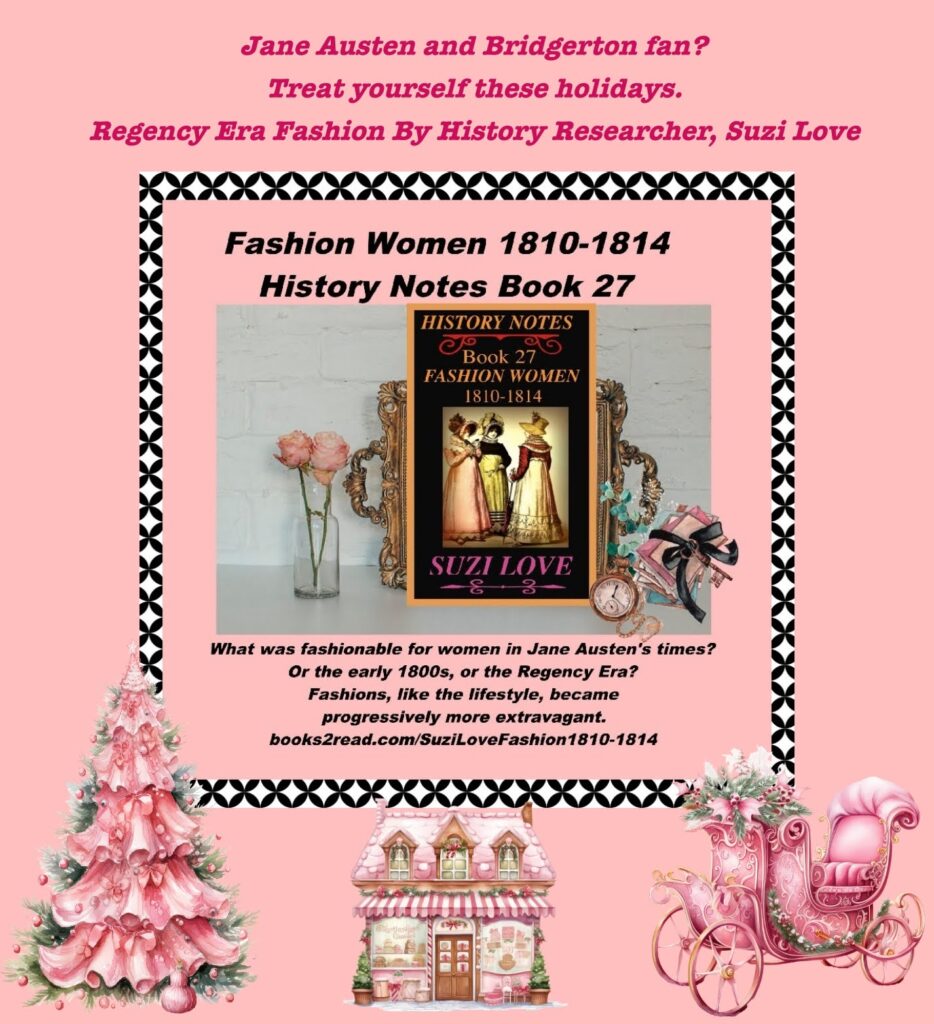
What was fashionable for women in Jane Austen’s times? Mourning, riding, daytime, evening clothing, plus underclothing, corsets and accessories. Fashion Women 1810-1814 History Notes Book 27 This book looks at what was fashionable for women in Jane Austen’s times, or the early 1800s, or the Regency Era in Britain. Wars were being fought around the globe so women’s fashion adopted a military look in support of soldiers. Fashions, like the lifestyle, became progressively more extravagant and accessories went from colorful to over-the-top. https://books2read.com/SuziLoveFashion1810-1814
The Lady’s Magazine said of the basis of women’s fashion that was popular for the first twenty years of the 1800s, ‘White is still the prevailing color for robes. For morning dresses, linen gowns, in large diamonds or squares, are fashionable. Indian muslins, plain or embroidered, are preferred to Florence and satins. The designs of embroidery for shawls are of infinite variety. Long gloves, which reach above the elbow, are not yet laid aside. Medallions are hung around the neck from crossed chains and some of these medallions are shaped like the bags, called ridicules. These reticules are of the lozenge or hexagon shape, with a small tassel at each angle. Reticules, or ridicules, are in lozenge or hexagon shapes with a small tassel at each angle. In capotes, or hats, and ribbands, the violet and dark green prevail over jonquil. Bracelets in hair, pear-shaped ear-rings, medallions on square plates, saltiers of colored stones, are still in fashion.’
“Bells are musics laughter.” By Thomas Hood (1799-1845), British poet and humorist.
Bells hold a long time association with Christmas. In Victorian times, carol singers used small handbells to play the tune of the carol. Sometimes there were bells without singing – Church bells are rung after sunset to signal the start of the Christmas Eve service, the first of Christmas. In England, the bellman goes round at midnight ringing his bell, and rattling off a stanza or two, for the gratuity which he confidently anticipates; while watchmen, firemen, rate-collectors, postmen, chimney-sweeps, street scavengers, the errand-boys of your baker, butcher, poultry merchant, and green-grocer, even to the hired singers in the churches all expect their Christmas-box. In Victorian times, carol singers used small hand bells to play the tune of the carol and sometimes there were bells without singing. Church bells are rung after sunset to signal the start of the Christmas Eve service, the first of Christmas.
The Bellman
The Bellman stands full face, shouting with wide-open mouth and ringing his hand-bell.
In his left hand he holds out his verses headed by a little figure of Napoleon wearing a huge tricorne and holding a gigantic sword:
‘This little Boney-says he’ll come At merry Christmas time,
But that I say is all a hum Or I no more will rhyme
Some say in Wooden house he’ll glide, Some say in air Balloon,
E’en those who airy schemes deride. Agree his coming soon.
Now honest people list to me, Though Income is but small, I’ll bet my Wig, to one Penney, He does not come at all.’ Hand-colored etching and aquatint.
How did they celebrate Christmas in Bridgerton and Jane Austen times? Historical information about the traditions of Christmas through the centuries, including the religious aspects, decorations, games, food and plays. History Of Christmases Past has lots of information and images about Christmas through the centuries, including religious aspects, decorations, games, food and plays. Historic images show how some traditions have changed while many have remained the same through the centuries. books2read.com/suziloveHOCP
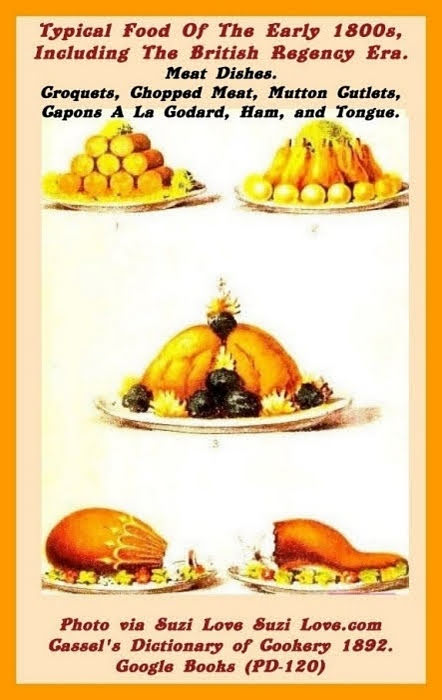
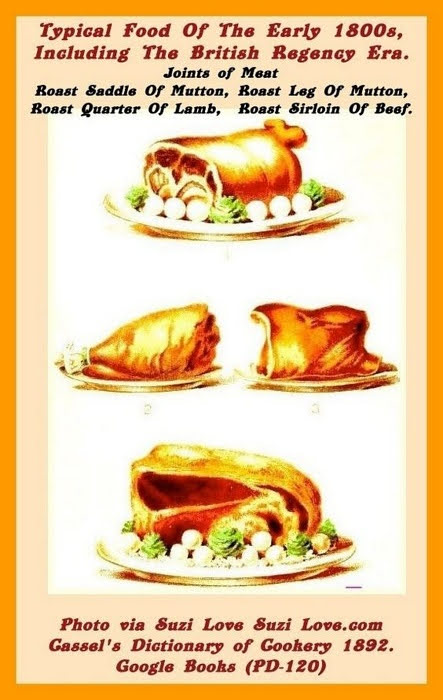
Christmas: Typical Christmas Food Eaten By the Bridgerton and Jane Austen Families. #Christmas #Food #JaneAusten #Bridgerton
On the Christmas menu was generally mince pies and perhaps a goose or a piece of beef, depending on the family’s wealth and status. Mince pies were not made of fruit mince as we do now, but of offal or meat such as bullock’s tongue cooked with spices, orange peel, and wine and then used to fill pastry cases.
Another Christmas specialty was a Yorkshire Christmas pie which would be filled with turkey, goose, a hen, or perhaps woodcocks, partridge, or pigeons. And after the main courses, came the Plum Pudding, mixed on Stir-Up Sunday according to each family’s recipe and then boiled in a cloth.
Angels – Heralds for the news of the birth of a baby in a manger.
Bells – Bells have rung out for all important events for centuries, plus lost sheep are found by the sound of the bell.
Candy Cane – Symbolizes the crook of the shepherds who visited Christ. Red represents the blood that was spilled and white is for purity. The peppermint oil that flavors is known for its strong healing properties.
Cards – Produced in Britain in 1843 to be sent with love to family and friends around the world by the new Postal services.
Carols – Poems and stories of worship made into songs.
Carolers – Groups of people who strolled the streets singing Christmas songs
Feasting – To celebrate the joy of the baby’s arrival on the 25th December.
Gift Giving – The Wise Men bowed before the baby and gave him gold, frankincense and myrrh.
Gold – Decorating using the color of one of the gifts of the wise men.
Green – Decorating using the color of evergreens which show everlasting love.
Holly – Represents Eternal Life and the crown of thorns worn by Jesus.
Mistletoe: In the 18th Century, men kissed a woman who stood under mistletoe to show love, friendship and goodwill. If a woman was un-kissed, she would (supposedly) never marry.
Nativity: The birth of Jesus Christ
Poinsettia – Red flowers used in countries such as Mexico to symbolize Christmas time.
Stockings – Hung by children to receive gifts
Twelve Days of Christmas: Twelve days between the birth of Christ on December 25 and the coming of the Magi on January 6, the Epiphany.
Tree – Evergreen tree symbolizes eternal life and love
Wreath – Made of evergreens to symbolize never ending love
Our modern Christmas tree tradition probably began in Germany in the 18th century, though some argue that Martin Luther began the tradition in the 16th century. An evergreen fir tree was used to celebrate winter festivals (pagan and Christian) for thousands of years. Nobody is really sure when Fir trees were first used as Christmas trees but it probably began 1000 years ago in Northern Europe. Many early Christmas Trees seem to have been hung upside down from the ceiling using chains.
The English phrase “Christmas tree”, first recorded in 1835, came from the German words Tannenbaum (fir tree) or Weinachtenbaum (Christmas tree). The Christmas tree is often explained as a Christianization of pagan tradition and ritual surrounding the Winter Solstice, which included the use of evergreen boughs, and an adaptation of pagan tree worship. At first, a figure of the Baby Jesus was put on the top of the tree. Over time it changed to an angel or fairy that told the shepherds about Jesus, or a star like the Wisemen saw.
Christian tradition associates the holly tree with the crown of thorns, and says that its leaves were white until stained red by the blood of Christ. Along with a Christmas tree, the interior of homes were decorated with plants, garlands, and evergreen foliage and in Victorian times, Christmas trees were decorated with candles to represent stars.
The early Germans conceived of the world as a great tree whose roots were hidden deep under the earth, but whose top, flourishing in the midst of Walhalla, the old German paradise, nourished the she-goat upon whose milk fallen heroes restored themselves. Yggdnafil was the name of this tree, and its memory was still green long after Christianity had been introduced into Germany, when much of its symbolic character was transferred to the Christmas-tree. At first fitted up during the Twelve Nights in honor of Berchta, the goddess of spring, it was subsequently transferred to the birthday of Christ, who, as the God-man, is become the “resurrection and the life.”
Queen Victoria saw a Christmas tree as a girl in 1832. The little princess wrote excitedly in her diary that her Aunt Sophia had set up two “trees hung with lights and sugar ornaments. All the presents being placed around the tree.” In 1841, Prince Albert, Queen Victoria’s German husband, arranged for a fir tree to be brought from Germany and decorated. By 1850, Victoria and Albert had Christmas trees erected in the British Royal Palaces and their children started the tradition of gathering around the tree.
‘The Christmas-tree is doubtless of German origin. Though in its present form it is comparatively of recent date, yet its pagan prototype enjoyed a very high antiquity.’ From 1873 Harper’s Bazaar, America.
A print of the royal family gathered about the Christmas tree at Windsor Castle appeared in the Illustrated London News in 1848, then in Godey’s Lady’s Book in 1850, and was reprinted again ten years later. The six-foot fir sits on a table, each tier laden with a dozen or more lighted wax tapers. An angel with outstretched arms poses at the top. Gilt gingerbread ornaments and tiny baskets filled with sweets hang by ribbons from the branches. Clustered around the base of the tree are dolls and soldiers and toys.
Christmas trees did exist in America before Queen Victoria made them famous, but mainly only amongst migrant groups from Europe. The writer of an 1825 article in The Saturday Evening Post mentions seeing trees in the windows of many houses in Philadelphia, a city with a large German population. He wrote, Their “green boughs laden with fruit, richer than the golden apples of the Hesperides, or the sparkling diamonds that clustered on the branches in the wonderful cave of Aladdin.” Gilded apples and nuts hung from the branches as did marzipan ornaments, sugar cakes, miniature mince pies, spicy cookies cut from molds in the shape of stars, birds, fish, butterflies, and flowers. A woman visiting German friends in Boston in 1832 wrote about their unusual tree hung with gilded eggshell cups filled with candies.
Not until the mid-nineteenth century did Christmas trees start spreading to homes with no known German connection. But once Queen Victoria approved of the custom of a Christmas tree, the practice spread throughout England and America and, to a lesser extent, to other parts of the world, through magazine pictures and articles. Upper-class Victorian Englishmen loved to imitate the royal family, and other nations copied the custom. Late in the century, larger floor-to-ceiling trees replaced the tabletop size.
19th Century Typical Meals and Table Settings for the Family and For Guests. This is typical of the food that would have been served at Jane Austen’s meal times. Historic food from 1860s Mrs. Beeton’s Household Management.
1800spical Modern Table Settings.1800s Typical China For Serving Dinner and Dessert. Dinner Plates, Soup Tureen, Covered Cheese Dish, Jug, Dessert plates and Serving Dish. From: 1860s Mrs. Beeton’s Book of Household Management. via Google Books (PD-150)RL_5_D2D_RetailerBuyLink_RL_5_
https://books2read.com/suziloveOLD