↓
 

Suzi Love

Making history fun, one year at a time.

Header_
  • Home
  • Newsletter
  • Pre order form
  • Shop
    • Cart
    • Checkout
    • My account
    • Refund and Returns Policy
  • Blog
  • BOOKS
    • History Events
    • Kelly’s Justice
    • Outback Arrival
    • Irresistible Aristocrats
    • History Notes
    • Scandalous Siblings
    • Love After Waterloo
    • Regency Life Series
  • Privacy Policy
  • EVENTS
Home » People » Bridgerton » Page 13 << 1 2 … 11 12 13 14 15 … 24 25 >>

Category Archives: Bridgerton

Post navigation

← Previous Post
Next Post→

1815 Black Wool Tailcoat As Worn By the Men in the Families of Jane Austen and the Bridgertons. Bridgerton #RegencyFashion #JaneAusten #BritishHistory

Suzi Love Posted on May 29, 2026 by Suzi LoveApril 10, 2026

1815 ca. Tailcoat, Probably British. Black wool, silk cotton and wood. Double-breasted, cutaway at the front waist, notched collar, straight sleeves, pleat falling from the back waist. via Metropolitan Museum, N.Y.C., U.S.A. As Worn By the Men in the Families of Jane Austen and the Bridgertons. #Regency #JaneAusten #Fashion #BritishHistory

Tailcoat: A Regency Era, or early 1800s, gentleman was outfitted in more practical fabrics, such as wool, cotton and buckskin rather than the fussy brocades and silks of the late 1700s. The men in Jane Austen’s life would have worn a black tailcoat like this for everyday wear. https://books2read.com/SuziLoveFashionMen1800-1819

1815 ca. Tailcoat, Probably British. Black wool, silk cotton and wood. Double-breasted, cutaway at the front waist, notched collar, straight sleeves, pleat falling from the back waist. via Metropolitan Museum, N.Y.C., U.S.A.
HN_23_D2D_Fashion Men 1800-1819
https://books2read.com/SuziLoveFashionMen1800-1819
Posted in 1800s, 1800s Mens Fashions, Bridgerton, Coat or Pelisse Or Redingote, England, Jane Austen, London, Regency Era, Regency Fashion, Suzi Love Images | Tagged 1800s men fashion, Bridgerton, England, Jane Austen, Metropolitan Museum NYC, Redingote Or Pelisse Or Coat, Regency Fashion, Regency Men, Tailcoat
food_1800s-typical-food-served-regency-history-_sml

1815 Typical English Dinner In Jane Austen and Bridgerton Times. Two Courses and Desert. #RegencyEra #JaneAusten #Food #History

Suzi Love Posted on May 21, 2026 by Suzi LoveApril 1, 2026

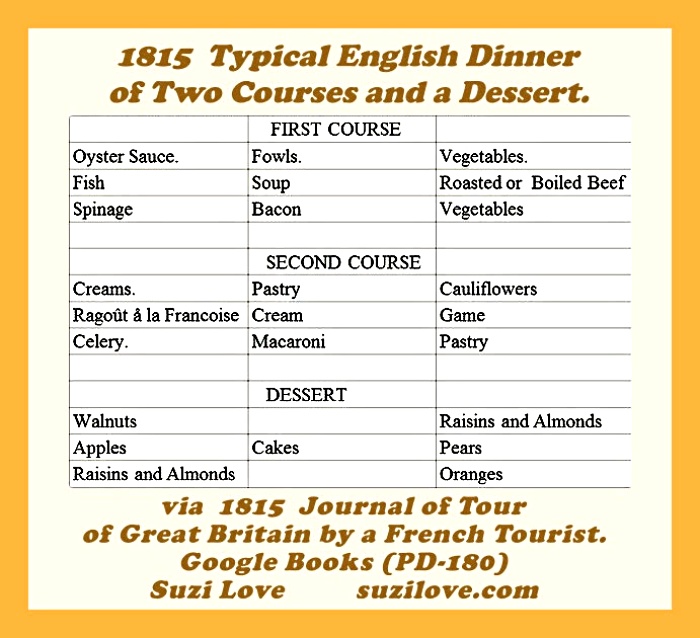
1815 Typical English Dinner In Jane Austen and Bridgerton Times. Two Courses and a Desert. From- 1815 Journal of Tour of Great Britain by a French Tourist via Google Books (PD-180)

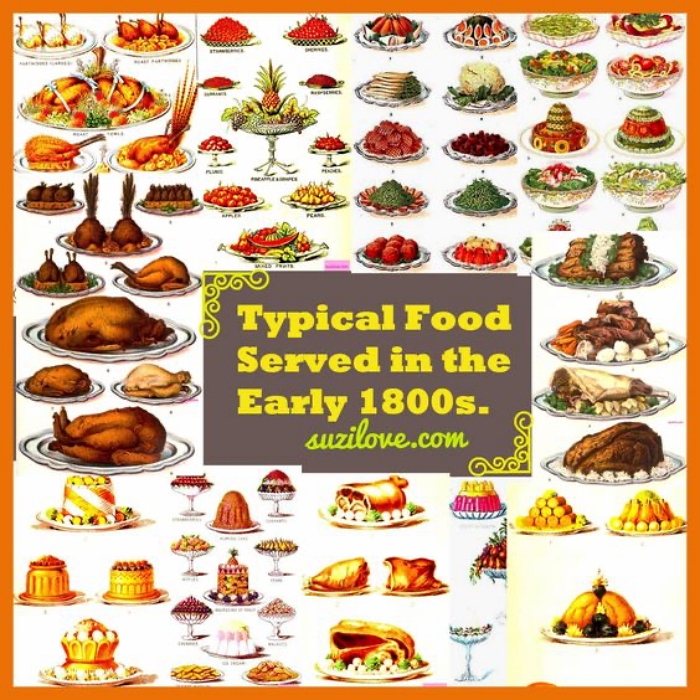
Typical food served during the early 1800s, or Regency Era. ‘Removes‘ were the dishes removed from the table during a meal, usually the soup and fish, and then replaced by other dishes. After all diners have had a chance to eat all the dishes on the table, the table is cleared and another set of dishes put on the table. This is the second course.

1815_TypicalEnglish-dinneroftwo-courses-and-a-desert.-from-1815-journal-of-tour-of-great-britain-by-a-french-tourist_sml
RL_5_D2D_RetailerBuyLink_RL_5_2
https://books2read.com/suziloveOLD
Posted in 1800s, Bridgerton, Food and Drink, Google Books, Jane Austen | Tagged Bridgerton, drink, Food, France, google books, household, Jane Austen, Regency Era, trave;

Why Did Women Wear Chatelaines Dangling From Chains In Bridgerton and Jane Austen’s Times? Women carried essential items on them. #Bridgerton #JaneAusten #RegencyFashion #GeorgianFashion #VictorianFashion

Suzi Love Posted on May 21, 2026 by Suzi LoveMay 15, 2026

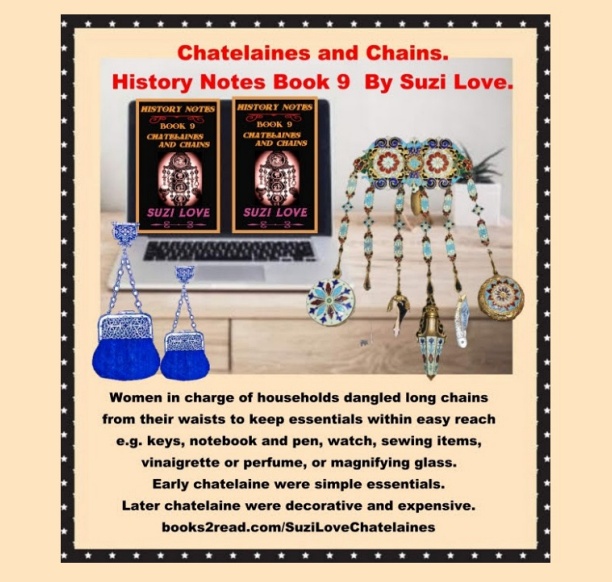
Jane Austen’s and the Bridgerton ladies personal necessities, keys, or chatelaines was a set of useful items hung from waist by decorative chain. Chatelaines and Chains. History Notes Book 9 By Suzi Love. Women in charge of households dangled long chains from their waists to keep essentials within easy reach e.g. keys, notebook and pen, watch, sewing items, vinaigrette or perfume, or magnifying glass. Early chatelaine were simple essentials. Later chatelaine were decorative and expensive.  http://books2read.com/SuziLoveChatelaines

Definition Chatelaine: The word Chatelaine is French and means the keeper of the keys. Chatelaine” derives from the Latin word for castle. In Medieval times, the chatelaine was in charge of the day-to-day running of the castle. Women in charge of households dangled long chains from their waists to keep essentials within easy reach e.g. keys, notebook and pen, watch, sewing items, vinaigrette or perfume, or magnifying glass. Early chatelaine were simple essentials. Later chatelaine were decorative and expensive. books2read.com/SuziLoveChatelaines

What did a chatelaine do? Most important task was keeper of the keys. Also ordered supplies, did bookkeeping, supervised servants, taught castle children, and organized guests.

hat were chatelaines used for?

  • Castle keepers needed keys safe, yet easily accessible.
  • By 1700’s, a metal jeweled ornament hung from pockets, attached to belts, or by hooks into skirt waistbands
  • During 1800’s, women wore large collections of tools hung from chains
  • Young girls sewed and did needlework and needed to carry sewing notions eg scissors, thimbles
  • Worn by women of all classes, from workers to nobility
  • Varied depending on class and finances.
  • Made of silver, brass, steel, leather, or fabric
  • During 19th century, fashionable dresses often had no waist and nowhere to hang chatelaines
  • Chatelaines became decorative brooches
  • Often given as a wedding present from a husband to bride
  • Later became fashion accessories
D2D_RetailerBuyLink_HN_9
books2read.com/SuziLoveChatelaines
D2D_RetailerBuyLink_HN_9. Chatelaines and Chains History Notes Book 9 books2read.com/SuziLoveChatelaines

Posted in 1700s, 1700s Womens Fashion, 1800s, 1800s women's fashion, 1900s, Australia, Box Or Container, Bridgerton, Chatelaine, Decorative Item, Edwardian Era, England, Europe, fashion accessories, Georgian Era, Georgian Fashion, History Notes, household, Jane Austen, money, Regency Era, Regency Fashion, Romantic Era, sewing, Suzi Love Books, Suzi Love Images, travel, U.S.A, Victorian Era, Writing Tools | Tagged 1700s Women's Fashion, 1800s women's fashion, Book 9, Bridgerton, chatelaines, decorative, Edwardian Era, England, fashion accessories, Fashion Plate, History Notes, Jane Austen, Regency Fashion, Romantic Era Fashion, sewing, Suzi Love Books, travel, Victorian fashion, Writing Tools

19th Century Food For The Upper Classes In Bridgerton and Jane Austen Times. #Bridgerton #JaneAusten #RegencyEra #HistoricalFood

Suzi Love Posted on May 19, 2026 by Suzi LoveApril 1, 2026

19th Century Food For The Upper Classes In Bridgerton and Jane Austen Times.

Typical Meals Served for the upper classes in the Georgian and Regency Eras. For the Upper classes in the 18th and through to the end of the 19th century, meals were elaborate affairs.  and served by well-trained staff anticipated their every need. Women prided themselves on hosting dinners for 50-60 people which often consisted of numerous courses, and all served with the best wines and followed, for the men at least, by expensive port. 

An older lady usually controlled the servants and the serving of meals. For more about this, take a look at Older Lady’s Day Regency Life Series Book 5 by Suzi Love. Overview of what an older lady did, wore, and how she lived in the early 19th Century. Information for history buffs and pictures for readers and writers of historical fiction. books2read.com/suziloveOLD

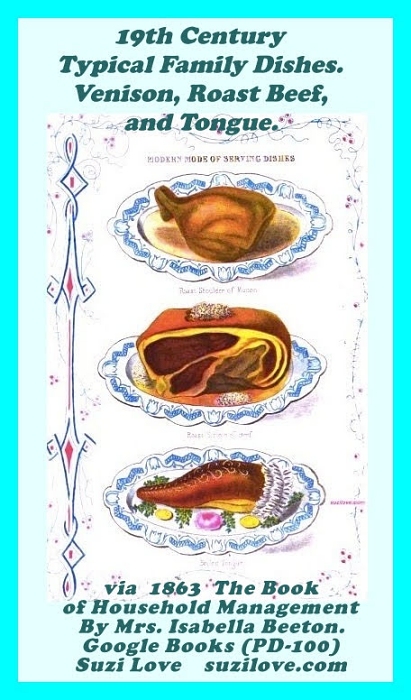
food_19th Century Typical Family Dishes. Venison, Roast Beef, and Tongue. via 1863 The Book of Household Management By Mrs. Isabella Beeton. Google Books (PD-100)
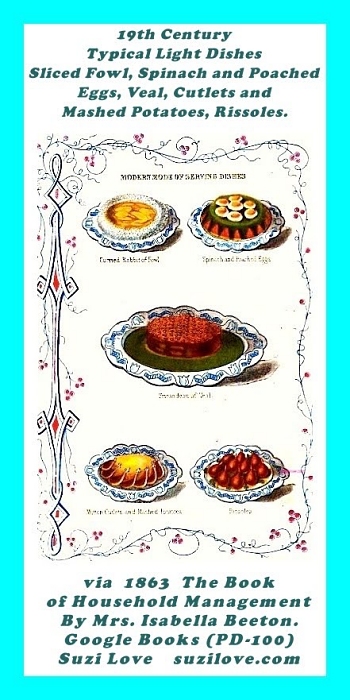
food_19th Century Typical Light Dishes. Sliced Fowl, Spinach and Poached eggs, Veal, cutlets and Mashed Potatoes, Rissoles. via 1863 The Book of Household Management By Mrs. Isabella Beeton. Google Books (PD-100)
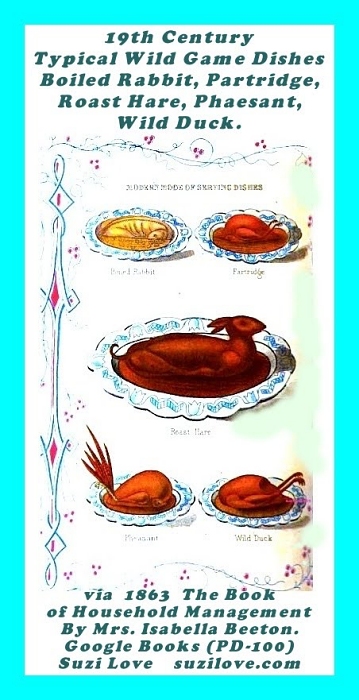
food_ 19th Century Typical Wild Game Dishes. Boiled rabbit, Partridge, Roast Hare, Pheasant, Wild Duck. via 1863 The Book of Household Management By Mrs. Isabella Beeton. Google Books (PD-100)
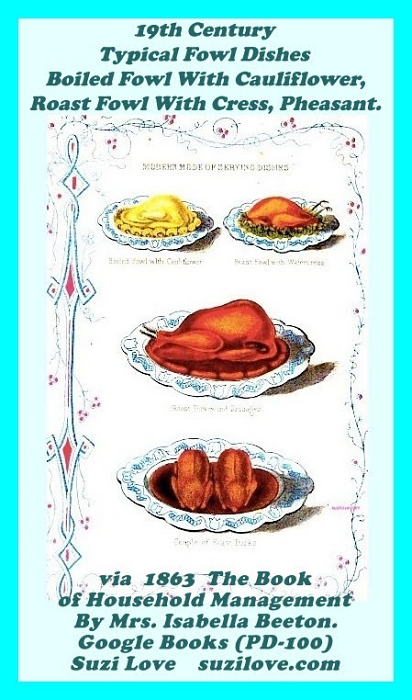
food_1800s Typical Fowl Dishes Served during the Regency years. Boiled Fowl With Cauliflower,Roast Fowl With Cress via 1863 The Book of Household Management By Mrs. Isabella Beeton. Google Books (PD-100)
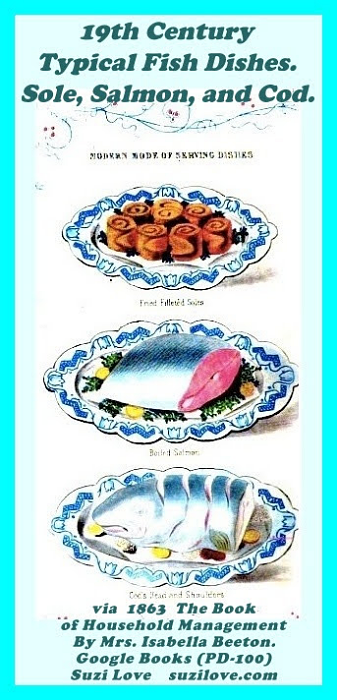
food_1800s Typical Fish Dishes Served Sole, Salmon, and Cod. via 1863 The Book of Household Management By Mrs. Isabella Beeton. Google Books (PD-100)
food_1800s Typical Meat Dishes Served via 1863 The Book of Household Management By Mrs. Isabella Beeton. Google Books (PD-100)
food_1800s Typical Modern Table Settings via 1863 The Book of Household Management By Mrs. Isabella Beeton. Google Books (PD-100)
food_1800s TypicalTable Setting 'A La Russe' (Russian style) via 1863 The Book of Household Management By Mrs. Isabella Beeton. Google Books (PD-100)

RL_5_D2D_RetailerBuyLink_RL_5_2
https://books2read.com/suziloveOLD
Posted in 1800s, Bath, Bridgerton, England, Food and Drink, History, household, Jane Austen, London, Regency Era, Romantic Era, Suzi Love Images, Victorian Era | Tagged Bridgerton, drinks, Food, google books, Jane Austen, Quotations, Regency Era, Regency Life Series, Romantic Era, Suzi Love Images, Victorian Era

1790-1820 ca. Embroidered Fichus, Or Shoulder Shawls, as worn in Bridgerton and Jane Austen times. #Bridgerton #RegencyFashion #JaneAusten

Suzi Love Posted on May 11, 2026 by Suzi LoveMay 11, 2026

1790-1820 ca. Fichus, Or Shoulder Shawls. Short and Long. Embroidered Cream Net Fichus as worn by ladies in the times of Jane Austen. via Whitaker Auction whitakerauction.smugmug.com

Definition Fichu: Triangular piece of lace, muslin, or other cloth worn about the neck and cleavage to fill in a low bodice or neckline and preserve a lady’s modesty. From the French ‘thrown over’. The Bridgerton family and Jane Austen and her female family and friends would have worn a Fichu over a light muslin dress for both warmth and modesty.

1790-1820 ca. Embroidered Cream Net Fichus, Or Shoulder Shawls. #Regency #Fashion
HN_25_D2D_fashwomen1801-1804
https://books2read.com/SuziLoveFashionWomen1801-1804
HN_25_D2D_fashwomen1801-1804 https://books2read.com/SuziLoveFashionWomen1801-1804

Posted in 1700s Womens Fashion, 1800s women's fashion, Bridgerton, England, Europe, fashion accessories, Georgian Fashion, Jane Austen, Regency Era, Regency Fashion, Suzi Love Images | Tagged 1800s women's fashion, Bridgerton, fashion accessories, fichu, Georgian Fashion, Jane Austen, Regency Fashion, sewing, Whitaker Auctions

18th Century Late – 19th Century Early Gloves as worn by women in Jane Austen’s and Bridgerton’s years. #janeausten #bridgerton #regencyfashion

Suzi Love Posted on May 11, 2026 by Suzi LoveFebruary 27, 2026

18th Century Late – 19th Century Early Gloves as worn by women in Jane Austen’s and Bridgerton’s years, French. Silk embroidered with silk. via Museum of Fine Arts, Boston. mfa.org

18th Century Late - 19th Century Early Gloves as worn by women in Jane Austen's and Bridgerton's years, French. Silk embroidered with silk. via Museum of Fine Arts, Boston. mfa.org
HN_25_D2D_fashwomen1801-1804
https://books2read.com/SuziLoveFashionWomen1801-1804
HN_25_D2D_fashwomen1801-1804 https://books2read.com/SuziLoveFashionWomen1801-1804

Posted in 1700s Womens Fashion, 1800s, 1800s women's fashion, Bridgerton, fashion accessories, France, Georgian Fashion, Jane Austen, Regency Era, Regency Fashion | Tagged 1700s Women's Fashion, 1800s women's fashion, Bridgerton, fashion accessories, Georgian Fashion, gloves, Jane Austen, Museum Of Fine Arts, Regency Fashion
shoes_19th Century Early. Flat Slippers, American. Gray silk with long ankle ties. via Metropolitan Museum New York City, U.S.A.

What shoes did the Bridgertons and Jane Austen wear? Gray Slippers, American, with long ankle ties. #JaneAusten #Bridgerton #shoes #regencyfashion

Suzi Love Posted on May 7, 2026 by Suzi LoveMay 6, 2026

What shoes did the Bridgertons and Jane Austen wear? Gray Slippers, American, with long ankle ties.

Typical Regency Era women’s footwear as worn by Jane Austen and her contemporaries and by the Bridgerton family were shoes that had low heels, slightly rounded toes, embellished with a bow and with ribbon ties for the ankles. Shoe styles and shapes were generally very plain but then shoes began to be made in bright colors to match the colorful Empire style, or high-waisted, gowns. Plus, as gowns were lighter and floatier, glimpses could be had of these new pretty shoes. Ribbons, rosettes and other decorative. embellishments allowed ladies to personalize shoes.

shoes_19th Century Early. Flat Slippers, American. Gray silk with long ankle ties. via Metropolitan Museum New York City, U.S.A.
HN_25_D2D_fashwomen1801-1804
https://books2read.com/SuziLoveFashionWomen1801-1804
HN_25_D2D_fashwomen1801-1804 https://books2read.com/SuziLoveFashionWomen1801-1804

Posted in 1800s, 1800s women's fashion, Bridgerton, Jane Austen, Regency Era, Regency Fashion, shoes, Suzi Love Images | Tagged 1800s women's fashion, Bridgerton, Jane Austen, Metropolitan Museum NYC, Regency Fashion, Shoes, USA

1813 April White Carriage Dress In Jane Austen and Bridgerton style with Pomona Green Mantle. #RegencyFashion #JaneAusten #Bridgerton

Suzi Love Posted on April 22, 2026 by Suzi LoveFebruary 27, 2026

1813 April Carriage Dress, English. Green coat over white Empire style dress of jaconet or cambric muslin, plaited bodice, long sleeve, deep frill, with a vandyke of needle-work. Russian mantle is made of Pomona or spring green sasnet, lined with white satin, trimmed with a rich frog fringe and closed with a cord or tassel. Close-fitting cottage slouch bonnet of the same material and edged with scalloped lace, tied on the left under the chin with ribbon, and decorated with a small cluster of spring flowers. Reticule, or bag, of the sam fabric, slippers of green kid, and gloves of primrose kid. Fashion Plate via Rudolph Ackermann’s ‘The Repository of Arts’. 

1813 April Carriage Dress, English. Green coat over white Empire style dress of jaconet or cambric muslin, plaited bodice, long sleeve, deep frill, with a vandyke of needle-work. Russian mantle is made of Pomona or spring green sasnet, lined with white satin, trimmed with a rich frog fringe and closed with a cord or tassel. Close-fitting cottage slouch bonnet of the same material and edged with scolloped lace, tied on the left under the chin with ribbon, and decorated with a small cluster of spring flowers. Reticule, or bag, of the sam fabric, slippers of green kid, and gloves of primrose kid. Fashion Plate via Rudolph Ackermann's 'The Repository of Arts'.
HN_27_D2D_fashwomen1810-1814
https://books2read.com/SuziLoveFashion1810-1814
HN_27_D2D_fashwomen1810-1814 https://books2read.com/SuziLoveFashion1810-1814
Posted in 1800s, 1800s women's fashion, Bridgerton, Coat or Pelisse Or Redingote, Dress Or Robe, fashion accessories, hats, Jane Austen, London, Regency Era, Regency Fashion, Reticule or Bag, sewing, shoes | Tagged 1800s women's fashion, Bridgerton, Dress Or Gown, fashion accessories, Fashion Plate, gloves, Hats And Hair, Jane Austen, Regency Fashion, reticule or bag, sewing, Shoes, The Repository Of Arts

18th-20th Centuries The Bath Assembly Rooms in Jane Austen and Bridgerton years. #bridgerton #JaneAusten #RegencyEra #Bath

Suzi Love Posted on April 19, 2026 by Suzi LoveFebruary 27, 2026

The Assembly Rooms in Bath, UK. One of my favorite places to visit.

Bath had two assembly rooms in the lower part of the town but they weren’t large enough for the rapidly increasing population so on the 30th September, 1771, New Rooms were opened on the north east of the Circus, between Bennett and Alfred Streets. These Upper Rooms were designed by the architect, John Wood, and were in a better part of town so they became much more fashionable. They were called the New, or Upper Rooms, to distinguish them from the older Assembly Rooms in the lower part of the town.

They were a set of public rooms purpose-built for the 18th century form of entertainment called an ‘assembly‘, where a large number of people came together to dance, drink tea, play cards, listen to music, or parade around the rooms and talk and flirt. The four rooms are the Ball Room, the Tea Room or Concert Room, the Octagon Room, and a Card Room. The Upper Rooms held two balls a week, a dress ball on Monday evenings and a fancy ball on Thursdays during the Bath season which was from October to early June. These balls were so popular they attracted between 800 and 1,200 guests at a time.

John Wood raised the money for the New Rooms by a “tontine” subscription, which was like a lottery. By April 1769,  £14,000 was raised amongst 53 people. When a subscriber died, their shares were added to the holdings of the other subscribers, which meant that the last surviving subscriber inherited everything.

The exterior of the Upper Assembly Room looks typically Georgian, but the interior is very grand and the high ceilings gave good ventilation on crowded ball nights and windows set at a high level prevented outsiders from looking in. Two long rectangular rooms flank the entrance hall and are linked by an octagonal room at the far end to form a U-shape.

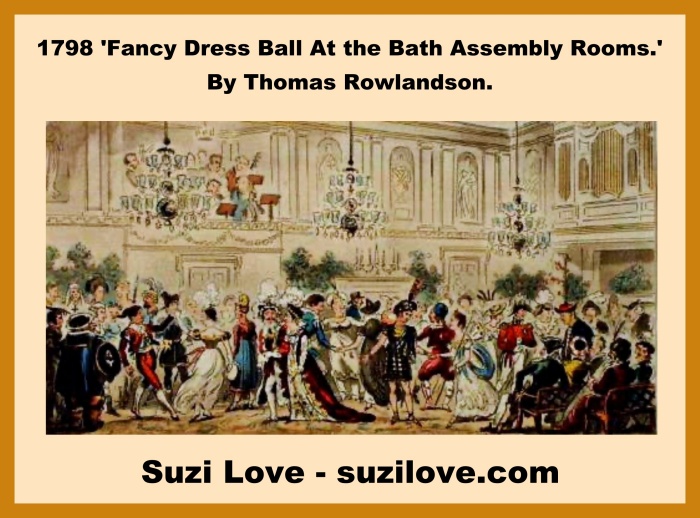
1798 Fancy Dress Ball at the Bath Assembly Rooms.' By Thomas Rowlandson.
1798 Fancy Dress Ball at the Bath Assembly Rooms.’ By Thomas Rowlandson.
Bath-Interior of Assembly Rooms, Bath.
Interior of Assembly Rooms, Bath.
Entrance to Assembly Rooms, Now Fashion Museum. Bath, U.K.
Bath_Entrance to Assembly Rooms, Now Fashion Museum. Bath, U.K.
Entrance to Assembly Rooms, Now Fashion Museum. Bath, U.K.
Bath_1805 Interior of Concert Room, Bath. By John Claude Nattes 'Bath Illustrated by a Series of Views.' Via Suzi Love - suzilove.com & Wikimedia Commons commons.wikimedia.org
1805 Interior of Concert Room, Bath. By John Claude Nattes ‘Bath Illustrated by a Series of Views.’ Via Suzi Love – suzilove.com & Wikimedia Commons commons.wikimedia.org
Bath_1799 Richard Nash Esq. Master of Ceremonies, Assembly Rooms, Bath From- 1799 The New Bath Guide Printed by R. Cruttwell.
1799 Richard Nash Esq. Master of Ceremonies, Assembly Rooms, Bath From- 1799 The New Bath Guide Printed by R. Cruttwell.
Bath_1771 The New Assembly Rooms Opened, Between Bennet and Alfred streets, Bath, U.K. via Suzi Love - suzilove.com & 1835 The Historical and Local New Bath Guide Published By C. Duffield.
1771 The New Assembly Rooms Opened, Between Bennet and Alfred streets, Bath, U.K. via Suzi Love – suzilove.com & 1835 The Historical and Local New Bath Guide Published By C. Duffield.

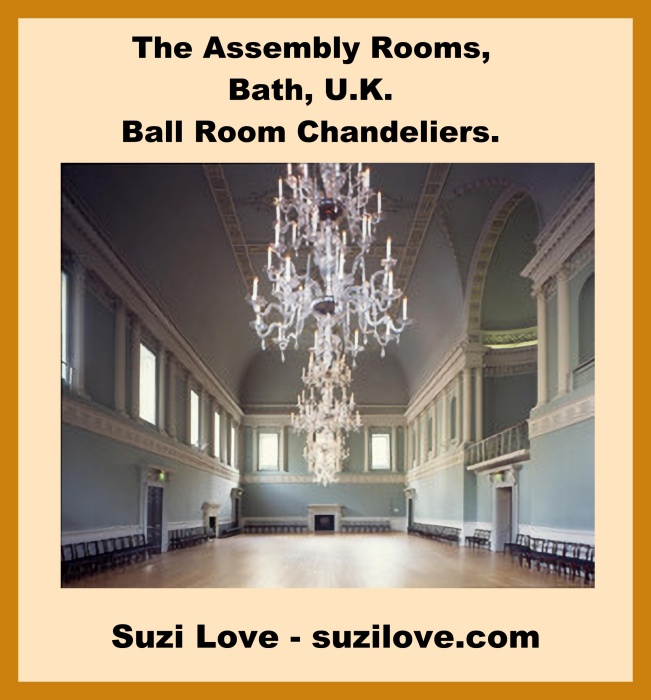
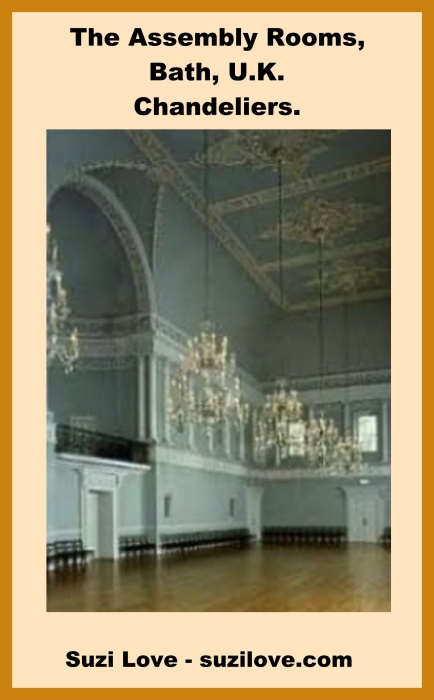
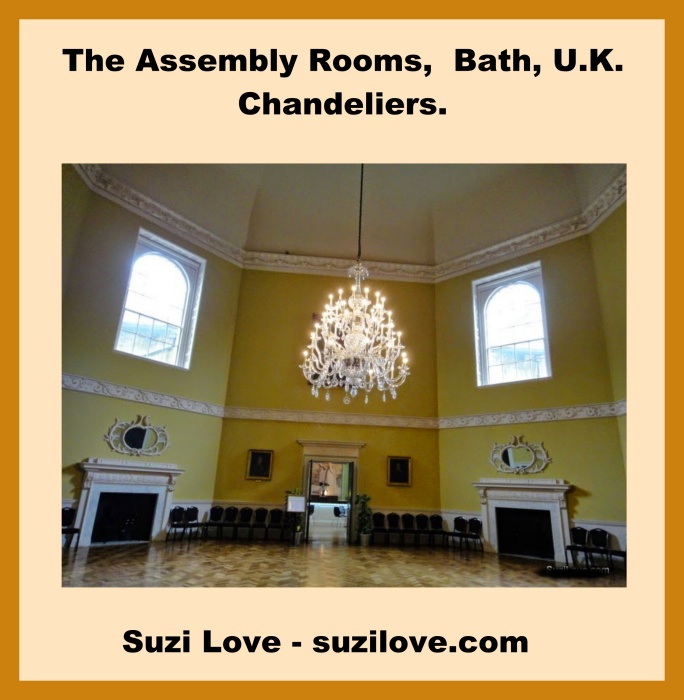
The Assembly Rooms are lit by a set of nine chandeliers, made for the building in 1771. Jonathan Collett of London originally provided a set of five chandeliers for the Ball Room when it opened in September 1771. Shortly afterwards the arm of one of the chandeliers fell off – narrowly missing the artist, Thomas Gainsborough, who lived nearby at the time. The Ball Room chandeliers were taken down and a new set was ordered from William Parker of London. Parker had already supplied three chandeliers for the Tea Room. It was agreed that Jonathan Collett should salvage the rejected set of Ball Room chandeliers and make one large chandelier to hang in the Octagon Room. The chandeliers in the three rooms had an average height of eight feet and they were made of Whitefriars crystal from the Whitefriars Glassworks in London and were originally lit by candles. The Ball Room and Tea Room chandeliers each had 40 lights and the Octagon chandelier had 48 lights.

During the 19th century, they were fitted for gas and were later converted to electric light. At the start of the Second World War, the chandeliers were put into storage and escaped destruction when the Assembly Rooms were bombed in 1942. During the extensive refurbishment of the building in 1988-1991, the chandeliers were restored by R. Wilkinson & Sons of London. The Bath Season ran from October to June. As the Season spanned the winter months and many activities took place in the evening it was essential to provide good artificial lighting.

The ball room is the largest of the three main rooms and is over 105 feet long and 42 feet wide and 42 feet high. It runs the whole length of the north side of the building and covers two storeys. The paint is called Ballroom Blue and was first created by David Mlinaric in the 1970s from an original colour swatch. “It is a stroke of luck that the colour sample of blue paint is still attached to the 1770s minute book of the Assembly Rooms Furnishing Committee.” said Lucy Powell, Assistant Archivist at Bath Record Office, “The building was bombed in 1942 so traces of the paint would never have survived otherwise.”  From: Fashion Museum, Bath.

On the other side, the tea room is 70 feet long and 27 feet wide and all the rooms had huge chandeliers to give light. In 1777, a card room was added to the Octagonal Room. Before the Card Room was added, the Octagon Room became famous for card playing, the favorite leisure activity from the Georgian Era through to the Regency, as the Upper Rooms were open for card games every day except Sunday. The Octagon Room is dominated by Gainsborough’s portrait of the first Master of Ceremonies at the Upper Rooms, Captain William Wade. Bath’s most famous Master of Ceremonies, Richard “Beau” Nash, never knew this building as he died in 1761.

Bath_The Assembly Rooms, Bath, U.K. Chandeliers.
Bath_Octagon Room, The Assembly Rooms, Bath, U.K. Chandeliers.
Bath_The Assembly Rooms, Bath, U.K. Chandeliers.
The Assembly Rooms, Bath, U.K. Ball Room Chandeliers.
Bath_The Assembly Rooms, Bath, U.K. Chandeliers.
The Assembly Rooms, Bath, U.K. Chandeliers.
Bath_The Assembly Rooms, Bath, U.K. Chandeliers.
The Assembly Rooms, Bath, U.K. Chandeliers.
Bath_The Assembly Rooms, Bath, U.K. Chandeliers.
The Assembly Rooms, Bath, U.K. Chandeliers.
Bath_The Assembly Rooms, Bath, U.K. Chandeliers.
The Assembly Rooms, Bath, U.K. Chandeliers.
Bath_The Assembly Rooms, Bath, U.K. Chandeliers.
The Assembly Rooms, Bath, U.K. Chandeliers.
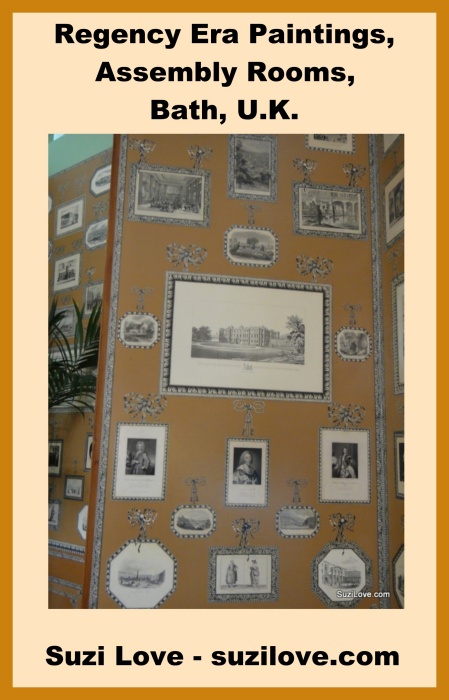
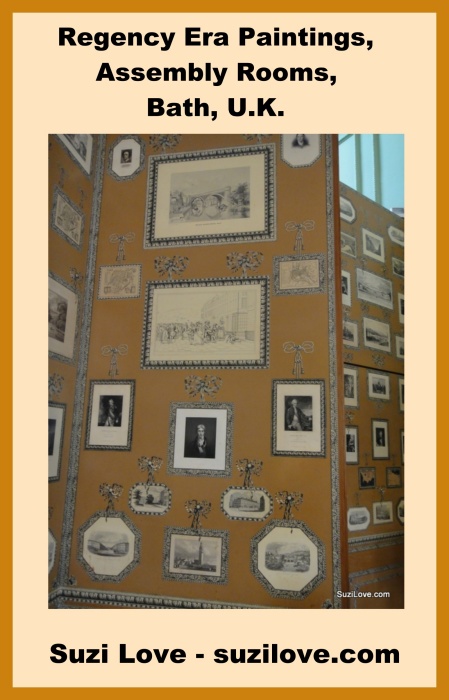
Bath_Regency Era Paintings, Assembly Rooms, Bath, U.K.
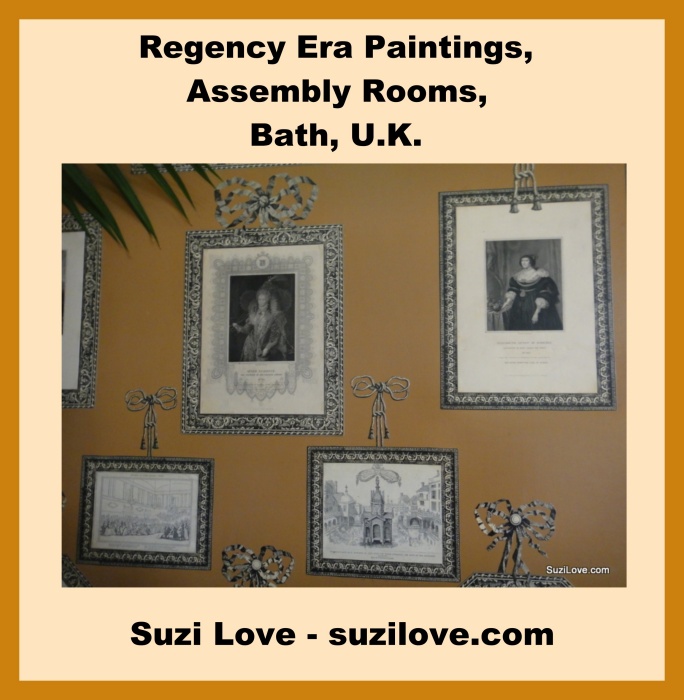
Regency Era Paintings, Assembly Rooms, Bath, U.K.
Bath_Regency Era Paintings, Assembly Rooms, Bath, U.K.
Regency Era Paintings, Assembly Rooms, Bath, U.K.
Bath_Regency Era Paintings, Assembly Rooms, Bath, U.K.
Regency Era Paintings, Assembly Rooms, Bath, U.K.
Bath_Regency Era Paintings, Assembly Rooms, Bath, U.K.
Regency Era Paintings, Assembly Rooms, Bath, U.K.

The tea room was used for refreshments, with tea generally served weak and black or perhaps with arrack and lemon, and on Wednesday nights during the Season concerts were held there. Fashionable visitors to Bath could also hold breakfasts there for their friends.

Many famous people visited the Assembly Rooms in the 18th and 19th centuries. Jane Austen and Charles Dickens both mention the Assembly Rooms in their novels and the diarist, Francis Kilvert, described a reception there in 1873. Subscription concerts were popular and many well-known musicians also visited, the most distinguished being Joseph Haydn, Johann Strauss the Elder, and Franz Liszt.

Today, the Octagon Room, the Tea Room, and the Cloak room Landings all showcase beautiful paintings and prints as the Upper Rooms were given to the National Trust in 1931. You can see paintings by Thomas Gainsborough and John Simmons as well as an Original ticket to the Thirteenth Dress Ball at the Assembly Rooms, 24 January 1803.

 Since 1963, the Upper Assembly Rooms have also housed the amazing Fashion Museum. The building is owned by the National Trust and is leased by Bath & North East Somerset Council.

RL_1_D2D_Regency Overview RetailerLinks
https://books2read.com/suziloveROver
RL_1_D2D_Regency Overview RetailerLinks https://books2read.com/suziloveROver
Posted in 1700s, 1800s, art, Bath, Bridgerton, cartoon, Jane Austen, Regency Era, Suzi Love Images | Tagged 1700s Or Georgian Era, 1800s Or 19th Century, architecture, art, Bath, Cartoons, Customs and Traditions, dancing, England, Jane Austen, music, Regency Era, Regency Life, Regency People | Leave a reply

1818 September White Morning Dress, Blue Spencer and Two Hats As Worn By The Bridgerton Ladies. #bridgerton #RegencyFashion #Spencer

Suzi Love Posted on April 7, 2026 by Suzi LoveFebruary 19, 2026

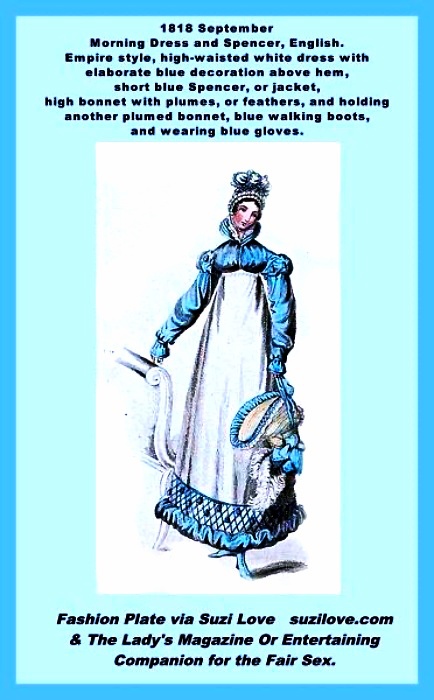
1818 September Morning Dress and Spencer, English. Empire style, high-waisted white dress with elaborate blue decoration above hem, short blue Spencer, or jacket, with puffs at the shoulders and straight sleeves, cap with plumes, or feathers, tied under her chin and holding another plumed bonnet, blue walking boots, and wearing blue gloves. Fashion Plate via Ladies Magazine.

Definition Empire Style Dress: High-waisted white gown defined women’s fashion during the Regency Era. ‘Empire’ is the name given to the period when Napoleon Bonaparte built his French Empire. High-waisted, loose gowns were adopted by the aristocracy as a symbol of turning away from the fussy, elaborate and expensive clothing worn in the 1700s.

Definition Spencer: Short jacket, cropped at the waist, worn over a dress, or gown. These close-fitting, tight sleeved, waist length jackets were modeled on a gentleman’s riding coat, but without tails. Delicate and regency dresses provided so little protection from the cold, so over garments were essential for warmth, modesty and good health.

1818 September Morning Dress and Spencer, English. Empire style, high-waisted white dress with elaborate blue decoration above hem, short blue Spencer, or jacket, high bonnet with plumes, or feathers, and holding another plumed bonnet, blue walking boots, and wearing blue gloves. Fashion Plate via Ladies Magazine.
HN_28_D2D_Fashion Women 1815-1819
https://books2read.com/SuziLoveFashionWomen1815-1819
Fashion Women 1815-1819 History Notes Book 28 https://books2read.com/SuziLoveFashionWomen1815-1819

Posted in 1800s, 1800s women's fashion, Bridgerton, Dress Or Robe, fashion accessories, hats, London, Regency Era, Regency Fashion, sewing, shoes, Spencer | Tagged 1800s women's fashion, Bridgerton, Dress Or Gown, fashion accessories, Fashion Plate, gloves, Hats And Hair, London, Regency Fashion, Shoes, The Lady's Magazine

Post navigation

← Previous Post
Next Post→

SUBSCRIBE TO SUZI LOVE'S NEWSLETTER.

Recent Posts

  • History Notes Book 24 Box Set. Love the Bridgertons and Jane Austen? Mourning, riding, dresses, underclothing, accessories. #Bridgerton #JaneAusten #RegencyFashion
  • Scenting Scandal: If Lady Laura Jamison had inherited her great-grandmother’s ability to portend disaster… #HistoricalMystery #VictorianRomance #RomCom
  • How did people travel in Bridgerton and Jane Austen’s years? What did they take to make themselves comfortable? #Bridgerton #JaneAusten #GeorgianEra #RegencyEra #VictorianEra
  • Love After Waterloo: “Mama, why doesn’t that man like me?” Daniel asked. Love After Waterloo. #RegencyRomance #ReadARegency #Militaryromance #Waterloo
  • 19th Century Early Typical Jane Austen Or Bridgerton Era Men’s Pants With Drop Down Front Flap. #Bridgerton #RegencyEra #JaneAusten #HistoricalFashion

Recent Comments

  1. Suzi Love on Book Hooks: Petunia and the Pearl Diver. Petunia was too well spoken for a brothel worker. #Regencyromance #historicalromance #London #mfrw
  2. Bianca White on Book Hooks: Petunia and the Pearl Diver. Petunia was too well spoken for a brothel worker. #Regencyromance #historicalromance #London #mfrw
  3. Suzi Love on Book Hooks: Petunia and the Pearl Diver. Petunia was too well spoken for a brothel worker. #Regencyromance #historicalromance #London #mfrw
  4. Suzi Love on Book Hooks: Petunia and the Pearl Diver. Petunia was too well spoken for a brothel worker. #Regencyromance #historicalromance #London #mfrw
  5. Suzi Love on Book Hooks: Petunia and the Pearl Diver. Petunia was too well spoken for a brothel worker. #Regencyromance #historicalromance #London #mfrw

Login

  • Log in

Archives

  • November 2026
  • October 2026
  • September 2026
  • August 2026
  • July 2026
  • June 2026
  • May 2026
  • April 2026
  • March 2026
  • February 2026
  • January 2026
  • December 2025
  • November 2025
  • October 2025
  • September 2025
  • August 2025
  • July 2025
  • June 2025
  • May 2025
  • April 2025
  • March 2025
  • February 2025
  • January 2025
  • December 2024
  • November 2024
  • October 2024
  • September 2024
  • August 2024
  • July 2024
  • June 2024
  • May 2024
  • April 2024
  • March 2024
  • February 2024
  • January 2024
  • October 2023
  • September 2023
  • August 2023
  • June 2022
  • April 2022

Categories

  • 1700s
  • 1700s Mens fashion
  • 1700s Womens Fashion
  • 1800s
  • 1800s Mens Fashions
  • 1800s women's fashion
  • 1900s
  • art
  • Australia
  • Bath
  • bedroom fashion
  • Book Hooks
  • Box Or Container
  • Bridgerton
  • Bus Trips
  • Canada
  • Carriage
  • cartoon
  • Celebrity
  • Chatelaine
  • Children
  • children
  • Christmas
  • Coat or Pelisse Or Redingote
  • Contemporary
  • Corset
  • Couple
  • Customs & Manners
  • dancing
  • December Scandal
  • Decorative Item
  • Dress Or Robe
  • Easter
  • Edwardian Era
  • Embracing Scandal
  • England
  • Ester In Images
  • Europe
  • Events
  • Fashion
  • fashion accessories
  • Food and Drink
  • Four Times A Virgin
  • France
  • furniture
  • Georgian Era
  • Georgian Fashion
  • Google Books
  • Grand Tour
  • Group
  • hats
  • History
  • History Events
  • History Notes
  • History Of Christmases Past
  • household
  • Hygiene
  • Irresistible Aristocrats
  • Jane Austen
  • Keanu Reeves
  • Kellys Justice
  • Legal
  • London
  • Love After Waterloo
  • Loving Lady Katharine
  • medical
  • military
  • money
  • mourning
  • Music
  • Outback Arrival
  • pants
  • Pastimes
  • peerage
  • People
  • Petunia and Pearl Diver
  • Places
  • Pleasure House Ball
  • postal
  • Queensland
  • Quotations
  • Regency Era
  • Regency Fashion
  • Regency Life Series
  • Reticule or Bag
  • riding
  • Romantic Era
  • Royalty
  • Russia
  • Scandalous Siblings Series
  • Scenting Scandal
  • Self Publishing
  • sewing
  • Shirt
  • shoes
  • Shopping
  • South Pacific
  • Spencer
  • sports
  • Suit
  • Sunday Snippet
  • Suzi Love
  • Suzi Love Books
  • Suzi Love Images
  • Suzi Love Writing
  • Swain Cove
  • THe Viscount's Pleasure House
  • travel
  • U.S.A
  • underclothing
  • Vest or Waistcoat
  • Victorian Era
  • Victorian Fashion
  • weapons
  • weddings
  • Writing Tools

1800s men fashion 1800s women's fashion antiques Bridgerton British history Cartoons Corset cravat decorative Dress Or Gown England europe fashion accessories Fashion Plate France Georgian era Georgian Fashion gloves google books Hats And Hair historical romance History Notes household Jane Austen jewelry Journal des Dames et des Modes London Metropolitan Museum NYC pants Redingote Or Pelisse Or Coat Regency Era Regency Fashion Regency London reticule or bag riding Romantic Era sewing shawls Shoes Suzi Love Books Suzi Love Images Tailcoat The Repository Of Arts underclothing Vest or Waistcoat

©2026 - Suzi Love - Weaver Xtreme Theme Privacy Policy
↑