1819 Pink Redingote, French. Also called a Walking Dress or Pelisse in England. Vertical front has pink satin bows, high white collar, matching pink satin hat and pink slippers. Short puffed sleeves over long straight, as was the fashion in 1819 across Europe. The type of outfit young Regency Era ladies would have worn if they were out shopping on Bond Street, walking in a park, or taking a carriage ride through Hyde Park. Fashion Plate via Journal des Dames et des Modes, or Costume Parisien. https://books2read.com/SuziLoveFashionWomen1815-1819
Definition Redingote Or Pelisse Or Walking Dress Or Coat: French word developed from English words, riding coat. Long fitted outdoor coat worn over other garments for warmth. Often left open at the front to show off the dress underneath. Sometimes cut away in front. Originally made with several capes and trimmed with large buttons. French fashion plates call these coats Redingotes and they are designed for women, men and children. English fashion plates call them a Pelisse, a walking dress, Promenade dress, or Carriage dress.
1819 Pink Redingote, French. Also called a Walking Dress or Pelisse in England. Vertical front has pink satin bows, high white collar, matching pink satin hat and pink slippers.Fashion Plate via Journal des Dames et des Modes, or Costume Parisien.
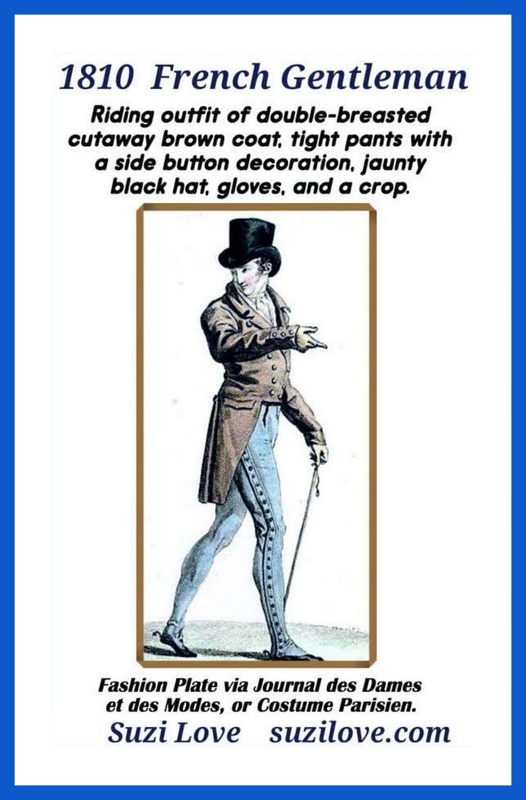
1810 French Gentleman. Riding outfit of double-breasted brown coat, tight pants with a side button decoration, jaunty black hat, gloves, and a crop. As Worn by Gentleman in the Bridgerton and Jane Austen Families. Fashion Plate via Journal des Dames et des Modes, or Costume Parisien.
Pantaloons: When tailcoats lengthened, breeches extended below the knees to accommodate the longer tails and were gradually replaced with slimmer fitting, longer pants, or pantaloons, that ended at the ankle. Pantaloons were close-fitting and sometimes buttoned all the way down the leg. To make them hug the leg tighter, knitted fabrics were used, or fabrics like nankin and kerseymere were cut on the bias.
In the early 1800s, men no longer wore complicated styles and extravagant fabrics. Men’s fashion simplified and became more conservative. A well cut tailcoat, vest, pantaloons and an immaculate cravat of beautiful white linen in the style of George Bryan, or Beau, Brummell. Clothes were a status symbol and indicated a man’s social position. These clothing items were the sort worn by Jane Austen’s male family and friends.
1810 Riding Outfit French DoubleBreastedBrownCoat Fashion Plate via Journal des Dames et des Modes, or Costume Parisien.HN_23_D2D_Fashion Men 1800-1819 History Notes Book 23
https://books2read.com/SuziLoveFashionMen1800-1819
In Jane Austen’s years of the early nineteenth century, women often wore light-weight dresses under which was worn a range of underclothing to stop gowns appearing transparent and sticking to a lady’s body. To preserve modesty, underclothing included a chemise next to the skin, then a corset, and then petticoats to give shape to a dress and to keep it away from her body.
1819 February Pink Ball Dress, English. Underskirt with white lace hem, pink layer with intricate decoration, short puffed sleeves, low décolletage, or neckline, white shawl and white hat with pink feather. Fashion Plate via John Belle’s La Belle Assemblée or, Bell’s Court and Fashionable Magazine, London. Women’s clothing came in the late 1810s came in a wide range of styles to suit every season and occasion. When attending assemblies or balls, ladies in Jane Austen’s times women wore Empire style dresses which were usually made of light fabric and floaty in style and often of a shorter length suitable for dancing. https://books2read.com/SuziLoveFashionWomen1815-1819
Definition Ball Dress: At the end of the 1810s, ball or dancing dresses had higher hemlines that rose several inches above the ankle so ladies wouldn’t trip on their hens or flounces and make a spectacle of themselves.
Definition Aigret, aigrette, egret: Plume of feathers or jeweled ornament in shape of feathers worn on head or hats. During the early 19th century, or Jane Austen’s lifetime, or during the years of the Bridgerton series, the favorite feathers were osprey and heron.
1819 February Pink Ball Dress, English. Underskirt with white lace hem
1816 October Half-Dress. A gown of lilac sarsnet, cut low round the bust, which is trimmed with pink ribbon, disposed so as to form a wreath; the shape of the back is marked by hands of pink, and a large bow, in the French style, ornaments the middle of it at bottom. The back is full; a plain light front forms the shape in a most becoming manner. Long full sleeve, composed of clear muslin, trimmed at the wrist with a single row of lace, and finished by a pink bow. Fichu to correspond, very full trimmed round the throat with lace. The bottom of the skirt is edged with pink, and trimmed with a single flounce of blond lace, set on very full, and surmounted by a wreath of French roses. Cornette composed of tulle, finished by a quilling of blond round the face, and fastened by a pink bow under the chin; a bow to correspond ornaments it on the forehead, and a bunch of flowers is placed very far back on the head. The style of this cornette, though French, is so simply elegant and becoming, that we have not for some time seen any half-dress cap to equal it. Plain gold ornaments. White kid gloves, and white kid slippers with pink rosettes. Fashion Plate via Rudolph Ackermann’s ‘The Repository of Arts’.
Definition Half Dress: Between undress and full dress, respectable outfit without an excess of formal accessories and might be worn either day or evening. Could include Afternoon Dress, such as Afternoon Walking Dress and even Evening Dress if not a very formal evening occasion, such as a theatre attendance or dinner engagement.
Definition Empire Style: Named after the First Empire in France, by 1800 Empire dresses had a very low décolleté, or neckline and a short narrow backed bodice attached to a separate skirt. Skirts started directly under the bust and flowed into the classical relaxed wide styles of Greece and Rome. This style of dress is associated with Jane Austen and her contemporaries as a simple cotton high-waisted dress was worn most days and accessorized according to the importance of the occasion.
1816 October Half-Dress. A gown of lilac sarsnet, cut low round the bust, which is trimmed with pink ribbon, disposed so as to form a wreath. Fashion Women 1815-1819 History Notes Book 28 https://books2read.com/SuziLoveFashionWomen1815-1819
19th Century Embroidered Silk Bag, Japan. Metal clasp and chain, embroidered with a beautiful bird and flowers. via Ruby Lane Antiques. rubylane.com
Definition Reticule: Bag or purse, often with a drawstring to pull closed and usually made of cloth or covered cardboard and often decorated with beading or embroidery. A reticule, or purse, or handbag, was usually carried by a woman during the Regency period to carry all their daily necessities. Earlier, women used pockets that tied at the waistline and were hidden in the folds of their skirts. Empire style, or early 1800s, high-waisted dresses made it impossible to either sewn in a pocket or to tie on a pocket. So women began carrying small, decorated bags called Reticules, or ridicules, which generally pulled close at the top with a drawstring.
1816 May Full Evening Dress, English. The type of evening dress the Bridgerton family and Jane Austen and her contemporaries would have worn to a formal evening event, such as a ball. A white satin slip, over which is a white lace dress, ornamented with three quillings of white lace on the skirt, intermixed with bows of white satin ribbon. The body and sleeve, both of which are richly ornamented with colored stones, are formed, as our readers will see by the print, in a very novel style. Head-dress, a cap composed of white satin, finished with a band edged with pearls, and a superb plume of white feathers. Necklace, ear-rings, and bracelets,’ colored stones intermixed with pearls. White satin slippers, and white kid gloves. We are indebted to the elegant invention Of Mrs. Gill, of Cork-street, Burlington-Gardens, for our dress this month. Fashion Plate via Rudolph Ackermann’s ‘The Repository of Arts’.
Definition Full Dress: Most formal of outfits, day or night, with all possible accessories added.
1816 May Full Evening Dress, English. A white satin slip, over which is a white lace dress, ornamented with three quillings of white lace on the skirt, intermixed with bows of white satin ribbon. Fashion Plate via Rudolph Ackermann’s ‘The Repository of Arts’. Fashion Women 1815-1819 History Notes Book 28 What did Jane Austen wear? . D2D_HN_28_https://books2read.com/SuziLoveFashionWomen1815-1819
19th Century Early Brown Trousers, American. Button waist, drop down front flap, or fall, and extra fabric in the back for easy movement. via Metropolitan Museum New York City, U.S.A. metmuseum.org https://books2read.com/SuziLoveFashionMen1800-1819
19th Century Early Brown Trousers With Drop Down Front flap, or ‘Fall’. #Regency #Men #Fashion19th Century Early Brown Trousers With Drop Down Front flap, or ‘Fall’. #Regency #Men #Fashion19th Century Early Brown Trousers With Drop Down Front flap, or ‘Fall’. #Regency #Men #Fashion https://books2read.com/SuziLoveFashionMen1800-1819
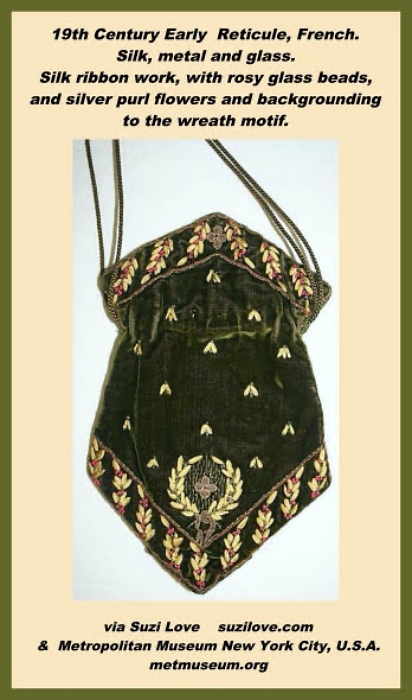
19th cent. Early. Reticule, or Bag, of silk, metal and glass, French, as carried in Jane Austen’s times. Silk ribbon work, with rosy glass beads, and silver purl flowers and backgrounding to the wreath motif. via Metropolitan Museum, N.Y.C., U.S.A. metmuseum.org
Definition Reticule: Bag or purse, often with a drawstring to pull closed and usually made of cloth or covered cardboard and often decorated with beading or embroidery. A reticule, or purse, or handbag, was usually carried by a woman during the Regency period to carry all their daily necessities. Earlier, women used pockets that tied at the waistline and were hidden in the folds of their skirts. Empire style, or early 1800s, high-waisted dresses made it impossible to either sewn in a pocket or to tie on a pocket. So women began carrying small, decorated bags called Reticules, or ridicules, which generally pulled close at the top with a drawstring.
19th Century. Early. Reticule. Silk, metal and glass. French. Silk ribbon work, with rosy glass beads, and silver purl flowers and backgrounding to the wreath motif. via Metropolitan Museum New York City, U.S.A. metmuseum.orgHN _3_D2D_RetailerBuyLink_HN_3
1816 August Walking Costume, or Pelisse, or Coat, English. Round dress, composed of cambric and trimmed with lace. The body is let in with a profusion of lace. Plain long sleeves, very full, except at the wrist where the fulness is confined by small plaits, sleeve finished by double frill of lace. Over the dress is a Pelisse of blue and white shot sarcenet, lined with white sarcenet and trimmed with white satin. Pelisse sleeve is very full and finished at the wrist by a cuff and bows of ribbon. Pelisse is made half high and finished at neck with a triple fall of rich lace but the neck is bare. White satin hat is turned up in front and ornamented with flowers. Kid gloves, blue kid shoes and a parasol. We are indebted for this tasteful dress to Mrs. Gill of Cork Street, Burlington Garden, London. Fashion Plate via Rudolph Ackermann’s ‘The Repository of Arts’.
Definition: Pelisse Or Redingote: Woman’s long, fitted coat often worn open in front to show off the dress underneath. Sometimes cut away in front. Originally made with several capes and trimmed with large buttons. French word developed from English words, riding coat. reefer. Single- or double-breasted, fitted, tailored, over-all coat usually made from sturdy fabric. Jane Austen and her contemporaries wore long coats like these to keep warm when out and about, visiting, shopping etc. The thin muslin dresses worn in the early 1800s were little protection against European winters. #Regency #Fashion #History
1816 August. Walking Costume, or Pelisse, or Coat, English. High waisted blue pelisse over a white dress, wide shawl collar with lace over layer, long sleeves, high flowered bonnet with ribbon ties, yellow gloves and a parasol. Fashion Plate via Rudolph Ackermann’s ‘The Repository of Arts’. Fashion Women 1815-1819 History Notes Book 28 What did Jane Austen wear? . D2D_HN_28_https://books2read.com/SuziLoveFashionWomen1815-1819