1811 White Dress, French. Dress with scalloped hem, pink Redingote, green paisley shawl and white hat. Fashion Plate via Journal des Dames et des Modes, or Costume Parisien.
Definition Redingote Or Pelisse Or Walking Dress Or Coat: Long fitted outdoor coat worn over other garments for warmth. Often left open at the front to show off the dress underneath. French word developed from English words, riding coat. Jane Austen and her contemporaries wore long coats like these to keep warm when out and about, visiting, shopping etc. The thin muslin dresses worn in the early 1800s were little protection against European winters.
1811 White Dress, French. Worn under a white spotted tunic with yellow over dress with long sleeves. White gloves, shoes and hat with plume, or feathers, or aigrette. Fashion Plate via Journal des Dames et des Modes, or Costume Parisien. Even though this is a French fashion plate, Jane Austen and her contemporaries would have worn long coats like these to keep warm when out and about, visiting, shopping etc. The thin muslin dresses worn in the early 1800s were little protection against European winters so warmth and color was added by tunics and coats in a huge variety of styles.
Definition Aigret, aigrette, egret: Plume of feathers or jeweled ornament in shape of feathers worn on head or hats. During the early 19th century., or Jane Austen’s lifetime, the favorite feathers were osprey and heron.
1770-1790 ca. Stays, or Corset, English. Pink silk damask, lined with linen, reinforced with whalebone, fingers spread over hips. via Victoria and Albert Museum, London, UK. collections.vam.ac.uk. https://books2read.com/SuziLoveCorsetBook15
1770-1790 ca. Front View. Pink Silk Damask Stays, Or Corset, English. via Victoria and Albert Museum, London, UK.
collections.vam.ac.uk.1770-1790 ca. Side View. Pink Silk Damask Stays, Or Corset, English. via Victoria and Albert Museum, London, UK.
collections.vam.ac.uk.1770-1790 ca. Back View. Pink Silk Damask Stays, Or Corset, English. via Victoria and Albert Museum, London, UK.
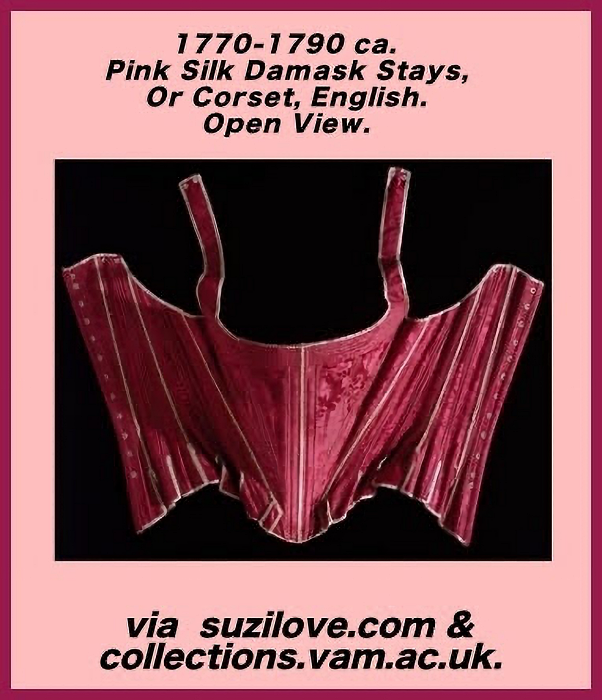
collections.vam.ac.uk.1770-1790 ca. Open View. Pink Silk Damask Stays, Or Corset, English. via Victoria and Albert Museum, London, UK.
collections.vam.ac.uk.1770-1790 ca. Side and Back Views. Pink Silk Damask Stays, Or Corset, English. via Victoria and Albert Museum, London, UK.
collections.vam.ac.uk.1770-1790 ca. Collage View. Pink Silk Damask Stays, Or Corset, English. via Victoria and Albert Museum, London, UK.
collections.vam.ac.uk.1770-1790 Pink Silk Damask Stays, Or Corset, English. #Georgian #Corset #BritishHistory1770-1790 Pink Silk Damask Stays, Or Corset, English. #Georgian #Corset #BritishHistory https://books2read.com/SuziLoveCorsetBook15 Share on XHN_15_D2D_Corsets 1700-1790
https://books2read.com/SuziLoveCorsetBook15
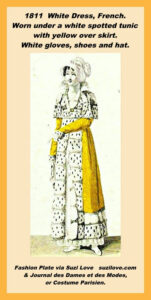
1811 White Dress, French. Worn under a white spotted tunic with yellow over skirt. White gloves, shoes and hat with drooping white feathers. Fashion Plate via Journal des Dames et des Modes, or Costume Parisien.
Although this is a French fashion plate, Jane Austen and her contemporaries wore a variety of tunics, spencers, and long coats to keep warm when out and about, visiting, shopping etc. Their thin muslin dresses weren’t any protection against harsh European winters or wet English weather.
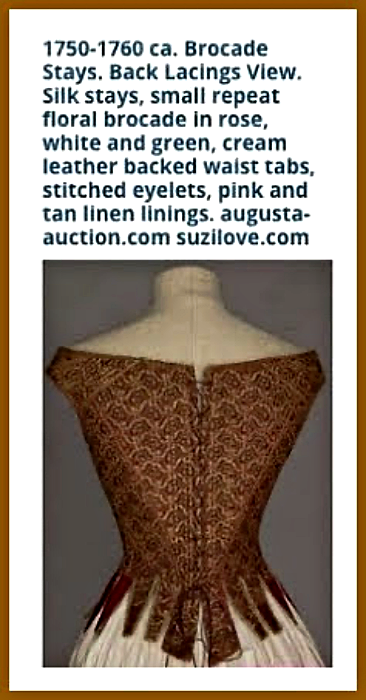
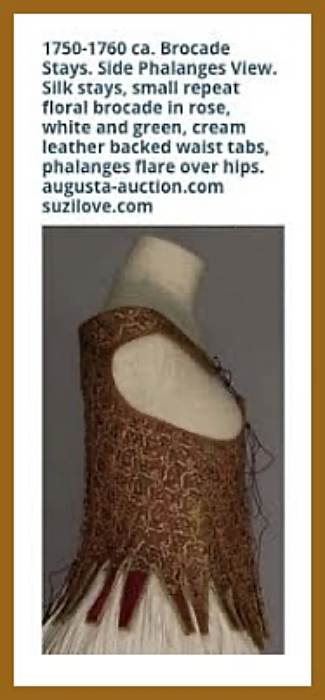
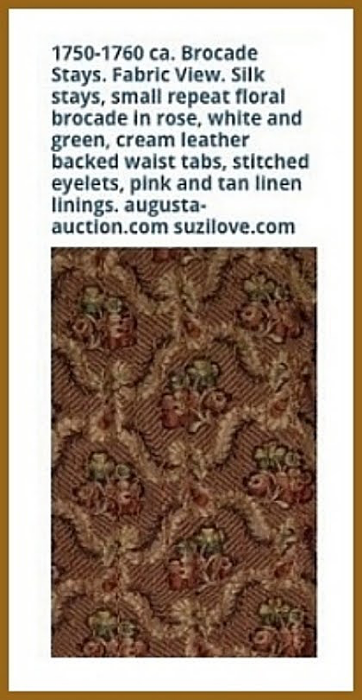
1750-1760 ca. Brown Silk Brocade Stays With Both Front and Back Lacings.
These silk stays have a small repeat floral brocade in rose, white, and green. There are cream, leather-backed waist tabs, stitched eyelets, and pink and tan linings. These stays, or corset, are unusual because they have both front and back lacings. This means that a lady could step in and out of her stays and then tighten the front lacing herself, thereby eliminating the need for assistance from a maid or dresser.
Women of the middle and lower classes needed to be able to dress themselves as they have no one to assist in tightening their lacings when they dressed. Most upper class ladies would be able to call upon a maid to help and would therefore generally use back lacing stays.
1750-1760 ca. Brown Silk Brocade Stays With Front and Back Lacings. Front Lacing View. via Augusta Auctions. augusta-auction.com1750-1760 ca. Brown Brocade Stays With Front and Back Lacings. Back Lacing View. via Augusta Auctions. augusta-auction.com1750-1760 ca. Brown Silk Brocade Stays With Front and Back Lacings. Side View. via Augusta Auctions. augusta-auction.com1750-1760 ca. Brown Silk Brocade Stays With Front and Back Lacings. Eyelet View. via Augusta Auctions. augusta-auction.com1750-1760 ca. Brown Silk Brocade Stays With Front and Back Lacings. Fabric View. via Augusta Auctions. augusta-auction.com1750-1760 ca. Brown Silk Brocade Stays With Both Front and Back Lacings #Georgian #History #Corset https://books2read.com/SuziLoveCorsetBook15 Share on X Corsets 1700-1790 History Notes Book 15 By Suzi Love ~ Award Winning Writer and Researcher. https://books2read.com/SuziLoveCorsetBook15
“The more I know of the world the more I am convinced that I shall never see a man whom I can really love. I require so much!” Jane Austen ~ Sense and Sensibility (1811)
1811 Woman Carrying Cloth and a Package. Sewing a dress? Green dress with a white bodice, green spotted cornet for a hat. Fashion Plate via Journal des Dames et des Modes, or Costume Parisien. Even though this a French fashion plate, this is typical of the Empire dresses worn by Jane Austen and her contemporaries. Low necklines and skirts that started directly under the bust and flowed into the classical relaxed wide styles of Greece and Rome. These high-waisted dresses were worn most days and cotton, silk or taffeta were the popular fabrics.
1790-1810 ca. Linen and Metal Corset, American Or European. Front Lacing. #Corset #RegencyEra #GeorgianEra #JaneAusten. https://books2read.com/SuziLoveCorsetBook16
Top Hat Styles Chart during the 1800s, from the Regency Era through to the Victorian years. Most popular style was cone shaped and tall in height. Originally made of beaver and very short but later from silk and taller. Tall crown, widens at top, narrow brim turns up slightly at sides.
From the finish of the 18th century until 1820, men’s fashions in European and European-influenced countries moved away from the formal wear of brocades, lace, wigs and powder to more informal and relaxed styles. Focus was on undress rather than formal dress. Typical menswear in the early 1800s included a tailcoat, a vest or waistcoat, either breeches, pants, or the newer trousers, stockings, shoes or boots, all worn with an overcoat and hat. This basic ensemble was accessorized with some form of neckcloth or cravat, gloves, walking stick, cane or riding crop, handkerchief, fobs, watch and perhaps a quizzing glass or eye glass.
Skirted coats were replaced with short-fronted, or cutaway, tailcoats worn over fitted waistcoats and plain, white linen shirts. Knee breeches were gradually replaced by tight-fitting pantaloons and later trousers, decorative shoes with buckles were replaced with a variety of boot styles, and fussy and ruffled neckwear gave way to intricately tied, white linen neck cloths. A Regency Era, or early 1800s, gentleman was outfitted in more practical fabrics, such as wool, cotton and buckskin rather than the fussy brocades and silks of the late 1700s.
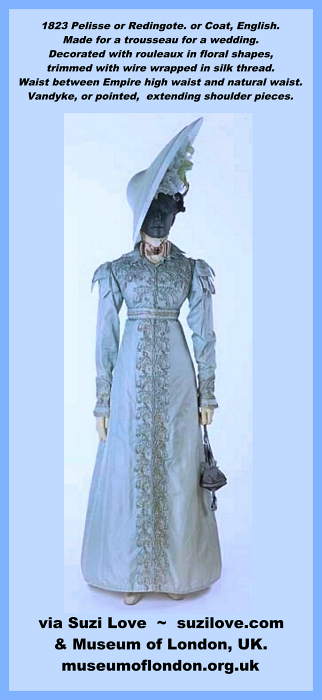
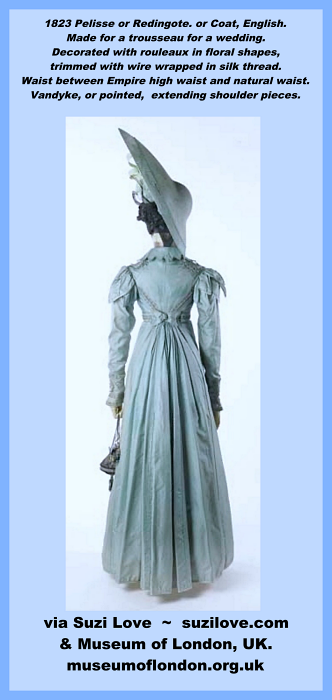
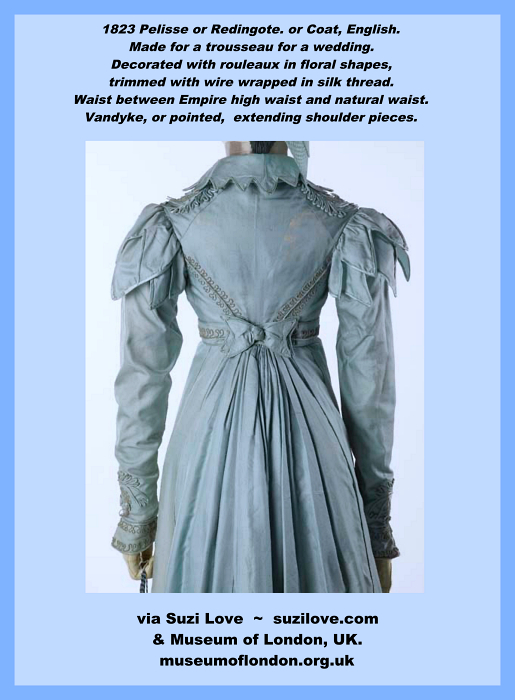
1823 Pelisse or Redingote or Walking dress, or Coat, English. Made for a wedding trousseau in 1823. Intricate decoration from rouleaux applied in floral shapes, and trimmed with wire wrapped in silk thread which stands out from the garment in loops at the ends. ‘Vandyke’ style of pointed shoulder pieces were fashionable at the time. Via Museum Of London, UK.
Definition Redingote Or Pelisse Or Walking Dress Or Coat: French word developed from English words, riding coat. Long fitted outdoor coat worn over other garments for warmth. Often left open at the front to show off the dress underneath. Sometimes cut away in front. Originally made with several capes and trimmed with large buttons. French fashion plates call these coats Redingotes and they are designed for women, men and children. English fashion plates call them a Pelisse, a walking dress, Promenade dress, or Carriage dress. books2read.com/suzilovePelisse
Definition Vandyke: Edging of v-shaped points, the name coming from the Flemish painter, Sir Anthony Vandyke, who was known for his short pointed beard.
1823 Blue Pelisse Or Redingote, British. Made for a trousseau for a wedding. via Museum of London.1823 Blue Pelisse Or Redingote, British. Made for a trousseau for a wedding. via Museum of London.1823 Blue Pelisse Or Redingote, British. Made for a trousseau for a wedding. via Museum of London.1823 Blue Pelisse Or Redingote, British. Made for a trousseau for a wedding. via Museum of London.1823 Blue Pelisse Or Redingote, British. Made for a trousseau for a wedding. via Museum of London.1823 Blue Pelisse Or Redingote, British. Made for a trousseau for a wedding. via Museum of London.1823 Blue Pelisse Or Redingote, British. Made for a trousseau for a wedding. via Museum of London.1823 Blue Pelisse Or Redingote, British. Made for a trousseau for a wedding. via Museum of London.1823 Blue Pelisse Or Redingote, British. Made for a trousseau for a wedding. via Museum of London.1823 Blue Pelisse Or Redingote, British. Made for a trousseau for a wedding. via Museum of London.1823 Blue Pelisse Or Redingote, British. Made for a trousseau for a wedding. via Museum of London.1823 Blue Pelisse Or Redingote, British. Made for a trousseau for a wedding. via Museum of London.1823 Blue Silk Pelisse, or Coat, Decorated With Rouleaux and Vandyke Points. #RegencyFashion #HistoricalFashion #Pelisse https://books2read.com/suzilovePelisse Share on XD2D_RetailerBuyLink_HN_5
http://books2read.com/suzilovePelisse