1800 ca. Tan Corduroy Breeches. Drop down front flap, or ‘fall’, with two buttons, three silver metal buttons at the waistband, watch pocket, corner pockets with buttons, pieced back with waist tie, saggy back with extra fabric to allow for easier movement when riding or sitting, four buttons and silk ties at knee. via Whitaker Auction whitakerauction.smugmug.com. https://books2read.com/SuziLoveFashionMen1800-1819.
Typical of a gentleman’s breeches worn during the early 1800s, or the Regency Era, or Jane Austen’s times. They have a front flap, or fall, which unbuttons and drops down and a back waist tie to adjust the waist size and there are buttons and ties to secure the breeches below the knee.
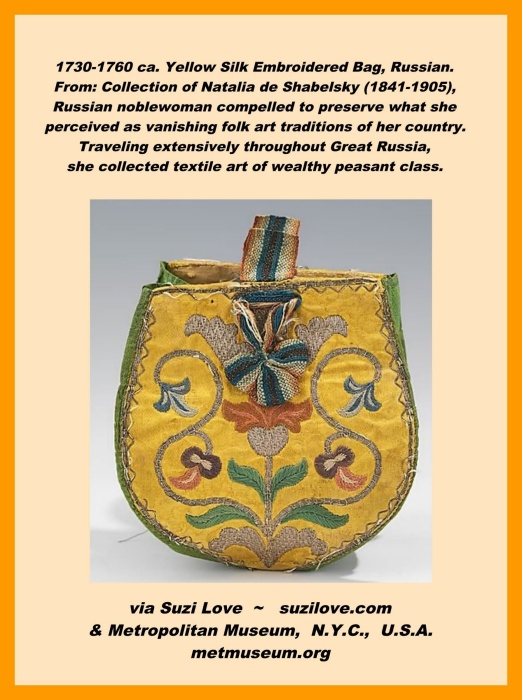
1730-1760 ca. Yellow Silk Embroidered Bag, Russian. From: Collection of Natalia de Shabelsky (1841-1905), Russian noblewoman preserving vanishing folk art traditions of her country. Traveling extensively throughout Great Russia, she collected textile art of wealthy peasant class. via Metropolitan Museum, NYC.
18th Century bags, or purses, were usually designed to hang from the waist or wrist to carry essential daily items on the person rather than making the long walk back through a castle or grand house to fetch things like coins, personal seals, toiletries or medicines.
1815 French Couple. Lady in evening dress with scooped neckline on low-cut pink bodice, floral headpiece and long white gloves. Gentleman in brown tailcoat and stirrup trousers, vest, and casual necktie. Fashion Plate via Journal des Dames et des Modes, or Costume Parisien.
The sort of fashionable outfits and items worn or carried by Jane Austen and her contemporaries when out in public. Ladies outfits for evening were accessorized with gloves, headdresses and jewelry and often dresses were of this shorter length for dancing. Gentlemen were always heavily accessorized as well with the essential of gloves, coats, waistcoats and neatly tied cravats. For more about the fashions of 1815, take a look at History Notes Books 23 and 28 men’s and women’s regency Era fashions.
Fashion Women 1815-1819 History Notes Book 28 What did Jane Austen wear? What was fashionable for women at the end of the Regency Era in Britain and the reconstruction in Europe after the wars. Book 28 for 1815-1819 in History Notes Includes fashions for mourning, riding, dresses, hats, shoes, reticules or bags, underclothing, accessories.
Fashion Men 1800-1819 History Notes Book 23 What was fashionable for men in early 1800s, or Jane Austen’s time, or Regency Era? Suits, hats, shoes, underclothing, fashion accessories, military and bedroom fashions. French fashions and Georgian and Regency Era fashions from Great Britain were copied around the world.
1805 Regency Group of Ladies and Gentlemen dressed as Jan Austen and her family and friends would have dressed. Ladies in dresses, bonnets, shawls, gloves, and carrying a reticule, or bag, and a parasol. Gentlemen in tailcoats, overcoats, trousers, vests, cravats, hats, boots and shoes and carrying walking sticks. via Men And Women In Costumes, 1804-1829. The Miriam and Ira D. Wallach Division, The New York Public Library, U.S.A.
1800 Elegant Young French Gentleman. Pulling on his top coat over a long tan coat. Tan gloves, brown hat, brown boots, cane. Fashion Plate via suzilove.com and Journal des Dames et des Modes, or Costume Parisien.
Overcoats: Called many names: Greatcoat, or Carrick, or Garrick, or Coachman’s, or Driving. Or Box Coat. Overcoats were voluminous and covered the other clothing. Usually with many capes, or collars, or pelerines covering the shoulders and with buttons down the front. Popular in the 19th century for riding, driving and travel as they kept the wearer warm and snow and rain off the body. Greatcoat: Overcoat with capes around the shoulders for men. Carrick or Garrick Coat: Other names for a gentleman’s inclement weather coat and worn for driving or travel.
1803 Jane Austen Style Dress Bodice and Five Trimmed Hats. Low cut bodice, puffed sleeves, scarf, four variations of trimmed hats. Fashion Plate via Journal des Dames et des Modes, or Costume Parisien. https://books2read.com/SuziLoveFashionWomen1801-1804
1805 Pink Redingote, French. Also called a Pelisse, a Walking Dress, or a Carriage Costume, in England. High-waisted, short puffed sleeves over long straight sleeves with elaborate embroidery to decorate, and close-fitting gold hat tied under her chin. Fashion Plate via Journal des Dames et des Modes, or Costume Parisien. Jane Austen and her contemporaries would have worn long coats like this one to keep warm when out and about, visiting, shopping etc. The thin muslin dresses worn in the early 1800s were little protection against European winters, so coats of some sort were added, plus colorful accessories like this shawl and the hat to add color and another layer of warmth.
Definition Redingote Or Coat Or Pelisse: Long fitted outdoor coat worn over other garments for warmth. French word developed from English words, riding coat. French fashion plates call these coats Redingotes and they are designed for women, men and children. English fashion plates call them a Pelisse, a walking dress, Promenade dress, or Carriage dress.
1808 Lady In A Dancing Dress, French. Dress of Tulle Broderie, short puffed sleeves, floral embroidery, dancing slippers and upswept hairstyle. Fashion Plate via Journal des Dames et des Modes, Costume Parisien. When attending assemblies or balls, ladies in Jane Austen’s times women wore Empire style dresses which were usually made of light fabric and floaty in style and often of a shorter length suitable for dancing.
1805 Lady With Her Sketching Portfolio In Half Dress, French. White, At-Home, High-waisted, relaxed & flowing dress with white cap and pink flowers to match, long gloves, slippers. Fashion Plate via Journal des Dames et des Modes, or Costume Parisien. Definition Caps: Worn as morning caps, night caps, or under other hats. Jane Austen and her family and female friends would have worn caps like these, sometimes during the morning at home, to bed to keep their long hair from becoming knotted, or under a bonnet to hold a hairstyle in place. Caps sometimes had hanging ties, or tails, and were also called ‘follow me lads’, or ‘flirtation ribbons’. Or flaps covering theirs called Lappets. Magazine Journal des Dames et des Modes, or Costume Parisien, French. French fashion magazine published between 1797 and 1839 and second oldest fashion magazine published in France. Pierre de la Mesangere was editor and published every five days, which is why there is an abundance of French fashion plates from these years in France and internationally.
1800s Silver and Carved Mother of Pearl Writing and Desk Set, French. Wax Seal, Dip Pen and Letter Opener in the style that Jane Austen would have used to write her novels and her letters. via Ruby Lane Antiques. rubylane.com. books2read.com/SuziLoveWritingTools





![1805_HalfDress_WhiteAtHomeDress_LadywithSketchingPortfolio_CP_Lge.jpg ]](https://www.suzilove.com/wp-content/uploads/2022/11/1805_HalfDress_WhiteAtHokmeDress_LadywithSketchingPortfolio_CP_Sml.jpg)

