Early 1800s Typical Regency Couple in a Curricle. The sort of vehicle Jane Austen and her contemporaries would have driven in. Young men loved them and occasionally women drove them.



Early 1800s Typical Regency Couple in a Curricle. The sort of vehicle Jane Austen and her contemporaries would have driven in. Young men loved them and occasionally women drove them.
1798 White Dress, French. Gold and black back insert to match gold stripes on the hem, white shawl with gold stripes, gold hat with black decoration. Via Journal des Dames et des Modes or Costume Parisien.
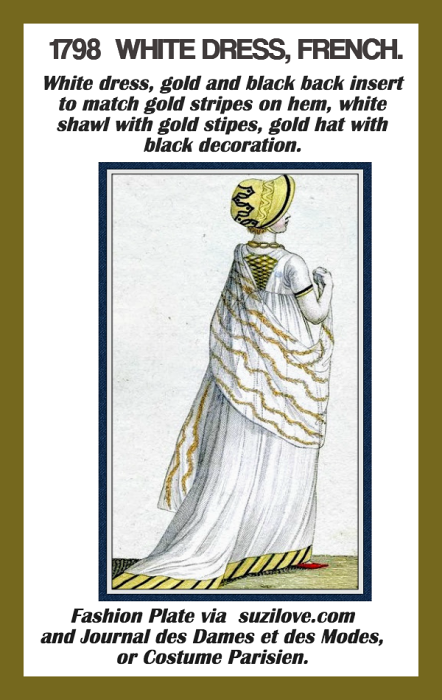

1800’s Flat men’s shoes, presumably part of the livrée-like Römer servant’s uniform of the type worn until 1866. via historisches-museum.frankfurt.de
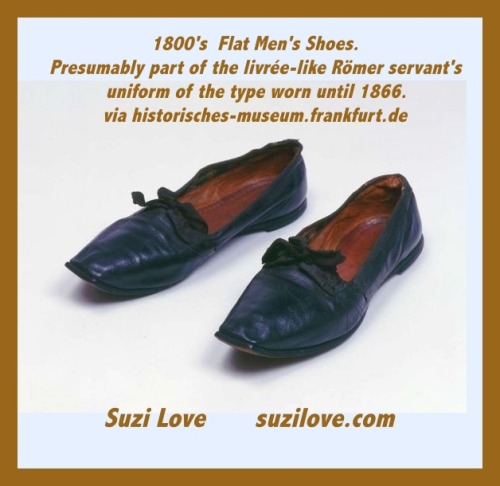

1811 Lady’s Redingote, or Pelisse, or Walking Dress, French. Blue Levantine walking dress, with pale blue hat of Drap. Fashion Plate via Journal des Modes et des Dames, or Costume Parisienne.
The term, Redingote, was used more in France and other parts of Europe and Pelisse or Walking Dress was used more in England. While the terms Redingote and Pelisse are often used interchangeably, the Redingote usually features a close fitted top and flares out at the hemline with a more tailored or military look than a Pelisse. Redingotes or Pelisses were needed to cover the flimsy dresses made of lightweight fabrics of the Regency years to provide warmth and some protection from windy conditions when gowns might lift and cause modesty issues. In Europe, a Redingote was a coat or robe like garment worn both indoors and out, indoors left open to reveal a dress while the outdoor version was made of heavier materials and of darker colors than the type worn indoors. The name comes from the term ‘riding coat.’
Definition Drap: Made of wool, shiny and velvety after treatment, hair uniformly laid in the direction of the cut, thick and resistant. Used for coats.
Definition Levantine: Stout silk cloth in twill weave. First made in the Levant, a large area in the Eastern Mediterranean region of Western Asia.
1811 Jane Austen Style Blue Levantine Redingote, Or Coat, French. #RegencyEra #JaneAusten #France https://books2read.com/SuziLoveFashion1810-1814 Share on X
1810-1815 ca. Salmon Pink Empire Style Dress, Norway. Typical Regency high-waisted dress. Long sleeves with puckered sleeve cap. Deep neckline with short shirred bodice. Long full skirt. via Digital Museum, Norway. digitalmuseum.no Regency fashion at its prettiest. The style of Empire style, or high-waisted, dress worn by Jane Austen and her contemporaries.
The Empire waist gown defined women’s fashion during the Regency Era. ‘Empire’ is the name given in France to the period when Napoleon built his French Empire. High-waisted, loose gowns were adopted by the aristocracy as a symbol of turning away from the fussy, elaborate and expensive clothing worn in the 1700s. Jean-Jaques Rousseau advocated copying peasants and returning to a simpler life and more natural fashions. Unrestricting clothing was part of the new Democracy in France and these simpler and flowing fashions were adopted all over Europe, including Britain and despite the continual wars being fought against France during the early 1800s. Not even war stopped fashions from being copied everywhere.


1808 Gorgeous Women’s Fashion In The Times Of Jane Austen. Fashion plates from Journal des Dames et des Modes or Costume Parisien. Dresses, coats or Redingotes, Spencers in purple and red, shawls, fichu or shoulder cape, shoes, hats and headdresses, gloves, and Reticules or bags. https://books2read.com/SuziLoveFashionWomen1805-1809


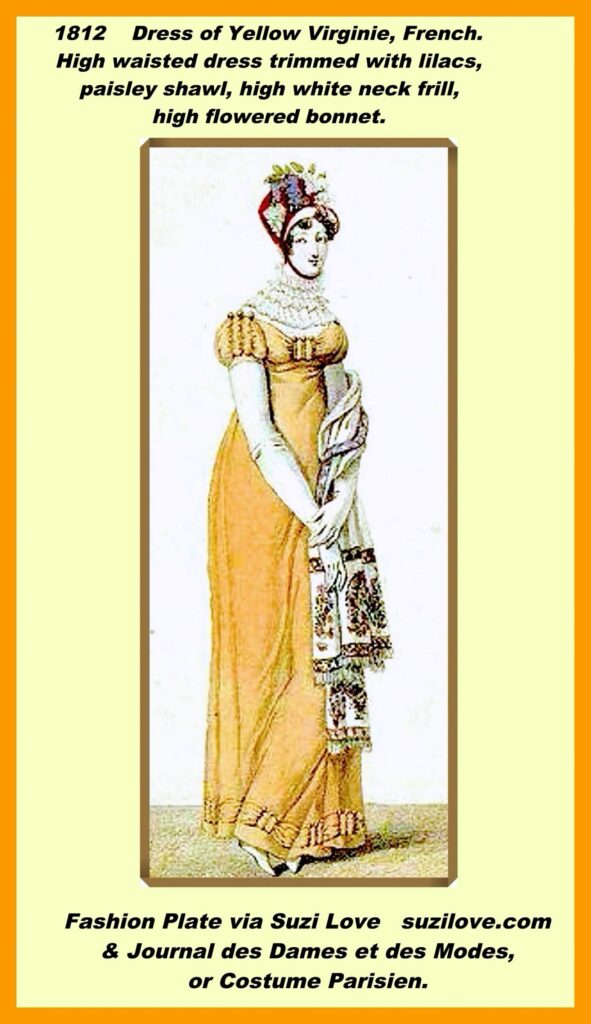
1812 Dress of Yellow Virginie, French. High waisted dress trimmed with lilacs, cashmere shawl, high white neck frill, high flowered bonnet. Fashion Plate via Journal des Dames et des Modes, Costume Parisien.
Typical of the Empire dresses worn by Jane Austen and her contemporaries. Low necklines and skirts that started directly under the bust and flowed into the classical relaxed wide styles of Greece and Rome. These high-waisted dresses were worn most days and cotton, silk or taffeta were the popular fabrics.
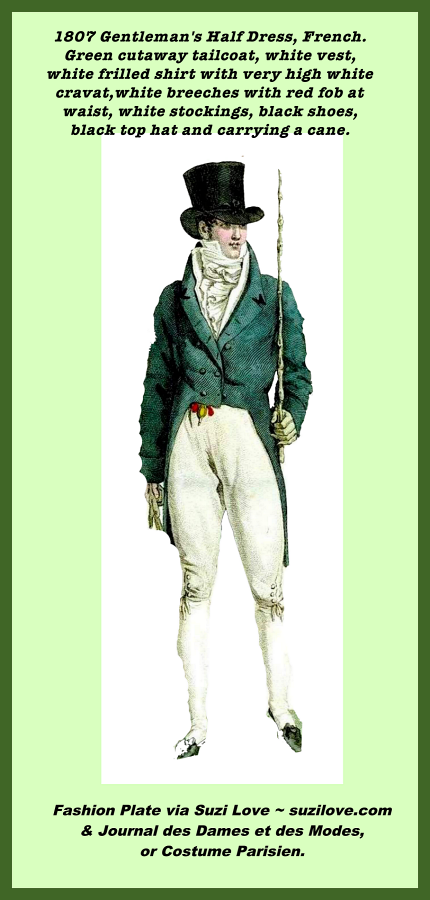
1807 Gentleman’s Half Dress, French. Green cutaway tailcoat, white vest, white frilled shirt with very high white cravat, white breeches with red fob at waist, white stockings, black shoes, black top hat and carrying a cane. Fashion Plate via Journal des Dames et des Modes, or Costume Parisien.
French fashions and Georgian and Regency Era fashions from Great Britain were copied around the world. This is the normal daily outfit for a gentleman in the early 1800s, or in the times of Jane Austen, for daily city and country life. https://books2read.com/SuziLoveFashionMen1800-1819


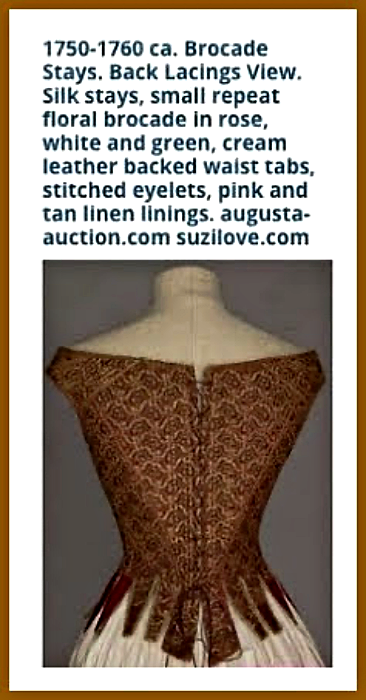
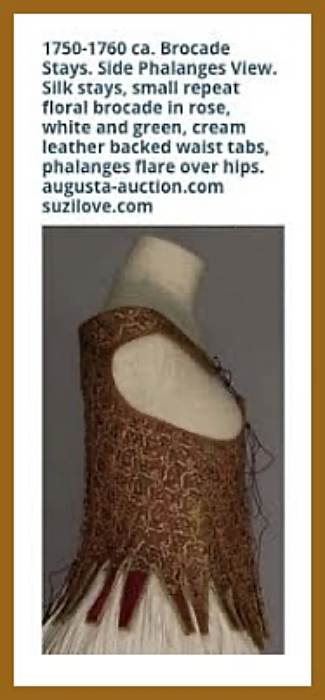
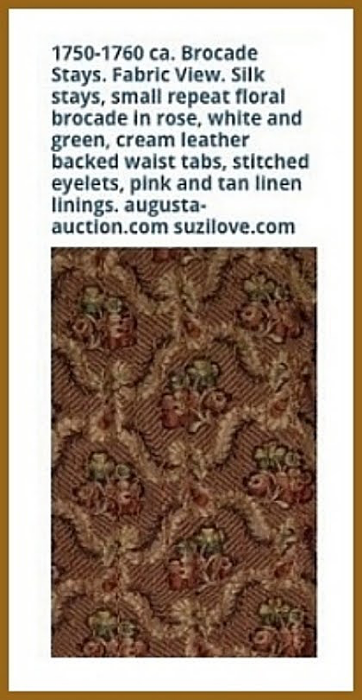
These silk stays have a small repeat floral brocade in rose, white, and green. There are cream, leather-backed waist tabs, stitched eyelets, and pink and tan linings. These stays, or corset, are unusual because they have both front and back lacings. This means that a lady could step in and out of her stays and then tighten the front lacing herself, thereby eliminating the need for assistance from a maid or dresser.
Women of the middle and lower classes needed to be able to dress themselves as they have no one to assist in tightening their lacings when they dressed. Most upper class ladies would be able to call upon a maid to help and would therefore generally use back lacing stays.



1805-1820 ca. Combination Shoe and Patten, Or Overshoe. Raises foot off the ground but still elegant enough to be genteel. Very practical but not to everyone’s taste. When Jane Austen and her family and friends went walking in the country, the ground was often very wet due to England’s high rainfall and snowfall so pattens were used to keep shoes and the hems of clothing out of the mud.
Only one of this pair of shoes survives. It effectively combines shoe and patten (overshoe) in one, so raising the foot off the ground but remaining sufficiently elegant to be considered genteel. This type of shoe was very practical but not to everyone’s taste. In 1840 The Shoemaker described it as going out of fashion partly because it looked ‘masculine for the chaster taste of the wearer’. via Victoria and Albert Museum, London, UK. collections.vam.ac.uk
