1799 Gentleman’s daily outfit of brown cutaway coat and baggy white trousers. #GeorgianEra #FashionPlate #France https://www.books2read.com/suziloveFashMen1700
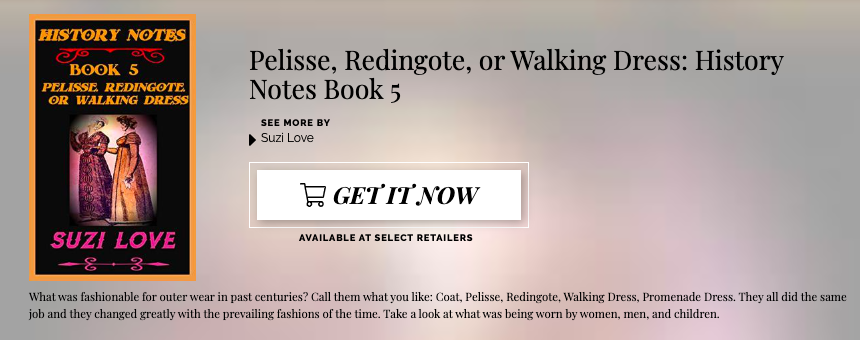
What was fashionable outdoor wear for Jane Austen and contemporaries? Reticules, Spencers, and Pelisses, or Walking Dresses, Or Redingotes. History Notes Books 3, 4, and 5 By Suzi Love.
What sort of coats did women wear during the Regency years? them what you like: Coat, Pelisse, Redingote, Walking Dress, Promenade Dress. Take a look at what was being worn by women, men, and children. books2read.com/suzilovePelisse
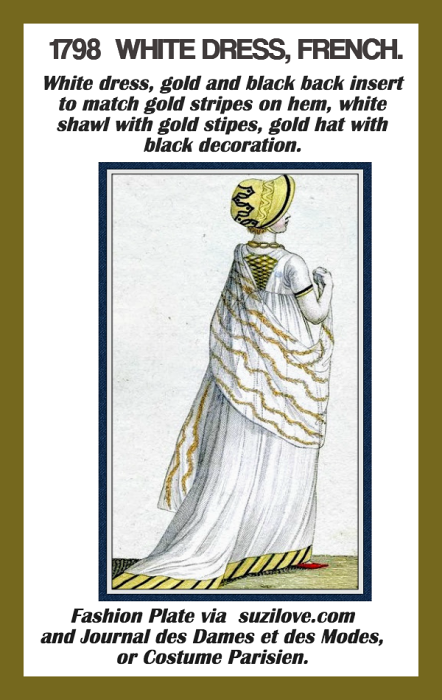
1798 White Dress, French. Gold and black back insert to match gold stripes on the hem, white shawl with gold stripes, gold hat with black decoration. Via Journal des Dames et des Modes or Costume Parisien.
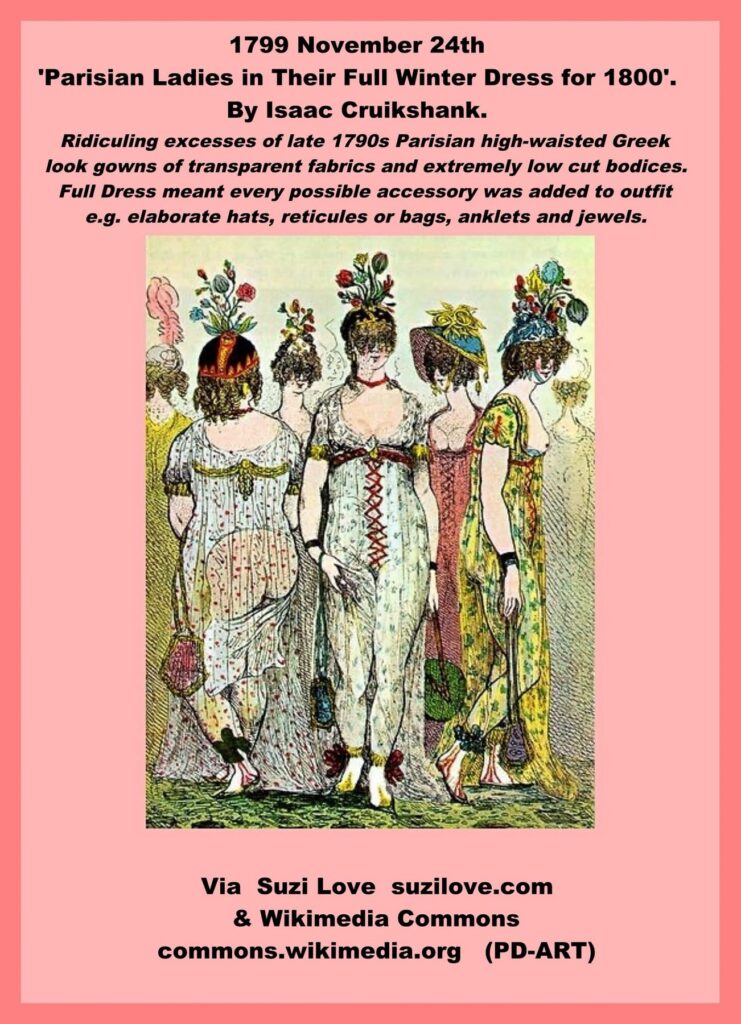
1799 November 24th ‘Parisian Ladies in Their Full Winter Dress for 1800’. By Isaac Cruikshank. Ridiculing excesses of late 1790s Parisian high-waisted Greek look gowns of transparent fabrics and extremely low cut bodices.Full Dress meant every possible accessory was added to outfits.g. elaborate hats, reticules or bags, anklets and jewels. Via British Museum, London, UK. britishmuseum.org (PD-Art)
1799 November 24th ‘Parisian Ladies in Their Full Winter Dress for 1800’. By Isaac Cruikshank. Ridiculing excesses of late 1790s Parisian high-waisted Greek look gowns of transparent fabrics and extremely low cut bodices.Full Dress meant every possible accessory was added to outfits.g. elaborate hats, reticules or bags, anklets and jewels. Via Suzi Love – suzilove.com & British Museum, London, UK. britishmuseum.org (PD-Art)1799 November 24th 'Parisian Ladies in Their Full Winter Dress for 1800'. Caricature By Isaac Cruikshank. #GeorgianEra #Cartoon #BritishHistory books2read.com/suziloveFashWomen1700s Share on XHN_1 Fashion Women Late 1700s History Notes Book 1 by Suzi Love.
What was fashionable for women in the late 1700s? Extravagant colors and fabrics and outrageous styles were all seen in these flamboyant fashions.
books2read.com/suziloveFashWomen1700s
This book shows how body wraps, stays, and corsets were worn to create a variety of fashionable silhouettes through past centuries. Corsets flattened breasts and accentuated rounded hips or pushed up breasts and showed off the bust line depending on the fashions of the time and the desired silhouette. Includes corsets through the Georgian, Regency, Victorian and Edwardian Eras and Jane Austen’s lifetime. Overview of corsets through history, including the Georgian, Regency, Victorian and Edwardian Eras and Jane Austen’s lifetime. History Notes Book 14.
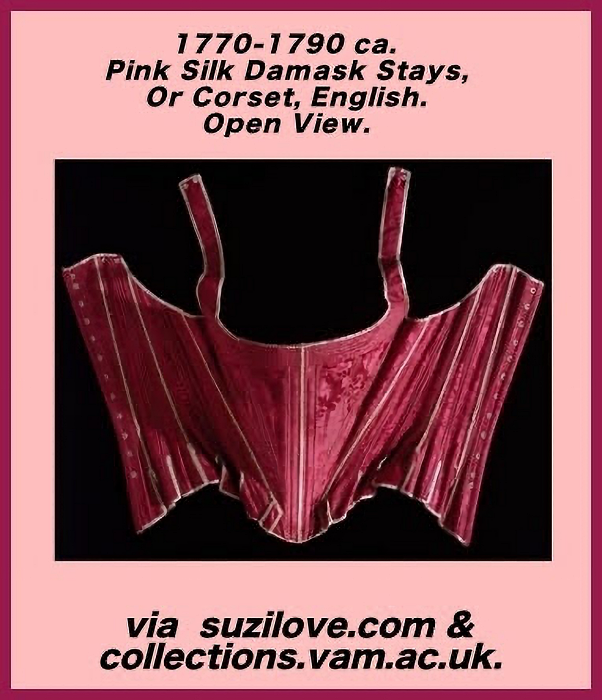
1770-1790 ca. Stays, or Corset, English. Pink silk damask, lined with linen, reinforced with whalebone, fingers spread over hips. via Victoria and Albert Museum, London, UK. collections.vam.ac.uk. https://books2read.com/SuziLoveCorsetBook15
1770-1790 ca. Front View. Pink Silk Damask Stays, Or Corset, English. via Victoria and Albert Museum, London, UK.
collections.vam.ac.uk.1770-1790 ca. Side View. Pink Silk Damask Stays, Or Corset, English. via Victoria and Albert Museum, London, UK.
collections.vam.ac.uk.1770-1790 ca. Back View. Pink Silk Damask Stays, Or Corset, English. via Victoria and Albert Museum, London, UK.
collections.vam.ac.uk.1770-1790 ca. Open View. Pink Silk Damask Stays, Or Corset, English. via Victoria and Albert Museum, London, UK.
collections.vam.ac.uk.1770-1790 ca. Side and Back Views. Pink Silk Damask Stays, Or Corset, English. via Victoria and Albert Museum, London, UK.
collections.vam.ac.uk.1770-1790 ca. Collage View. Pink Silk Damask Stays, Or Corset, English. via Victoria and Albert Museum, London, UK.
collections.vam.ac.uk.1770-1790 Pink Silk Damask Stays, Or Corset, English. #Georgian #Corset #BritishHistory1770-1790 Pink Silk Damask Stays, Or Corset, English. #Georgian #Corset #BritishHistory https://books2read.com/SuziLoveCorsetBook15 Share on XHN_15_D2D_Corsets 1700-1790
https://books2read.com/SuziLoveCorsetBook15
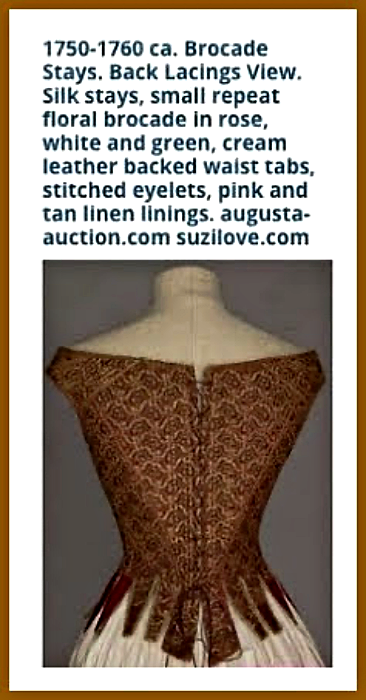
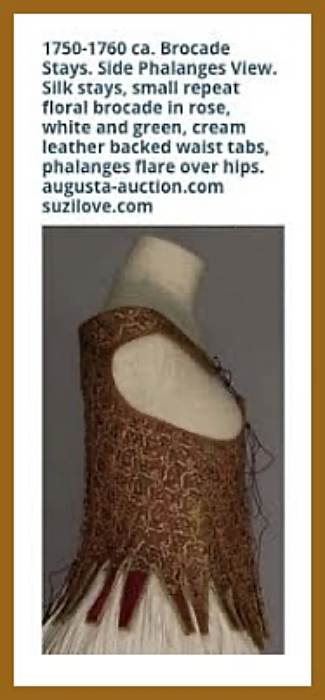
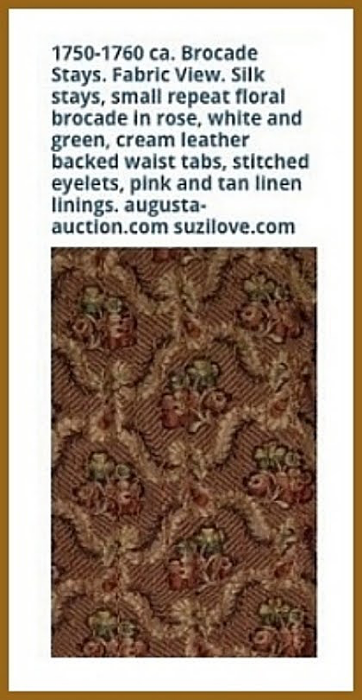
1750-1760 ca. Brown Silk Brocade Stays With Both Front and Back Lacings.
These silk stays have a small repeat floral brocade in rose, white, and green. There are cream, leather-backed waist tabs, stitched eyelets, and pink and tan linings. These stays, or corset, are unusual because they have both front and back lacings. This means that a lady could step in and out of her stays and then tighten the front lacing herself, thereby eliminating the need for assistance from a maid or dresser.
Women of the middle and lower classes needed to be able to dress themselves as they have no one to assist in tightening their lacings when they dressed. Most upper class ladies would be able to call upon a maid to help and would therefore generally use back lacing stays.
1750-1760 ca. Brown Silk Brocade Stays With Front and Back Lacings. Front Lacing View. via Augusta Auctions. augusta-auction.com1750-1760 ca. Brown Brocade Stays With Front and Back Lacings. Back Lacing View. via Augusta Auctions. augusta-auction.com1750-1760 ca. Brown Silk Brocade Stays With Front and Back Lacings. Side View. via Augusta Auctions. augusta-auction.com1750-1760 ca. Brown Silk Brocade Stays With Front and Back Lacings. Eyelet View. via Augusta Auctions. augusta-auction.com1750-1760 ca. Brown Silk Brocade Stays With Front and Back Lacings. Fabric View. via Augusta Auctions. augusta-auction.com1750-1760 ca. Brown Silk Brocade Stays With Both Front and Back Lacings #Georgian #History #Corset https://books2read.com/SuziLoveCorsetBook15 Share on X Corsets 1700-1790 History Notes Book 15 By Suzi Love ~ Award Winning Writer and Researcher. https://books2read.com/SuziLoveCorsetBook15
1790-1810 ca. Linen and Metal Corset, American Or European. Front Lacing. #Corset #RegencyEra #GeorgianEra #JaneAusten. https://books2read.com/SuziLoveCorsetBook16
1780 ca. Gold Silk Banyan, British. For at-home wear, a gentleman had a dressing gown, often with a matching waistcoat, and an undress cap or turban. “This yellow damask banyan with its bold Chinese Chippendale – inspired pattern would have been an imposing sight on the streets or in the drawing rooms of London.” via Metropolitan Museum New York City, U.S.A. metmuseum.org Credit: Catharine Breyer Van Bomel Foundation Fund, 1978 Accession Number:1978.135.1
From the Curator: ‘For at-home wear, a gentleman had a dressing gown, often with a matching waistcoat, and an undress cap or turban.As for breeches, they were not designed especially for this casual ensemble, but rather borrowed from other suits.The dressing gown was cut like a man’s loose coat and usually hung to the floor, though there were also versions that stopped below the knees. Since there were no fastenings, the wearer overlapped the dressing gown in front when he walked so that the sides did not billow out behind him.The sleeves were originally rolled back to form cuffs, but later dressing gowns display the fashionable cuff of their period.In England these dressing gowns were called “banyans” or “Indian nightgowns” because of their kimono-like form and Eastern origin. Banyans were made in a variety of fabrics, including silk brocades, damasks, and printed cottons. By the 1780s, gentlemen ventured out of doors in this comfortable and stylish costume. According to Town and Country Magazine in 1785: “Banyans are worn in every part of the town from Wapping to Westminster, and if a sword is occasionally put on it sticks out of the middle of the slit behind. This however is the fashion, the ton, and what can a man do? He must wear a banyan.”This yellow damask banyan with its bold Chinese Chippendale – inspired pattern would have been an imposing sight on the streets or in the drawing rooms of London.’ via Metropolitan Museum New York City, U.S.A. metmuseum.org