1842 History of England By Charles Knight. via Google Books (PD100)




1842 History of England By Charles Knight. via Google Books (PD100)
Are you a Bridgerton fan? Love Jane Austen? Love history? Take a look at a Young Gentleman’s Day in early 1800s. Young Gentleman’s Day Regency Life Series Books 2 by Suzi Love. Easy to read books on what a young gentleman did, wore, and lived during the early 1800s, or the Regency Era when King George 3rd was mad and his son, Prince George, was the Regent in Britain. #Regency #JaneAusten #amwriting books2read.com/suziloveYGD

What did an older lady do and wear in the Regency Era? Information & pictures for readers and writers of early 1800s history, nonfiction and fiction. books2read.com/suziloveOLD
The older lady’s day usually started with her toilette in her bedroom, where her maid helped her dress for the day and styled her hair. After that, she would join her family downstairs for breakfast unless she preferred a tray with either tea or hot chocolate in her bedroom as she prepared for her busy day. Her day would be made up of speaking with the housekeeper and the cook about the week’s menus, assuring that the servants were all available that day and no one was ill, and checking the list of foods needed. She would also enquire if the laundry was up to date and that they had enough good linen to make up all the beds before extended family members and guests arrived. If she was in the country and hosting a weekend house party, she would assign rooms to the guests on her lists and query that all was in readiness for their arrival.
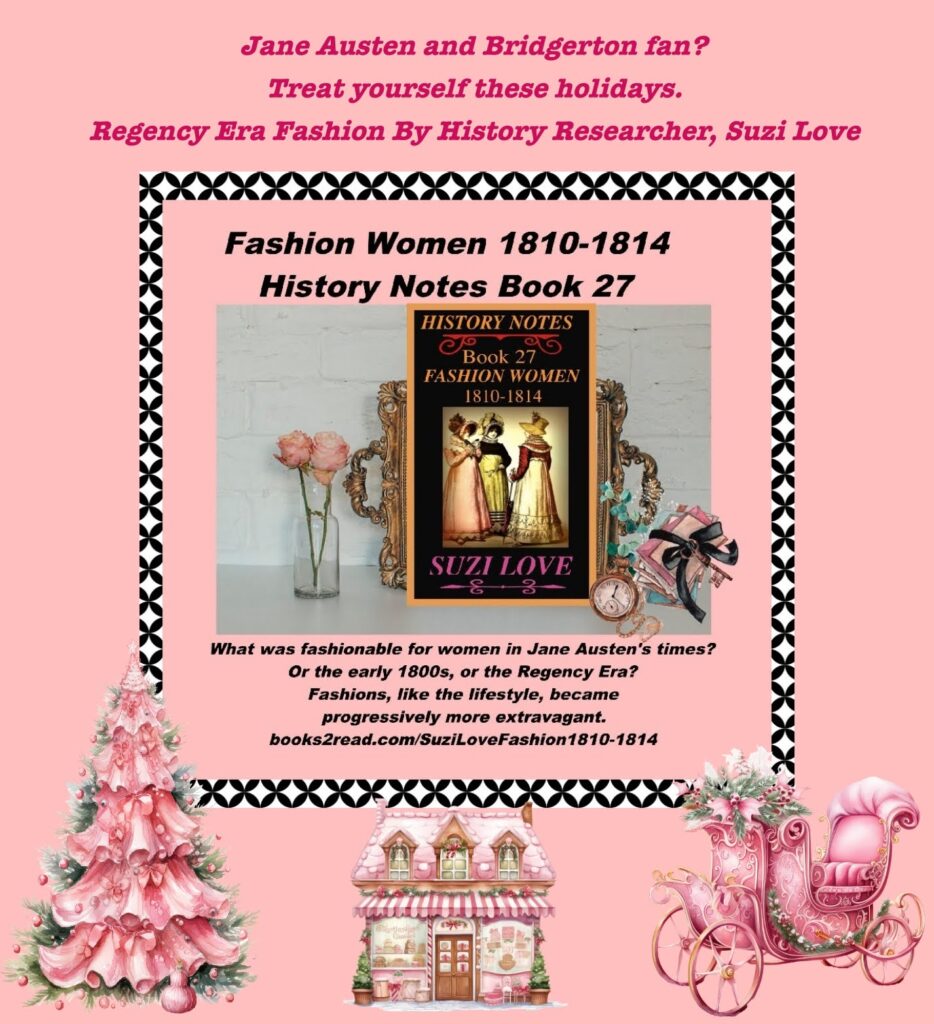
What was fashionable for women in Jane Austen’s times? Mourning, riding, daytime, evening clothing, plus underclothing, corsets and accessories. Fashion Women 1810-1814 History Notes Book 27 This book looks at what was fashionable for women in Jane Austen’s times, or the early 1800s, or the Regency Era in Britain. Wars were being fought around the globe so women’s fashion adopted a military look in support of soldiers. Fashions, like the lifestyle, became progressively more extravagant and accessories went from colorful to over-the-top. https://books2read.com/SuziLoveFashion1810-1814
The Lady’s Magazine said of the basis of women’s fashion that was popular for the first twenty years of the 1800s, ‘White is still the prevailing color for robes. For morning dresses, linen gowns, in large diamonds or squares, are fashionable. Indian muslins, plain or embroidered, are preferred to Florence and satins. The designs of embroidery for shawls are of infinite variety. Long gloves, which reach above the elbow, are not yet laid aside. Medallions are hung around the neck from crossed chains and some of these medallions are shaped like the bags, called ridicules. These reticules are of the lozenge or hexagon shape, with a small tassel at each angle. Reticules, or ridicules, are in lozenge or hexagon shapes with a small tassel at each angle. In capotes, or hats, and ribbands, the violet and dark green prevail over jonquil. Bracelets in hair, pear-shaped ear-rings, medallions on square plates, saltiers of colored stones, are still in fashion.’

Early in the reign of Queen Victoria,
Hawkesbury House in Belgravia, London
”Remove that hideous gown!” Justin Tremayne, known in amusement- seeking society as Handsome Hawkesbury or the Virile Viscount, struggled to hide his rising frustration. “I need to examine your body. All of it.”
Thomas, red-faced, lurched to his feet. “I say, Justin, she seems like a lady.”
“Thomas, you should know by now, on the outside they’re all ladies. However, underneath they all seek the same thing.”
The woman flinched. Justin yawned, not bothering to cover his mouth, and then collapsed back into his armchair. Leaning his head back on the headrest, he laughed. “My love, if you’ve better to show me than them, do as I’ve asked. Undress!”
She muttered something that sounded like, “Rude swine.” He laughed and indicated the empty space on the chaise longue beside Bart. “If you’re suffering personal timidity, at least take a seat and watch. Give the girls your opinion on what tricks attract gentlemen the fastest. What do you do to entice a man?” Her hands fisted at her sides but she stood her ground.
“I realize you’re amusing yourself at my expense, but I give you fair warning, my lord. If you continue with these childish taunts and force me to leave without letting me speak to you, in private, you’ll regret it later.”
He pointed to the door. “And I’m also issuing a warning. Join in or leave. Perkins will show you out. I’ve run out of patience with the so- called weaker sex and the schemes and lies that women seem to delight in bringing to my door.”
https://books2read.com/suziloveTVPH The Viscount’s Pleasure House. Irresistible Aristocrats Book 1 By Suzi Love.

Brenton, Lord Mallery, sniffed again. Shook his head in denial. Ridiculous to imagine Lillian, his Lillian, was the wearer of that country orchard scent. Or to picture her here, at a pleasure house ball. Bloody hell, perhaps his family’s worst fears had become a reality and he’d morphed from a recluse into a madman.
His cousin, Michael, stared at him and snorted. ‘What on earth are you doing?’
Brent shook his head again. ‘Must be imagining things. I know only one person who wears that perfume and she mixes it herself, her own blend of citrus fruits. That woman is a lady and a duke’s daughter and certainly wouldn’t be attending a courtesan’s ball.’
‘Good God! You don’t mean−’

Christmas: Yule Log
Pagans burned a great log and a mammoth candle on the 21st of December, the shortest day in the year, because it was seen as the turning-point in the conflict between the contending forces of winter and spring.
From Harpers Bazaaar “The Yule-block, or Christmas-log, with its warm welcome, extending even to the poor and the stranger as they gathered around the hospitable board is being gradually supplanted by the Christmas-tree.”
Formerly the Yule-log, a huge section of the birch, was cut from a tree selected on Candlemas-day, which so late as the time of Queen Elizabeth was the last day of the Christmas holidays. On the following Christmas-eve it was dragged in and placed upon the hearth with great ceremony, the merry-makers pulling with a will, and singing the while the modernized Christmas carol commencing,
“Come, bring with a noise,
My merrie, merrie boys,
The Christmas-log to the firing.”
It was then kindled with a brand from last year’s Christmas fire, which, if it was not thus kept continually burning, still linked the merrymaking of one Christmas-time to that of another.
In Ramsgate, Kent, and the Isle of Thanet, the custom styled “hodening” is still in vogue. The “hoden,” which appears to be a cross between the “white horse” and the Klapperbock of the Germans, is accompanied by a number of youths in fantastic dress, who go round from door to door ringing bells and singing Christmas carols.


The Boar’s head At Christmas.
Christmas in the Olden Time by Walter Scott.
Then was brought in the lusty brawn
By old blue-coated serving man;
Then the grim boar’s head frowned on high,
Crested with bays and rosemary.
Well can the green-garbed ranger tell
How, when and where the monster fell;
What dogs before his death he tore,
And all the baitings of the boar.
The wassal round, in good brown bowls,
Garnished with ribbons, blithely trowls.
There the huge sirloin reeked: hard by
Plum-porridge stood, and Christmas pye;
Nor failed old Scotland to produce,
At such high-tide, her savory goose.
Because wild boar was the most feared animal, serving it at a meal represented the victory of good over evil. During the 17th century, wild boar became extinct in Britain so a pig’s head was used instead. The head was often presented on a decorated platter with an apple in its mouth and carried in by bearers in a dramatic manner. The tradition of serving ham for Christmas lunch or dinner probably came from the idea of serving boar’s head or roasted boar joints to guests at Christmas.
To say nothing of the roast beef and plum-pudding, Christmas pies, furmity, and snap-dragons, the Yule-log and the mistletoe have not finally abdicated, while the boar’s head, decorated with rosemary or prickly holly, maintains its place at the English Christmas dinner, and is still served up in great state at the royal Christmas table. At Oxford, U.K., the boar’s head was carried in by the strongest of the guardsmen, singing a Christmas carol, and preceded by a forester, a huntsman, and a couple of pages dressed in silk and carrying the mustard which was regarded as a great luxury and an infallible digester.


The following celebrated carol of the Boar’s Head is found in the book of ‘Christmasse Carolles’ published in 1521 by Wynkyn de Warde:
The boar’s head in bande bring I,
With garlandes gay and rosemary,
I pray you all synge merely,
Qui estis in convivio.
“The bore’s head, I understande,
Is the chefe servyce in this lande.
Loke wherever it be fande,
Servite cum cantico.
“Be gladde, lordes, both more and lasse,
For this bath ordayned our stewarde,
To chere you all this Christmasse,
The bore’s head with mustarde.”
At Oxford, U.K., the boar’s head was carried in by the strongest of the guardsmen, singing a Christmas carol, and preceded by a forester, a huntsman, and a couple of pages dressed in silk and carrying the mustard which was regarded as a great luxury and an infallible digester. A similar custom appears to have prevailed in Genoa in the times of the Dorias when a boar decorated with branches of laurel and accompanied by trumpeters was annually presented to the Doria family by the Abbot of San Antonio at Pré at midday on the 24th of December.
Another Christmas Tradition is kisisng under the Mistletoe. So have fun this Christmas and find someone to kiss. The problem in hotter climates is to find the Mistletoe, of course. Darn!
Mistletoe was used by Druid priests 200 years before the birth of Christ in their winter celebrations. They revered the plant since it had no roots yet remained green during the cold months of winter. The ancient Celtics believed mistletoe to have magical healing powers and used it as an antidote for poison, infertility, and to ward of evil spirits. The plant was also seen as a symbol of peace, and it is said that among Romans, enemies who met under mistletoe would lay down their weapons and embrace.
Scandanavians associated the plant with Frigga, their goddess of love, and it may be from this that we derive the custom of kissing under the mistletoe. Those who kissed under the mistletoe had the promise of happiness and good luck in the following year. Mistletoe was associated with Christmas as both a decoration under which lovers kiss, as well as a protection from witches and demons. Sounds romantic, although mistletoe is actually a parasitic plant that grows on other trees or plants and comes in many varieties.
In Britain, mistletoe was mainly found in the western and southwestern parts, so the custom wasn’t even followed in all parts of England. But where the mistletoe custom was followed, it was hung in doorways and the greenery was watched by young gentlemen in hopes of catching a pretty girl to kiss, usually on the cheek.
Traditionally, a man was allowed to kiss a woman who was standing underneath mistletoe and bad luck would befall any woman who refused. In some places, it was the custom to pick a berry for each kiss and when all the berries were gone, no more kisses could be taken.


Christmas Greenery: Holly, Ivy and Evergreen Boughs. #Christmas #Holidays #customs #Europe https://books2read.com/suziloveHOCP
Continue reading →