Craftsmen created containers of precious metals, leather, and silks and decorated them with jewels and engraving. Jane Austen and her contemporaries would have used writing boxes, linen boxes when travelling, boxes to hold their food and drink supplies while traveling by carriage, and decorative boxes to keep letters, ribbons, gloves, hairpins etc. Boxes, Cases, and Necessaires By Suzi Love, History Notes Book 11. books2read.com/suziloveBoxesCases.
HN_11_Craftsmen created containers of precious metals, leather, silks, and decorated them with jewels to make exquisite and expensive items as well as practical carrying cases. books2read.com/suziloveBoxesCases
Jane Austen and the Bridgerton family used boxes of metal, leather, or silks, decorated with jewels and engraving. #Bridgerton #Travel #JaneAusten #RegencyEra #Antiques books2read.com/suziloveBoxesCases
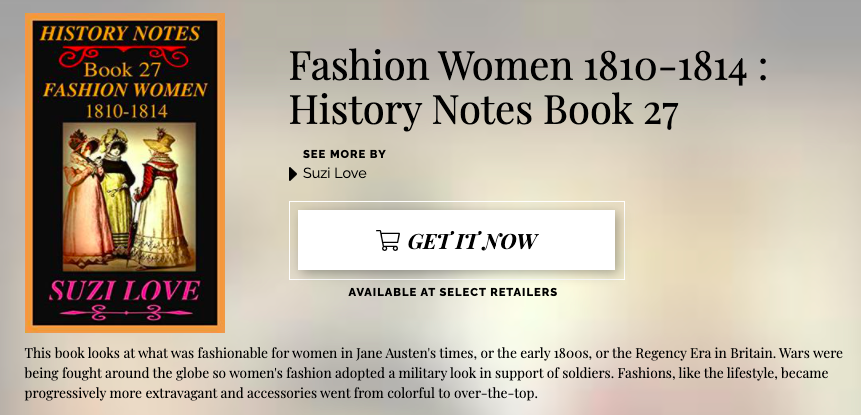
What was fashionable for women in Jane Austen’s times? Mourning, riding, daytime, evening clothing, plus underclothing, corsets and accessories. Fashion Women 1810-1814 History Notes Book 27 This book looks at what was fashionable for women in Jane Austen’s times, or the early 1800s, or the Regency Era in Britain. Wars were being fought around the globe so women’s fashion adopted a military look in support of soldiers. Fashions, like the lifestyle, became progressively more extravagant and accessories went from colorful to over-the-top. https://books2read.com/SuziLoveFashion1810-1814
The Lady’s Magazine said of the basis of women’s fashion that was popular for the first twenty years of the 1800s, ‘White is still the prevailing color for robes. For morning dresses, linen gowns, in large diamonds or squares, are fashionable. Indian muslins, plain or embroidered, are preferred to Florence and satins. The designs of embroidery for shawls are of infinite variety. Long gloves, which reach above the elbow, are not yet laid aside. Medallions are hung around the neck from crossed chains and some of these medallions are shaped like the bags, called ridicules. These reticules are of the lozenge or hexagon shape, with a small tassel at each angle. Reticules, or ridicules, are in lozenge or hexagon shapes with a small tassel at each angle. In capotes, or hats, and ribbands, the violet and dark green prevail over jonquil. Bracelets in hair, pear-shaped ear-rings, medallions on square plates, saltiers of colored stones, are still in fashion.’
These are the types of outfits worn by Jane Austen and contemporaries in English magazines, where French fashions were obsessively copied despite the two countries being at war for many years. In Jane Austen’s years, she and her contemporaries spent a lot of time walking outdoors. People were encouraged to partake in outdoor pursuits to maintain good health. Fragile slippers were worn for balls and evening events but for walking sturdier shoes were needed, In the early 1800s, these were typically made of leather, had a very small heel, slightly rounded toes and were laced up on the top.
What was fashionable in Bridgerton and Jane Austen’s times? Mourning, riding, daytime, evening fashion plus underclothing. #Bridgerton #JaneAusten #RegencyFashion https://books2read.com/SuziLoveFashion1810-1814
Are you a reader or writer of Regency Romance? Love Jane Austen’s books? Want to know more about the mourning, riding, underclothing and other Regency Era women’s fashions in Regency romances? What was fashionable for women in Jane Austen’s times? Mourning, riding, daytime, evening clothing, plus underclothing, corsets and accessories. This book looks at what was fashionable for women in Jane Austen’s times, or the early 1800s, or the Regency Era in Britain. Wars were being fought around the globe so women’s fashion adopted a military look in support of soldiers. Fashions, like the lifestyle, became progressively more extravagant and accessories went from colorful to over-the-top.
Love Bridgerton and Jane Austen fashions? Mourning, riding, daytime, evening fashions plus corsets and underclothing. #Bridgerton #JaneAusten #RegencyFashion https://books2read.com/SuziLoveFashion1810-1814
Young Lady’s Day is Book 4 in the Regency Life Series. This book depicts the often-frivolous life and fashions of a young lady in the early 1800’s, but also gives a glimpse into the more serious occupations a young lady may undertake. Through historic images, historical information, and funny anecdotes, it shows how a young lady fills her day, where she is permitted to go, and who she is allowed spend time with. These light-hearted looks at the longer Regency years are an easy to read overview of what people did and wore, and where they worked and played. There is plenty of information to interest history buffs, and lots of pictures to help readers and writers of historical fiction visualize the people and places from the last years of the 18th Century until Queen Victoria took the throne.
Love the Bridgertons? Jane Austen fan? Early 1800’s glimpse into frivolous and serious occupations filling a young lady’s day. #Bridgerton #JaneAusten #RegencyEra #Nonfiction #AmWriting https://books2read.com/suziloveYLD
Craftsmen created containers of precious metals, leather, and silks and decorated them with jewels and engraving. Jane Austen and her contemporaries would have used writing boxes, linen boxes when travelling, boxes to hold their food and drink supplies while traveling by carriage, and decorative boxes to keep letters, ribbons, gloves, hairpins etc. Boxes, Cases, and Necessaires By Suzi Love, History Notes Book 11. books2read.com/suziloveBoxesCases.
Jane Austen, the Bridgerton family, and contemporaries used jeweled boxes of metal, leather, or silks. #Bridgerton #Travel #JaneAusten #RegencyEra #Antiques books2read.com/suziloveBoxesCases
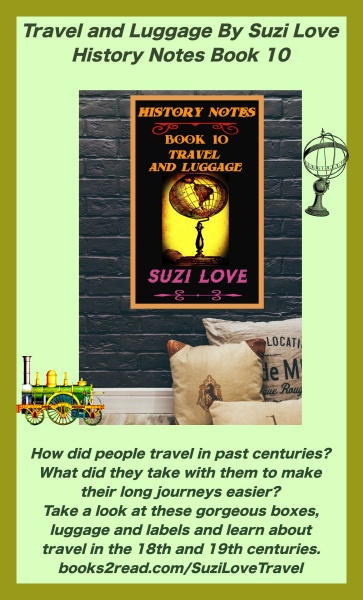
How did people travel in Jane Austen and Bridgerton years? What did they take with them to make their long journeys easier? Travel by road, ship, canal, or railway all took a long time and had dangers so people learned to prepare. And then, in the nineteenth century, road improvements, inventions, and scientific developments made travel more pleasurable. Travel and Luggage By Suzi Love History Notes Book 10 books2read.com/SuziLoveTravel
Horse Power To Steam. Various alternatives to horse power were tested in London’s streets during the 19th century. Steam powered road engines and trams proved too heavy and damaged the roads. Stationary steam engines were used to haul trams attached to a cable but these were only really effective on hills that we too steep for horses. There were also experiments with trams driven gas engines and battery electric power. but was successfully developed. Petrol engines were still primitive and unreliable in the 1890s. In 1900 the reliable horse still dominated the streets of London but new technology was to revolutionize road transport.
Travel and Luggage By Suzi Love History Notes Book 10. How did people travel in Jane Austen’s times. In past centuries? What did they take with them to make their long journeys easier? Travel by road, ship, canal, or railway all took a long time and had dangers so people learned to prepare. And then, in the nineteenth century, road improvements, inventions, and scientific developments made travel more pleasurable. books2read.com/SuziLoveTravel HN_10_D2D_RetailerBuyLink_Travel and Luggage By Suzi Love History Notes Book 10 #History #travel How did people travel in past centuries? What did they take with them to make their long journeys easier? books2read.com/SuziLoveTravel
1775-1777 ca. Snuffbox With Medallion, Russian. Made by Johann Baltasar Gass St Petersburg, Russia. Gold, silver, cut diamonds; chased, engraved and pounced. via liveinternet.ru
18th Century Snuff Boxes. Not only were boxes made to serve a purpose, but decorative boxes of all types were prized, especially in the 18th Century when everything decorative and extravagant was in vogue and taking a pinch of snuff was fashionable. Snuff is made from ground or pulverized tobacco leaves and is sniffed from a pinch of snuff placed on the back of the hand. Flavorings were added to the tobacco to give a fast hit of nicotine and a lasting scent. Snuff began in the Americas and was used in Europe by the 17th Century.
1775-1777 ca. Snuffbox With Medallion, Russian. Made by Johann Baltasar Gass St Petersburg, Russia. Gold, silver, cut diamonds; chased, engraved and pounced. via liveinternet.ru
Snuff became popular from the mid 1600s to the mid 1800s and was more popular than smoking. Inhaling snuff, or snuffing, was first seen by a European missionary in 1493 in Christopher Columbus’s new world within Haiti’s indigenous Taino. Until then, tobacco had been unknown to Europeans, but its use spread quickly throughout Europe during the 1500s. By the second half of the 17th century, ornate boxes started being produced to keep the precious powder dry and an entire industry making accessories blossomed around the fashion of taking snuff. Noblemen, and some women, carried extravagantly decorated snuff boxes with them at all times and would offer a pinch of their own particular blend to friends and family. Therefore, these boxes were always on display and so it became a competition to see who could have the most bejeweled or expensive box possible.
19th Century Late. Sterling Silver Five Piece Writing or Desk Set, Peru (under German Company). Hinged cut crystal inkwell with beveled edges, wheel cut starburst at base, wax seal with blank matrix, blotter, dip pen and letter opener. Each with guilloche enamel featuring yellow rose with lush green leaves on pale blue background, trimmed with a lighter shade of blue enamel. Dip pen with allover pale blue guilloche enamel, pen nib marked 14k Gold Plated.
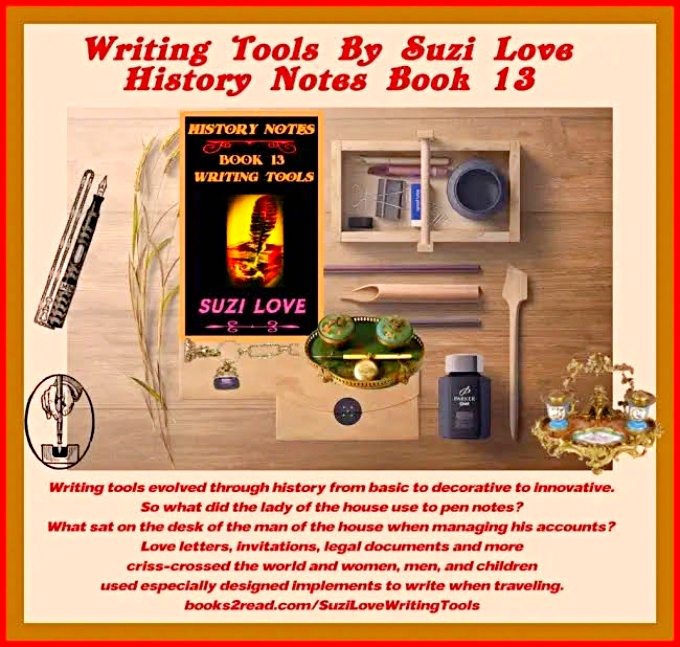
HN_13_D2D_WritingTools Book 13 What did the lady of the house use to pen notes? What sat on the desk of the man of the house when managing his accounts? #History #Nonfiction #travel books2read.com/SuziLoveWritingTools
What did the lady of the house use to pen notes in Bridgerton and Jane Austen’s years? What sat on the desk of Jane Austen’s male contemporaries when they managed household and estate accounts? books2read.com/SuziLoveWritingTools. Writing Tools, History Notes Book 13.
1809 Messrs. Harding Howell and Co., London, UK. View of interior of Harding Howell and Co., draper’s shop on Pall Mall. Ladies examine latest fashions and fabrics which they could then request of their dressmakers. This house extended 150 feet from front to back and was divided by glass petitions into four departments, furs and fans, haberdashery, jewellery, ornaments and perfumes, and millinery. bl.uk
1809 Interior of Messrs. Harding Howell and Co. Draper’s Shop, Pall Mall, London, U.K.







![19th Century Late SterlingSilverFivePieceWritingorDeskSetPeru_Dippenwithpaleblueguillocheenamel_pennib14kGoldPlatedbatch.jpg ]
19th Century Late. Sterling Silver Five Piece Writing or Desk Set, Peru (under German Company). Hinged cut crystal inkwell with beveled edges, wheel cut starburst at base, wax seal with blank matrix, blotter, dip pen and letter opener. Each with guilloche enamel featuring yellow rose with lush green leaves on pale blue background, trimmed with a lighter shade of blue enamel. Dip pen with allover pale blue guilloche enamel, pen nib marked 14k Gold Plated.](https://suzilove.files.wordpress.com/2021/06/writing_19th_century_late_writing-and-desk-setperu_lge-1_lge_sml.jpg?w=554)