1845-1865 ca. Cream Silk Evening Slippers, British. Cream evening shoes with ankle ties and lace trim. Trim is unusual because mid 19th Century ladies’ shoes were often plain as only toes showed beneath fashionable long skirts. Designed By Hobbs, famous London shoemaker, and with a label attached to lining with a regal crest to show maker’s royal patronage. via Metropolitan Museum, NYC, U.S.A. metmuseum.org
Fashion Women 1815-1819 History Notes Book 28 https://books2read.com/SuziLoveFashionWomen1815-1819
A sedan chair is a portable enclosed chair for a single passenger. It was generally carried by two “chairmen” holding poles attached to either side of the chair. Sedan chairs were fashionable in England and Europe during the 17th, 18th and early 19th centuries and were an important part of the social life of the times. They were very useful for negotiating crowded, unsafe, narrow, winding and often filthy streets and were particularly used by “invalids, ladies and party goers”. Sedan chairs had the advantage of being able to be carried up and down stairs and could deliver the passenger from inside their own home to inside their destination without having to step outside.
1784 Sedan Chair. ‘The return from a masquerade. A morning scene.’ A young lady dressed as shepherdess with staff slumps in a sedan chair. Asleep or drunk her head and shoulders hang outside window. Two porters smile and dwarf chimney sweep carries a mask.’ By Robert Dighton and Cari.
1784 Sedan Chair. ‘The return from a masquerade. A morning scene.’ A young lady dressed as shepherdess with staff slumps in a sedan chair. Asleep or drunk her head and shoulders hang outside window. Two porters smile and dwarf chimney sweep carries a mask.’ By Robert Dighton and Cari.
The 19th century English author, Elizabeth Gaskell, described the use and function of the sedan perfectly in her novel “Wives and Daughters” when she reminisced how the Browning sisters chose to be transported to a ball by sedan chair, which ‘came into the parlor, and got full of the warm air, and nipped you up, and carried you tight and cosy into another warm room, where you could walk out without having to show your legs by going up steps, or down steps.’
The Bath Chair was invented in Bath, England, in the mid 18th Century to transport the wealthy and the sick around the city. It could be steered by the passenger and rivaled and then outdid the Sedan Chair as only one chairman was needed to operate it. The last Bath Chairman retired in 1949.
Typical 1700s, or Eighteenth Century Sedan Chair. Portable enclosed chair for single passenger usually carried by two chairmen holding poles attached to either side of chair. Fashionable during 17th, 18th and early 19th centuries when needed to negotiate crowded, unsafe, narrow, and dirty streets. Used by invalids, ladies and party goers. The sedan chair comprises a small kiosk with a curved timber roof which is covered with leather and studded with brass nails. The front and side panels are painted in green with floral decorations of cherubs and flowers. The back panel is of plain timber. Access to the chair was via a hinged door at the front. Inside, the chair is upholstered in silk and features padded upholstered arm rests. The windows have raw silk curtains which are gathered with tassels. The present brackets and poles are reproductions made in 1986 prior to display in the Transport exhibition. The total length of the new poles are 80 inches. The sedan chair door lock features the initials “V.F.” and a set of crossed keys with the wording “PARIS” and the number “34”. Via Powerhouse Museum, Sydney, Australia.
Typical 1700s, or Eighteenth Century Sedan Chair. Portable enclosed chair for single passenger usually carried by two chairmen holding poles attached to either side of chair. Fashionable during 17th, 18th and early 19th centuries when needed to negotiate crowded, unsafe, narrow, and dirty streets. Used by invalids, ladies and party goers. The sedan chair comprises a small kiosk with a curved timber roof which is covered with leather and studded with brass nails. The front and side panels are painted in green with floral decorations of cherubs and flowers. The back panel is of plain timber. Access to the chair was via a hinged door at the front. Inside, the chair is upholstered in silk and features padded upholstered arm rests. The windows have raw silk curtains which are gathered with tassels. The present brackets and poles are reproductions made in 1986 prior to display in the Transport exhibition. The total length of the new poles are 80 inches. The sedan chair door lock features the initials “V.F.” and a set of crossed keys with the wording “PARIS” and the number “34”. Via Powerhouse Museum, Sydney, Australia.
The longest journey recorded in a sedan chair was made by Princess Amelia, youngest daughter of King George III, who in 1728 was carried by 8 chairmen working in reliefs from London to Bath, a distance of 172 kms (107 miles). This sedan chair door lock features the initials “V.F.” and a set of crossed keys with the wording “PARIS” and the number “34”.
HN_10_D2D_RetailerBuyLink_ History Notes Book 10 books2read.com/SuziLoveTravel
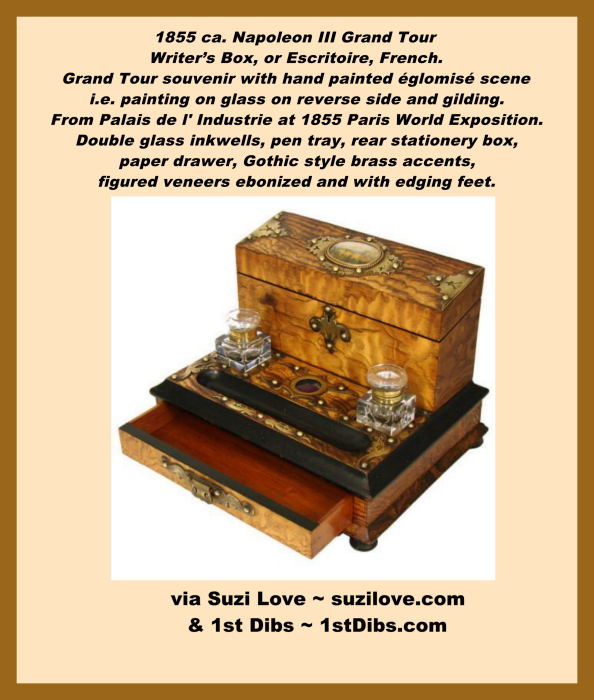
1855 ca. Napoleon III Grand Tour Influenced Travel Writer’s Box, Or Ecritoire, French. Double inkwell with rear stationery box, Gothic style brass accents and Grand Tour souvenir hand painted eglomise scene, the Palais de l’ Industrie from the 1855 Paris World Exposition! Figured veneers, ebonized edging, feet and pen tray and brass or bronze accents. via 1st Dibs 1stdibs.com
HN_13_D2D_WritingTools Book 13 What did the lady of the house use to pen notes? What sat on the desk of the man of the house when managing his accounts? #History #Nonfiction #travel books2read.com/SuziLoveWritingTools
19th Century Early. Gilt and Patinated Bronze Inkstand , or Encrier, or a little reservoir of ink. Rectangular base mounted with a round lidded ink pot with a porcelain container and a sand pot, each raised on winged lion feet, centered by a palm decorated columnar carrying handle, with two pen holes. via 1st Dibs Auctions 1stdibs.com
The type of inkstand that households would have in Bridgerton and Jane Austen households for writing letters and keeping track of estate matters.
HN_13_D2D_WritingTools Book 13 What did the lady of the house use to pen notes? What sat on the desk of the man of the house when managing his accounts? #History #Nonfiction #travel books2read.com/SuziLoveWritingTools
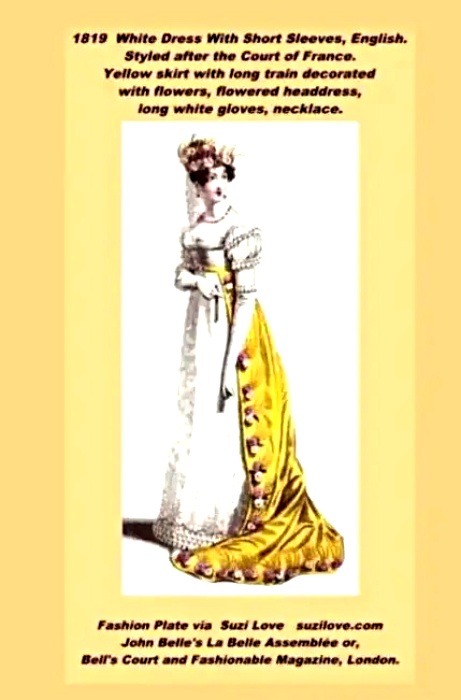
1819 White Dress With Short Sleeves, English. Styled after the Court of France. Yellow skirt with long train decorated with flowers. Flowered headdress, long white gloves, necklace.Fashion Plate via John Belle’s La Belle Assemblée or, Bell’s Court and Fashionable Magazine, London.
Fashion Women 1815-1819 History Notes Book 28 https://books2read.com/SuziLoveFashionWomen1815-1819
Reader or Writer of Regency Era Books? Love the Bridgertons and Jane Austen? Nonfiction book, Older Gentleman’s Day, gives an overview of his daily life by Award Winning researcher and author, Suzi Love. A sometimes comical look at an older gentleman’s clothing, social life, and responsibilities in the early 1800s. Take a look at where he went, what he wore, and how he managed the family’s finances. Older Gentleman’s Day, Regency Life Series Book 3 books2read.com/suziloveOGD
Regency is the time period in England that began in 1811 when King George III had increasing bouts of madness and was finally declared mad. The Prince of Wales was officially named Regent, often referred to as “Prinny”, and the Regency period ran until 1820 when King George III died and the prince was crowned King George IV. The long Regency era is from the time of Jane Austen and the Napoleonic Wars until the time Queen Victoria ascended the throne.
RL_3_OGD_Older Man’s Day Regency Life Series Book 3 by Suzi Love #Regency #History books2read.com_suziloveOGD
Reader or Writer of the Regency Era? Love the Bridgertons and Jane Austen? Try Older Gentleman’s Day for an overview of daily life. #Bridgerton #RegencyEra #JaneAusten #nonfiction http://books2read.com/suziloveOGD
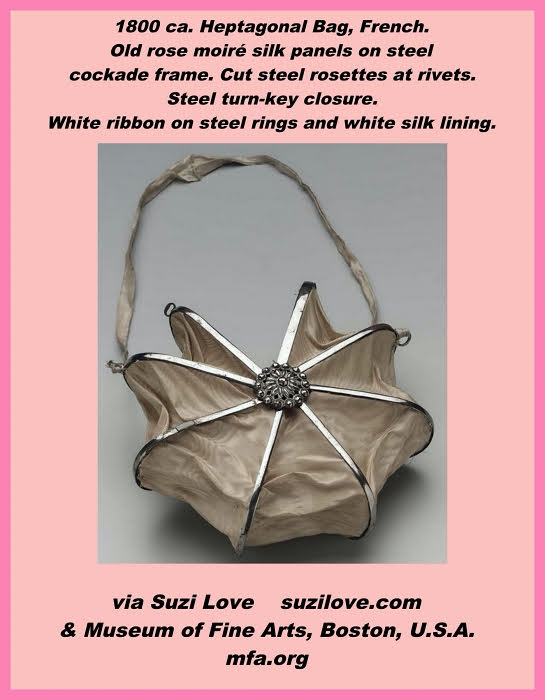
1800 ca. Heptagonal Bag, French. Old rose moiré silk panels on steel cockade frame. Cut steel rosettes at rivets. Steel turn-key closure. White ribbon on steel rings. White silk lining. Credit: The Elizabeth Day McCormick Collection via Museum of Fine Arts, Boston, U.S.A. mfa.org
Reticule Or Bag: As the silhouette of dresses became more form fitting and fabrics lighter and more transparent, pockets could no longer be hidden in the folds of skirts or underwear. Something else was needed to hold a lady’s essentials. Small purses, like men’s money pouches, were used by women to carry money for gambling, sewing necessities, and women’s daily requirements such as combs. A bag or purse, often with a drawstring to pull closed and usually made of cloth or covered cardboard and often decorated with beading or embroidery was called a reticule, or ridicule. They came in a variety of shapes, sizes, and materials. Jane Austen and her contemporaries would have purchased or hand made reticules, or bags, for each other for gifts and carried them with them whenever they went out.
1800 ca. Heptagonal Bag, French. Old rose moiré silk panels on steel cockade frame. Cut steel rosettes at rivets. Steel turn-key closure. White ribbon on steel rings. White silk lining. Credit: The Elizabeth Day McCormick Collection via Museum of Fine Arts, Boston, U.S.A. mfa.org
1800 ca. Heptagonal Bag Of Old Rose Moiré Silk Panels With A Steel Turn-Key Closure. #JaneAusten #France #Reticule books2read.com/suziloveReticules
1780 ca. English Guitar, Lisbon Made by Jaco Vieira da Silva. Pine back, sides and soundboards, with pine and wood purfling or bordering, brass openwork rose, framed with mother-of-pearl. The English guitar was a fashionable instrument from about 1750, considered easy to play and tuned in C major, although the player would use a capo, much like a modern folk-guitarist, in order to change the key. The tuning pegs were often small metallic pins that could be turned with a watch-key, to keep the strings in tune longer. This instrument was made in Portugal, a country with strong trading links with England, and its peg box is decorated with a paper ‘cameo’ in imitation of a jasper ware medallion, a motif made popular by Josiah Wedgwood (1730-1795) from about 1770. Victoria and Albert Museum, London, U.K. History Notes Book 6 Music General https://www.suzilove.com/wp-admin/books2read.com/suziloveMusicGeneral \
1715-1775 ca. Flat Drawstring Bag, French. Strung glass beads, or sablé, held together by looping stitches. Polychrome Rococo design on white ground, shepherd, shepherdess, four sheep around orange tree center, border with cornucopias and flowers. Ecru silk cord drawstrings with floral bead-covered wood tassels. Blue silk lining. via Museum of Fine Arts, Boston.