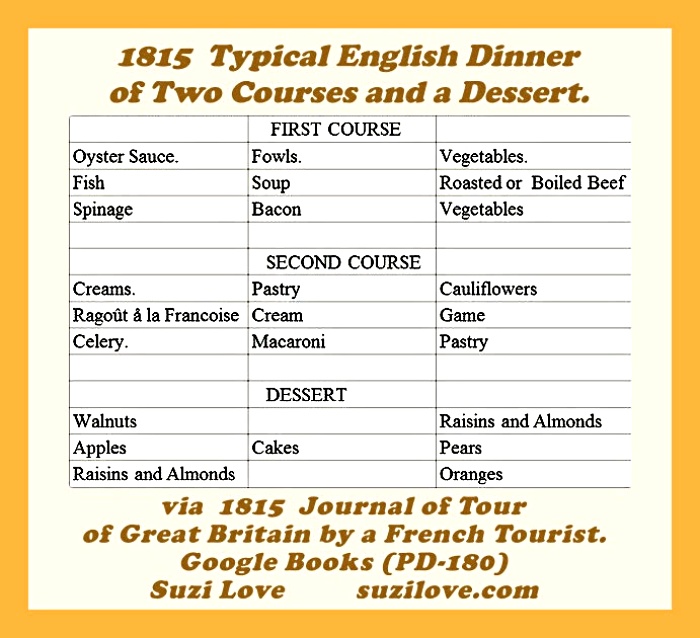
1815 Typical English Dinner In Jane Austen and Bridgerton Times. Two Courses and a Desert. From- 1815 Journal of Tour of Great Britain by a French Tourist via Google Books (PD-180)
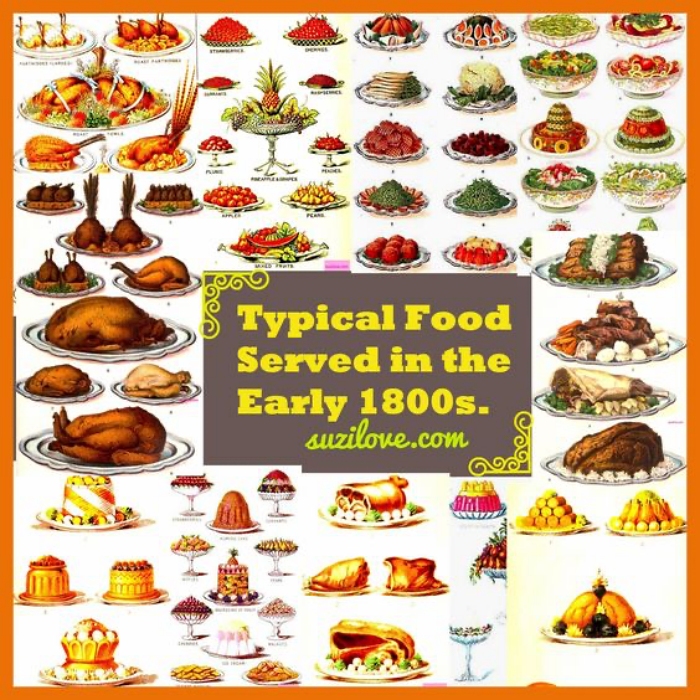
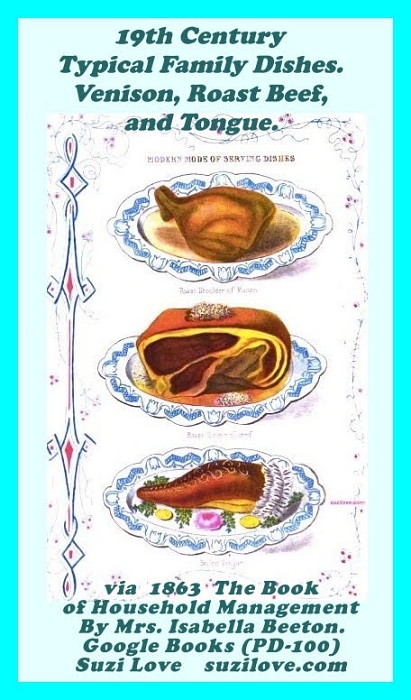
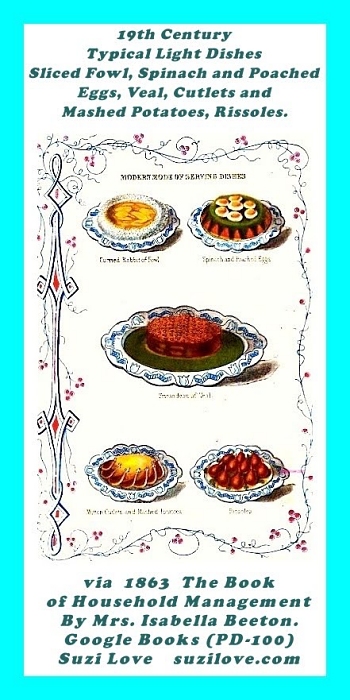
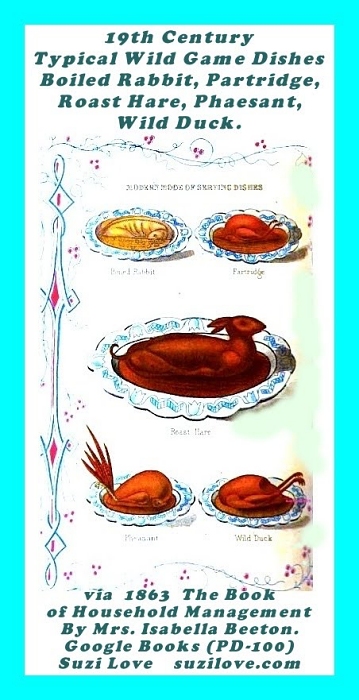
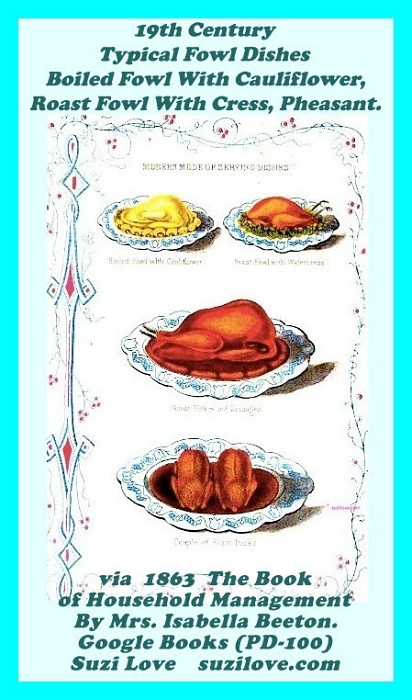
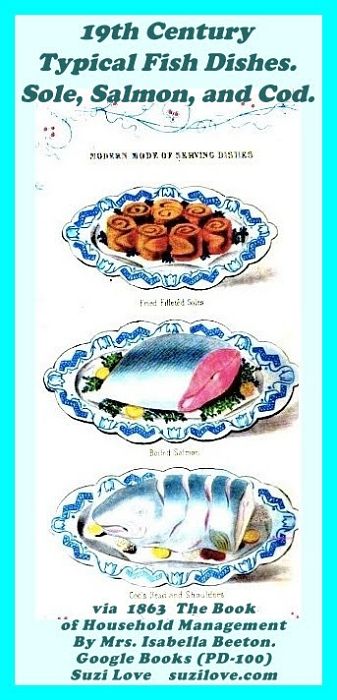
Typical food served during the early 1800s, or Regency Era. ‘Removes‘ were the dishes removed from the table during a meal, usually the soup and fish, and then replaced by other dishes. After all diners have had a chance to eat all the dishes on the table, the table is cleared and another set of dishes put on the table. This is the second course.
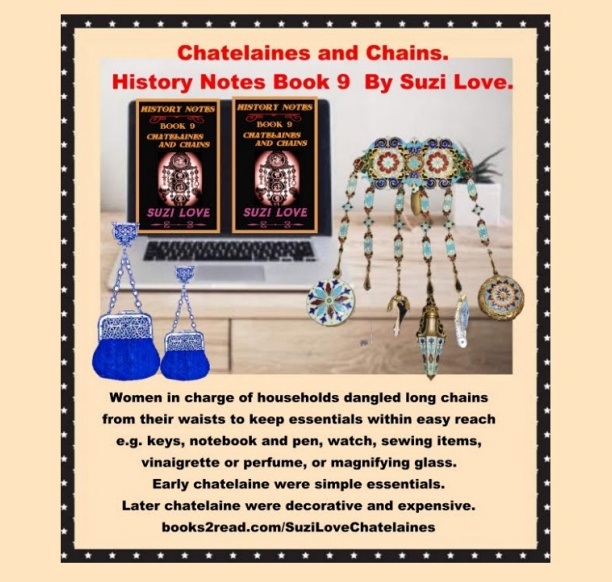
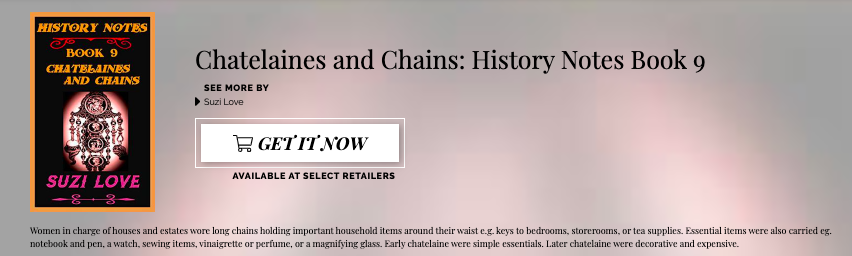
Jane Austen’s and the Bridgerton ladies personal necessities, keys, or chatelaines was a set of useful items hung from waist by decorative chain. Chatelaines and Chains. History Notes Book 9 By Suzi Love. Women in charge of households dangled long chains from their waists to keep essentials within easy reach e.g. keys, notebook and pen, watch, sewing items, vinaigrette or perfume, or magnifying glass. Early chatelaine were simple essentials. Later chatelaine were decorative and expensive. http://books2read.com/SuziLoveChatelaines
Definition Chatelaine: The word Chatelaine is French and means the keeper of the keys. Chatelaine” derives from the Latin word for castle. In Medieval times, the chatelaine was in charge of the day-to-day running of the castle. Women in charge of households dangled long chains from their waists to keep essentials within easy reach e.g. keys, notebook and pen, watch, sewing items, vinaigrette or perfume, or magnifying glass. Early chatelaine were simple essentials. Later chatelaine were decorative and expensive.books2read.com/SuziLoveChatelaines
What did a chatelaine do? Most important task was keeper of the keys. Also ordered supplies, did bookkeeping, supervised servants, taught castle children, and organized guests.
19th Century Food For The Upper Classes In Bridgerton and Jane Austen Times.
Typical Meals Served for the upper classes in the Georgian and Regency Eras. For the Upper classes in the 18th and through to the end of the 19th century, meals were elaborate affairs. and served by well-trained staff anticipated their every need. Women prided themselves on hosting dinners for 50-60 people which often consisted of numerous courses, and all served with the best wines and followed, for the men at least, by expensive port.
An older lady usually controlled the servants and the serving of meals. For more about this, take a look at Older Lady’s Day Regency Life Series Book 5 by Suzi Love. Overview of what an older lady did, wore, and how she lived in the early 19th Century. Information for history buffs and pictures for readers and writers of historical fiction. books2read.com/suziloveOLD
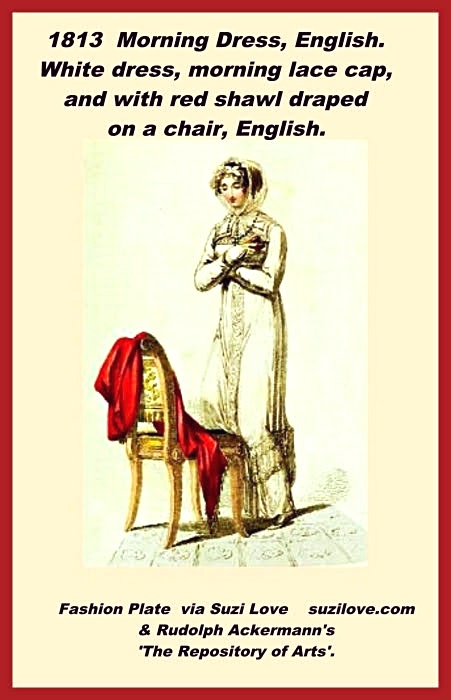
1813 October Morning Dress, English. Jane Austen and her family and friends would have worn this style of relaxed dress and cap. White At-Home dress with morning lace cap and a red shawl. Plain cambric underdress, three-quartered muslin or Chinese silk robe trimmed round the bottom and up the front with Indian border, or needle-work, and finished with a deep flounce of lace. Convent hood and pelerine of white net lace, confined under the chin with a silk cord and tassel. Hair in irregular curls with a fancy flower in the front. Short rosary and cross, plus bracelets, of coquilla beads. Buff or lemon kid slippers and pale tan gloves. Fashion Plate via Rudolph Ackermann’s ‘The Repository of Arts’.
This is a typical outfit worn at home in the morning in the house, to be seen only by family or close friends. A lady might wear this while writing having breakfast, writing letters, or reading. Called by the various names of Undress, to At-Home dress, or Morning dress, it is the most relaxed ensemble a lady will wear all day. The sort of outfit Jane Austen would have worn when writing her books.
1812 Red Dress, French. High-waisted red Merino wool dress with short puffed sleeves, high Chako hat with a plume long white gloves and white shoes. Fashion Plate via Journal des Dames et des Modes, or Costume Parisien.HN_27_D2D_fashwomen1810-1814
https://books2read.com/SuziLoveFashion1810-1814
What did Jane Austen and friends wear? Early 1800s fashions were elegant and pretty with high waists and fabrics that were almost transparent. These Empire style gowns, named after Napoleon’s first Empress, became popular throughout Europe, and were then copied around the world. Colorful outwear was added to make an ensemble more attractive and warmer. History Notes Book 26 Fashion Women 1805-1809. https://books2read.com/SuziLoveFashionWomen1805-1809
The Empire waist gown defined women’s fashion during the Regency Era. ‘Empire’ is the name given in France to the period when Napoleon built his French Empire. High-waisted, loose gowns were adopted by the aristocracy as a symbol of turning away from the fussy, elaborate and expensive clothing worn in the 1700s. Jean-Jaques Rousseau advocated copying peasants and returning to a simpler life and more natural fashions. Unrestricting clothing was part of the new Democracy in France and these simpler and flowing fashions were adopted all over Europe, including Britain and despite the continual wars being fought against France during the early 1800s. Not even war stopped fashions from being copied everywhere.
Chatelaines and Chains History Notes Book 9 By Suzi Love. What do you know about Chatelaines and Chains worn in Jane Austen’s and Bridgerton times? Women in charge of households carried important items with them. History Notes Book 9 Chatelaines and Chains. books2read.com/SuziLoveChatelaines
Personal Necessities, keys, or chatelaines was a set of useful items hung from waist by decorative chain. Chatelaines and Chains. History Notes Book 9 By Suzi Love. Women in charge of households dangled long chains from their waists to keep essentials within easy reach e.g. keys, notebook and pen, watch, sewing items, vinaigrette or perfume, or magnifying glass. Early chatelaine were simple essentials. Later chatelaine were decorative and expensive. http://books2read.com/SuziLoveChatelaines
Definition Chatelaine: The word Chatelaine is French and means the keeper of the keys. Chatelaine” derives from the Latin word for castle. In Medieval times, the chatelaine was in charge of the day-to-day running of the castle. Women in charge of households dangled long chains from their waists to keep essentials within easy reach e.g. keys, notebook and pen, watch, sewing items, vinaigrette or perfume, or magnifying glass. Early chatelaine were simple essentials. Later chatelaine were decorative and expensive.books2read.com/SuziLoveChatelaines
What did a chatelaine do? Most important task was keeper of the keys. Also ordered supplies, did bookkeeping, supervised servants, taught castle children, and organized guests.
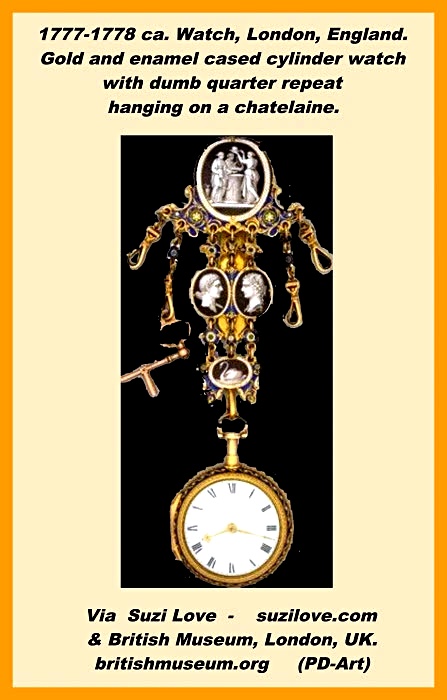
1777-1778 ca. Gold and enamel Cased Cylinder Watch with dumb quarter- repeat and en-suite Chatelaine, London, England. Via British Museum, London, UK. britishmuseum.org books2read.com/SuziLoveChatelaines
D2D_RetailerBuyLink_HN_9. Chatelaines and Chains History Notes Book 9 By Suzi Love. #regency Women in charge of houses wore long chains holding important household items around their waist e.g. keys, pen, notebook, sewing. books2read.com/SuziLoveChatelaines
1800s Typical Puddings and Pastries.These are the sort of puddings and pastries Jane Austen’s family would have eaten on a regular basis during the early 1800s, or Regency Era. Open Apple Tart, Galette, Apricot Fritters, Pancakes and Apricot Jam, Charlotte Russe, Macaroni Cheese, Cherry Tart, Mince Pies, Almond Puddings, Tartlets, Compote Of Fruit, Fruit Pudding, Fruit Tart, Christmas Plum Pudding, Milk Pudding and Roly Poly Jam Pudding. From: 1850s- 1860s Mrs. Beeton’s Books of Household Management. via Google Books (PD-150). 1800s Typical Puddings and Pastries Served In Households Like Jane Austen’s. https://books2read.com/suziloveOLD
1806 Short-Sleeved White Muslin Dress With Train. Bodice and sleeves have ribbon decoration, evening flowered headdress, half parure of necklace and ear bobs, and gorgeous Indian hand-loomed green shawl. Fashion Plate via Journal des Dames et des Modes, or Costume Parisien.
Definition Half Parure: A Parure is a matched set of jewelry, including a necklace, bracelet, earrings, pin etc. A half Parure didn’t include a jewelled headdress, or tiara.
Definition Shawls: The shawl started off in India as a fine wool garment for men that could be worn as a scarf, turban or as a mantle: the word comes from the Persian shäl. Originally imported from the East, European Kashmir shawls were made first in Norwich and Edinburgh in Britain in the late 18th century. Shawls were an essential item in the early 1800s to cover the thin gowns women wore. They were made of muslin, gauze, silk, wool, and velvet, though cashmere shawls were the softest and most prized.
1756-1762 ca. Gold and Enamel Étui, French. Probably by Jean Ducrollay, 1756-62, Paris. via Metropolitan Museum New York City, U.S.A. metmuseum.org
books2read.com/SuziLoveWritingTools