Cartoons For Riders At The Hunt. Typical comical scenes from The Bridgertons and Jane Austen’s Daily Lives. From: 1860 Mr. Sponge’s Sporting Tour by Robert Smith Surtees. via Google Books (PD-100)




Cartoons For Riders At The Hunt. Typical comical scenes from The Bridgertons and Jane Austen’s Daily Lives. From: 1860 Mr. Sponge’s Sporting Tour by Robert Smith Surtees. via Google Books (PD-100)
1817 June Blue Riding Costume, English. Loose riding habit with a train on the skirt, high white neck frill on the shirt underneath, and rows of decoration on the shoulders and cuffs of the habit jacket, an extra high hat with multiple plumes, or, feathers and gloves. Fashion Plate via The Lady’s Magazine Or Entertaining Companion for the Fair Sex.
Male tailors made most women’s riding habits during the Regency years and they were constructed similarly to men’s riding outfits. Generally in two pieces, a jacket and a skirt, and with a shirt with a frilled collar or front opening underneath. The trains of a habit could be caught up for walking, usually with a button and loop, and unhooked and let down so that the skirt flowed over the woman’s legs when she rode side saddle. Due to the numerous wars during the early 1800s, it was seen as patriotic for women to add military style touches to outfits in support of military men. The shoulder and cuff trims resemble the epaulettes and coat trims of a military uniform.


1890-1920 ca. Sterling Silver Chatelaine, England. Center Medallion With Portraits, three drops of monogrammed mesh purse, globe-shaped watch and book-shaped case. Via Augusta Auctions – augusta-auction.com
Definition
What did a chatelaine do?

What were chatelaines used for?

1763 Shagreen Etui Or Necessaire, English. via Gould Antiques ~ gouldantiques.com
Definition Etui Or Necessaire: Small toiletry, writing, or sewing containers carried by ladies and gentlemen in vast castles or large manor houses so their essentials were always on hand. Also used when traveling, where space was always limited. Easily carried in a pocket, or bag or reticule, to use for personal grooming, sewing repairs e.g. ripped hem or missing button, to do embroidery or to write a letter.
Definition Shagreen: Type of rawhide, originally made from the back of a horse or a wild donkey. In the 18th century, the skin of a shark was used as well.


1820-1840 ca. Hand-Embroidered Wedding Corset, Connecticut, USA. Ivory cotton covered with hand embroidery, including love birds on hearts, front pocket for busk, eyelets for back lacing. Trapunto (to embroider) cording decorates and shapes corset. The back closure has ivory eyelets for the lacing. The center-front has a pocket panel for inserting a busk. Trapunto (to embroider) shapes the corset by outlining the design with two or more rows of running stitches and then padding from the underside which gives a raised effect.The technique was always considered very elegant. Trapunto first appeared in 14th century Sicily and was widely adopted for clothing in Tudor England, and then brought to America by the new settlers. In addition to the cording, the corset is totally covered with hand-embroidered flowers and there are two embroidered love birds on hearts at the center-front. Above the birds is a section of trapunto work. via Vintage Textiles


1818 Blue Levantine Redingote, French. High-waisted walking coat, high white neck frill, bonnet of blue Gros de Naples with pink flowers, short puffed sleeves over long straight sleeves, white gloves and blue shoes. Fashion Plate via Journal des Dames et des Modes, or Costume Parisien. The type of outfit young Regency Era ladies would have worn if they were out shopping on Bond Street, walking in a park, or taking a carriage ride through Hyde Park.
Definition Redingote Or Pelisse Or Walking Dress Or Coat: French word developed from English words, riding coat. Long fitted outdoor coat worn over other garments for warmth. Often left open at the front to show off the dress underneath. Sometimes cut away in front. Originally made with several capes and trimmed with large buttons. French fashion plates call these coats Redingotes and they are designed for women, men and children. English fashion plates call them a Pelisse, a walking dress, Promenade dress, or Carriage dress.

1745-1750 ca. Necessaire, or small decorative box, with watch, probably German. Fitted with sewing and writing implements as well as a watch, this unmarked nécessaire shows delightful chinoiserie decoration in the Rococo style, echoing the work of the influential Munich designer François Cuvilliés (1695–1768). via Metropolitan Museum New York City, U.S.A. metmuseum.org
Small toiletry, writing, or sewing containers were called Necessaire or Etui: Tiny boxes or containers were carried in large castles or sprawling manor houses so a lady or gentleman had their essentials with them all day. They were also important when traveling by coach, trains, or ships where space was always limited. A necessaire or Etui was easily carried in a bag, reticule, or pocket so essentials were on hand for personal grooming, to repair a ripped hem, replace a button, to embroider, or to write a note or letter.


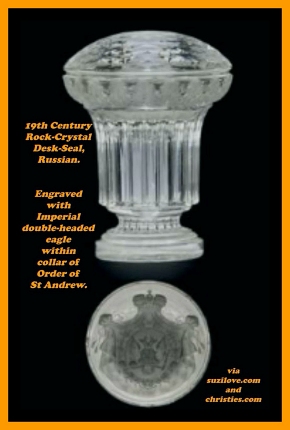
19th Century Rock-Crystal Desk-Seal, Russian. Fluted handle with domed top carved with oak leaves, matrix engraved with Imperial double-headed eagle within collar of Order of St Andrew, on ermine mantle and surmounted by the Imperial crown. via Christie’s Auction Rooms. christies.com. The type of seals that would have been on desks in Jane Austen’s times for sealing and identifying letters.
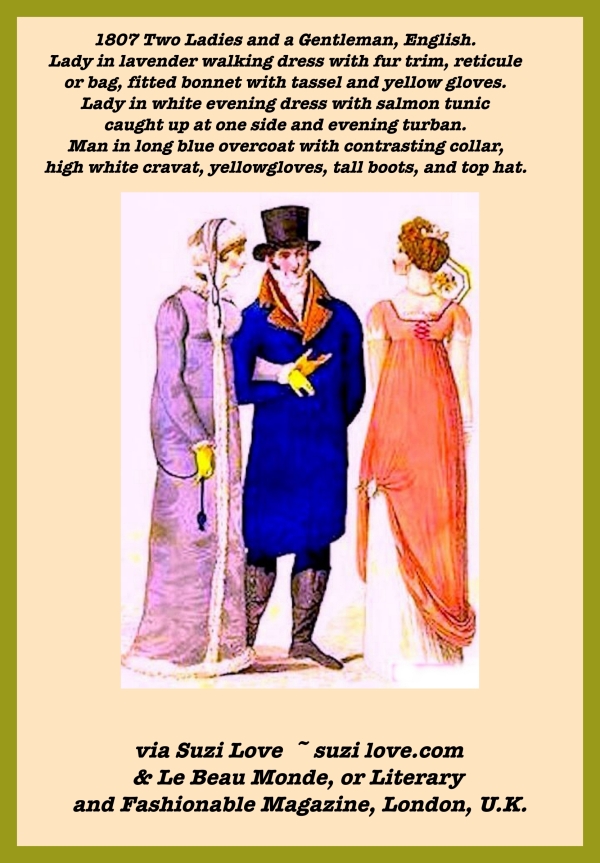
1807 Two Ladies and a Gentleman, English. Lady in lavender walking dress with fur trim, reticule or bag, fitted bonnet with tassel and yellow gloves. Lady in white evening dress with salmon tunic caught up at one side and evening turban. Man in long blue overcoat with contrasting collar, high white cravat, yellow gloves, tall boots, and top hat. Typical of the sort of outfits ladies and gentlemen in Jane Austen’s times would have worn while out walking, visiting friends or for an evening event, like a dinner party. A long coat, or Redingote or Pelisse for warmth when outdoors, and all matched with the essentials, day or night, of hats and gloves. via Le Beau Monde, or Literary and Fashionable Magazine, London, U.K.

1818 November ‘Fashionables Of 1818’ By George Cruikshank.Couple walk arm-in-arm with the man wearing Dandy costume of bell-shaped top-hat, trousers strapped under high-heeled boots without spurs and jauntily carried cane. Much shorter lady wears enormously high bonnet, striped over-dress over frilled white muslin, skirt above ankles, and carries a large ermine muff. Via British Museum, London, UK. britishmuseum.org (PD-Art)
These are the sort of outfits a couple would wear in Jane Austen’s times although these are exaggerated in caricatures to poke fun at the extremes of Regency fashion when women’s hats were so large and high that a lady was dwarfed by her devotion to fashion and a gentleman’s collar and neckcloth were so high he couldn’t turn his head to speak to the lady.
