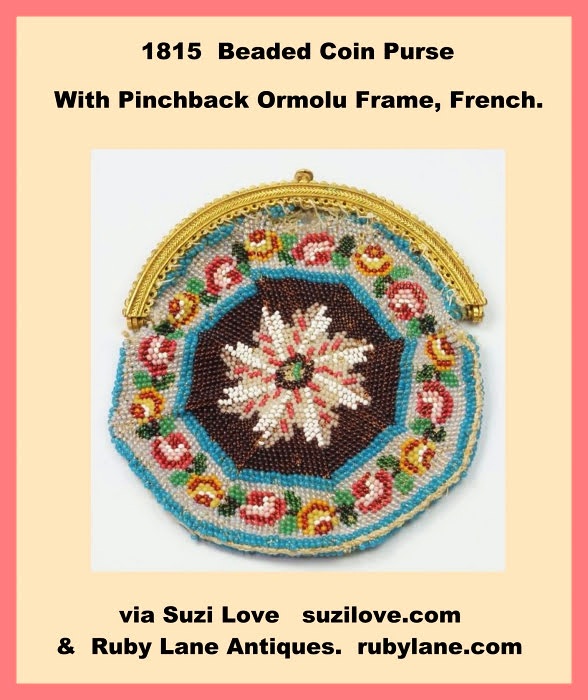
1815 Beaded Coin Purse With Pinchback Ormolu Frame. Would have been carried inside a reticule, or larger bag, so a woman had small coinage on hand to pay for items on those occasions when a gentleman wasn’t with her to pay for them. Via Ruby Lane Antiques.
A reticule, or purse, or handbag, was usually carried by a woman during the Regency period to carry all their daily necessities. Earlier, women used pockets that tied at the waistline and were hidden in the folds of their skirts. Empire style, or early 1800s, high-waisted dresses made it impossible to either sewn in a pocket or to tie on a pocket.
1815 Beaded Coin Purse With Pinchback Ormolu Frame from Jane Austen and Bridgerton years. #JaneAusten #Bridgerton #handbag #RegencyFashion books2read.com/suziloveReticules
Lapdesk, English. Exterior covered in metal with a lacquer finish and edged with stamped and gold lacquered brass strips. Interior veneered in kingwood with plush velvet writing surface. walpoleantiques.com
1820 Lapdesk, English. Exterior covered in metal with a lacquer finish and edged with stamped and gold lacquered brass strips. Interior veneered in kingwood with plush velvet writing surface. walpoleantiques.com
1820 Metal Exterior Travel Lap Desk from Bridgerton years. #bridgerton #RegencyEra #Travel #BritishHistory books2read.com/SuziLoveWritingTools
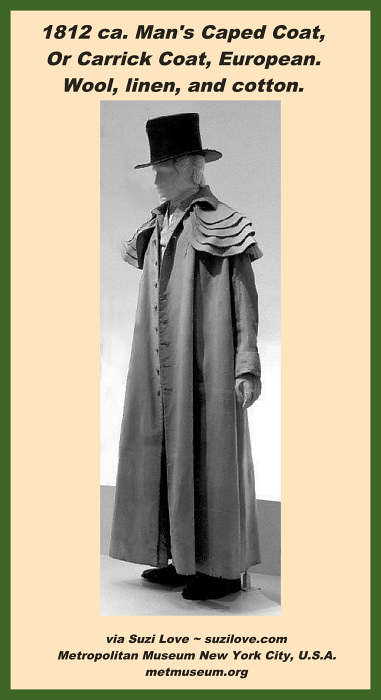
1812 Man’s wool, linen, and cotton long coat with four shoulder capes, European. Also called a Carrick Coat, a Driving Coat, or a Redingote in France. via Metropolitan Museum, NYC, USA. ~ metmuseum.org
A Regency Era, or early 1800s, gentleman was outfitted in more practical fabrics, such as wool, cotton and buckskin rather than the fussy brocades and silks of the late 1700s. The men in Jane Austen’s life and the Bridgerton men would have worn this sort of warm and practical coat like this when riding his horse in inclement weather or when driving his carriage.
Definition: Carrick Coat: Or Garrick or Coachman’s coat, with capes, or collars, popular in 19th century for riding and travel.
1812 ca. Back View. Man’s Caped Coat, Or Carrick Coat, European.
Wool, linen, and cotton. via Metropolitan Museum New York City, U.S.A. metmuseum.org1812 ca. Front View. Man’s Caped Coat, Or Carrick Coat, European.
Wool, linen, and cotton. via Metropolitan Museum New York City, U.S.A. metmuseum.org1812 ca. Back View Black and White. Man’s Caped Coat, Or Carrick Coat, European.
Wool, linen, and cotton. via Metropolitan Museum New York City, U.S.A. metmuseum.org1812 ca. Front View Black and White. Man’s Caped Coat, Or Carrick Coat, European.
Wool, linen, and cotton. via Metropolitan Museum New York City, U.S.A. metmuseum.org1812 ca. Front View Black and White With Umbrella. Man’s Caped Coat, Or Carrick Coat, European.
Wool, linen, and cotton. via Metropolitan Museum New York City, U.S.A. metmuseum.org
Love the Bridgerton family and Jane Austen? Reader Or Writer of Regency Era stories? Mourning and riding fashion, dresses, hats, shoes, reticules or bags, underclothing and fashion accessories. books2read.com/SuziLoveFashionWomen1815-1819
History Notes 28 Fashion Women 1815-1819: This book looks at what was fashionable for women in the Georgian Era and at the end of the Regency Era in Britain and the reconstruction in Europe after the wars. Lifestyles were freer and fashions expressed this by becoming the focus of most women’s lives. A wardrobe full of opulent accessories was requisite. Includes mourning and riding fashion, dresses, hats, shoes, reticules or bags, underclothing, and fashion accessories.
Are you a reader or writer of the Regency Era? Lover of the Bridgertons and Jane Austen? Mourning and riding fashion,underclothing and corsets. #Bridgerton #JaneAusten #RegencyFashion #mourningFashion https://books2read.com/SuziLoveFashionWomen1815-1819
Fashion Women 1815-1819 History Notes Book 28 What did Jane Austen wear? This book looks at what was fashionable for women in the Georgian Era and at the end of the Regency Era in Britain and the reconstruction in Europe after the wars. Lifestyles were freer and fashions expressed this by becoming the focus of most women’s lives. A wardrobe full of opulent accessories was requisite. Includes mourning and riding fashion, dresses, hats, shoes, reticules or bags, underclothing, and fashion accessories.
1823 Couple In Evening Costumes, French. Short length dancing dress of white gauze, short sleeves, pink ribbon trim, flowers, parure, or jewelry set, dancing shoes and hair in a bandeau. Man in half dress of black tailcoat, yellow vest, short length white trousers, high white cravat, blue fob, and curled hair style. via Modes Francaises L’Indiscreet, France.
From the finish of the 18th century until 1820, men’s fashions in European and European-influenced countries moved away from the formal wear of brocades, lace, wigs and powder to more informal and relaxed styles. Focus was on undress rather than formal dress. Typical menswear in the early 1800s included a tailcoat, a vest or waistcoat, either breeches, pants, or the newer trousers, stockings, shoes or boots, all worn with an overcoat and hat. This basic ensemble was accessorized with some form of neckcloth or cravat, gloves, walking stick, cane or riding crop, handkerchief, fobs, watch and perhaps a quizzing glass or eye glass.
Skirted coats were replaced with short-fronted, or cutaway, tailcoats worn over fitted waistcoats and plain, white linen shirts. Knee breeches were gradually replaced by tight-fitting pantaloons and later trousers, decorative shoes with buckles were replaced with a variety of boot styles, and fussy and ruffled neckwear gave way to intricately tied, white linen neck cloths. A Regency Era, or early 1800s, gentleman was outfitted in more practical fabrics, such as wool, cotton and buckskin rather than the fussy brocades and silks of the late 1700s.
1809 Wedgwood and Byerley showrooms for Wedgwood china, York Street, London, UK. Plate via Rudolph Ackermann’s Repository of Arts. The premises of master potter Josiah Wedgwood in York Street, St James’ Square, London, U.K. Wedgwood china was known for its high quality, beautiful glazes and Wedgwood trademark printed on the back of each item. The London show-room was managed by Thomas Byerley, who also held a quarter share of the business. From 1790 to 1810 the firm was known as Wedgwood and Byerley. Josiah Wedgwood had smallpox as a child with left him with a weakened knee so he couldn’t work the foot pedal of a potter’s wheel. Instead, he concentrated on designing pottery and unique glazes. By 1763, he was commissioned by high ranking British people, including Queen Charlotte.
In 1780, his longtime partner died and Wedgwood’s left leg had been amputated so he asked Erasmus Darwin to help run the business and their children married. The Wedgwood inheritance allowed Charles Darwin to pay for being a naturalist. From 1786 to 1789, Wedgwood took on the project of duplicating the Portland Vase from the 1st century BD. His two sons took over the business and Josiah died at home in 1795. During his life, he helped invent modern marketing and direct mail, money-back guarantees, traveling salesmen, self-service, free deliver, buy one get one free and illustrated catalogs.
1809 Josiah Wedgwood and Thomas Byerley China Showrooms in Jane Austen’s times in York Street, London. #JaneAusten #RegencyEra #London #trade https://books2read.com/suziloveYLD
Love After. Waterloo: Blurb: When Lady Melton and her son, Daniel, are forced to join antagonistic Captain Belling and the last group of wounded British soldiers evacuating Waterloo and traveling back to London, she expects clashes with army deserters. What she doesn’t anticipate is how much she and her son will need the belligerent Captain after they reach London. https://books2read.com/suziloveLAW
Book Hook: Lady Melton had conversed with gentlemen in Brussels who’d held similar views to the Captain, and who had looked down their aristocratic noses at any lady who defied tradition. Explaining her long-term interest in medicine to men who assumed that ladies lived to sip, shop, and embroider had been futile, and one of many reasons that she’d gladly left London and traveled to the Continent to live with her brothers. Ironic that she and her unborn child had been safer in battle-torn Europe than in the country of her birth, and sad that she and Daniel were now forced to return to family members that she disliked and a claustrophobic lifestyle that she barely tolerated.
She glanced around the Captain’s headquarters. Most of the walls remained intact, so at least she and her son would be partially protected from the elements tonight. Her brothers’ house hadn’t fared so well. British infantrymen had commandeered a French cannon and had been dragging it down the road towards Brussels when it had misfired. The shell had gone high over the trees and exploded near Brendon’s camp-side hospital. The majority of the roof had collapsed, dragging down large sections of the walls, and forcing them to sleep in army tents the past few nights.
Despite Wellington’s victory over Napoleon four days earlier, soldiers, to use the term loosely, still lingered around Waterloo. They and deserters from both sides had joined local famers in picking through the remains of bodies, uniforms, and armory to pilfer anything of value. There’d been nowhere safe to hide a lady and her son, so her brothers had packed what remained of their equipment and taken them, along with a few wounded British soldiers, to the Captain’s quarters, knowing that his orders were to protect whoever remained of French stragglers and deserters.
The twins hadn’t lingered, because Wellington and what was left of his British troops were marching back towards Brussels and Brendon’s skills as a physician were urgently needed. Benjamin, an aide to Wellington, had stayed to organize the repatriation of their soldiers and the departure of their sister and nephew.
When Lady Melton and son join antagonistic Captain Belling and last group of wounded British soldiers evacuating Waterloo, she expects clashes with army deserters.What she doesn’t anticipate is how much she and her son will need the belligerent Captain after they reach London. #RegencyRomance #MilitaryRomance https://books2read.com/suziloveLAW
Book Hooks: Ironic that Lady Melton and her unborn child had been safer in battle-torn Europe than in England. #MilitaryRomance #RegencyRomance #BattleofWaterloo books2read.com/suziloveLAW
1814 Statistics On Classes, Properties and Population In Great Britain. From: 1814 A Treatise On Wealth and Power. By Patrick Colquhoun. These are the statistics for England in Jane Austen’s time, or the early 1800s, or Regency Era.
1814 Statistics On Classes, Properties, Population In Jane Austen’s Great Britain. #JaneAusten #BritishHistory #RegencyEra #Statistics books2read.com/suziloveROver
Writing Regency Era Fiction Or Nonfiction? Need more information on Older Gentleman’s Day in early 1800s, or Bridgerton’s and Jane Austen’s Regency Era. A lighthearted overview of an older gentleman’s clothing, social life, and responsibilities in the early 1800s. Take a look at where an older man went, what he wore, and how he managed the family’s finances and his estates. Older Gentleman’s Day Regency Life Series Book 3 books2read.com/suziloveOGD
What Did An Older Gentleman Do In Early 1800s, or Jane Austen’s Regency Era? An overview of an older gentleman’s clothing, social life, and responsibilities in the early 1800s. Take a look at where he went, what he wore, and how he managed the family’s finances. Older Gentleman’s Day Regency Life Series Book 3 books2read.com/suziloveOGD
Strictly speaking, the REGENCY ERA refers to the years between 1811 and 1820 when George IV acted as Prince Regent when his father was unable to remain in power due to his illness, or rather his madness. For convenience, the term REGENCY YEARS is used to describe the longer period from the last two years of the Georgian Era (1809-1810), plus the ten years under the Prince Regent (1811-1820), and up until 1837 when Queen Victoria came to the throne.
RL_3_OGD_Older Man’s Day Regency Life Series Book 3 by Suzi Love #Regency #History books2read.com_suziloveOGD
What Did An Older Gentleman Do In the Bridgerton’s or Jane Austen’s Regency Era? #Bridgerton #RegencyEra #JaneAusten #BritishHistory http://books2read.com/suziloveOGD
1802 ‘The Cow Pock or The Wonderful Effects Of The New Inoculation’. By James Gillray. Caricature depicting the early controversy surrounding Dr. Edward Jenner’s cowpox vaccination program begun in 1796 in England. Recipients of the vaccine developing cow-like appendages. Via British Museum, London, UK. britishmuseum.org (PD-Art)
Cartoon: 1802 ‘The Cow Pock or The Wonderful Effects Of The New Inoculation’ By James Gillray. #Cartoon #RegencyEra #medical https://books2read.com/suziloveROver