Love the Bridgerton Series? Fan of Jane Austen? What did men wear in the early 1800s? Suits, hats, shoes, underclothing, military and bedroom fashions. #Bridgerton #RegencyFashion #JaneAusten #BritishHistory.
The Regency Era saw a wide variety of acceptable pants for men. Breeches were worn as part of a man’s daily outfit during the early 1800s and were necessary for formal occasions, such as court appearances, during the entire Regency Era. However, younger gentlemen moved away from breeches for daytime wear around 1807 and adopted a variety of long pants called trousers, pantaloons, buckskins or inexpressables. Knee-length breeches, worn with stockings, continued to be worn by older gentlemen through the entire Regency Era.
Around 1807, upper class gentlemen wore trousers held up by suspenders or pantaloons, which were closely fitted and worn with tall boots. Buckskins, made from deerskin, were comfortable to wear for riding. Inexpressibles were very tight leggings that left little to the imagination of young ladies. Every Regency man’s outfit included a hat, gloves, shoes or boots, and a selection of added accessories from a walking stick, watch on a chain, fobs, coin purse and a handkerchief.
What did the lady of the house use to pen notes in Bridgerton and Jane Austen’s years? What sat on the desk of Jane Austen’s male contemporaries when they managed household and estate accounts? books2read.com/SuziLoveWritingTools. Writing Tools, History Notes Book 13.
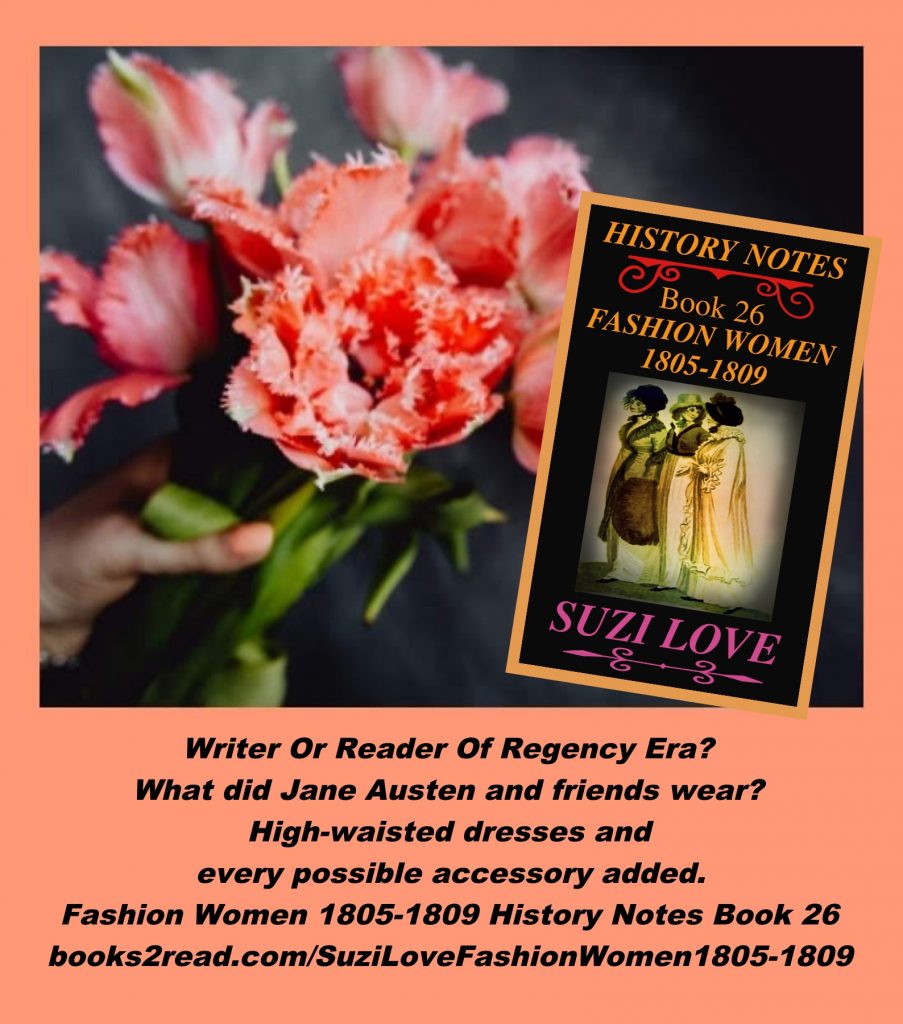
What did Jane Austen and friends wear? Early 1800s fashions were elegant and pretty with high waists and fabrics that were almost transparent. These Empire style gowns, named after Napoleon’s first Empress, became popular throughout Europe, and were then copied around the world. Colorful outwear was added to make an ensemble more attractive and warmer. History Notes Book 26 Fashion Women 1805-1809. https://books2read.com/SuziLoveFashionWomen1805-1809
The Empire waist gown defined women’s fashion during the Regency Era. ‘Empire’ is the name given in France to the period when Napoleon built his French Empire. High-waisted, loose gowns were adopted by the aristocracy as a symbol of turning away from the fussy, elaborate and expensive clothing worn in the 1700s. Jean-Jaques Rousseau advocated copying peasants and returning to a simpler life and more natural fashions. Unrestricting clothing was part of the new Democracy in France and these simpler and flowing fashions were adopted all over Europe, including Britain and despite the continual wars being fought against France during the early 1800s. Not even war stopped fashions from being copied everywhere.
1896 Sainted Prince Vladimir. Porcelain egg. Oval medallion on a golden background depicts Vladimir-wearing crown, a red mantle, and holding a cross. https://books2read.com/suziloveEasterAfter the painting by Victor Vasnetsov. Imperial Porcelain Factory, St Petersburg. Porcelain, overglaze polychrome painting and gilding/ Height: 11.4 cmOn the one side in an oval medallion on a golden background with plant ornament is a depiction of the Sainted Prince Vladimir wearing a crown and red mantle and holding a cross. The green frame is embellished with a garland of leaves. On the reverse, in another green frame with a garland of leaves on a pale blue background is an ornamented Greek cross with Christ Pantocrator in the centre. A pattern of stars and rosettes surrounds the cross.The prototype for the painting was the image of St Vladimir created by Victor Vasnetsov in St Vladimir’s Cathedral in Kiev.
20th Century Early Easter Egg. Side 1. The Resurrection of Christ. The Descent into Limbo. Side 2. The Most Orthodox Prince St. Vladimir. Made By Lukutin Factory Russia. Papier-mache and silk, painted in oil gilded and lacquered.
The production of the famous Fabergé jewelry firm that created eggs with surprises from gold, silver and precious stones won the world recognition. Jewelry miniature eggs
were very popular gifts and objects of collecting among rich Russians at the turn of the 20th century. They were used for making necklaces, pendants and bracelets that were worn during the Easter Week according to the well-established traditions.
Imperial and private fabrics and works, best artists, jewelers and craftsmen took part in creating Easter souvenirs.
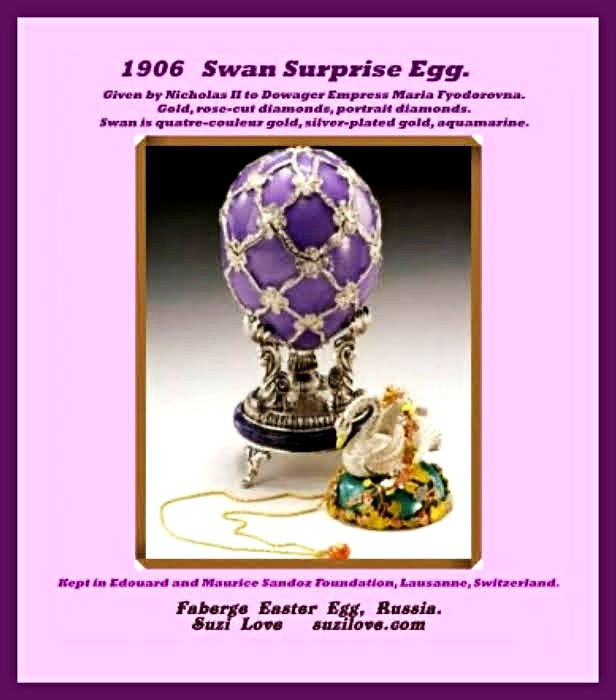
1906 Swan Imperial Faberge Surprise Easter Egg. Commissioned by Tzar Nicholas II and presented to the Dowager Empress Maria Feodorovna for her 40th wedding anniversary. Faberge Easter Egg, Russia.
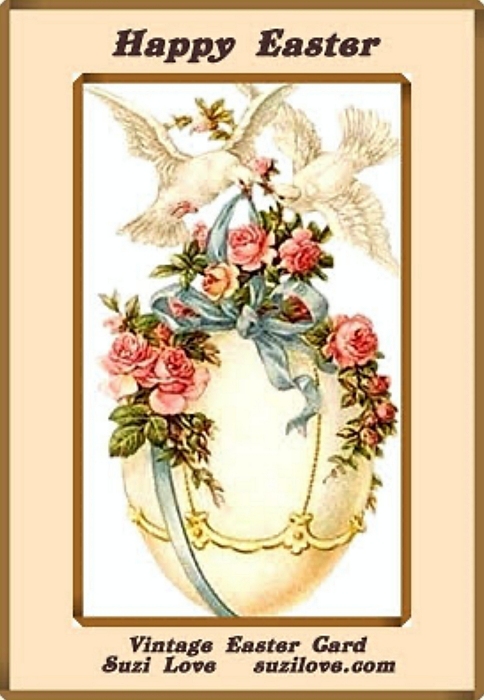
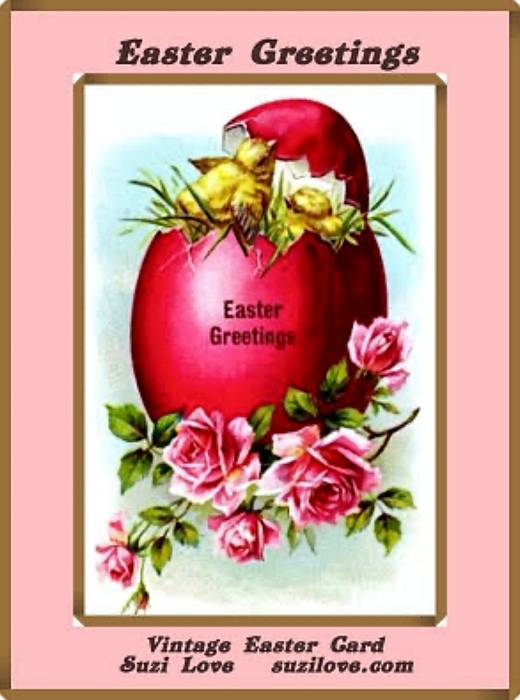
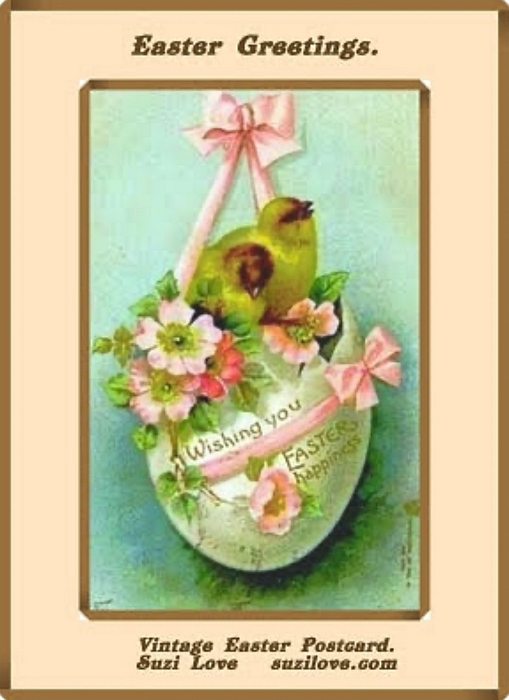
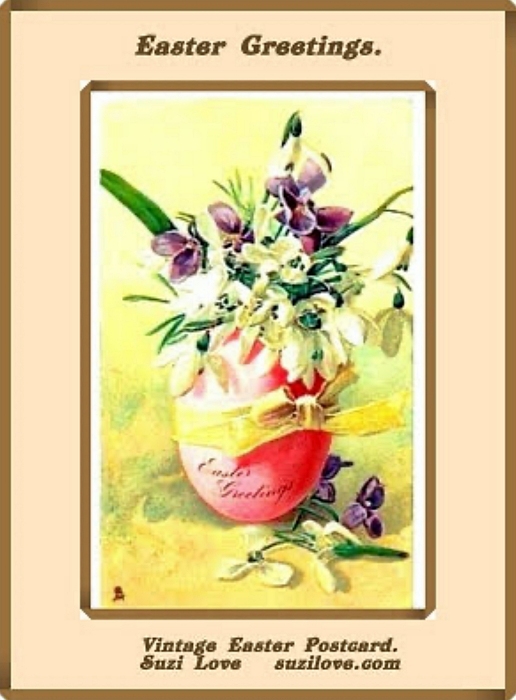
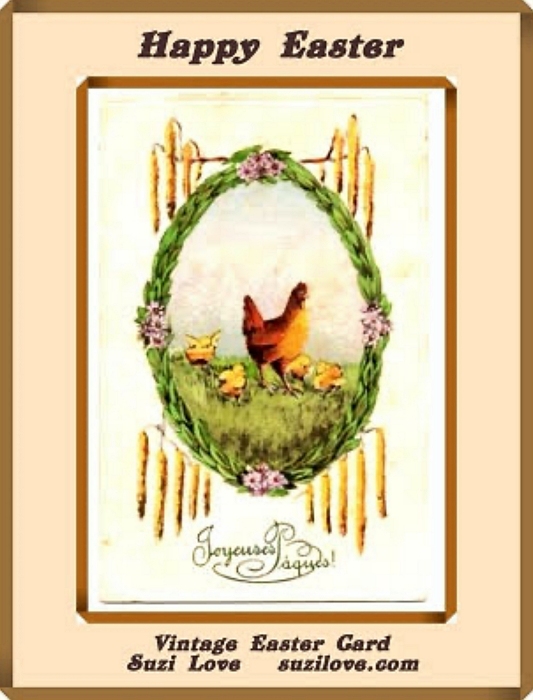
Ordinary people began to celebrate Easter by sending postcards as gifts. At first, mainly religious pictures appeared on postcards. Then postcards images became more about real life and people. In the early 1900s, postcards became more fanciful and pretty for young children. Religious images were gradually replaced by images that children could understand and relate to about Easter.
Postcards then concentrated on images of chickens and eggs, symbolic of birth and rebirth such as chickens emerging from cracked shells as Christ emerged from the tomb. Children were then added to the images so cards became for something for the whole family. Children with chickens and eggs became very popular on postcards. Bunny rabbits became associated with Easter and children could relate to these as it fitted with their idea of the Easter bunny.
Ellen Clapsaddle (1865 – 1934). An American illustrator from the late 19th and early 20th centuries and recognized as the most prolific postcard and greeting card artist of her time. Her greatest success was single-faced cards that could be kept as souvenirs or mailed as postcards. These cards were highly prized particularly during the peak of the golden age of souvenir postcards from 1898 to 1915. She is credited with over 1000 designs in post cards and souvenir cards. Cards in the mid 1900s were created to send personal Easter messages to loved ones such as mothers and fathers, grandparents, aunts and uncles and siblings. Artists from around the world began creating beautiful cards to share at Easter.
Jenny Eugenia Nyström (1854 – 1946) was a Swedish painter and illustrator who illustrated Easter postcards for, and about, children and happy ideas, especially European subjects.Jenny Nystrom (1884-1946)
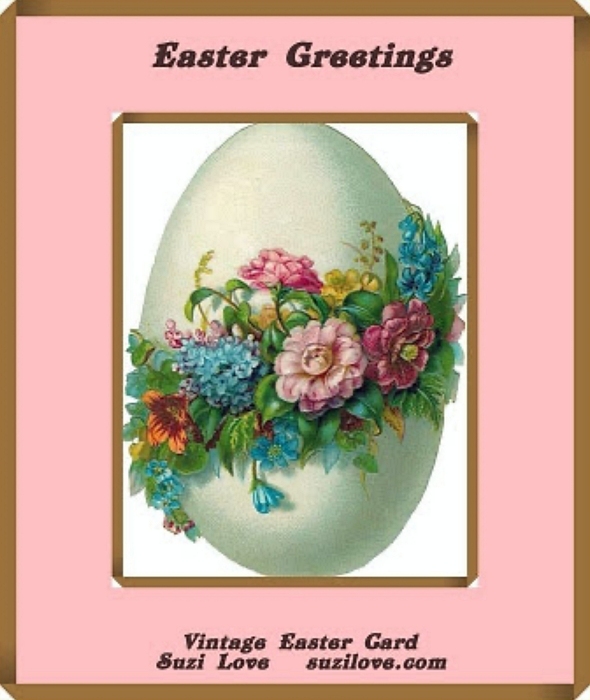
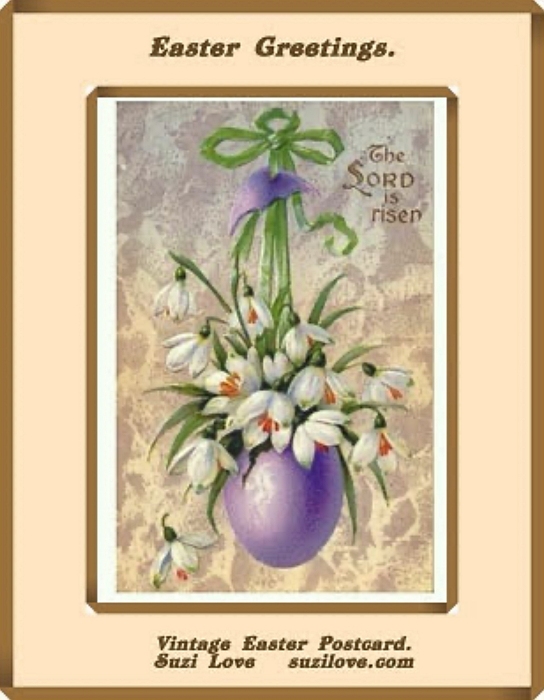
Egg With Flowers. Easter Greetings.
Suzi Love – suzilove.comEgg With Flowers. Easter Greetings.
Suzi Love – suzilove.comEgg With Flowers. Easter Greetings.
Suzi Love – suzilove.comEgg With Flowers. Easter Greetings.
Suzi Love – suzilove.comEgg With Flowers. Easter Greetings.
Suzi Love – suzilove.comEgg With Flowers. Easter Greetings.
Suzi Love – suzilove.comEgg With Flowers. Easter Greetings.
Suzi Love – suzilove.comEgg With Flowers. Easter Greetings.
Suzi Love – suzilove.com
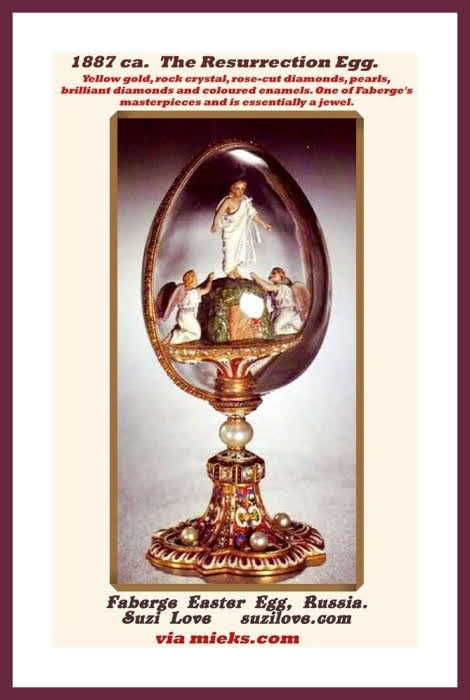
1887 Resurrection Imperial Faberge Egg. Yellow gold, rock crystal, rose-cut-diamonds, pearls, brilliant diamonds and various colored enamels. One of Faberge’s masterpieces and is essentially a jewel.
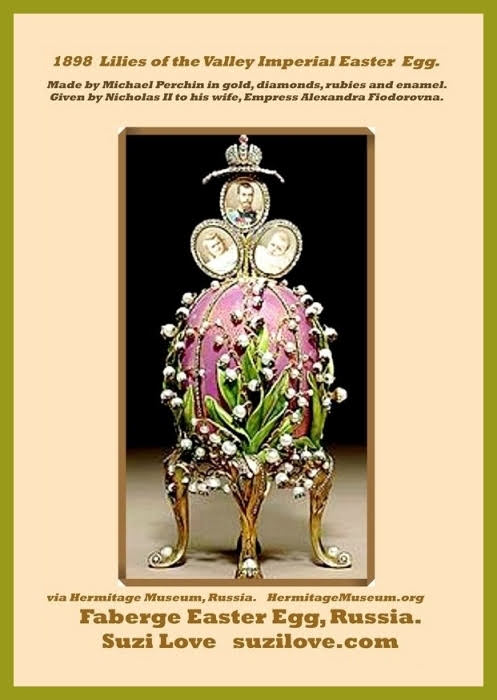
1898 Lilies Of The Valley Imperial Faberge Easter Egg, Russia. An imperial Easter egg presented by Nicholas II to his wife, Empress Alexandra Fiodorovna, for Easter 1898. Gold, diamonds, rubies and pink guilloché enamel with lily-of-the-valley flowers (pearls/diamonds) and contains a hidden portrait. From The Fabergé firm, St Petersburg made by Michael Perchin. Height is 20 cm opened. Via Collection of the Fund ‘The Link of Times’.
The name Faberge is associated with the Russian Imperial family for whom most of the world’s most famous eggs were created. In 1870, Faberge inherited his father’s jewelry business and quickly became known for his brilliant designs. A display of his work and the gold medal he was awarded in Moscow’s Pan-Russian Exhibition of 1882 brought him to the attention of the Russian nobility.
In 1885, Faberge was commissioned by Tsar Alexander III of Russia to create an Easter egg for his wife, the Empress Maria Fedorovna. This became known as The Hen Egg, the first Imperial Faberge Egg, and is made of gold. The Empress was so happy with the gift that Alexander appointed Fabergé a ‘Goldsmith by Special Appointment to the Imperial Crown’ and the following year commissioned another egg. From then on, Faberge was given complete freedom with future Imperial designs which become even more elaborate every year. A famous Fabergé egg is one of sixty eight jeweled eggs made by Fabergé and his assistants for the Russian Tzars and private collectors between 1885 and 1917.
After the Russian Revolution, the House of Faberge was nationalized by the Bolsheviks and the Faberge family fled to Switzerland where Peter Carl Faberge died in 1920. Several of the Faberge Imperial eggs are still missing.