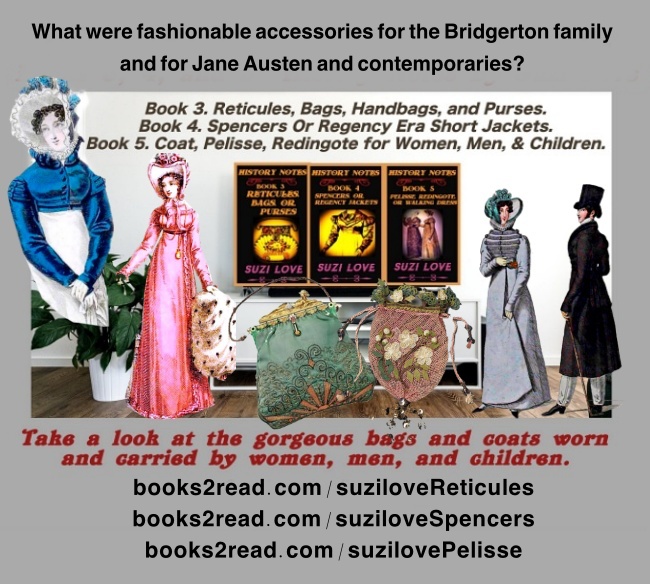
Fashion Must Haves In Jane Austen’s Times: Reticules, Spencers, Redingotes. History Notes Series Books 3, 4, and 5.
Reticule Or Bag: Purse, often with a drawstring to pull closed and usually made of cloth or covered cardboard and often decorated with beading or embroidery. Carried by a woman during the Regency period to carry all their daily necessities. in the place of pockets.
Spencer: Short jacket, cropped at the waist, worn over a dress, or gown. Delicate and regency dresses provided so little protection from the cold, so over garments were essential for warmth, modesty and good health.
Pelisse Or redingote Or Walking Dress: Coat worn over clothing of both sexes for warmth and protection from the elements.
Do you need more factual and visual information for your historical fiction? Try History Notes Books 1-13. Non-fiction Series: Fashion, music and social manners in the 18th and 19th centuries e.g.
The Duke of St. Martin asks Lady Rebecca Jamison, “Who protects you from the current set of fire-breathing dragons?” #HistoricalRomance #Mystery https://books2read.com/suziloveES
“And who protects you from the current set of fire-breathing dragons?”
She raised her chin. “I’ve outgrown such childishness.”
She lowered herself to the closest settee, a demonstration of ladylike maturity and a reprieve for her trembling knees.
“Pity.” His forehead furrowed into a pained frown. “Ah.
That’s why you wore a disguise. And why you came so late at night.”
She nodded. “The consortium watches our house and tracks our movements. In order to speak with you alone, I was forced to dress like this and sneak out the servant’s entrance in the dark. Although luckily, the syndicate’s inner circle doesn’t want me dead. Not yet.
“Wonderful!” He glared at her. “Your blithe not yet offers such comfort to my nerves.”
She glared back. “Oooh! I cannot explain if you interrupt with your sarcastic jabs.”
He dipped his head, and then waved a hand. “I apologize for my uncertain temperament this evening. Please, tell me about Peggy, and what she did at your Women’s Society.”
“She writes — No, she wrote the letters for women who wish to invest in stock ventures. We were trying to keep their identities, and their objectives, a secret.”
“Why? Because they’re women? Because jobbers stood for them in the Exchange?”
She raised a brow. “For someone only recently returned to London, you appear exceedingly well acquainted with the inside activities at the Exchange.”
He shrugged. “I’ve spent every spare moment since my return settling the family’s finances. Naturally, I’ve looked in at the Foreign Funds Room a time or two. Nobody in my position can afford to let bank balances sit idle, despite some labeling it as trade.”
“I’m impressed, Cayle. You detested accounts when your father wanted you to learn.”
Once more he shrugged, yet his show of nonchalance appeared overdone. “Perhaps it was more of not liking the methods of the educator, rather than the subject being taught.”
She shuddered at her recollection of the late duke’s disciplinary methods. “But you’re correct,” she said, pushing away images of birch rods twanging on bare flesh. “Some in our prudish society frown upon a gentleman of your caliber frequenting auction rooms. But, for a woman, it’d be an outrage.”
His eyes fixed upon her, all signs of his earlier fatigue vanished. “I can well imagine.”
“Though legally nothing prevents a woman from owning shares,” she said, assessing his concentration by the tense way he held his long, muscled body. “Visiting members are vetted at the door. Bank managers and jobbers pay eight guineas a year to enter the main Exchange room, yet self-righteous men evict females.”
“So, is it your gender that sees you under threat?”
“Not merely our gender. When the consortium heard we invested in secret, and often did very well, at first they became alarmed. Then, they became angry. Very angry indeed.”
“I can well imagine men abhorring being bested by a female.”
ES_ Embracing Scandal Book 1 Scandalous Siblings Series D2D_ES_ https://books2read.com/suziloveES
Want a glimpse into the life of a young lady in Jane Austen and the Bridgerton years? #bridgerton #RegencyEra #JaneAusten
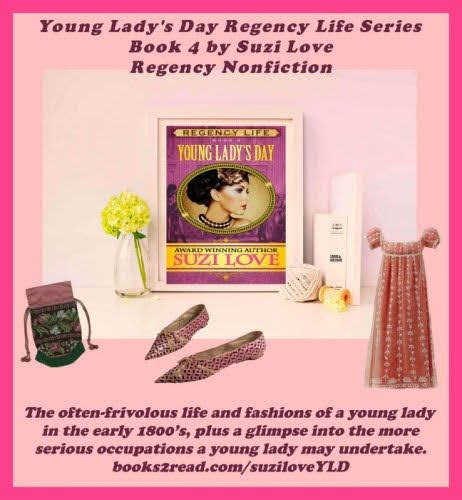
Young Lady’s Day is Book 4 in the Regency Life Series. This book depicts the often-frivolous life and fashions of a young lady in the early 1800’s, but also gives a glimpse into the more serious occupations a young lady may undertake. Through historic images, historical information, and funny anecdotes, it shows how a young lady fills her day, where she is permitted to go, and who she is allowed spend time with. These light-hearted looks at the longer Regency years are an easy to read overview of what people did and wore, and where they worked and played. There is plenty of information to interest history buffs, and lots of pictures to help readers and writers of historical fiction visualize the people and places from the last years of the 18th Century until Queen Victoria took the throne. https://books2read.com/suziloveYLD
Love the life of Jane Austen and her stories? Fan of the Bridgerton series? Reader or writer of the early 1800s, or Regency Era? For information and pictures, try Regency Life Series by Suzi Love. Light-hearted series about Regency Era, or early 1800s. For writers, readers and history lovers.
Thes books use historic images, historical information, and funny anecdotes to give an overview of life through the late Georgian and the Regency years. A light-hearted look at the people, places, and fashions of the times, plus an easy to read overview of the politics and economics. There is plenty of information to interest history buffs, and lots of pictures to help readers and writers of historical fiction visualize the people and places from the last years of the 18th Century until Queen Victoria took the throne.
Try Books 1-5 Regency Life Series by Suzi Love. Regency Overview – Young Gentleman’s Day – Older Gentleman’s Day – Young Lady’s Day – Older Lady’s Day
Regency Era Overview: Images, information and funny anecdotes give an overview of life in Jane Austen’s times or early 1800s. #Regency #JaneAusten #BritishHistory
Captain Belling cleared his throat and turned to face Lady Melton. “I owe you an apology for not personally seeing to your comfort. I’ve not been at my most amicable recently. Our evacuation plans have changed five times in the past three days, because each messenger has brought worse news about conditions of the roads. Wellesley probably pictured us rounding up a fleet of comfortable carriages to transport the wounded to the coast, after which boats would magically whisk us across the Channel until, within a few days, the wounded would be under the care of a staff of competent physicians. Apparently, the first and largest batches of wounded soldiers managed that scenario and are, I hope, being loaded into the boats as we speak. Word is that the second group ran afoul of deserters on three separate occasions.”
“British or French?”
He shrugged. “Who knows? Men probably went rogue from many forces as soon as the battle turned and we became the winners. Napoleon was so confident of victory that he didn’t plan for retreat. So, retreating regiments were bottlenecked at the bridge at Sambre and soldiers ran away, rather than die during the chaos. Disenchanted soldiers from every country meet, form alliances, and will then kill without compunction, to stay free, or to appease their hunger for food and women. And every day, more will be on the roads.”
When she stiffened, he said, “Don’t worry. Our messengers reported where they’d seen large groups, and we’ll avoid those roads.” She sat still as a statue and listened. “I’d like to get to London without killing anyone else, because I’m tired of the fighting, tired of wars.”
She shuffled a few inches back towards him and laid her hand on his knee. “I’m sorry that I’ve added to your problems.” She looked down at her sleeping son. “Sorry you have two more passengers to worry about.”
“Our main problem is transport. The first groups needed the biggest wagons, so we must make do with inferior vehicles.”
“Daniel and I are used to cramped quarters. We’re grateful for whatever you arrange.”
“Humph. I’m glad to hear that.” When she gave him a puzzled look, he pointed to a mattress set at a right angle to her cot but with their ends almost touching. “I shall now be sleeping there.”
The small noise she made pleased him. She didn’t scream like a virginal girl would if told that a man would be sleeping in such close proximity, but sounded surprised to find that she’d pressed herself up against him.
Her hand flew to her mouth. “Oh, dear. I’ve taken your bed. I’ve forced you to use a mattress on the floor.”
He laughed softly. “Believe me, that’s far better than propping against a tree and trying to snatch an hour’s sleep before battle. Or squeezing between a sea of horses and men so you stay warm and don’t expire from frostbite.”
“How long have you been with Wellesley?”
He leaned forward and rested his arms on his knees. “Too damn long.”
“So you’re pleased to be going home?”
“Pleased? No. Resigned, yes. My friends, my fellow officers, were ordered back to Brussels. I feel guilty that I’m not with them.”
“But surely they will return home soon, now that we’ve defeated Napoleon?”
“We’ve thought the war finished several times before, and I fear this time may prove the same. Nobody can predict what the Corsican will do next.”
She squeezed his thigh. “You’re worn out, Gabe. Things will be better when you’re in London once again.”
Outback Arrival : A contemporary medical set in an outback Australian hospital. A city nurse follows the doctor she loves to the bush town where he manages his family’s cattle properties, determined to prove her love for him. But can he accept that she is carrying his baby and that those he trusts have lied?
‘No, no, no! Bodies don’t stand up and walk out of hospitals.’
‘I’m real sorry, Nurse Kristie.’ The weather beaten grounds-man shuffled his feet in front of her office desk, distress adding a decade to his sixty something years.‘Looked everˈwhere. Can’t find it.’
‘This can’t be happening, Joey. A corpse cannot just disappear. Somebody must have noticed something.’
‘Sure ain’t sometin´ no normal person’d tuck un’erneath their arm. Walk out with, when visitors go ‘ome.’
Kristie adopted the calm and confident demeanor that had helped her tackle hundreds of emergency room dramas without showing a moment of panic. Casualty nurses joked that no matter how many crazy things you’d dealt with, something stranger was always about to walk in your door. Or in today’s case, walk out of the morgue’s door.
She hauled in a deep breath, while mentally chastising herself for not making more time to attend yoga classes, for Joey’s sake if not her own. She faked a confident smile. ‘We have to find his body, Joey. Quickly. Before the board’s fusspots hear what’s happened. Or we’ll have them arriving, en masse, and breathing down our necks.’
When she’d arrived four weeks earlier, the majority of the board members had welcomed her with open arms. Enticing an experienced nurse away from a city hospital to a remote outback town didn’t happen every day and the town had seen them as heroes saving their stretched outback health system. The few remaining few board members, however, were old-fashioned, staid, and highly suspicious of her motives.
Kristie had learned to be vigilant at work and circumspect when off duty. During her three months’ probation as Director of Nursing, she couldn’t afford any slip ups or she wouldn’t be contracted for a permanent position, no matter how desperate rural towns were to keep medical staff.. Those board members, the ones lacking a sense of humor, would be horrified that a recently deceased member of their small community had mysteriously disappeared from the hospital’s morgue. Although morgue was a loose term for a brick shed which housed a refrigerator, a work bench, and was supposedly cooled by a temperamental air-conditioner. Misplacing a body, without any of her rostered staff noticing, would be classified by the board as her first mistake, a huge mistake.
I’m participating in MFRW Book Hooks—browse the current hop
Writing and Publishing? Tips and Tricks in Self Publishing: Absolute Beginner’s Guide. Information, contacts, and checklists steer you towards professionally produced books. Helps both fiction and non-fiction authors and available in digital and paperback. Co-Authored by two Australians: multi-published Imogene Nix and best-selling and award winning Suzi Love. books2read.com/selfpublishing
D2D_SP_Contacts, lists, cheat sheets, and checklists to set goals and steer you towards professionally produced books. eBook and paperback #amwriting #nonfiction #selfpublishing books2read.com:selfpublishing
Nothing had prepared Lady Katharine Montgomery for the jumble of feelings overwhelming her when Alex worshipped her body, first with words and later with his hands and mouth. For years around this house, she’d been forced to appear dowdy, unintelligent, and totally self-effacing to never anger her father, or draw his wrath. Now, though, every degrading restriction was lifted from her mind, body, and life.
Her father was dead. Yesterday, she’d buried her hatred for the despicable man who’d given her life during the quarter hour it took to stand at his grave and, along with all the other hypocrites present, pretend to mourn as they buried his mortal remains. He’d cheated traders, beaten plantation workers, and horse-whipped her within an inch of her life. She and all the other mourners hoped he’d rot in hell.
Last night, she’d felt free to liberate the passionate nature she’d kept buried for six and twenty years for fear of her father’s explosive wrath. But one night with Lord Alexander St. John had changed everything. One night with a lover who was gentle and caring had her aching for more, more of Alex and more of life with him.
Corsets 1880-1900 History Notes Book 20. This book shows how a fashionable silhouette became of paramount importance and how a well-fitted corset became a fashion essential. As well as a decorative fashion item, tight lacing gave a narrow waist and the desired feminine form under clothing. https://books2read.com/SuziLoveCorsetBook20