1890-1900s Porcelain Easter Egg. Inscription “Christ is risen!”. The Kornilov Brothers Factory, St Petersburg. Via Hermitage Museum Faberge Easter Egg, Russia. books2read.com/suziloveEaster
A porcelain Easter egg from the 1890–1900s featuring the inscription “Christ is risen!” was a traditional Russian Orthodox Easter gift. They were produced by both the Kornilov Brothers Factory and the Imperial Porcelain Factory in St. Petersburg. The State Hermitage Museum in St. Petersburg has a large collection of Imperial-era porcelain Easter eggs. These eggs were exchanged, hung on ribbons, or placed on stands during Easter as a symbol of life’s renewal. The words “Christ is Risen!” was a traditional Russian Easter greeting.
1900 Friendship, or, Hoof Faberge Egg, Russia. Presented by Tzarina Alexandra to one of her friends. Red gold bowenite, diamonds, rubies and pearls.
The name Faberge is associated with the Russian Imperial family for whom most of the world’s most famous eggs were created. In 1870, Faberge inherited his father’s jewelry business and quickly became known for his brilliant designs. A display of his work and the gold medal he was awarded in Moscow’s Pan-Russian Exhibition of 1882 brought him to the attention of the Russian nobility. In 1885, Faberge was commissioned by Tsar Alexander III of Russia to create an Easter egg for his wife, the Empress Maria Fedorovna. This became known as The Hen Egg, the first Imperial Faberge Egg, and is made of gold. The Empress was so happy with the gift that Alexander appointed Fabergé a ‘Goldsmith by Special Appointment to the Imperial Crown’ and the following year commissioned another egg. From then on, Faberge was given complete freedom with future Imperial designs which become even more elaborate every year. A famous Fabergé egg is one of sixty eight jeweled eggs made by Fabergé and his assistants for the Russian Tzars and private collectors between 1885 and 1917. After the Russian Revolution, the House of Faberge was nationalized by the Bolsheviks and the Faberge family fled to Switzerland where Peter Carl Faberge died in 1920. Several of the Faberge Imperial eggs are still missing.1900 Friendship, or, Hoof #Faberge #Easter Egg. Presented by Tzarina Alexandra to one of her friends. Red gold bowenite, diamonds, rubies and pearls. Faberge Easter Egg, Russia.
1916 Steel Military Surprise Faberge Easter Egg, Russia. Gift from Nicholas II to his wife Tzaritsa Alexandra Fyodorovna. Surprise is a miniature painting on an easel of the Tzarin planning with his generals in field. Faberge Easter Egg, Russia.
The name Faberge is associated with the Russian Imperial family for whom most of the world’s most famous eggs were created. In 1870, Faberge inherited his father’s jewelry business and quickly became known for his brilliant designs. A display of his work and the gold medal he was awarded in Moscow’s Pan-Russian Exhibition of 1882 brought him to the attention of the Russian nobility. In 1885, Faberge was commissioned by Tsar Alexander III of Russia to create an Easter egg for his wife, the Empress Maria Fedorovna. This became known as The Hen Egg, the first Imperial Faberge Egg, and is made of gold. The Empress was so happy with the gift that Alexander appointed Fabergé a ‘Goldsmith by Special Appointment to the Imperial Crown’ and the following year commissioned another egg. From then on, Faberge was given complete freedom with future Imperial designs which become even more elaborate every year. A famous Fabergé egg is one of sixty eight jeweled eggs made by Fabergé and his assistants for the Russian Tzars and private collectors between 1885 and 1917. After the Russian Revolution, the House of Faberge was nationalized by the Bolsheviks and the Faberge family fled to Switzerland where Peter Carl Faberge died in 1920. Several of the Faberge Imperial eggs are still missing.
What did the Bridgerton ladies and Jane Austen use to carry her personal items? Ridicule, Reticule, Or Handbag? Call them what you like: purses, bags, handbags, reticules, ridicules, clutches, or pocket replacements. They all did the same job and they changed greatly with the prevailing fashions of time. books2read.com/suziloveReticules
Definition Of A Reticule; Bag or purse, often with a drawstring to pull closed and usually made of cloth or covered cardboard and often decorated with beading or embroidery. A reticule, or purse, or handbag, was usually carried by a woman during the Regency period to carry all their daily necessities. Earlier, women used pockets that tied at the waistline and were hidden in the folds of their skirts. Empire style, or early 1800s, high-waisted dresses made it impossible to either sewn in a pocket or to tie on a pocket, so women began carrying small, decorated bags called Reticules, or ridicules, which generally pulled close at the top with a drawstring. These Reticules, or bags, were the forerunners of our modern day purses.
The term ‘ridicule’ derived from the Latin ‘ridiculum’ and first used in France during the 17th century and meant subjecting something or someone to mockery. As women’s tiny bags were mocked, or ridiculed, for being a useless fashion accessory carried outside when they were first used in the late 1700s, it’s likely this is how the name ‘ridicule’ started. The later term ‘reticule’ derived from the Latin reticulum, meaning ‘netted bag’ and was applied when bags became larger and often made from netting. In the late 1700s and early 1800s, they were also known as indispensables as they carried all the personal items a lady needed upon her person every day. They were easily made by ladies, easy to carry and became an indispensable fashion accessory.
In the early nineteenth century, reticules started to look like future handbags as they were often made from rigid card or molded mâché or card into a variety of shapes. Early bags were circular and with a drawstring but as women wanted their reticules to look individual they could be made with two halves and a hinged metal closure or with concertina sides. Materials varied from silk, cotton and string and shapes were round, hexagonal or lozenge shapes with shell shaped bags becoming very popular during the Regency and Romantic Eras.
1800s magazines were written for well bred women who could read, so they gave plenty of ideas for how ladies could make and embellish reticules for their own use and as pretty gifts. Needlework was highly encouraged as a pastime for a lady so bags were frequently embroidered or decorated with beading. By the 1820s, reticules became more like our modern handbags using soft leather gathered at the top or hard leather with a rigid fastener and metal chain for carrying.
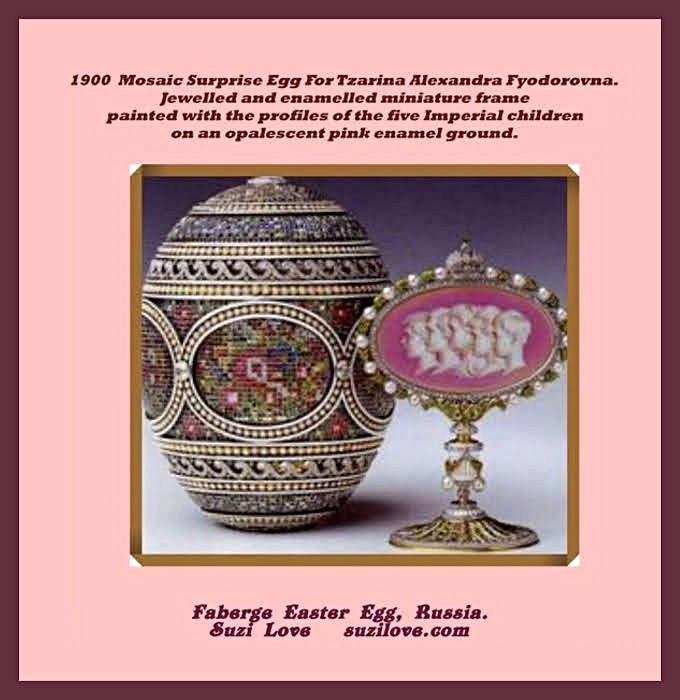
1900 Mosaic Faberge Surprise Egg, Russia. For Tzarina Alexandra Fyodorovna The miniature frame is painted with the profiles of the five Imperial-Russian children on an opalescent pink enamel ground. Faberge Easter Egg, Russia.
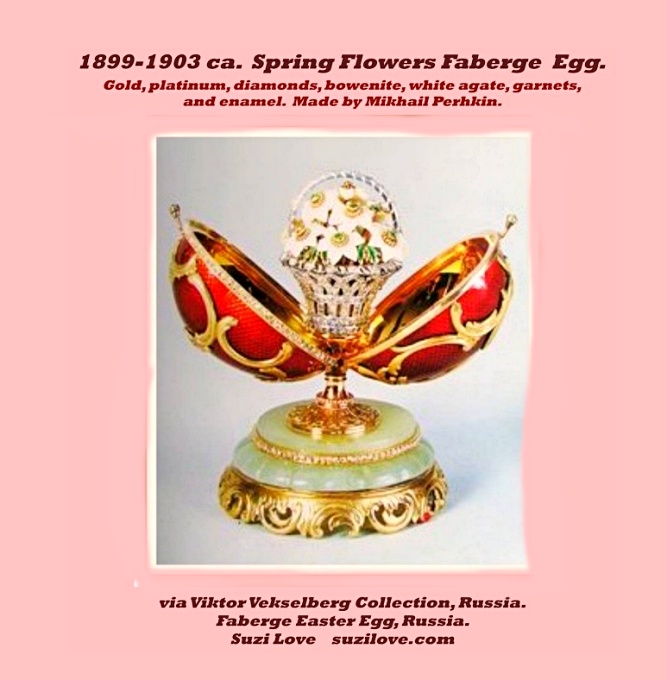
1899-1903 ca. Spring Flowers Imperial Surprise Faberge Easter Egg. Gold, platinum diamonds, bowenite, white agate, demantoid, garnets, and enamel. By Mikhail Perhkin. Via Viktor Vekselberg Collection in Russia. Faberge Easter Egg, Russia. Faberge Easter Egg, Russia.
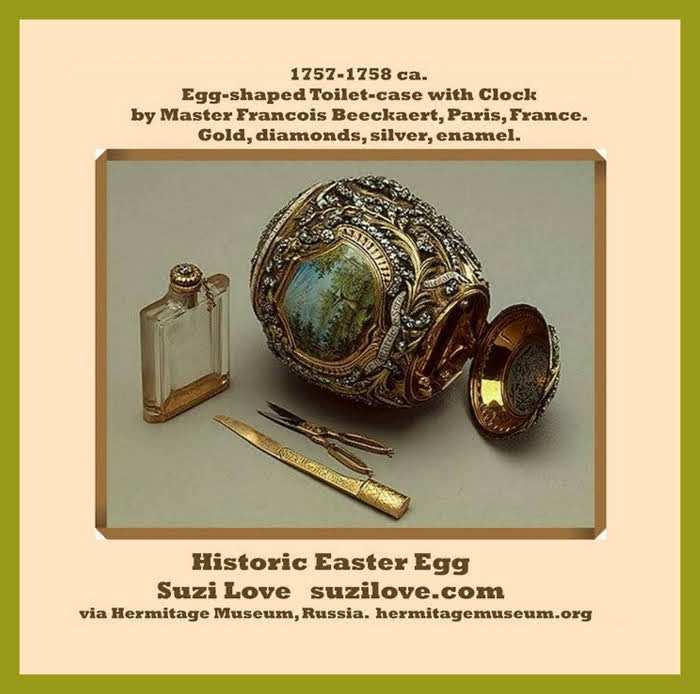
1757-1758 ca. Egg Shaped Toilet Case With Clock. By Master Francois Beeckaert, Paris, France. Gold, diamonds, silver, enamel. via Hermitage Museum, Russia.
1911 Orange Tree, or, Bay Tree Faberge Imperial Easter Egg. Gift to Maria from her son. Automaton nightingale emerges and sings when the correct orange is turned. Gold, jade, diamonds, vitrines, amethysts, rubies, pearls, agates, and bird has feathers. Faberge Easter Egg, Russia.
The name Faberge is associated with the Russian Imperial family for whom most of the world’s most famous eggs were created. In 1870, Faberge inherited his father’s jewelry business and quickly became known for his brilliant designs. A display of his work and the gold medal he was awarded in Moscow’s Pan-Russian Exhibition of 1882 brought him to the attention of the Russian nobility.In 1885, Faberge was commissioned by Tsar Alexander III of Russia to create an Easter egg for his wife, the Empress Maria Fedorovna. This became known as The Hen Egg, the first Imperial Faberge Egg, and is made of gold. The Empress was so happy with the gift that Alexander appointed Fabergé a ‘Goldsmith by Special Appointment to the Imperial Crown’ and the following year commissioned another egg. From then on, Faberge was given complete freedom with future Imperial designs which become even more elaborate every year. A famous Fabergé egg is one of sixty eight jeweled eggs made by Fabergé and his assistants for the Russian Tzars and private collectors between 1885 and 1917.After the Russian Revolution, the House of Faberge was nationalized by the Bolsheviks and the Faberge family fled to Switzerland where Peter Carl Faberge died in 1920. Several of the Faberge Imperial eggs are still missing.
The name Faberge is associated with the Russian Imperial family for whom most of the world’s most famous eggs were created. In 1870, Faberge inherited his father’s jewelry business and quickly became known for his brilliant designs. A display of his work and the gold medal he was awarded in Moscow’s Pan-Russian Exhibition of 1882 brought him to the attention of the Russian nobility.
In 1885, Faberge was commissioned by Tsar Alexander III of Russia to create an Easter egg for his wife, the Empress Maria Fedorovna. This became known as The Hen Egg, the first Imperial Faberge Egg, and is made of gold. The Empress was so happy with the gift that Alexander appointed Fabergé a ‘Goldsmith by Special Appointment to the Imperial Crown’ and the following year commissioned another egg. From then on, Faberge was given complete freedom with future Imperial designs which become even more elaborate every year. A famous Fabergé egg is one of sixty eight jeweled eggs made by Fabergé and his assistants for the Russian Tzars and private collectors between 1885 and 1917.
After the Russian Revolution, the House of Faberge was nationalized by the Bolsheviks and the Faberge family fled to Switzerland where Peter Carl Faberge died in 1920. Several of the Faberge Imperial eggs are still missing.
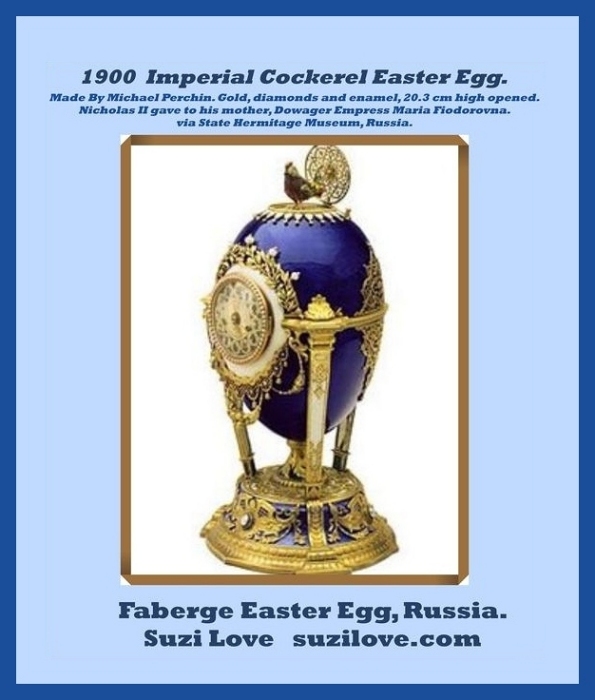
1900 Cockerel Faberge Easter Egg, or, Cuckoo Clock Egg was given by Tsar Nicholas II to Empress Maria Feodoronova. Mechanism on top rear enables its bird to come out and move. The egg is part of the Viktor Vekselberg Collection, owned by The Link of Times Foundation, and housed in the Fabergé Museum in Saint Petersburg, Russia. Faberge Easter Egg, Russia.
Embracing Scandal Book 1, Scandalous Siblings Series. Lady Rebecca Jamison sneaks into the house of the Duke of St. Martin to beg his assistance to combat a rogue and murderous group of railway investors.
Lady Rebecca Jamison told The Duke of St. Martin. ‘We utilize Foster and Braithwaite as our stock trading agents and invest through them using the minimum identification on any documents.”
“Impressive. I heard that Foster and Braithwaite’s business grew twelve fold in the last few years by riding on railway stocks.”
“Hence, our problem. Their profits, our profits, became legendary. People speculated about the mysterious names on share certificates.” At his puzzled look she added, “Simple enough. We draw up letters. Ladies sign with their initials and family name, nothing more, so no one realizes the investors aren’t men. Or rather, no one did before.”
“And now?”
“Two weeks ago, some members of the outer circle approached my brother, Michael. They believe him to be personally responsible for our own change in fortune.”
“How big a change in fortune?”
“Oh, nothing too major.” She waved a hand in a vague manner and hoped her face didn’t flush. “Modest successes. Dividend rates in excess of six percent in some situations.”
His eyebrows shot upwards. “Six percent! Nobody I do business with calls that modest. No wonder they wish to obliterate all reference to your family, and your Society.”
“Yes, if only we’d been able to keep our good fortune a secret. We take the uttermost care with our clandestine activities, as we value our privacy and our reputations.”
The Duke raised a brow and pointed at his clock. “Oh, yes. Great care with your reputation!”
She chose to ignore him. “Michael laughed it off. Refused to join their so-called group of friends who dabbled in investing. So they raised the stakes. If he refuses to hand over m … his calculations for all the new railway share ventures opening, within the next two weeks, they vowed to destroy the members of his family. One by one, until he gives in.”
“Ah, now I understand. That’s why they’re keeping you alive. They’re waiting to acquire the records. They assume as eldest, and involved in a charitable society, you hold the most knowledge of…” When he mumbled, she stiffened. Did he guess? “Of Michael’s future stock predictions. Then, when they have all they require, they’ll kill all–”
“Yes, yes, I know. They’ll dispense with us regardless.”
She lifted her chin a notch. “But I can resolve this situation. Given a little more time, plus a little assistance from you.”
“Ah! Back to the crux of the matter. What you require from me.”