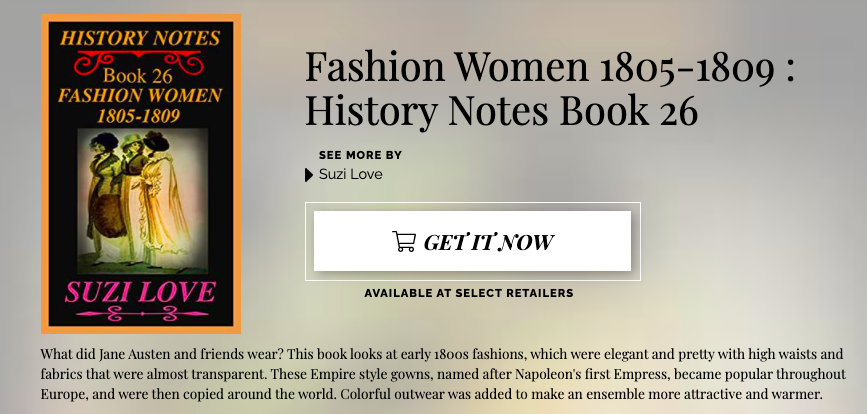
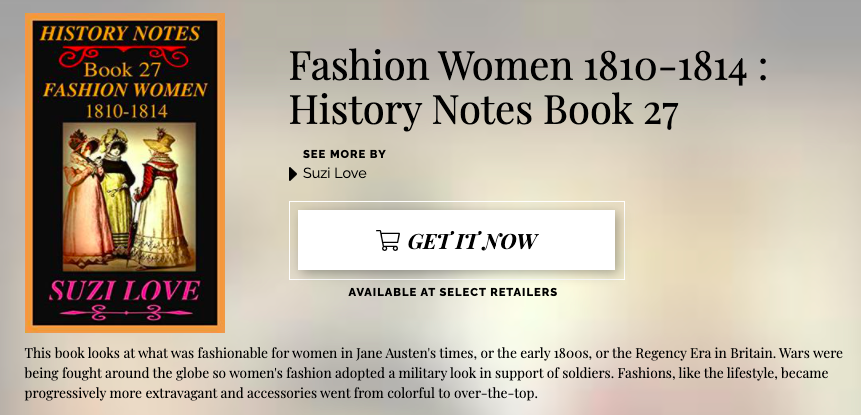
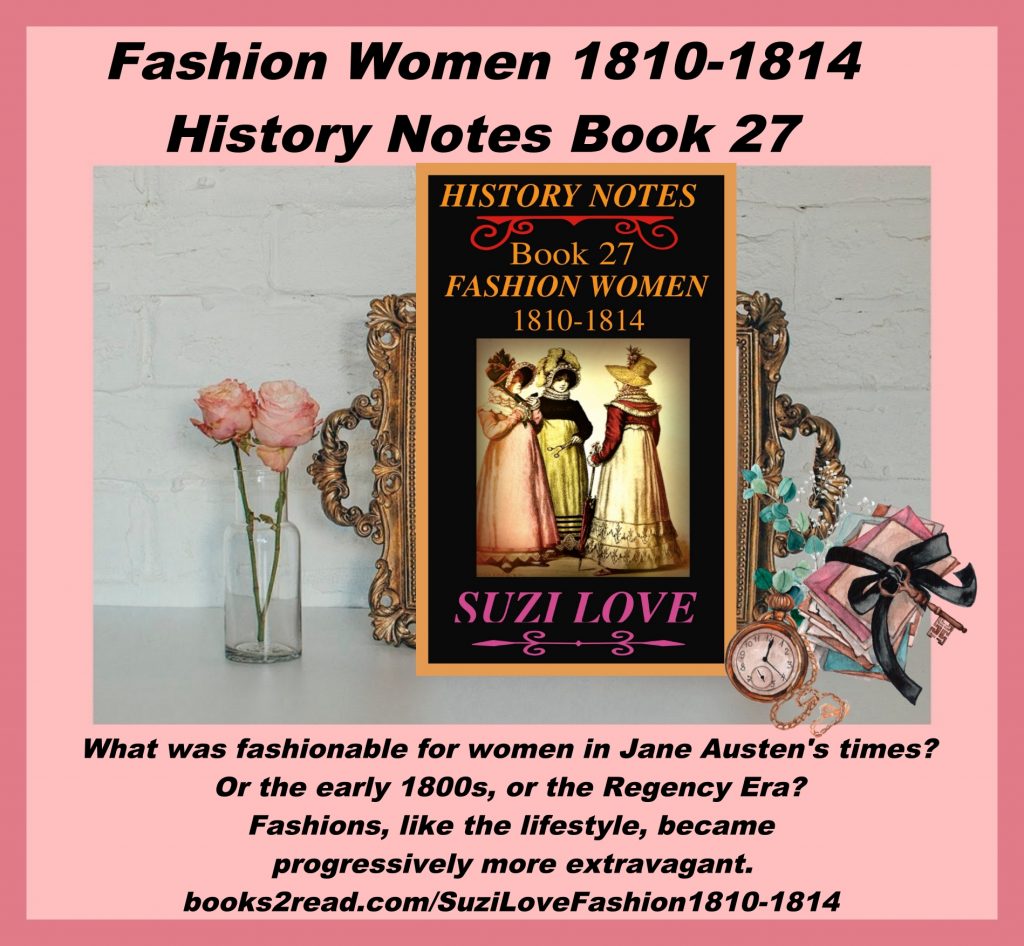
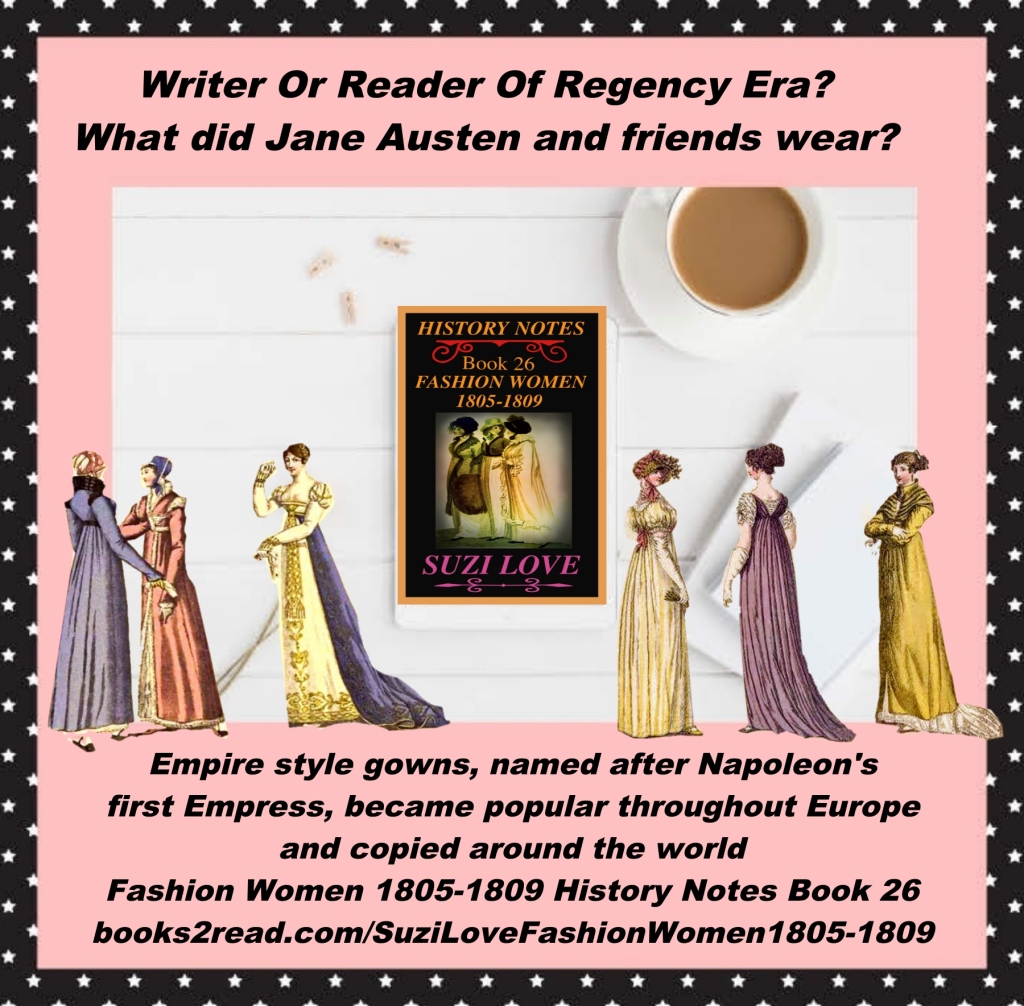
An overview of women’s fashions in the first twenty years of the 19th century. What was fashionable for women in Jane Austen’s times, or the early 1800s. Wars were being fought around the globe so women’s fashion adopted a military look in support of soldiers. In Britain, the Prince Regent ruled instead of his father, King George III, so fashions, like the lifestyle, became more extravagant and accessories went from pretty to opulent. This set includes books 12, 25, 26, 27 and 28.
From the finish of the 18th century until 1820, men’s fashions in European and European-influenced countries moved away from the formal wear of brocades, lace, wigs and powder to more informal and relaxed styles. Focus was on undress rather than formal dress. Typical menswear in the early 1800s included a tailcoat, a vest or waistcoat, either breeches, pants, or the newer trousers, stockings, shoes or boots, all worn with an overcoat and hat. This basic ensemble was accessorized with some form of neckcloth or cravat, gloves, walking stick, cane or riding crop, handkerchief, fobs, watch and perhaps a quizzing glass or eye glass.
Skirted coats were replaced with short-fronted, or cutaway, tailcoats worn over fitted waistcoats and plain, white linen shirts. Knee breeches were gradually replaced by tight-fitting pantaloons and later trousers, decorative shoes with buckles were replaced with a variety of boot styles, and fussy and ruffled neckwear gave way to intricately tied, white linen neck cloths. A Regency Era, or early 1800s, gentleman was outfitted in more practical fabrics, such as wool, cotton and buckskin rather than the fussy brocades and silks of the late 1700s.
1818 Gorgeous women’s fashion In the late Regency Era. Dresses, coats or Redingotes, Spencers, shawls, fichu or shoulder cape, shoes, hats and headdresses, gloves, and Reticules or bags as displayed in various fashion magazines.
Fashion Accessory: Completes and complements outfit. Two groups- 1. Those worn e.g. bonnets, caps and hats, boots and shoes, cravats and ties, gloves, mittens and muffs, jewelry, scarves and shawls, socks and stockings 2. Those carried e.g. bags, fans, and parasols.
If you are a reader or writer of early 1800s, or Regency Era fashions such as mourning and riding fashion, dresses, hats, shoes, reticules or bags, underclothing and fashion accessories, try History Notes Book 28 Women’s Fashions 1815-1819
1809 Women’s Fashions: Dresses, Shawls, Hats and Jewelry from various fashion magazines. Typical of the outfits worn by Jane Austen and her contemporaries for daytime and evening activities. An Empire style, or high-waisted white cotton dress worn under a Spencer or short jacket, a Redingote, or coat, for warmth and with pretty hats, shawls and shoes.
1805 Women’s Dresses and Fashion Accessories. Fashion plates from Fashions of London and Paris. Gorgeous Regency Era clothing came in a wide range of styles to suit every season and occasion. Ladies in Jane Austen’s times wore Empire style dresses which were usually of light fabric and floaty in style so accessories were essential to keep women warm. Accessory: item which contributes to the overall effect but is of secondary importance is the dictionary definition of an accessory, but the term has only been applied in relation to personal appearance since the 19th century. As defined by dress historians, accessories usually complete an outfit and are chosen to complement it. Accessories fall into two groups: Those worn, such as bonnets, caps and hats, boots and shoes, cravats and ties, gloves, mittens and muffs, jewellery, scarves and shawls, socks and stockings. Those that are carried, such as bags, canes, fans, parasols and umbrellas, and swords.
1816 January Blue Carriage Dress, English. High neck but no collar, front is fitted but back has slight fullness and very short bodice. Puffed roll to decorate the hem, trimmed in bias cut blue satin, long sleeves finished at wrists with satin, gloves of white kid and ‘sandals’ or shoes of blue kid leather. Head-dress à la mode de Paris is an unusual cap of white lace and decorated with two rolls of ribbon. “We are indebted to the tasteful fancy of Mrs. Bean, of Albemarle Street, for both our dresses this month.” Fashion Plate via Rudolph Ackermann’s ‘The Repository of Arts’.
Jane Austen and her contemporaries would have worn this style of outdoor, or carriage ensemble with a coat over a dress. These outdoor dresses were labelled a variety of names. In England, this might also have been called a Walking Or Promenade dress, or Pelisse. In Europe, it would be called a Redingote.
Definition: Pelisse, Walking Dress, Carriage dress, Promenade Dress, Redingote. Long, fitted coat sometimes cut away in front to show off the dress underneath. Originally made for men with several capes and trimmed with large buttons, they were adapted to add an additional, and warmer, layer to the typical white muslin dresses worn in the early 1800s. Those light weight dresses were good in summer but not suited to harsh winters. Over the carriage dress, a shawl could be added as well as a muff to give a warm and comfortable outfit for traveling by carriage.
1816 January Blue Carriage Dress, English. High neck but no collar, front is fitted but back has slight fullness and very short bodice. Puffed roll to decorate the hem, trimmed in bias cut blue satin, long sleeves finished at wrists with satin, gloves of white kid and ‘sandals’ or shoes of blue kid leather. Head-dress à la mode de Paris is an unusual cap of white lace and decorated with two rolls of ribbon. “We are indebted to the tasteful fancy of Mrs. Bean, of Albemarle Street, for both our dresses this month.” Fashion Plate via Rudolph Ackermann’s ‘The Repository of Arts’.1816 January Blue Carriage Dress And Unusual Lace Cap. #Regency #JaneAusten #Fashion https://books2read.com/SuziLoveFashionWomen1805-1809 Share on X
1812 October Autumnal Carriage Or Morning Costume, English. Loose white jaconet muslin dress, high in the neck, with double frills of deep vandyke lace that fall over the Spencer. Blue satin Spencer ornamented with silver cord and buttons ‘en militaire’ and held at the throat with a cord and tassels, a quartered foundling cap of lace tied under the chin with a full band and decorated with an autumnal flower. Grey kid shoes, lemon gloves and a ridicule, or bag, of purple velvet. Fashion Plate via Rudolph Ackermann’s ‘The Repository of Arts’.
Dress – Morning: Worn either at home, out shopping, or for walking in the park or country. Presentable but not overly accessorized.
Spencer: Short body-hugging jacket worn for warmth &modesty. Said to have originated in accident to Lord Spencer in hunting when coattails torn off.
1812 October Autumnal Carriage Or Morning Costume, English. Loose white jaconet muslin dress, high in the neck, with double frills of deep vandyke lace that fall over the Spencer. Blue satin Spencer ornamented with silver cord and buttons ‘en militaire’ and held at the throat with a cord and tassels, a quartered foundling cap of lace tied under the chin with a full band and decorated with an autumnal flower. Grey kid shoes, lemon gloves and a ridicule, or bag, of purple velvet. Fashion Plate via Rudolph Ackermann’s ‘The Repository of Arts’.1812 October Autumnal Carriage Or Morning Costume With Blue Satin Spencer. #RegencyEra #JaneAusten #HistoricalFashion. https://books2read.com/SuziLoveFashion1810-1814 Share on XHN_27_D2D_fashwomen1810-1814
https://books2read.com/SuziLoveFashion1810-1814
1840-1880 ca. Burgundy and White Silk Jacket, Russian. #Romantic #Fashion #Russia via suzilove.com and Metropolitan Museum New York City, U.S.A. metmuseum.org
1840-1880 ca. Burgundy and White Jacket, Russian. Silk, metal, and cotton. Brooklyn Museum Costume via suzilove.com and Metropolitan Museum New York City, U.S.A. metmuseum.org