Writing Regency Era Fiction Or Nonfiction? Need more information on Older Gentleman’s Day in early 1800s, or the Bridgerton family or Jane Austen’s Regency Era. A lighthearted overview of an older gentleman’s clothing, social life, and responsibilities in the early 1800s. Take a look at where an older man went, what he wore, and how he managed the family’s finances and his estates. Older Gentleman’s Day Regency Life Series Book 3 books2read.com/suziloveOGD
1807 Fashionable French Couple. Man: Blue cutaway coat and yellow breeches. Lady: Lemon and blue dress and bonnet. Typical of the ensembles worn by Jane Austen and her family and friends. Fashion Plate via Journal des Dames et des Modes, or Costume Parisien.
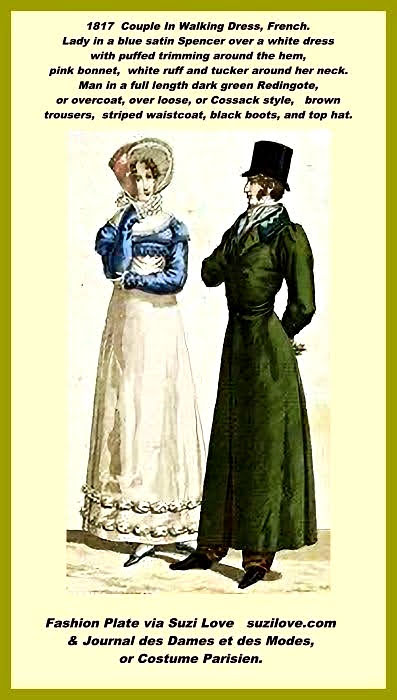
1817 Couple In Jane Austen and Bridgerton style Walking Dress and Gentleman in Same Green Redingote.
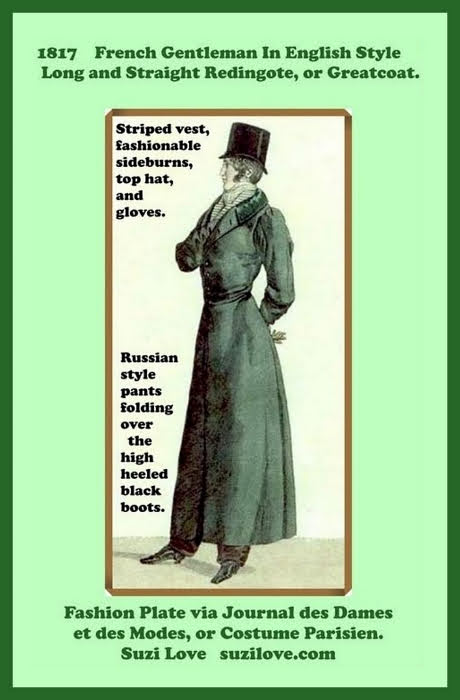
Lady: Blue satin Spencer over a white dress with puffed trimming around hem, pink bonnet, white ruff and tucker. Man: Long green Redingote, or overcoat, in the English style. Long brown trousers, striped waistcoat or vest, top hat, gloves and boots. Fashion Plate via Journal des Dames et des Modes, or Costume Parisien. Definition Redingote Or Coat Or Pelisse: Long fitted outdoor coat worn over other garments for warmth. French word developed from English words, riding coat. French fashion plates call these coats a Redingote and English plates call them a Pelisse, Or Walking Dress, or Carriage Costume. These are the types of outfits worn by Jane Austen and contemporaries in English magazines, where French fashions were obsessively copied despite the two countries being at war for many years.
This same Fashion Plate is seen below for the gentleman.
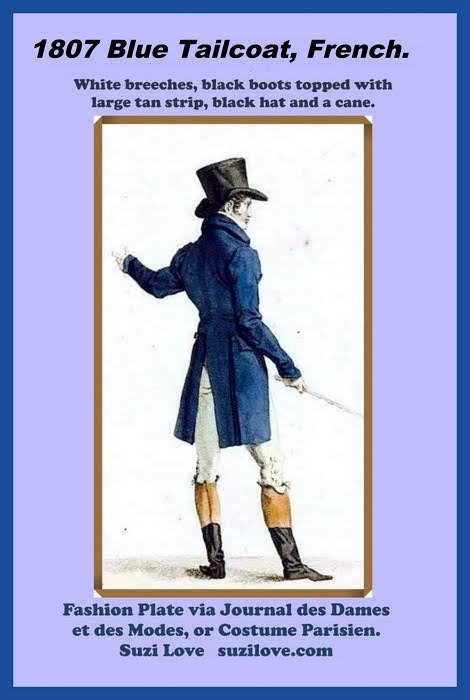
1807 Gentleman’s Blue Tailcoat, French. White breeches, black boots topped with large tan strip, black hat and a cane. Plate via Journal des Dames et des Modes, or Costume Parisien.
French fashions and Georgian and Regency Era fashions from Great Britain were copied around the world. This is what men wore in the times of Jane Austen for city and country life.
1815 Long Blue Overcoat with brown fur trim, white trousers, scarf, top hat and a cane. Fashion Plate via Journal des Dames et des Modes, or Costume Parisien. I can picture Jane Austen’s male friends and family and the Bridgerton men wearing this gorgeous coat when out walking or driving in the park.
1820 ca. Groups of Dandies fashionably dressed. Hand Colored etching. Published By J. Le Petit, Dublin, U.K. Via British Museum, London, UK. britishmuseum.org (PD-Art)
A dandy is a man who places a lot of importance on his appearance, on having refined language living his life in a leisurely manner. A dandy didn’t have to be an aristocrat. He could also be a middle class man or a self-made man of wealth who could afford to place all his emphasis on his clothing and his leisure time.
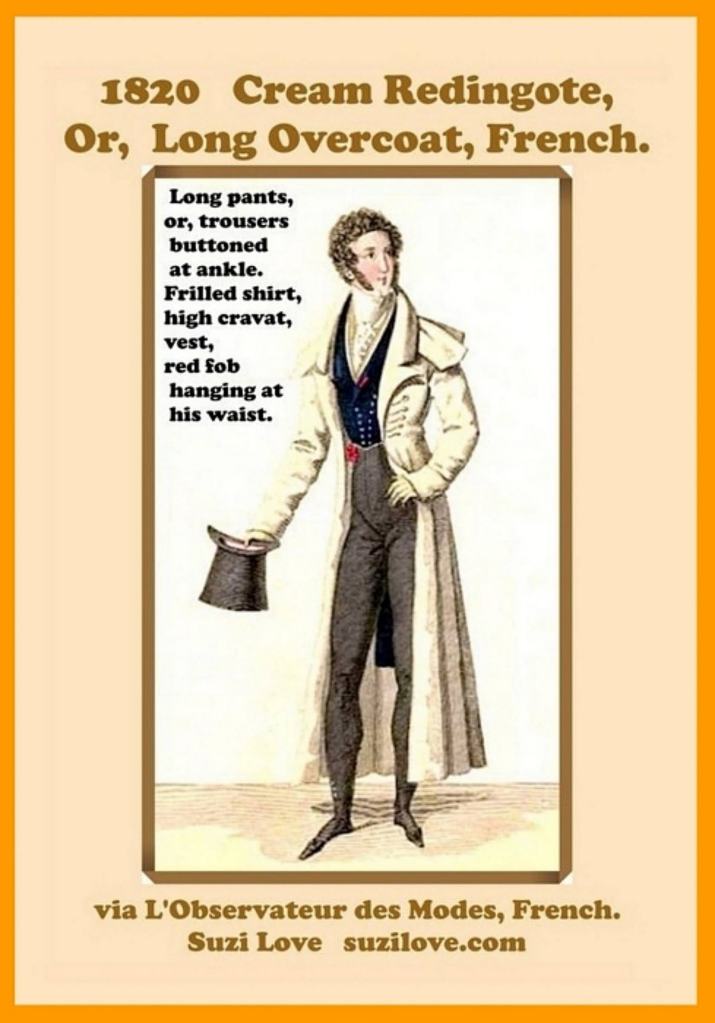
1820 Gentleman’s Cream Redingote, Or Long Overcoat, French. Long pants, or trousers, buttoned at the ankles, frilled shirt, high cravat, vest, red fob hanging at his waist. via L’Observateur des Modes, French.
1810 Man’s Suit and Girl’s Dress, Portugal. Man’s purple pleated silk jacket, vest, and breeches embroidered with silk threads. Girl: White silk tulle dress embroidered with silk threads and an overdress of yellow cotton satin. via National Costume Museum, Portugal. The sort of men’s formal clothing worn for court and typical girl’s dress as worn in Jane Austen’s times.
1810 Les Invisibles. By James Gillray. Two men walk towards each other, each with a lady hanging to each arm, all have their faces concealed by some part of their dress, hat, or collar, or both. One man has a round hat, with a fantastically curved brim projecting downwards. The other has a huge crescent-shaped cocked hat with the peaks dipping over face and back. Via British Museum, London, UK. britishmuseum.org (PD-Art)
1798 Gentleman’s Outfit, French. Long green overcoat with yellow buttons, tan gloves, black boots topped with yellow band, gloves with three seams across the back of the hand, high white cravat, black hat, fob at his waist and holding a cane. Fashion Plate via Journal des Dames et des Modes, or Costume Parisien.