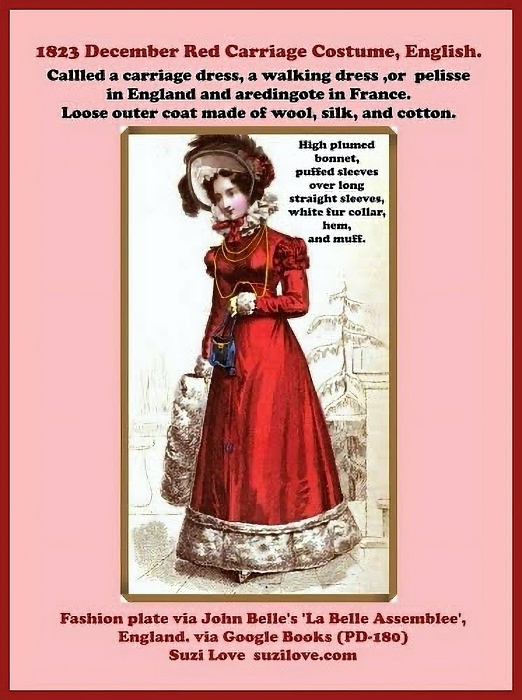
1823 December Red Carriage Costume, English. Gorgeous red dress with waistline a couple of inches below the bust, puffed short sleeves over long straight sleeves, wide white fur hem trim to match the white fur muff, white ruffle at the neck. High bonnet with a feather tied under the chin with a red bow. Fashion plate via John Belle’s ‘La Belle Assemblee’, England.
Definition Redingote Or Pelisse Or Walking Dress Or Carriage Dress Or Coat: French word developed from English words, riding coat. Long fitted outdoor coat worn over other garments for warmth. Often left open at the front to show off the dress underneath. Sometimes cut away in front. Originally made with several capes and trimmed with large buttons. French fashion plates call these coats Redingotes and they are designed for women, men and children. English fashion plates call them a Pelisse, a walking dress, Promenade dress, or Carriage dress. books2read.com/suzilovePelisse
How did Jane Austen and her family? Did they go by stagecoach? The dreadful condition of British roads caused great apprehension to all classes of travelers. Making a journey anywhere in the country was a big undertaking and often a gentleman composed his last will and testament before his departure. Traveling in vehicles was only possible during the day or on the nights with very bright moonlight with few vehicles attempting road travel in winter and any travel on a Sunday was frowned upon.
Description of Stage Coach Travel in England. via 1815 Journal Tour of Great Britain. “The gentlemen coachmen, with half-a dozen great coats about them, immense capes, a large nosegay at the button-hole, high mounted on an elevated seat, with squared elbows, a prodigious whip, beautiful horses, four in hand, drive in a file to Salthill, a place about twenty miles from London, and return, stopping in the way at the several public-houses and gin-shops where stage-coachmen are in the habit of stopping for a dram, and for parcels and passengers on the top of the others as many as seventeen persons. These carriages are not suspended, but rest on steel springs, of a flattened oval shape, less easy than the old mode of leathern braces on springs. Some of these stage coaches carry their baggage below the level of the axletree.”
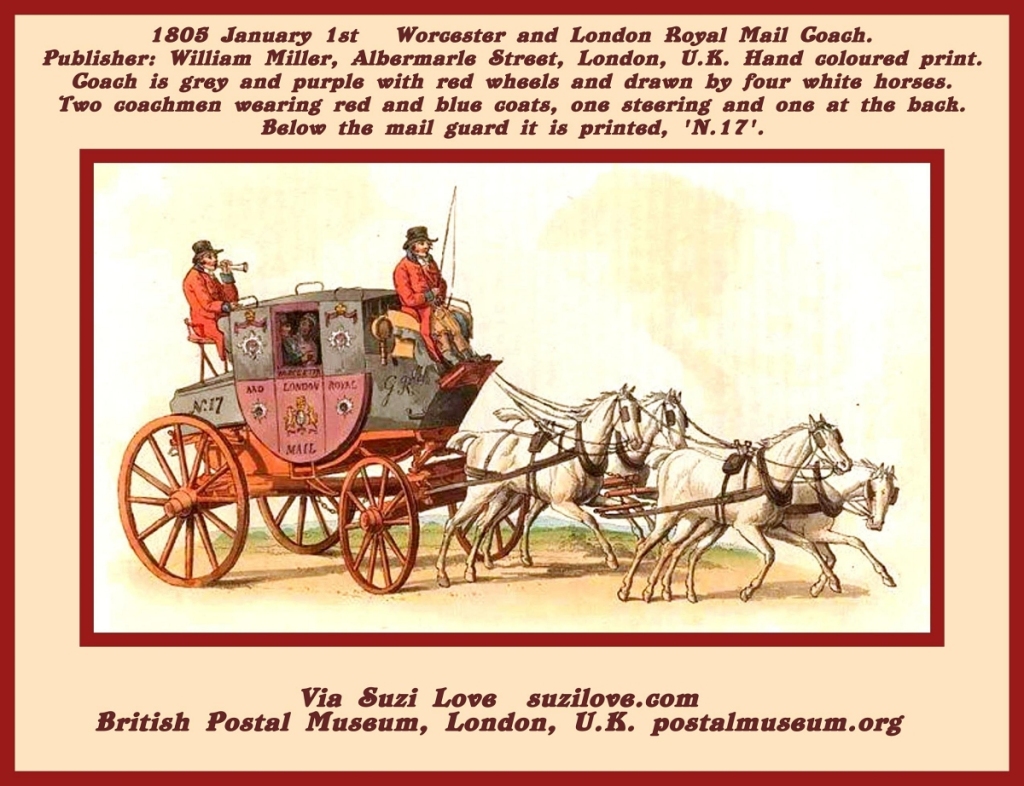
Coach Carriage Line Drawing. Photo Editing by Suzi Love ~ suzilove.com via Pearson Scott Foresman donation to Wikimedia Commons.1805 January 1st Worcester and London Royal Mail Coach. Publisher: William Miller, Albermarle Street, London, U.K. Hand colored print. Coach is grey and purple with red wheels and drawn by four white horses. Below the mail guard it is printed, ‘N.17’. Via Suzi Love suzilove.com British Postal Museum, London, U.K. postalmuseum.org
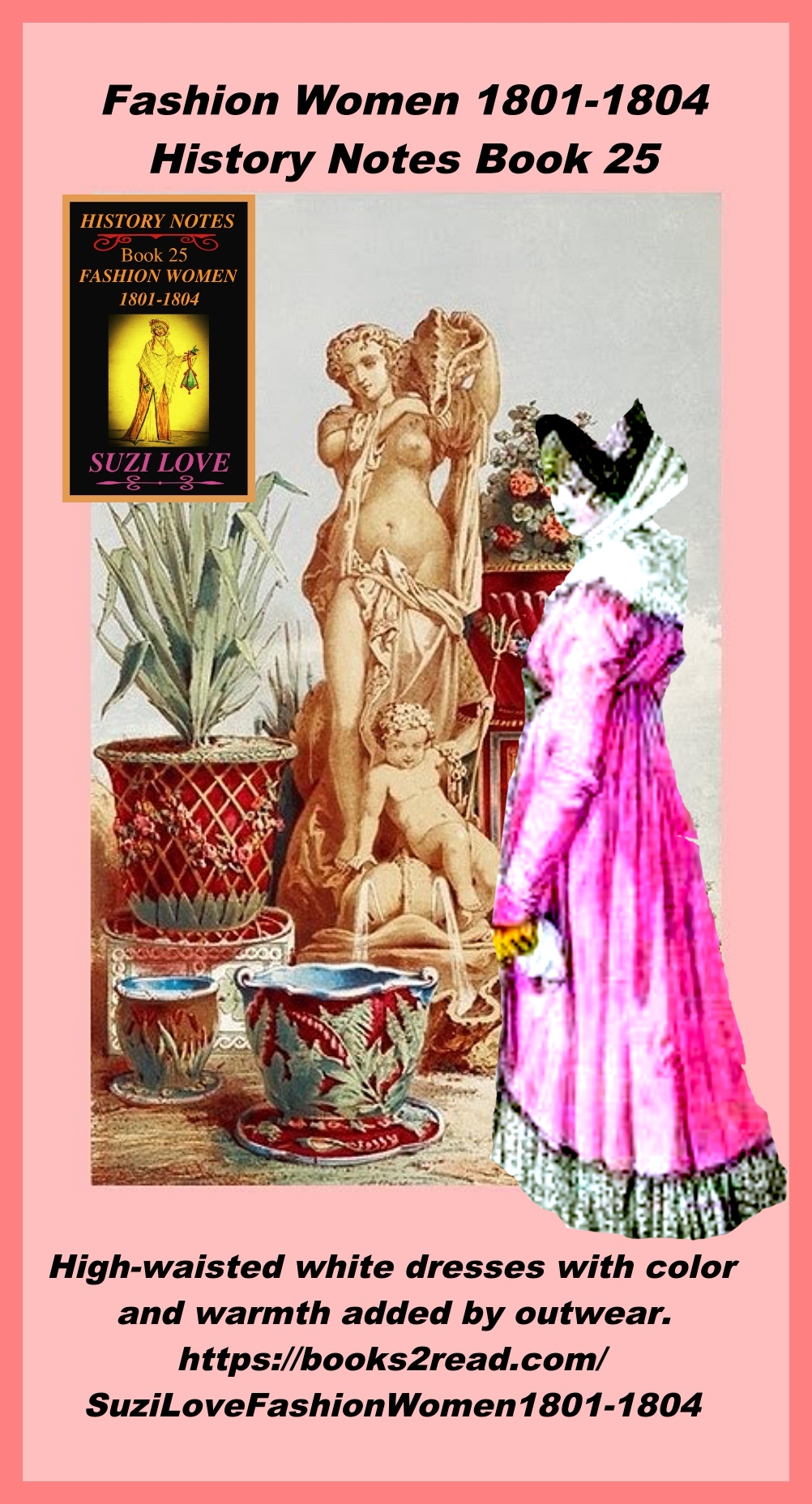
Fan of the Bridgerton Series? Jane Austen Lover? Writer Or Reader Of Regency Era? What did they wear in early 1800s? Women’s clothing changed dramatically in early 1800s. New silhouette copied simplistic styles of Greeks and Romans. High-waisted white dresses and flowing skirts with color and warmth added by outerwear and accessories. Fashion Women 1801-1804 History Notes Book 25 https://books2read.com/SuziLoveFashionWomen1801-1804
Definition Empire Style Dress: High-waisted white gowns defined women’s fashion during the Regency Era. ‘Empire’ is the name given to the period when Napoleon Bonaparte built his French Empire. High-waisted, loose gowns were adopted by the aristocracy as a symbol of turning away from the elaborate clothing worn in the 1700s. This sort of high-waisted dress would have been worn by Jane Austen and her contemporaries in England.
Definition Shawls: The shawl started off in India as a fine wool garment for men that could be worn as a scarf, turban or as a mantle: the word comes from the Persian shäl. Originally imported from the East, European Kashmir shawls were made first in Norwich and Edinburgh in Britain in the late 18th century. Shawls were an essential item in the early 1800s to cover the thin gowns women wore. They were made of muslin, gauze, silk, wool, and velvet, though cashmere shawls were the softest and most prized.
1820 ca. Silk Spencer, British. Made of silk and willow. Short length, long sleeves, extensive decoration on shoulders, sleeves and wrists. Military style braiding on the spencer in support of all the soldiers fighting wars across the world. The sort of jacket worn by fashionable Regency ladies over their light and flowing Empire dresses. Credit Line:Catharine Breyer Van Bomel Foundation Fund, 1987 via Metropolitan Museum New York City, U.S.A. metmuseum.org
Definition Spencer: Short jackets cut to match the high waistlines of Empire dresses. They often copied military styling, such as braiding, shoulder decoration, buttons and loop fasteners, and wrist adornments. They were generally of complex construction, often with a diamond shaped piece in the back. Said to have originated in an accident to Lord Spencer while hunting when his coat tails were torn off and he wore it as a short jacket.
1820 ca. Spencer, British. Silk and willow. Front View.1820 ca. Spencer, British. Silk and willow. Back View. 1820 ca. Spencer, British. Silk and willow. Sleeve View. 1820 ca. Spencer, British. Silk and willow. Sleeve Decoration View. 1820 ca. Spencer, British. Silk and willow. Braiding View. 1820 ca. Spencer, British. Silk and willow. Wrist View.
1820 ca. Military Style Silk Spencer With Braiding In the Style of the Bridgertons and Jane Austen. #Bridgerton #JaneAusten #RegencyFashion #BritishHistory books2read.com/suziloveSpencers
HN_4_Spencers, Or Jackets. #Regency #Georgian #Victorian #Fashion History Notes Book 4 By Suzi Love.
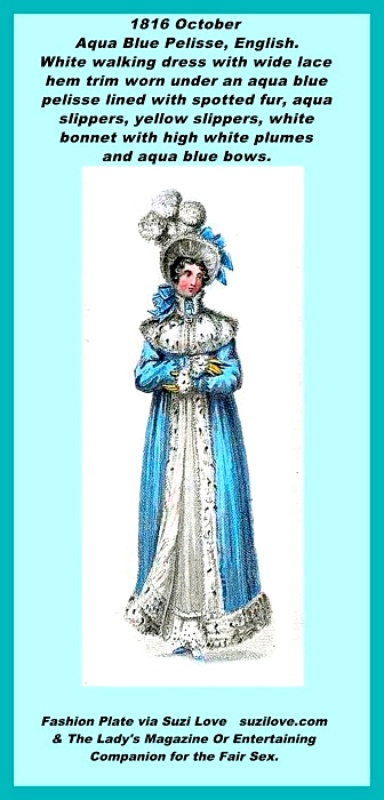
1816 October. Pelisse, English. White walking dress with wide lace hem trim worn under an aqua blue pelisse lined with spotted fur, aqua slippers, yellow slippers, white bonnet with high white plumes and aqua blue bows. Fashion Plate via Lady’s Magazine.
During the early 1800s, dress fabrics and dresses were thin, sometimes almost transparent. These lightweight white cotton dresses were fashionable in Jane Austen’s times, but they were certainly not warm when a lady was out walking or when riding in a carriage. Numerous outer layers could be added for warmth and to brighten and personalize an outfit. These might be an overdress, pelisse or redingote, hat, shawl, gloves, or large fur muff.
A typical outdoor outfit worn by the Bridgerton family, or Jane Austen and her contemporaries, when going outside consisted of an Empire style, or high-waisted, white cotton dress worn under a Pelisse, or Redingote, or coat, for warmth and with an added layer with the pretty shawl. Hats were made to match gowns and cloaks and fashionable women spent an extraordinary amount of time coordinating complete ensembles which included reticules or bags, shoes, shawls, gloves, hats, parasols, and fans. Typical Empire style dresses had low necklines and with skirts that started directly under the bust and flowed into the classical relaxed wide styles of Greece and Rome. These were worn most days and cotton, silk or taffeta were the popular fabrics.
Definition Redingote Or Pelisse Or Walking Dress Or Coat: French word developed from English words, riding coat. Long fitted outdoor coat worn over other garments for warmth. Originally made with several capes and trimmed with large buttons. For women, the coat was often cut away in the front or left open to show off the dress underneath. French fashion plates call these coats Redingotes and they were worn by men, women, and children. English fashion plates call the coats a Pelisse, a walking dress, Promenade dress, or Carriage dress.
1816 October. Pelisse, English. White walking dress with wide lace hem trim worn under an aqua blue pelisse lined with spotted fur, aqua slippers, yellow slippers, white bonnet with high white plumes and aqua blue bows. Fashion Plate via Lady’s Magazine.
1810 ca. Muslin, or Cotton, Bodiced Petticoat With Sleeves, British.The sort of petticoat Jane Austen wore beneath her dresses, for both modesty and warmth. via Killerton House. National Trust, U.K. nationaltrustcollections.org.uk
In Jane Austen’s years of the early nineteenth century, women often wore light-weight dresses under which was worn a range of underclothing to stop gowns appearing transparent and sticking to a lady’s body. To preserve modesty, underclothing included a chemise next to the skin, then a corset, and then petticoats to give shape to a dress and to keep it away from her body.
Petunia and the Pearl Diver: A hot Regency romance. Petunia needs money to save her aristocratic family. The pearl diver needs a woman to save him, body and soul. Their night together at a London brothel could solve both problems. But can their relationship survive in the real world?Because walking away becomes impossible when one night leaves them craving more…and more.
Book Hook: The pearl diver looked at the fidgeting Mistress. When she’d first come into the room he’d thought…no fucking chance. Miss I’m-Afraid-of-My-Own-Shadow would waste his time and his money. However, he’d underestimated the sheer brazen determination of the woman, because she was still in this room with him, when he’d have bet another strand of pearls that she’d have turned tail and run in the first three minutes. Hell, the other two girls were seasoned prostitutes and they’d run after getting no reaction from him, due to equal parts of disbelief, frustration, and his howling anger.
“What’s your name?” He didn’t expect an answer, but he’d startled her into a response.
“Petunia.”
She looked more shocked than he was that she’d blurted out what he assumed was her real name. Street walkers, even high class ones, used stage names. The two girls before had called themselves Strawberry and Plum.
She seemed horrified, perhaps even terrified, over her mistake, which made him wonder what the hell she was hiding. If she was employed here, she’d have called herself…another fruit? Pineapple, or lemon? Her expression was sour enough to have sucked lemons.
“John.” She waved at guard number one, the big man with an obvious liking for male physiques. “Turn him over.”
The pearl diver glared at the guard, but they tossed him to his stomach as if he was a lump of meat thrown into a frying pan. “Shit.” He kicked backwards, but missed. The whip cracked near his bare backside and he yelled. “Holy mother of God.” He tried to look at his backside to see if it was marked.
“I’m your mistress, so you don’t speak unless spoken to.”
The whip cracked a second time, but thankfully only stung a little as her aim was so crooked.
“That will remind you,” Petunia announced, “that I’m here to do a job. I need those pearls. So you’re not leaving until I’ve earned them.”
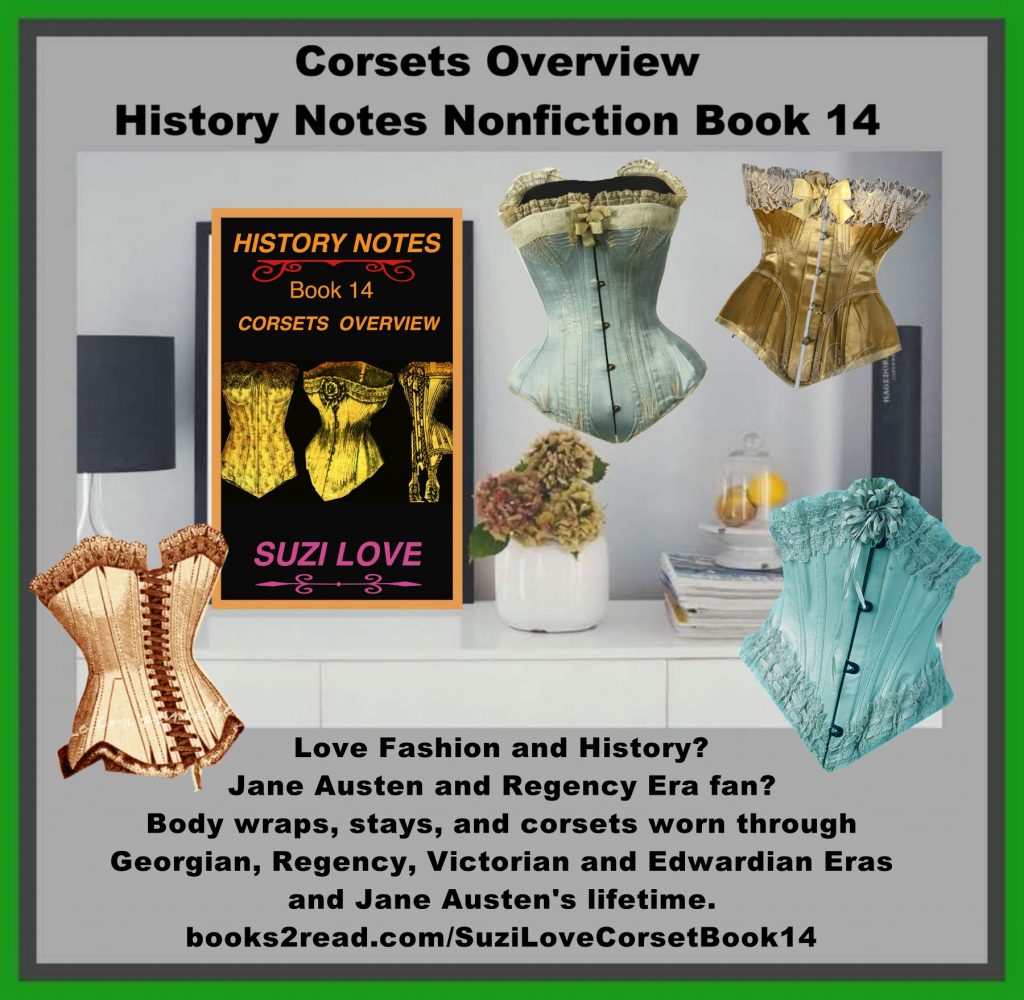
This book shows how body wraps, stays, and corsets were worn to create a variety of fashionable silhouettes through past centuries. Corsets flattened breasts and accentuated rounded hips or pushed up breasts and showed off the bust line depending on the fashions of the time and the desired silhouette. Overview of corsets through history, including the Georgian, Regency, Victorian and Edwardian Eras, and the Bridgerton and Jane Austen’ years. History Notes Book 14.
The name stays probably comes from the French estayer meaning to support. The word corset, which comes from the French word corps for body, had been in use centuries earlier, though often with not quite the same meaning. By the beginning of the 19th century when these undergarments took on more shape and form, the word corset was generally used instead of stays.
During the 1820s, fashions changed from the loose and flowing Regency Era or Empire style gowns and the waistline lowered back to almost the natural position. Towards the mid 1800s, breast cups were added to corsets to give more support and breast comfort. Corsets were lengthened to the hip and gussets added in both the bust area and over the hips. Therefore corsets had more shaping but with less boning.
From the 1820s onwards, menbegan to wear corsets and this continued through the Romantic Era, though the men who wore corsets usually claimed they needed them for back pain.
Queen Victoria ruled England from 1837 to 1901 and at the beginning of her reign, dress waists were around their natural line. But as the years of her reign progressed, fashionable waists became thinner and corsets were redesigned to give more of an hourglass figure.
Early Victorian Era corsets were cotton, boned with mainly whale bone, laced at the back and with tiny hooks and eyes up the front for front fastening. By the middle of the century, corsets were beginning to be more decorative with embroidery and ribbons and then later made of colorful silks and satins.
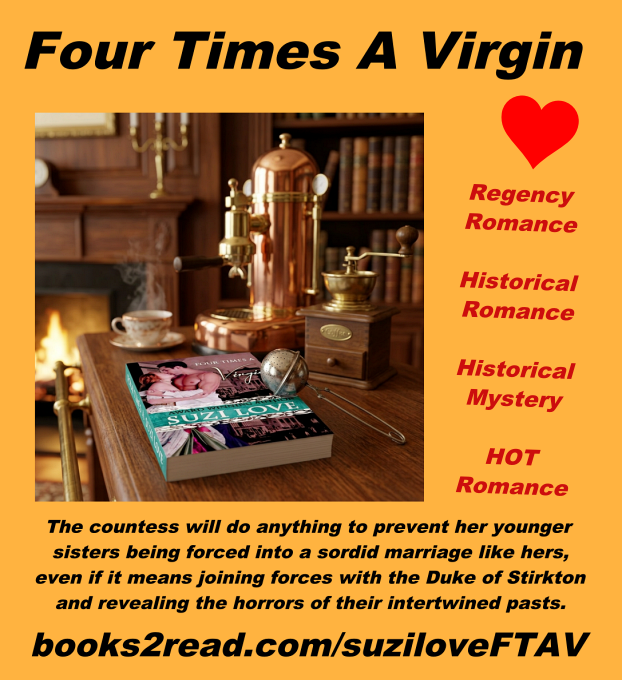
1821, April 1st Duke of Stirkton’s residence, Mayfair, London. The countess threw back her head and laughed. “Your good name will suffer far more than mine, if I reveal your family’s depraved secrets.” She shrugged “My reputation was shredded long ago.”
“Our past is entwined so exposing me will also expose you,” Max, Duke of Stirkton, reiterated firmly. “Therefore, you shall present yourself here tomorrow morning at ten, when I’ll present you with the first box of papers and you’ll agree to my terms.”
“There’ll be no terms except mine.”
Max paced the length of his room with his hands clasped behind his back and didn’t look at her. Negotiating tactics; he sensed he’d need every one he could employ to stay a step ahead of Carina. “In exchange for the names of those two men and for my help uncovering the third,” he said in a cool voice, “you’ll entertain me for a month.”
“Your wealth can buy you a companion in any brothel in London and your title would ensure you were invited into beds all over the city.”
“None of those women interest me at present.”
“By some ridiculous whim, you’ve fixed your attention on me, despite the fact that I’ve only been here for twenty minutes.”
“My mind has been fixated on you for a lot longer than twenty minutes.”
She frowned. “I’m unsure whether I should be flattered or insulted. Is this supposed to ease your guilt?”
Looking for a new Historical Mystery? Lady Rebecca Jamison invests in railway stocks to save family from ruin. #ReadARegency #VictorianRomance #HistRomance #HistoricalMystery https://books2read.com/suziloveES