1812 White Court Dress, French. Very small bodice, short sleeves, long burgundy velvet train, tiara, long white gloves and a fan. Fashion Plate via Journal des Dames et des Modes, or Costume Parisien.
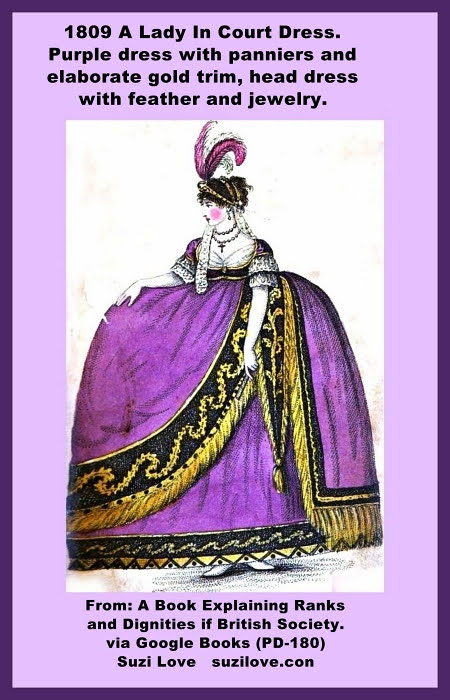
Definition Court Dress: Usually, the difference between a court dress and a ball dress was in the quality of fabrics used, how elaborate the design, and the number and quality of the accessories. Plus, in England in the early 1800s court dresses were required by Queen Charlotte to have hoops and in France and other European countries court dresses a long train, usually expensively decorated. During the Regency Era, white cotton dresses were considered suitable for many evening events, but definitely not for an evening event in a palace.
Regency Gentleman’s Sporting Life in the times of Jane Austen. By Robert Cruikshank via Google Books Races, bowls, sailing, fox hunting… all the sports enjoyed by people in Regency Era. From: 1826 The English Spy by Robert Cruikshank via Google Books (PD150)
1826 Doncaster Race Course for the Great St. Leger Race. Regency Sporting Life. via 1826 The English Spy By English Cartoonist, Robert Cruikshank.1826 Bowling Alley at Worcester, England. Regency Sporting Life. via 1826 The English Spy By English Cartoonist, Robert Cruikshank.1826 View of Berkeley Hunt Kennel, England. Regency Sporting Life. via 1826 The English Spy By English Cartoonist, Robert Cruikshank.1826 Casualties Of The Hunt.A Regency Gentleman’s Sporting Life. Regency Sporting Life. via 1826 The English Spy By English Cartoonist, Robert Cruikshank.1826 Race characters at the turf, Regency Sporting Life. via 1826 The English Spy By English Cartoonist, Robert Cruikshank.1826 Regency Gentleman's Sporting Life By Robert Cruikshank. #Cartoon #RegencyEra #GoogleBooks https://books2read.com/suziloveYGD Share on XRL_2_D2D_RetailerBuyLink_RL_2
https://books2read.com/suziloveYGD
1811 White Dress, French. Dress with scalloped hem, pink Redingote, green paisley shawl and white hat. Fashion Plate via Journal des Dames et des Modes, or Costume Parisien.
Definition Redingote Or Pelisse Or Walking Dress Or Coat: Long fitted outdoor coat worn over other garments for warmth. Often left open at the front to show off the dress underneath. French word developed from English words, riding coat. Jane Austen and her contemporaries wore long coats like these to keep warm when out and about, visiting, shopping etc. The thin muslin dresses worn in the early 1800s were little protection against European winters.
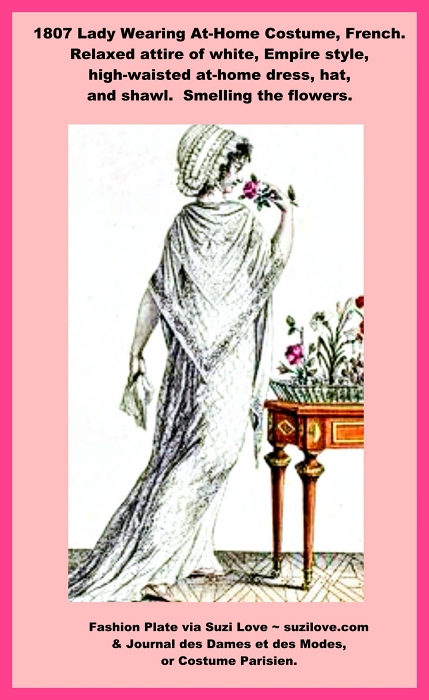
1811 White Dress, French. Worn under a white spotted tunic with yellow over dress with long sleeves. White gloves, shoes and hat with plume, or feathers, or aigrette. Fashion Plate via Journal des Dames et des Modes, or Costume Parisien. Even though this is a French fashion plate, Jane Austen and her contemporaries would have worn long coats like these to keep warm when out and about, visiting, shopping etc. The thin muslin dresses worn in the early 1800s were little protection against European winters so warmth and color was added by tunics and coats in a huge variety of styles.
Definition Aigret, aigrette, egret: Plume of feathers or jeweled ornament in shape of feathers worn on head or hats. During the early 19th century., or Jane Austen’s lifetime, the favorite feathers were osprey and heron.
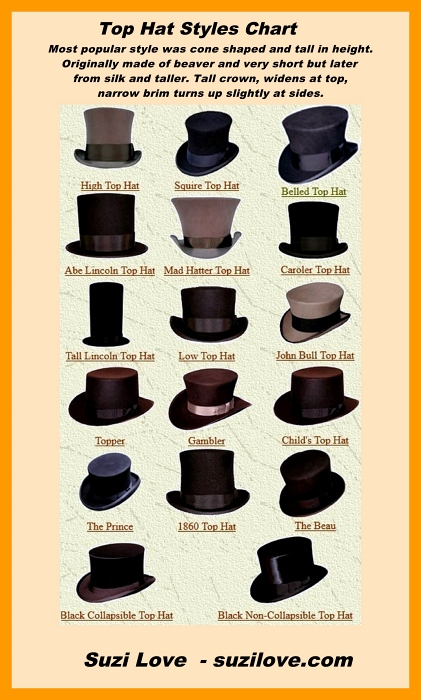
Top Hat Styles Chart during the 1800s, from the Regency Era through to the Victorian years. Most popular style was cone shaped and tall in height. Originally made of beaver and very short but later from silk and taller. Tall crown, widens at top, narrow brim turns up slightly at sides.
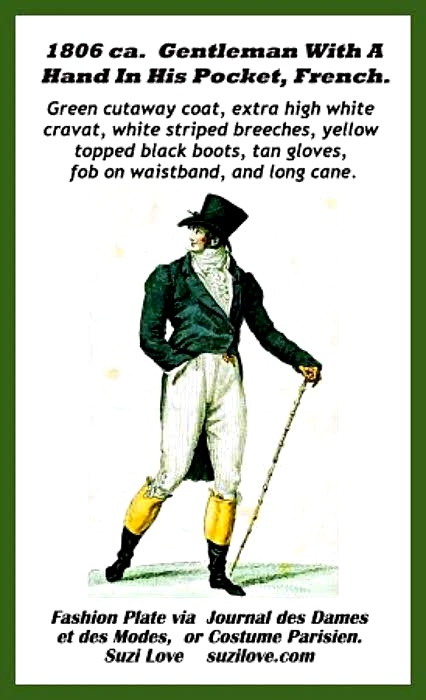
From the finish of the 18th century until 1820, men’s fashions in European and European-influenced countries moved away from the formal wear of brocades, lace, wigs and powder to more informal and relaxed styles. Focus was on undress rather than formal dress. Typical menswear in the early 1800s included a tailcoat, a vest or waistcoat, either breeches, pants, or the newer trousers, stockings, shoes or boots, all worn with an overcoat and hat. This basic ensemble was accessorized with some form of neckcloth or cravat, gloves, walking stick, cane or riding crop, handkerchief, fobs, watch and perhaps a quizzing glass or eye glass.
Skirted coats were replaced with short-fronted, or cutaway, tailcoats worn over fitted waistcoats and plain, white linen shirts. Knee breeches were gradually replaced by tight-fitting pantaloons and later trousers, decorative shoes with buckles were replaced with a variety of boot styles, and fussy and ruffled neckwear gave way to intricately tied, white linen neck cloths. A Regency Era, or early 1800s, gentleman was outfitted in more practical fabrics, such as wool, cotton and buckskin rather than the fussy brocades and silks of the late 1700s.
1823 Pelisse or Redingote or Walking dress, or Coat, English. Made for a wedding trousseau in 1823. Intricate decoration from rouleaux applied in floral shapes, and trimmed with wire wrapped in silk thread which stands out from the garment in loops at the ends. ‘Vandyke’ style of pointed shoulder pieces were fashionable at the time. Via Museum Of London, UK.
Definition Redingote Or Pelisse Or Walking Dress Or Coat: French word developed from English words, riding coat. Long fitted outdoor coat worn over other garments for warmth. Often left open at the front to show off the dress underneath. Sometimes cut away in front. Originally made with several capes and trimmed with large buttons. French fashion plates call these coats Redingotes and they are designed for women, men and children. English fashion plates call them a Pelisse, a walking dress, Promenade dress, or Carriage dress. books2read.com/suzilovePelisse
Definition Vandyke: Edging of v-shaped points, the name coming from the Flemish painter, Sir Anthony Vandyke, who was known for his short pointed beard.
1823 Blue Pelisse Or Redingote, British. Made for a trousseau for a wedding. via Museum of London.1823 Blue Pelisse Or Redingote, British. Made for a trousseau for a wedding. via Museum of London.1823 Blue Pelisse Or Redingote, British. Made for a trousseau for a wedding. via Museum of London.1823 Blue Pelisse Or Redingote, British. Made for a trousseau for a wedding. via Museum of London.1823 Blue Pelisse Or Redingote, British. Made for a trousseau for a wedding. via Museum of London.1823 Blue Pelisse Or Redingote, British. Made for a trousseau for a wedding. via Museum of London.1823 Blue Pelisse Or Redingote, British. Made for a trousseau for a wedding. via Museum of London.1823 Blue Pelisse Or Redingote, British. Made for a trousseau for a wedding. via Museum of London.1823 Blue Pelisse Or Redingote, British. Made for a trousseau for a wedding. via Museum of London.1823 Blue Pelisse Or Redingote, British. Made for a trousseau for a wedding. via Museum of London.1823 Blue Pelisse Or Redingote, British. Made for a trousseau for a wedding. via Museum of London.1823 Blue Pelisse Or Redingote, British. Made for a trousseau for a wedding. via Museum of London.1823 Blue Silk Pelisse, or Coat, Decorated With Rouleaux and Vandyke Points. #RegencyFashion #HistoricalFashion #Pelisse https://books2read.com/suzilovePelisse Share on XD2D_RetailerBuyLink_HN_5
http://books2read.com/suzilovePelisse
1802 Typical Gentlemen’s Fashions worn during the early 1800s, or Regency Era, or Jane Austen’s times. Fashion Plates via Journal des Dames et des Modes, Costume Parisien.
Regency Menswear: Typical menswear in the early 1800s included a tailcoat, a vest or waistcoat, either breeches, pants, or the newer trousers, stockings, shoes or boots, all worn with an overcoat and hat. This basic ensemble was accessorized with some form of neckcloth or cravat, gloves, a walking stick, cane or riding crop, handkerchief, fobs, a watch and perhaps a quizzing glass or eye glass.
From the finish of the 18th century until 1820, men’s fashions in European and European-influenced countries moved away from the formal wear of brocades, lace, wigs and powder to more informal and relaxed styles. Focus was on undress rather than formal dress. Typical menswear in the early 1800s included a tailcoat, a vest or waistcoat, either breeches, pants, or the newer trousers, stockings, shoes or boots, all worn with an overcoat and hat. This basic ensemble was accessorized with some form of neckcloth or cravat, gloves, walking stick, cane or riding crop, handkerchief, fobs, watch and perhaps a quizzing glass or eye glass.
Skirted coats were replaced with short-fronted, or cutaway, tailcoats worn over fitted waistcoats and plain, white linen shirts. Knee breeches were gradually replaced by tight-fitting pantaloons and later trousers, decorative shoes with buckles were replaced with a variety of boot styles, and fussy and ruffled neckwear gave way to intricately tied, white linen neck cloths. A Regency Era, or early 1800s, gentleman was outfitted in more practical fabrics, such as wool, cotton and buckskin rather than the fussy brocades and silks of the late 1700s.
11811 Half-Mourning Dress, French. Black dress, high white neck ruffle, black hat with white trim and white shoes.
In November, 1810, Princess Amelia, youngest daughter of George III, died. At the end of 1810 full mourning of complete black would have been worn but by the beginning of 1811, half mourning would still have been to respect the loss of a royal family member. Half-mourning allowed touches of silver, grey, mauve and white to be added to a mostly black outfit and would be worn after the period of full mourning was ended, times depending on the relationship to the deceased person. Garments and accessories could either be trimmed with black, jet jewelry worn, black ribbons added, or a layer of black net or gauze added to a dress or hat.
Jane Austen and her family would have worn this type of outfit when mourning a relative or friend. However, as black dresses, black tunics, and black lace shawls were popular throughout the Regency years, it is often hard to decide what was definitely made for mourning and what was simply fashionable wear. Fashion Plate via Journal des Dames et des Modes, or Costume Parisien. https://books2read.com/SuziLoveFashion1810-1814
Definition Half or Slight Mourning: Allowed touches of grey and white to be added to full, or deep, mourning ensembles. Some lustre, or shine, was allowed in fabrics and accessories. After a time, mauve or deep purple could also be worn.
1812 June Green Riding Dress, English. Fashion Plate via Rudolph Ackermann’s ‘The Repository of Arts’. This riding habit was probably made in two pieces. It has a vertical front decoration and is embroidered with black at the cuffs à la militaire. The small riding hat from black beaver is adorned with gold cordon and tassels and with a long ostrich feather of green in the front, or a green hat with black tassels and black feather. Black half boots, laced and fringed with green, York tan gloves, and riding crop. When this dress is worn as a carriage or walking costume, it is made as a pelisse without the riding jacket, and confined round the waist by a fancy belt of black and green. This habit was made by Mr. S. Clark, 37 Golden Square.” Riding habits and accessories were generally the only ladies’ clothing made by tailors rather than dressmakers.
1811 Typical Regency Era Man’s Overcoat or Driving Coat. Fashion Plate via Journal des Dames et des Modes, or Costume Parisien. Overcoats were called many names: Greatcoat, Carrick or Garrick Coat, Coachman’s or Driving Or Box Coat. With many shoulder capes, or pelerines, to keep rain and snow off the body.
From the finish of the 18th century until 1820, men’s fashions in European and European-influenced countries moved away from the formal wear of brocades, lace, wigs and powder to more informal and relaxed styles. Focus was on undress rather than formal dress. Typical menswear in the early 1800s included a tailcoat, a vest or waistcoat, either breeches, pants, or the newer trousers, stockings, shoes or boots, all worn with an overcoat and hat. This basic ensemble was accessorized with some form of neckcloth or cravat, gloves, walking stick, cane or riding crop, handkerchief, fobs, watch and perhaps a quizzing glass or eye glass.
Skirted coats were replaced with short-fronted, or cutaway, tailcoats worn over fitted waistcoats and plain, white linen shirts. Knee breeches were gradually replaced by tight-fitting pantaloons and later trousers, decorative shoes with buckles were replaced with a variety of boot styles, and fussy and ruffled neckwear gave way to intricately tied, white linen neck cloths. A Regency Era, or early 1800s, gentleman was outfitted in more practical fabrics, such as wool, cotton and buckskin rather than the fussy brocades and silks of the late 1700s.