Regency Era Overview: Images, information, funny anecdotes give overview of Jane Austen’s and Bridgerton’s times. #Bridgerton #RegencyEra #JaneAusten #BritishHistory https://books2read.com/suziloveROver
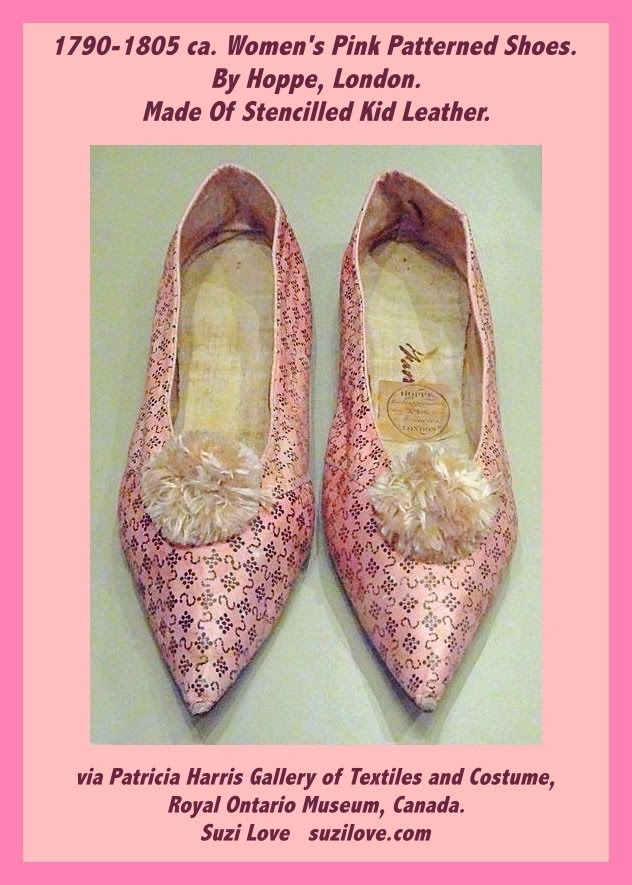
1790-1805 ca. Women’s pink patterned kid leather shoes as worn by Jane Austen and other ladies in her times. Made by Hoppe, London, of stencilled kid leather.
In Jane Austen’s years, fragile slippers were worn for balls and evening events but for walking sturdier shoes were needed, In the early 1800s, slippers were made of fabric such as satin or from leather, were flat or had a very small heel, slightly rounded toes and were laced up on the top. They were usually not made in right or left, but instead one shoe shape and in multiples so that when one slipper wore out, another was on hand to replace it.
1811 January Evening Dresses, English. Standing Figure: French frock with half train of black imperial gauze worn over a slip of white sarsnet or satin, ornamented with a Vandyke border of white velvet or thread lace. White velvet hat ornamented with two curled ostrich feathers, with a silver or beaded band. White kid gloves and shoes. Sitting Figure: Grecian robe of silver grey crape worn over a white satin under-dress, ornamented at the hem and each side with a light and tasteful border of black bugles. Stomacher edged with black beads, corresponding with those which finish the bosom and sleeves. Earrings, necklace, and bracelets of jet. Hair in waved curls on each side of the face, divided in front of the forehead with a full plait and barrel comb of jet. White satin slippers with black jet clasps or bugle rosettes. White kid gloves and a fan of silver-frosted crape. Back-ground figure: Dress of black Venetian velvet with short Circassian sleeve, gathered in a knot of white beads or pearl, bosom and stomacher to correspond, pearl necklace, ear-rings, and bracelets. Belt of white velvet with mother-of-pearl clasps. Convent veil of white cobweb net confined with a pearl crescent, à la Diana. Sandal slippers and gloves of white kid and fan of carved ivory. Fashion Plate via Rudolph Ackermann’s ‘The Repository’ of Arts.
Definition Evening Dress: Minute distinctions between ball, dinner, evening and opera gowns meant different quality of fabrics and designs. A Ball Gown differed from an evening dress as expensive silk fabrics were usually worn, light or heavy, decorated with lace, embroidery or beading, with low-cut bodice, short or no sleeves, and full skirts. In the early 1800s, white cotton dresses were considered suitable for many evening events, but not for balls. And definitely not for an evening event in a palace. White dresses with white embroidery for evening were considered fashionable and exclusive as only the wealthy could afford them.
1809 January Walking Dress, English. Polish bonnet, mantle of gold velvet with an invisible hood trimmed with ermine, antique collar fastened with a gold ornament in form of a shell. Morning dress, white muslin Brussels spot, with worked stomacher, trimmed down the front and at the bottom, worked along hanging sleeves, twisted and fastened at the wristband with small gold ornament to match mantle and cincture of the dress, gold sandals laced with brown cords and tassels and York tan gloves. Plate via Rudolph Ackermann’s ‘The Repository’ of Arts.
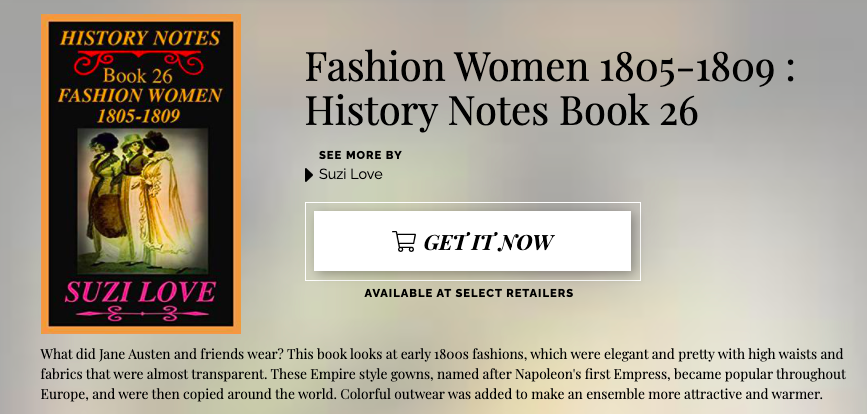
Fashion Women 1805-1809 History Notes Book 26 What did Jane Austen and friends wear? https://books2read.com/SuziLoveFashionWomen1805-1809
1809 Pink Evening Dress Of Levantine, French. V-neck bodice, decorated hem, long gloves and Toque hat with feathers, or aigrette. Fashion Plate via Journal des Dames et des Modes, or Costume Parisien.
Definition Fabric Levantine: Stout silk cloth in twill weave. First made in the Levant, a large area in the Eastern Mediterranean region of Western Asia.
Definition Aigret, aigrette, egret: Upright plume of feathers or jeweled ornament in shape of feathers worn on head or hats. 19th century favorite feathers osprey and heron.
Fashion Women 1805-1809 History Notes Book 26 What did Jane Austen and friends wear? https://books2read.com/SuziLoveFashionWomen1805-1809
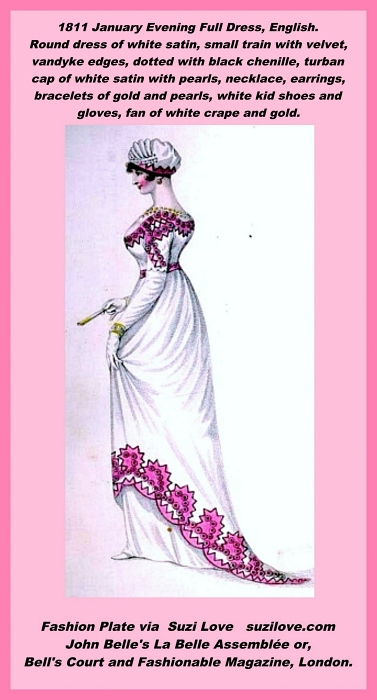
1811 January Evening Full Dress, English. Round dress of white satin, small train with pink velvet, vandyke edges, dotted with black chenille, turban cap of white satin with pearls, necklace, earrings, bracelets of gold and pearls, white kid shoes and gloves, fan of white crape and gold. Fashion Plate via John Belle’s La Belle Assemblée or, Bell’s Court and Fashionable Magazine, London.
Definition Van Dyke Points: V-shaped lace and trims named after a 17th Century Flemish painter, Sir Anthony Van Dyck, known for painting V-shaped lace collars and scalloped edges on sitters.
Definition Velvet or Velour: Silk with short, dense and smooth pile produced by pile warp raised in loops above ground weave through introduction of rods during the weaving.
1811 January Evening Full Dress, English. Round dress of white satin, small train with pink velvet, vandyke edges27_D2D_FashWomen1810-1814
1807 October Drawing Room Full Dresses In Empire Style, English. Blue overdress over trained gown. White dress with train and feathered headdress. Fashion Plate via Lady’s Monthly Museum, London, UK.
Definition Empire Style Dress: High-waisted white gown defined women’s fashion during the Regency Era. ‘Empire’ is the name given to the period when Napoleon Bonaparte built his French Empire. High-waisted, loose gowns were adopted by the aristocracy as a symbol of turning away from the fussy, elaborate and expensive clothing worn in the 1700s.
1807 October Drawing Room Full Dresses, English. Blue overdress over trained gown. White dress with train and feathered headdress. Fashion Plate via Lady’s Monthly Museum, London, UK.HN_26_D2D_FsshionWomen1805-1809
An overview of women’s fashions in the first twenty years of the 19th century. What was fashionable for women in Jane Austen’s times, or the early 1800s. Wars were being fought around the globe so women’s fashion adopted a military look in support of soldiers. In Britain, the Prince Regent ruled instead of his father, King George III, so fashions, like the lifestyle, became more extravagant and accessories went from pretty to opulent. This set includes books 12, 25, 26, 27 and 28.
What was fashionable for women in Jane Austen’s times, or 1800s, or Regency Era. High-waisted dresses were extravagantly accessorized and hats, shoes, parasols and bags were added. Set includes History Notes Books 12, 25, 26, 27 and 28.
Fashion Women 1800-1819 Box Set History Notes Book 24 An overview of the first twenty years of the 19th century. These books look at what was fashionable for women in Jane Austen’s times, or the early 1800s. Wars were being fought around the globe so women’s fashion adopted a military look in support of soldiers. In Britain, the Prince Regent ruled instead of his father, King George III, so fashions, like the lifestyle, became more extravagant and accessories went from pretty to opulent. This set includes books 12, 25, 26, 27 and 28. https://books2read.com/SuziLoveFashionWomenBoxSet
1801-1818 ca. ‘Diablo, or devil on two sticks’. Lessons In The Devil Series Plate 55: Man teaching a woman how to play diabolo, or devil on two sticks. via 1801-1818 Le Bon Genre, French. Gentleman in blue tailcoat, high white shirt and cravat, pants and black shoes. Lady in white dress with high frilled neckline, long sleeves and wearing green walking boots. Hand-colored etching. Published by: Pierre La Mésangère. Via British Museum, London, UK britishmuseum.org (PD-Art)
Jane Austen and Games: In Jane Austen’s times, games were a part of daily life. Families played all sorts of games, indoors and outside, to pass the time, especially at house parties or family gatherings.
Diablo, Or Devil On Two Sticks: Double cone type of yo-yo that is twirled, spun, tossed and caught on a string attached to two hand sticks. The toy, or Diablo, is kept spinning by manipulating it back and forth along the string and by tossing into the air. Numerous tricks can be performed e.g. toss, trapeze, cat’s tail and the umbrella.
Fashion Women 1815-1819 History Notes Book 28 https://books2read.com/SuziLoveFashionWomen1815-1819
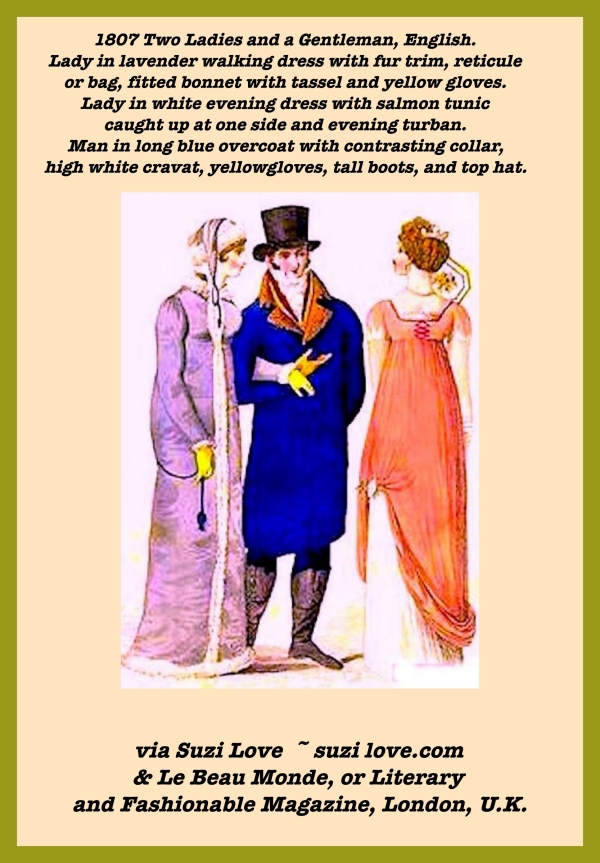
1807 Two Ladies and a Gentleman, English. Lady in lavender walking dress, or Pelisse, with fur trim, holding a blue reticule or bag, fitted lavender bonnet with tassel and yellow gloves. Lady in white evening dress with salmon tunic caught up at one side and evening turban. Man in long blue overcoat, or Redingote, with contrasting collar, high white cravat, yellow gloves, tall Hessian boots with tassels, and wearing a top hat. via Le Beau Monde, or Literary and Fashionable Magazine, London, U.K.
These are the types of outfits worn by Jane Austen and contemporaries in England and shown in their English magazines. The same designs had probably already been seen in France, because English publishers obsessively copied French fashions despite the two countries being at war for many years.