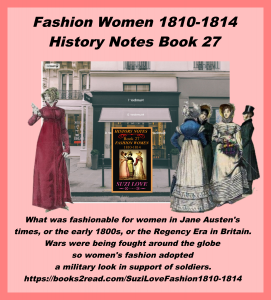
Fashion Women 1810-1814 History Notes Book 27 This book looks at what was fashionable for women in Jane Austen’s times, or the early 1800s, or the Regency Era in Britain. Wars were being fought around the globe so women’s fashion adopted a military look in support of soldiers. Fashions, like the lifestyle, became progressively more extravagant and accessories went from colorful to over-the-top. https://books2read.com/SuziLoveFashion1810-1814
What was fashionable for women in Jane Austen’s times? Mourning, riding, daytime, evening clothing, plus underclothing, corsets and accessories. Fashion Women 1810-1814 History Notes Book 27 This book looks at what was fashionable for women in Jane Austen’s times, or the early 1800s, or the Regency Era in Britain. Wars were being fought around the globe so women’s fashion adopted a military look in support of soldiers. Fashions, like the lifestyle, became progressively more extravagant and accessories went from colorful to over-the-top. https://books2read.com/SuziLoveFashion1810-1814
The Lady’s Magazine said of the basis of women’s fashion that was popular for the first twenty years of the 1800s, ‘White is still the prevailing color for robes. For morning dresses, linen gowns, in large diamonds or squares, are fashionable. Indian muslins, plain or embroidered, are preferred to Florence and satins. The designs of embroidery for shawls are of infinite variety. Long gloves, which reach above the elbow, are not yet laid aside. Medallions are hung around the neck from crossed chains and some of these medallions are shaped like the bags, called ridicules. These reticules are of the lozenge or hexagon shape, with a small tassel at each angle. Reticules, or ridicules, are in lozenge or hexagon shapes with a small tassel at each angle. In capotes, or hats, and ribbands, the violet and dark green prevail over jonquil. Bracelets in hair, pear-shaped ear-rings, medallions on square plates, saltiers of colored stones, are still in fashion.’
What was fashionable for women in Jane Austen’s times? Mourning, riding, daytime, evening clothing, plus underclothing, corsets and accessories. Wars were being fought so women adopted military looks in support of soldiers. https://books2read.com/SuziLoveFashion1810-1814 History Notes Book 27 Women’s Fashions 1810-1814.
1808 Orange Redingote, or Pelisse, French. Walking dress with white vertical front trim and wearing a blue hat with three rows of lace trim hanging down to cover the face. Fashion Plate via Journal des Dames et des Modes, Costume Parisien. Jane Austen and her female contemporaries wore coats like these when outdoors because they needed the warmth over the fashionable light muslin dresses that all women wore. Redingotes could be both comfortable and decorative. They often had military elements in support of the thousands of men involved in ongoing wars.
Definition Redingote Or Pelisse Or Walking Dress Or Coat: Long fitted outdoor coat worn over other garments for warmth. Often left open at the front to show off the dress underneath. French word developed from English words, riding coat.
What did Jane Austen and friends wear? Early 1800s fashions were elegant and pretty with high waists and fabrics that were almost transparent. These Empire style gowns, named after Napoleon’s first Empress, became popular throughout Europe, and were then copied around the world. Colorful outwear was added to make an ensemble more attractive and warmer. History Notes Book 26 Fashion Women 1805-1809. https://books2read.com/SuziLoveFashionWomen1805-1809
The Empire waist gown defined women’s fashion during the Regency Era. ‘Empire’ is the name given in France to the period when Napoleon built his French Empire. High-waisted, loose gowns were adopted by the aristocracy as a symbol of turning away from the fussy, elaborate and expensive clothing worn in the 1700s. Jean-Jaques Rousseau advocated copying peasants and returning to a simpler life and more natural fashions. Unrestricting clothing was part of the new Democracy in France and these simpler and flowing fashions were adopted all over Europe, including Britain and despite the continual wars being fought against France during the early 1800s. Not even war stopped fashions from being copied everywhere.
Fashion Women 1810-1814 History Notes Book 27. This book looks at what was fashionable for women in Jane Austen’s times, or the early 1800s, or the Regency Era in Britain. Wars were being fought around the globe so women’s fashion adopted a military look in support of soldiers. Fashions, like the lifestyle, became progressively more extravagant and accessories went from colorful to over-the-top.
1815 June White Carriage Dress, English. Lady reading a book in a high-waisted white satin Pelisse, or Walking Or Carriage dress in the relaxed Empire style as would have been worn at home in the early 1800s, or during Jane Austen’s time. Richly ornamented with clusters of leaves made in white twilled sarsnet, headed with tull. Open fronts, trimmed to the bottom of the waist with a superb shell trimming of white satin ribbon and tull, loose sleeves trimmed at the wrists. High hat of white satin and tull with a plume of feathers of the pomona green. Half-boots of similar color. Gloves en suite and a necklace. Lady is viewing paintings and the program in her hand says ‘British Institution’. In this issue of The Repository there is an article called ‘Exhibition of Paintings by the Flemish and Dutch Masters at the British Institution, Pall Mall.’ Fashion Plate via Rudolph Ackermann’s ‘The Repository of Arts’.
1809 March. White walking dress as Jane Austen. would have worn in England. Pale blue tunic worn over a white dress and with an unusual blue hat trimmed in yellow to match the tunic. Carrying a matching blue reticule and wearing blue slippers and yellow gloves. Description on Fashion Plate, “A Polish cap, and pelisse of silver grey cloth, trimmed with gold or silver, buttoned down the front with small round buttons, a high collar, with a lace ruff ; boots of same colour as the pelisse, and both embroidered with gold or silver. York tan gloves. This dress was transmitted to a lady of high rank from Warsaw, and would alone evince the taste and elegance of the ladies of that country, were they not already sufficiently known. Engraved Plate via Rudolph Ackermann’s ‘The Repository’ of Arts.
Definition Reticule Or Ridicule Or Bag or Purse: Often with a drawstring to pull closed and usually made of cloth or covered cardboard and often decorated with beading or embroidery. A reticule, or purse, or handbag, was usually carried by a woman during the Regency period to carry all their daily necessities. Earlier, women used pockets that tied at the waistline and were hidden in the folds of their skirts. Empire style, or early 1800s, high-waisted dresses made it impossible to either sewn in a pocket or to tie on a pocket. So women began carrying small, decorated bags called Reticules, or ridicules, which generally pulled close at the top with a drawstring.
Fashion Women 1805-1809 History Notes Book 26 What did Jane Austen and friends wear? This book looks at early 1800s fashions, which were elegant and pretty with high waists and fabrics that were almost transparent. These Empire style gowns, named after Napoleon’s first Empress, became popular throughout Europe, and were then copied around the world. Colorful outwear was added to make an ensemble more attractive and warmer. https://books2read.com/SuziLoveFashionWomen1805-1809
1806 Red Velvet Redingote, French. Short puffed sleeves over long straight sleeves, white fur Fichu, or shoulder shawl, interesting matching hat with white satin trim. Fashion Plate via Journal des Dames et des Modes, or Costume Parisien.
Redingotes or Pelisses were needed to cover the flimsy dresses made of lightweight fabrics of the Regency years to provide warmth and some protection from windy conditions when gowns might lift and cause modesty issues. Jane Austen and her contemporaries often walked to places and so would have needed the warmth of a Pelisse or coat in the cold British winters. https://books2read.com/SuziLoveFashionWomen1805-1809
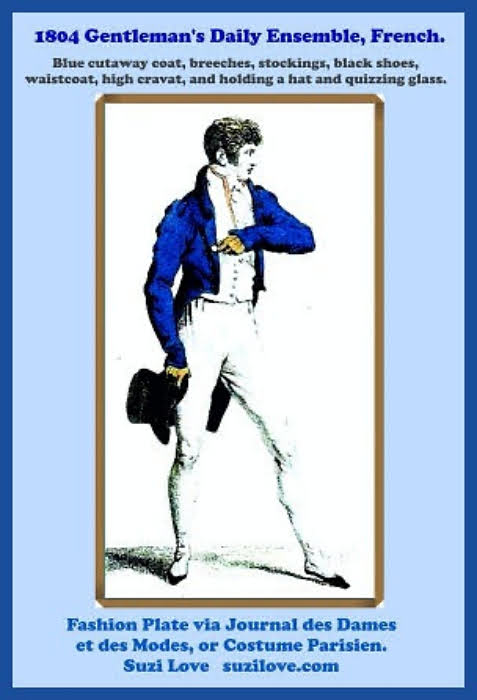
1804 Men’s Fashions In The Time Of Jane Austen. From the finish of the 18th century until 1820, men’s fashions in European and European-influenced countries moved away from the formal wear of brocades, lace, wigs and powder to more informal and relaxed styles. Focus was on undress rather than formal dress. Typical menswear in the early 1800s included a tailcoat, a vest or waistcoat, either breeches, pants, or the newer trousers, stockings, shoes or boots, all worn with an overcoat and hat. This basic ensemble was accessorized with some form of neckcloth or cravat, gloves, walking stick, cane or riding crop, handkerchief, fobs, watch and perhaps a quizzing glass or eye glass.
In 1806, the Journal des Dames et des Modes stated, ‘The informal outfit for a young man includes a coat of similar style, snug pantaloons which are probably knitted, and a striped waistcoat.’
Skirted coats were replaced with short-fronted, or cutaway, tailcoats worn over fitted waistcoats and plain, white linen shirts. Knee breeches were gradually replaced by tight-fitting pantaloons and later trousers, decorative shoes with buckles were replaced with a variety of boot styles, and fussy and ruffled neckwear gave way to intricately tied, white linen neck cloths. A Regency Era, or early 1800s, gentleman was outfitted in more practical fabrics, such as wool, cotton and buckskin rather than the fussy brocades and silks of the late 1700s.