1805-1810 ca. Double Breasted Tailcoat, South Carolina, U.S.A. Cotton, plain-woven (tabby woven), partly lined with cotton, plain-woven (tabby). Cutaway at the front waist and with a notched collar. via Colonial Williamsburg, USA. history.org
Tailcoat: A Regency Era, or early 1800s, gentleman was outfitted in more practical fabrics, such as wool, cotton and buckskin rather than the fussy brocades and silks of the late 1700s.
1819 January ‘Going to White’s’. By Richard Dighton. Lord Alvanley walks on the pavement going to White’s Club for gentlemen in London wearing a top-hat, double-breasted coat, strapped trousers, and the high collar of a dandy. Via British Museum, London, UK. britishmuseum.org (PD-Art)
White’s was an exclusive Gentlemen’s Club on St. James Street, London, U.K where well-dressed men, or Dandies, gathered at a special table in front of the large bow window looking out at the street. This became known as a seat of privilege and was used by London’s most famous Dandy, Beau Brummell. Other well-known dandies were William Arden, Joshua Allen, Thomas Raikes and Ball Hughes. Cartoonists loved to ridicule these high-in-the-instep gentlemen who wore the most fashionable clothes and set the fashion trends for the Regency years, and the years when Jane Austen was writing her famous novels.
1800-1830 ca. Drawstring Bag, German. Basket-shaped, Ecru cotton knit embroidered with colored glass beads in design of grapevine on upper half, open work embroidered with weaving motif on lower half. Wired at center, cardboard at base. Green silk cord drawstring. The Elizabeth Day McCormick Collection via Museum of Fine Arts, Boston, U.S.A. mfa.org
Definition Reticule Or Ridicule Or Bag or Purse: Often with a drawstring to pull closed and usually made of cloth or covered cardboard and often decorated with beading or embroidery. A reticule, or purse, or handbag, was usually carried by a woman during the Regency period to carry all their daily necessities. Earlier, women used pockets that tied at the waistline and were hidden in the folds of their skirts. Empire style, or early 1800s, high-waisted dresses made it impossible to either sewn in a pocket or to tie on a pocket. So women began carrying small, decorated bags called Reticules, or ridicules, which generally pulled close at the top with a drawstring.
1801 Young Man’s Daily Outfit, French. Blue cutaway coat with extra high collar, brown knee breeches, chin high white cravat, an all-over curly hairstyle and a round-hat with a wide brim and a low crown which is flat on the top. The hats only decoration is a narrow ribbon and buckle. Fashion Plate via Journal des Dames et des Modes, or Costume Parisien. https://books2read.com/SuziLoveFashionMen1800-1819
I love when the same fashion plate is repeated with two ladies or a lady and a gentleman. 1808 Ladies In High Waisted Dresses, French. Green dress with short sleeves, white frill back bow and white lace headdress. White dress with short puffed sleeves, paisley shawl and red coral necklace. Fashion Plate via Journal des Dames et des Modes, or Costume Parisien. https://books2read.com/SuziLoveFashionWomen1805-1809. Gorgeous Regency Era clothing came in a wide range of styles to suit every season and occasion. Ladies in Jane Austen’s times wore Empire style dresses which were usually of light fabric and floaty in style so accessories were essential to keep women warm.
What was fashionable for outer wear in past centuries? Different names in different countries: Pelisse, Redingote, Coat, Or Walking Dress. The Bridgertons and Jane Austen and her contemporaries wore long coats like these to keep warm when out and about, visiting, shopping etc. The thin muslin dresses worn in the early 1800s were little protection against European winters. http://books2read.com/suzilovePelisse
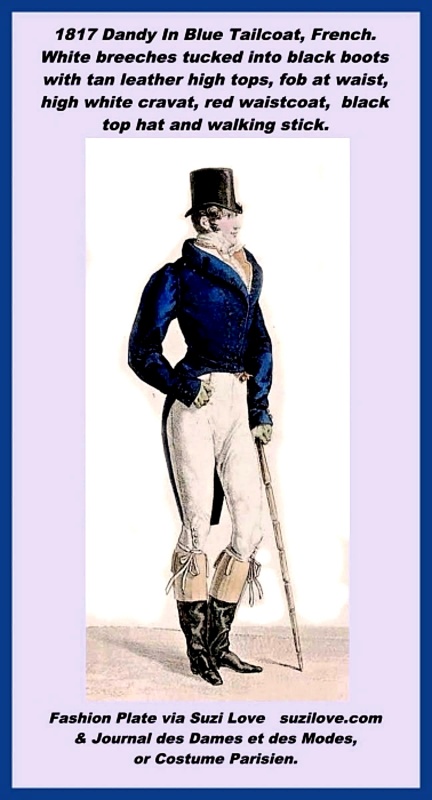
1817 Dandy In Blue Tailcoat, French. White breeches tucked into black boots with tan leather high tops, fob at waist, high white cravat, red waistcoat, black top hat and walking stick. Fashion Plate via Journal des Dames et des Modes, or Costume Parisien.
Dandy: The author of The Hermit in London, a series of sketches published in 1819—1820 observed: ‘A distinguished Exquisite is padded all over to-day; and all the other foplings are, on the morrow, mere walking pin-cushions. A fat prince, or a fat dandy, requires confinement in his limbs; and all his subjects are immediately restrained within the same limits. One day, the back is to be as broad as an Irish chairman’s, and the shoulders to be bolstered up to imitate a hod-man; and the next, the shoulders are to be flat, and a man is to be pinched in and laced up until he resembles an earwig. All these are Master Snip’s maneuvers, who continues to make his bill equally long, whether the spencer or the box-coat be in vogue.
Beau Brummell was one of the most celebrated dandies of all time. Cartoonists ridiculed these high-in-the-instep gentlemen who wore the most fashionable clothes and set the fashion trends for the Regency years, the years when Jane Austen was writing her famous novels and the years when the Bridgerton series is set.
1800 Outfit Of A Young Man With Grey Cutaway Coat, French. Grey cutaway coat, red vest or waistcoat, high white cravat, yellow breeches with red fob at waist, yellow gloves, black boots with tassels, hat and walking stick. Fashion Plate via Journal des Dames et des Modes, or Costume Parisien.
In the early years of the 19th century, men’s fashions changed dramatically. Coats were cut higher in the front and finished in long tails at the back. Waist length square-cut waistcoats were displayed beneath tailcoats. The lining of the shoulders and upper chest of the coat was sometimes quilted to improve the fit and some dandies wore boned corsets to give them a small waist. Trousers became increasingly fashionable in the first quarter of the 19th century as men gradually adopted long trousers rather than knee breeches. At first long length pants were only worn for day and informal dress and breeches were still required for court dress, but by the 1820s trousers were accepted as evening wear.
Typical menswear in the early 1800s included a tailcoat, a vest or waistcoat, either breeches, pants, or the newer trousers, stockings, shoes or boots, all worn with an overcoat and hat. This basic ensemble was accessorized with some form of neckcloth or cravat, gloves, walking stick, cane or riding crop, handkerchief, fobs, watch and perhaps a quizzing glass or eye glass. The tan hat from the late 18th century was worn and developed into the top hat which was worn for day and formal dress throughout the 19th century. Hair was carefully styled into a windswept look or worn short and curled.
Hessian Boots: In the 1790s, British Army officers wore boots called Hessians, named after German mercenaries who fought alongside the British in wars, including in the Irish Rebellion of 1798. The soldiers from the German state of Hesse were called Hessians and their boots took their name from Hesse, where they were made. The Hessian boot was made from soft, highly polished calfskin, knee high, curved top and with a V cut at the front and often had a decorative tassel.
They were shaped like a stirrup so the rider could easily insert their feet into the stirrups and the feet were kept securely in place. But tassels on Hessian boots were designed for wearing with breeches and didn’t suit tight fitting and fashionable new trousers that dandies like Beau Brummell wore in 1800s and so were replaced by Wellington Boots.
In 1823, the New Monthly Magazine had a comical story about tight pantaloons and Hessian boots being a perfect pairing. ‘…. tight pantaloons without Hessian boots were as preposterous as a haunch of venison without currant-jelly, or a leg of pork without peas-pudding.’ https://books2read.com/SuziLoveFashionMen1800-1819
1816 July Opera Dress, English. Dress of white lace worn over a rich soft white satin slip. Skirt trimmed in a style of peculiar elegance, with lace festooned at regular distances, festoons edged by plain band of byas satin and finished by pearl ornaments of a very novel and pretty shape. Lace body is cut byas and richly ornamented round the bosom with pointed lace. Plain long sleeve, very full, except towards the wrist, which is nearly tight to the arm, and elegantly finished with lace. Hair ornamented with a wreath of French roses, parted in front, and simply dressed in loose curls, which fall very low on each side. Hind hair forms a tuft at the back of the head. Necklace, ear-rings, and bracelets of pearl. White satin slippers, and white kid gloves and a blush colored French silk scarf. Fashion Plate via Rudolph Ackermann’s ‘The Repository of Arts’.
Gorgeous Regency Era clothing came in a wide range of styles to suit every season and occasion. Ladies in the Bridgerton series and in Jane Austen’s times wore Empire style dresses which were usually made of light fabric and floaty in style. By the later 1810s, stripes were very popular and lace and frills were added to make the dress more individual.