1813 French Couple In Morning Dress. Man: Brown overcoat and tan trousers. Lady: White dress and bonnet, long yellow gloves and holding a watering can. Fashion Plate via Journal des Dames et des Modes, or Costume Parisien. books2read.com/SuziLoveFashionMen1800-1819
1800-1850 ca. Reticule, Or Bag. Brown bag with monogram and drawstring, British. The Bridgerton family and Jane Austen and their female contemporaries would have sewn, gifted and used a bag similar to this. via Snowshill Manor, National Trust, U.K. nationaltrustimages.org.uk
Definition Reticule: Bag or purse, often with a drawstring to pull closed and usually made of cloth or covered cardboard and often decorated with beading or embroidery. A reticule, or purse, or handbag, was usually carried by a woman during the Regency period to carry all their daily necessities. Earlier, women used pockets that tied at the waistline and were hidden in the folds of their skirts. Empire style, or early 1800s, high-waisted dresses made it impossible to either sewn in a pocket or to tie on a pocket. So women began carrying small, decorated bags called Reticules, or ridicules, which generally pulled close at the top with a drawstring.
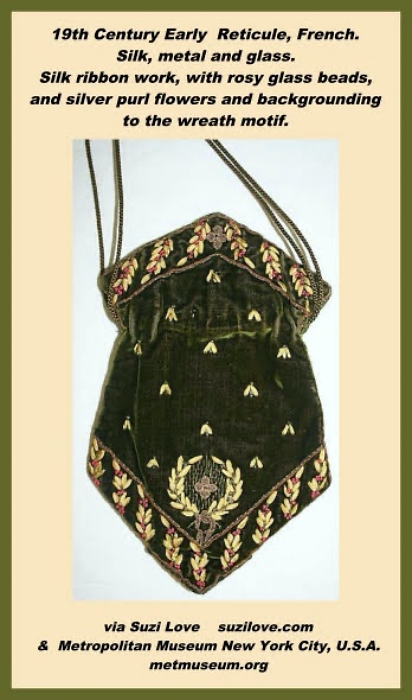
19th cent. Early. Reticule, or Bag, of silk, metal and glass, French, as carried in Jane Austen’s times. Silk ribbon work, with rosy glass beads, and silver purl flowers and backgrounding to the wreath motif. via Metropolitan Museum, N.Y.C., U.S.A. metmuseum.org
Definition Reticule: Bag or purse, often with a drawstring to pull closed and usually made of cloth or covered cardboard and often decorated with beading or embroidery. A reticule, or purse, or handbag, was usually carried by a woman during the Regency period to carry all their daily necessities. Earlier, women used pockets that tied at the waistline and were hidden in the folds of their skirts. Empire style, or early 1800s, high-waisted dresses made it impossible to either sewn in a pocket or to tie on a pocket. So women began carrying small, decorated bags called Reticules, or ridicules, which generally pulled close at the top with a drawstring.
1819 February Pink Ball Dress, English. Underskirt with white lace hem, pink layer with intricate decoration, short puffed sleeves, low décolletage, or neckline, white shawl and white hat with pink feather. Fashion Plate via John Belle’s La Belle Assemblée or, Bell’s Court and Fashionable Magazine, London. Women’s clothing came in the late 1810s came in a wide range of styles to suit every season and occasion. When attending assemblies or balls, ladies in Jane Austen’s times women wore Empire style dresses which were usually made of light fabric and floaty in style and often of a shorter length suitable for dancing. https://books2read.com/SuziLoveFashionWomen1815-1819
Definition Ball Dress: At the end of the 1810s, ball or dancing dresses had higher hemlines that rose several inches above the ankle so ladies wouldn’t trip on their hens or flounces and make a spectacle of themselves.
Definition Aigret, aigrette, egret: Plume of feathers or jeweled ornament in shape of feathers worn on head or hats. During the early 19th century, or Jane Austen’s lifetime, or during the years of the Bridgerton series, the favorite feathers were osprey and heron.
1806 White Bodice and Red Scarf. Various Hats, Bonnets and an evening headdress. Fashion Plate via Journal des Dames et des Modes, or Costume Parisien.
French fashions like this were copied by English magazines so these styles of hats would have been worn by Jane Austen and her contemporaries. https://books2read.com/SuziLoveFashionWomen1805-1809
1815 Pink Dress, French. Cashmere dress with white underdress showing the sleeves, decorated hem, turban of tulle and satin, diamond pointed hem, slippers and shawl. Fashion Plate via Journal des Dames et des Modes, or Costume Parisien. https://books2read.com/SuziLoveFashionWomen1815-1819
Definition Aigret, aigrette, egret: Plume of feathers or jeweled ornament in shape of feathers worn on head or hats. During the early 19th century., or Jane Austen’s lifetime, the favorite feathers were osprey and heron.
Definition Empire Style: Named after the First Empire in France, by 1800 Empire dresses had a very low décolleté, or neckline and a short narrow backed bodice attached to a separate skirt. Skirts started directly under the bust and flowed into the classical relaxed wide styles of Greece and Rome. This style of dress is associated with Jane Austen and her contemporaries as a simple cotton high-waisted dress was worn most days and accessorized according to the importance of the occasion.
Fashion Women 1815-1819 History Notes Book 28 What did Jane Austen wear? . D2D_HN_28_https://books2read.com/SuziLoveFashionWomen1815-1819
19th Century Embroidered Silk Bag, Japan. Metal clasp and chain, embroidered with a beautiful bird and flowers. via Ruby Lane Antiques. rubylane.com
Definition Reticule: Bag or purse, often with a drawstring to pull closed and usually made of cloth or covered cardboard and often decorated with beading or embroidery. A reticule, or purse, or handbag, was usually carried by a woman during the Regency period to carry all their daily necessities. Earlier, women used pockets that tied at the waistline and were hidden in the folds of their skirts. Empire style, or early 1800s, high-waisted dresses made it impossible to either sewn in a pocket or to tie on a pocket. So women began carrying small, decorated bags called Reticules, or ridicules, which generally pulled close at the top with a drawstring.
1816 August Walking Costume, or Pelisse, or Coat, English. Round dress, composed of cambric and trimmed with lace. The body is let in with a profusion of lace. Plain long sleeves, very full, except at the wrist where the fulness is confined by small plaits, sleeve finished by double frill of lace. Over the dress is a Pelisse of blue and white shot sarcenet, lined with white sarcenet and trimmed with white satin. Pelisse sleeve is very full and finished at the wrist by a cuff and bows of ribbon. Pelisse is made half high and finished at neck with a triple fall of rich lace but the neck is bare. White satin hat is turned up in front and ornamented with flowers. Kid gloves, blue kid shoes and a parasol. We are indebted for this tasteful dress to Mrs. Gill of Cork Street, Burlington Garden, London. Fashion Plate via Rudolph Ackermann’s ‘The Repository of Arts’.
Definition: Pelisse Or Redingote: Woman’s long, fitted coat often worn open in front to show off the dress underneath. Sometimes cut away in front. Originally made with several capes and trimmed with large buttons. French word developed from English words, riding coat. reefer. Single- or double-breasted, fitted, tailored, over-all coat usually made from sturdy fabric. Jane Austen and her contemporaries wore long coats like these to keep warm when out and about, visiting, shopping etc. The thin muslin dresses worn in the early 1800s were little protection against European winters. #Regency #Fashion #History
Fashion Women 1815-1819 History Notes Book 28 What did Jane Austen wear? . D2D_HN_28_https://books2read.com/SuziLoveFashionWomen1815-1819
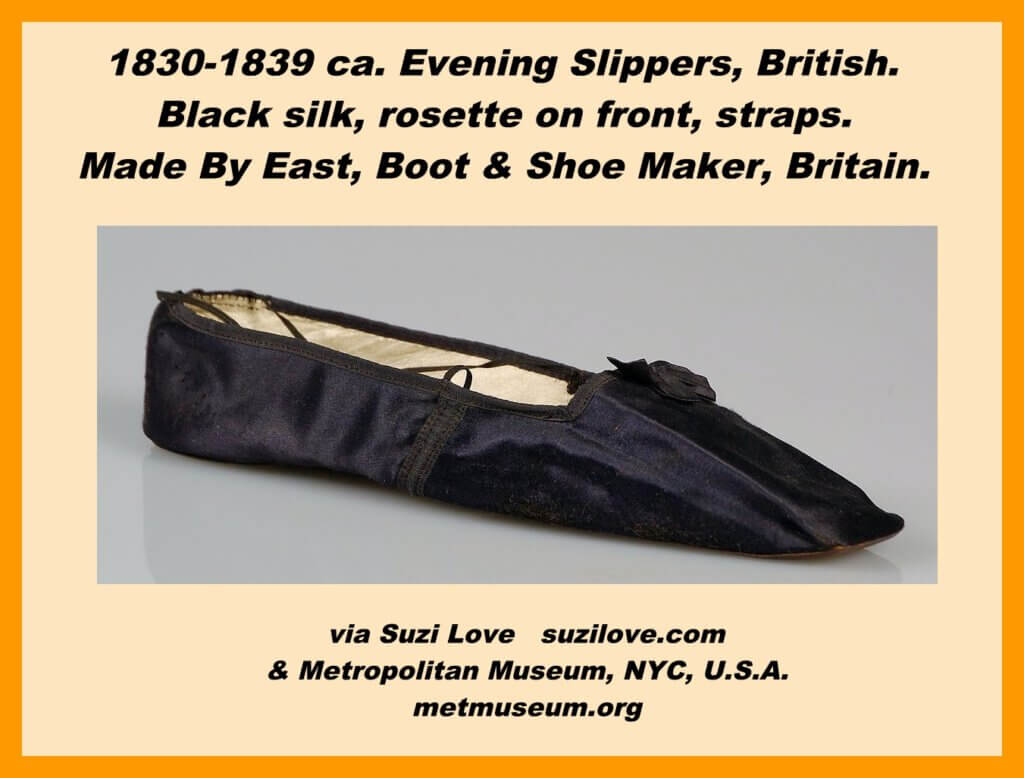
1830-1839 ca. Black Evening Slippers, British. Black silk, rosette on front, straps. Made By East, Boot & Shoe Maker, Britain. via Metropolitan Museum, NYC, U.S.A.
1830s Shoes: Producing different shoes for right and left feet started around 1830 in France. In these first attempts, little paper labels on the insoles of the shoes indicated left and right. However, the shoes were still made on straight lasts with no differentiation between the left and right foot. By the end of the 19th century, producing left and right shoes had become common as shoemakers then worked with combinations of sole and vamp cuts tailored to fit either the right or the left foot. The first steps towards the mechanisation of shoemaking were taken during the Napoleonic Wars. In 1810, engineer Marc Brunel developed a machinery that could mass-produce nailed boots for the soldiers of the British Army. But after the end of the war in 1815, manual labour became cheap, and the demand for military shoes declined. The industrialization of shoemaking began around 1830.
1816 May Full Evening Dress, English. The type of evening dress the Bridgerton family and Jane Austen and her contemporaries would have worn to a formal evening event, such as a ball. A white satin slip, over which is a white lace dress, ornamented with three quillings of white lace on the skirt, intermixed with bows of white satin ribbon. The body and sleeve, both of which are richly ornamented with colored stones, are formed, as our readers will see by the print, in a very novel style. Head-dress, a cap composed of white satin, finished with a band edged with pearls, and a superb plume of white feathers. Necklace, ear-rings, and bracelets,’ colored stones intermixed with pearls. White satin slippers, and white kid gloves. We are indebted to the elegant invention Of Mrs. Gill, of Cork-street, Burlington-Gardens, for our dress this month. Fashion Plate via Rudolph Ackermann’s ‘The Repository of Arts’.
Definition Full Dress: Most formal of outfits, day or night, with all possible accessories added.
Fashion Women 1815-1819 History Notes Book 28 What did Jane Austen wear? . D2D_HN_28_https://books2read.com/SuziLoveFashionWomen1815-1819