What sort of carriages were used in the early 1800s, or Regency Era, or during Jane Austen’s lifetime?



What sort of carriages were used in the early 1800s, or Regency Era, or during Jane Austen’s lifetime?
An overview of women’s fashions in the first twenty years of the 19th century. What was fashionable for women in Jane Austen’s times, or the early 1800s. Wars were being fought around the globe so women’s fashion adopted a military look in support of soldiers. In Britain, the Prince Regent ruled instead of his father, King George III, so fashions, like the lifestyle, became more extravagant and accessories went from pretty to opulent.
Reader Or Writer of Regency Era? Love Jane Austen and Bridgerton fashions? What was fashionable for women in Jane Austen’s times, or 1800s, or Regency Era. High-waisted dresses were extravagantly accessorized and hats, shoes, parasols and bags were added. Set includes History Notes Books 12, 25, 26, 27 and 28. https://books2read.com/SuziLoveFashionWomenBoxSet
Ladies clothing in the early 1800’s featured a high waist line called an Empire Line, or Empire style dress, with a waist line just under the natural bust line and much higher than the natural waist. The high-waisted, or short-bodied, Regency styles shifted focus away from the natural waist and so left the natural waist unconstricted, in direct contrast to previous and future styles. Britain took these simple European styles and progressively made them more elaborate by adding more and more complicated embroidery onto white fabrics to create the white on white look popular for many years.
The empire look of fine muslin dresses left women more exposed than in the Georgian Era when fabrics had been thicker and styles bulkier. Women, especially in England, preserved their modesty by adding lace, frills, flounces, ruches, and fabric plaits to dresses to adequately cover any parts that might inadvertently be exposed. Outer layers, such as Spencers, Redingotes or Pelisses or coats, and shawls, were also added for warmth and to brighten outfits. This Empire fashion was totally dependent on a supply of fine, translucent cotton muslin – at first imported from India, then later, less exclusive imitations often woven and printed or embroidered in Britain. Fabrics were soft and lightweight and muslins and other cotton fabrics from India and other Asian countries were in high demand.


1890-1920 ca. Sterling Silver Chatelaine, England. Center Medallion With Portraits, three drops of monogrammed mesh purse, globe-shaped watch and book-shaped case. Via Augusta Auctions – augusta-auction.com
Definition
What did a chatelaine do?

What were chatelaines used for?

Top Hat Styles Chart during the 1800s, from the Regency Era through to the Victorian years. Most popular style was cone shaped and tall in height. Originally made of beaver and very short but later from silk and taller. Tall crown, widens at top, narrow brim turns up slightly at sides. https://books2read.com/SuziLoveFashionMen1800-1819


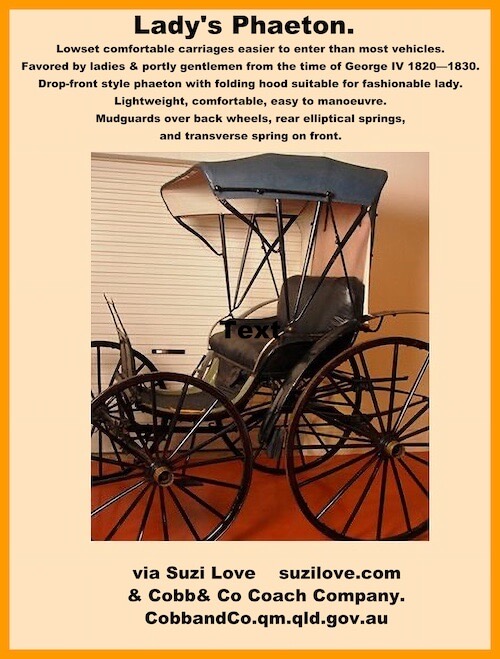
1800s Early A Lady’s Phaeton.
Drop-front phaeton with folding hood suitable for a fashionable lady as lightweight, comfortable and easy to manoeuvre. Mudguards over the back wheels, rear elliptical springs and transverse elliptical spring fitted to the front. via Cobb and Co. Museum, Toowoomba, Australia.
Definition Carriage Lady’s Phaeton: Low set comfortable carriages easier to enter than most vehicles. Favored by ladies and portly gentlemen from the time of George IV 1820-1830.
Definition Phaeton: Open, four-wheeled, doorless carriage, popular in the 18th and 19th centuries. One or two seats, usually a folding or falling top, and owner-driven. The type of carriage liked by young ladies in Jane Austen’s times as the lady could drive herself, The most spectacular phaeton was the English four-wheeled high-flyer was the top phaeton, with body of a light seat for two resting on two sets of springs and reached by a ladder.

What was fashionable for outer wear in past centuries? Different names in different countries: Pelisse, Redingote, Coat, Or Walking Dress. The Bridgertons and Jane Austen and her contemporaries wore long coats like these to keep warm when out and about, visiting, shopping etc. The thin muslin dresses worn in the early 1800s were little protection against European winters. http://books2read.com/suzilovePelisse



I love Pinterest for keeping thousands of historical images in some sort of order. And I love using Pinterest Boards as inspiration for my romance books. What about you? Do you use Pinterest for planning something, or just for fun? Need more hints for what to do with your boards and pins? Take a look at these fascinating articles on Pinterest. if you want even more Pinterest information and tips for becoming a power user, check out my Suzi Love Pinterest Boards

1800-1850 ca. Reticule, Or Bag. Brown bag with monogram and drawstring, British. The Bridgerton family and Jane Austen and their female contemporaries would have sewn, gifted and used a bag similar to this. via Snowshill Manor, National Trust, U.K. nationaltrustimages.org.uk
Definition Reticule: Bag or purse, often with a drawstring to pull closed and usually made of cloth or covered cardboard and often decorated with beading or embroidery. A reticule, or purse, or handbag, was usually carried by a woman during the Regency period to carry all their daily necessities. Earlier, women used pockets that tied at the waistline and were hidden in the folds of their skirts. Empire style, or early 1800s, high-waisted dresses made it impossible to either sewn in a pocket or to tie on a pocket. So women began carrying small, decorated bags called Reticules, or ridicules, which generally pulled close at the top with a drawstring.

