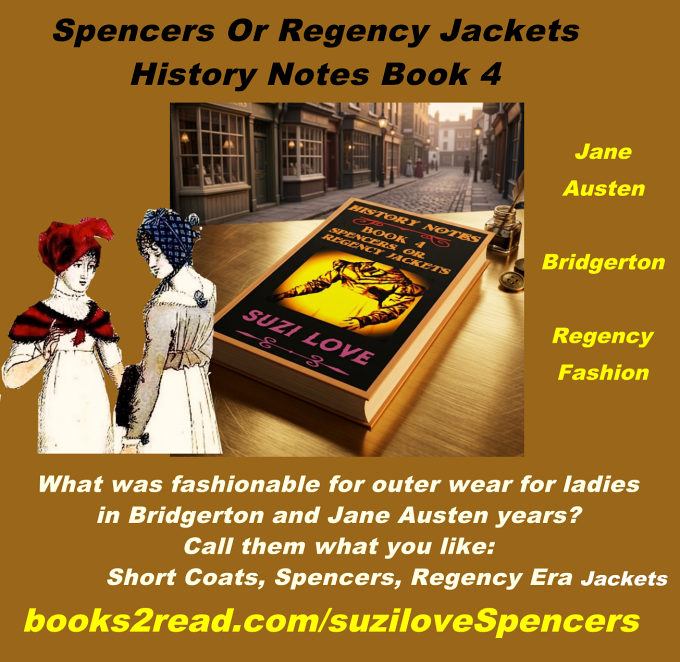
Spencers Or Regency Jackets By Suzi Love. History Notes Book 4. What was fashionable for outer wear in past centuries? Call them what you like: Spencers, short jackets, or Regency jackets were very popular. Take a look at the jackets being worn by women in the early 1800s or the times of Jane Austen. books2read.com/suziloveSpencers
Definition: Spencer – Short, bodice hugging, usually long sleeved, outer jacket. For warmth and for fashion.
Definition Caroline Spencer: Worn during the Directoire and First Empire (1790-1815 C.E.). Spencer with pelerine cape that was made of white kerseymere and trimmed with light blue satin cut on bias.
Spencers were short jackets cut to match the high waistlines of Empire dresses. They often copied military styling, such as braiding, shoulder decoration, buttons and loop fasteners, and wrist adornments. They were generally of complex construction, often with a diamond shaped piece in the back.
HN_4_Spencers, Or Jackets. #Regency #Georgian #Victorian #Fashion History Notes Book 4 By Suzi Love.
1800 Young Dandy’s Morning Outfit, French. Brown, doublebreated, cutaway coat, striped trousers tucked into high black boots with tassels, gloves, small jaunty hat and a walking stick. Fashion Plate via Journal des Dames et des Modes, or Costume Parisien.
Dandy: The author of The Hermit in London, a series of sketches published in 1819—1820 observed: ‘A distinguished Exquisite is padded all over to-day; and all the other foplings are, on the morrow, mere walking pin-cushions. A fat prince, or a fat dandy, requires confinement in his limbs; and all his subjects are immediately restrained within the same limits. One day, the back is to be as broad as an Irish chairman’s, and the shoulders to be bolstered up to imitate a hod-man; and the next, the shoulders are to be flat, and a man is to be pinched in and laced up until he resembles an earwig. All these are Master Snip’s maneuvers, who continues to make his bill equally long, whether the spencer or the box-coat be in vogue.
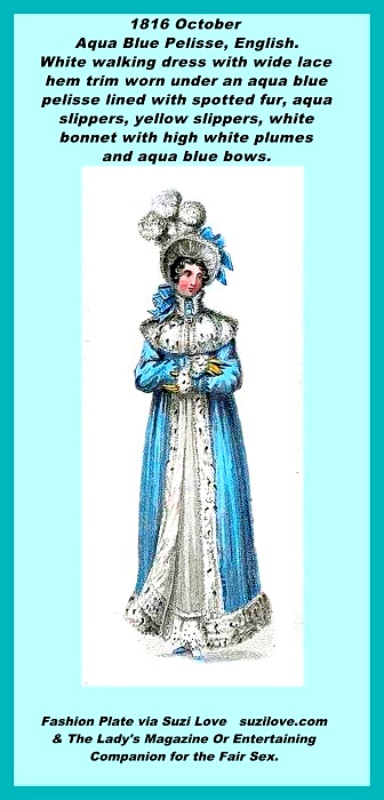
1816 October. Pelisse, English. White walking dress with wide lace hem trim worn under an aqua blue pelisse lined with spotted fur, aqua slippers, yellow slippers, white bonnet with high white plumes and aqua blue bows. Fashion Plate via Lady’s Magazine.
During the early 1800s, dress fabrics and dresses were thin, sometimes almost transparent. These lightweight white cotton dresses were fashionable in Jane Austen’s times, but they were certainly not warm when a lady was out walking or when riding in a carriage. Numerous outer layers could be added for warmth and to brighten and personalize an outfit. These might be an overdress, pelisse or redingote, hat, shawl, gloves, or large fur muff.
A typical outdoor outfit worn by the Bridgerton family, or Jane Austen and her contemporaries, when going outside consisted of an Empire style, or high-waisted, white cotton dress worn under a Pelisse, or Redingote, or coat, for warmth and with an added layer with the pretty shawl. Hats were made to match gowns and cloaks and fashionable women spent an extraordinary amount of time coordinating complete ensembles which included reticules or bags, shoes, shawls, gloves, hats, parasols, and fans. Typical Empire style dresses had low necklines and with skirts that started directly under the bust and flowed into the classical relaxed wide styles of Greece and Rome. These were worn most days and cotton, silk or taffeta were the popular fabrics.
Definition Redingote Or Pelisse Or Walking Dress Or Coat: French word developed from English words, riding coat. Long fitted outdoor coat worn over other garments for warmth. Originally made with several capes and trimmed with large buttons. For women, the coat was often cut away in the front or left open to show off the dress underneath. French fashion plates call these coats Redingotes and they were worn by men, women, and children. English fashion plates call the coats a Pelisse, a walking dress, Promenade dress, or Carriage dress.
1816 October. Pelisse, English. White walking dress with wide lace hem trim worn under an aqua blue pelisse lined with spotted fur, aqua slippers, yellow slippers, white bonnet with high white plumes and aqua blue bows. Fashion Plate via Lady’s Magazine.
1801 Young Man’s Daily Outfit, French. Blue cutaway coat with extra high collar, brown knee breeches, chin high white cravat, an all-over curly hairstyle and a round-hat with a wide brim and a low crown which is flat on the top. The hats only decoration is a narrow ribbon and buckle. Fashion Plate via Journal des Dames et des Modes, or Costume Parisien. https://books2read.com/SuziLoveFashionMen1800-1819
1816 July Opera Dress, English. Dress of white lace worn over a rich soft white satin slip. Skirt trimmed in a style of peculiar elegance, with lace festooned at regular distances, festoons edged by plain band of byas satin and finished by pearl ornaments of a very novel and pretty shape. Lace body is cut byas and richly ornamented round the bosom with pointed lace. Plain long sleeve, very full, except towards the wrist, which is nearly tight to the arm, and elegantly finished with lace. Hair ornamented with a wreath of French roses, parted in front, and simply dressed in loose curls, which fall very low on each side. Hind hair forms a tuft at the back of the head. Necklace, ear-rings, and bracelets of pearl. White satin slippers, and white kid gloves and a blush colored French silk scarf. Fashion Plate via Rudolph Ackermann’s ‘The Repository of Arts’. https://books2read.com/SuziLoveFashionWomen1815-1819
Gorgeous Regency Era clothing came in a wide range of styles to suit every season and occasion. Ladies in the Bridgerton series and in Jane Austen’s times wore Empire style dresses which were usually made of light fabric and floaty in style. By the later 1810s, stripes were very popular and lace and frills were added to make the dress more individual.
Fashion Women 1815-1819 History Notes Book 28 What did Jane Austen wear? https://books2read.com/SuziLoveFashionWomen1815-1819
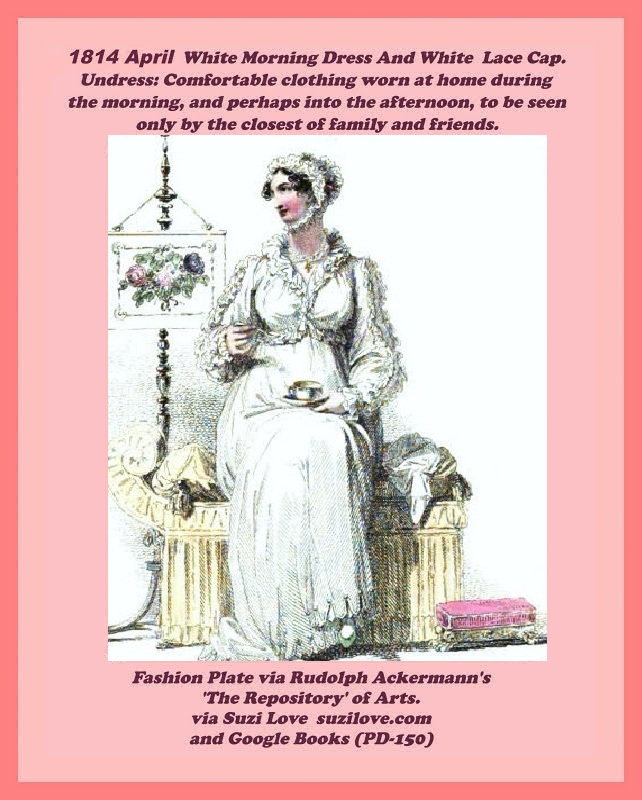
1814 April Morning Dress and Lace Cap. ‘”A petticoat and bodice of fine jaconet muslin, finished round the bottom in vandykes and small buttons. The Rochelle spencer composed of the same material, appliqued with footing lace down the sleeve, and trimmed at each edge with a narrow but full border of muslin. Double fan frill of muslin round the neck, very full, continuing round the bottom of the waist, where it is gathered on a beading of needle-work. Bourdeaux mob cap, composed of lace, with treble full borders, narrowed under the chin. A small flower placed backward, on the left side. Hair much divided in front, and in full waved curls on each side. Necklace of twisted gold and pearl, with pendant cross in the center. Spring Green kid slippers and gloves of the same.” “This dress is from Mrs. Gill, of Cork-street, to whose taste and invention this work as well as the world of fashion, are under continued obligations.” Fashion Plate via Rudolph Ackermann’s ‘The Repository of Arts’. https://books2read.com/SuziLoveFashion1810-1814
Definition Van Dyke Points: V-shaped lace and trims named after a 17th Century Flemish painter, Sir Anthony Van Dyck, known for painting V-shaped lace collars and scalloped edges on sitters.
Definition Jaconet: Cotton fabric of medium thickness made in England, lighter than shirting and heavier than mull.
Definition Muslin: Thin fabric said to take its name from Mosul or Moosul, a large town in Turkish Asia where it was first made.
1814 April Morning Dress and Lace Cap. Petticoat and bodice of fine lace jaconet muslin finished with vandykes and small buttons. Fashion Plate via Rudolph Ackermann’s ‘The Repository of Arts’.HN_27_D2D_fashwomen1810-1814
Love the Bridgerton family and Jane Austen? Reader Or Writer of Regency Era stories? Mourning and riding fashion, dresses, hats, shoes, reticules or bags, underclothing and fashion accessories. books2read.com/SuziLoveFashionWomen1815-1819
History Notes 28 Fashion Women 1815-1819: This book looks at what was fashionable for women in the Georgian Era and at the end of the Regency Era in Britain and the reconstruction in Europe after the wars. Lifestyles were freer and fashions expressed this by becoming the focus of most women’s lives. A wardrobe full of opulent accessories was requisite. Includes mourning and riding fashion, dresses, hats, shoes, reticules or bags, underclothing, and fashion accessories.
Ladies clothing in the early 1800’s featured a high waist line called an Empire Line, or Empire style dress, with a waist line just under the natural bust line and much higher than the natural waist. High-waisted Empire Line styles dominated fashions for at least three decades from the 1790s until the 1820s. The high-waisted, or short-bodied, Regency styles shifted focus away from the natural waist and so left the natural waist unconstricted, in direct contrast to previous and future styles.
Britain took these simple European styles and progressively made them more elaborate by adding more and more complicated embroidery onto white fabrics to create the white on white look popular for many years. The empire look of fine muslin dresses left women more exposed than in the Georgian Era when fabrics had been thicker and styles bulkier. Women, especially in England, preserved their modesty by adding lace, frills, flounces, ruches, and fabric plaits to dresses to adequately cover any parts that might inadvertently be exposed. Outer layers, such as Spencers, coats and shawls, were also added.
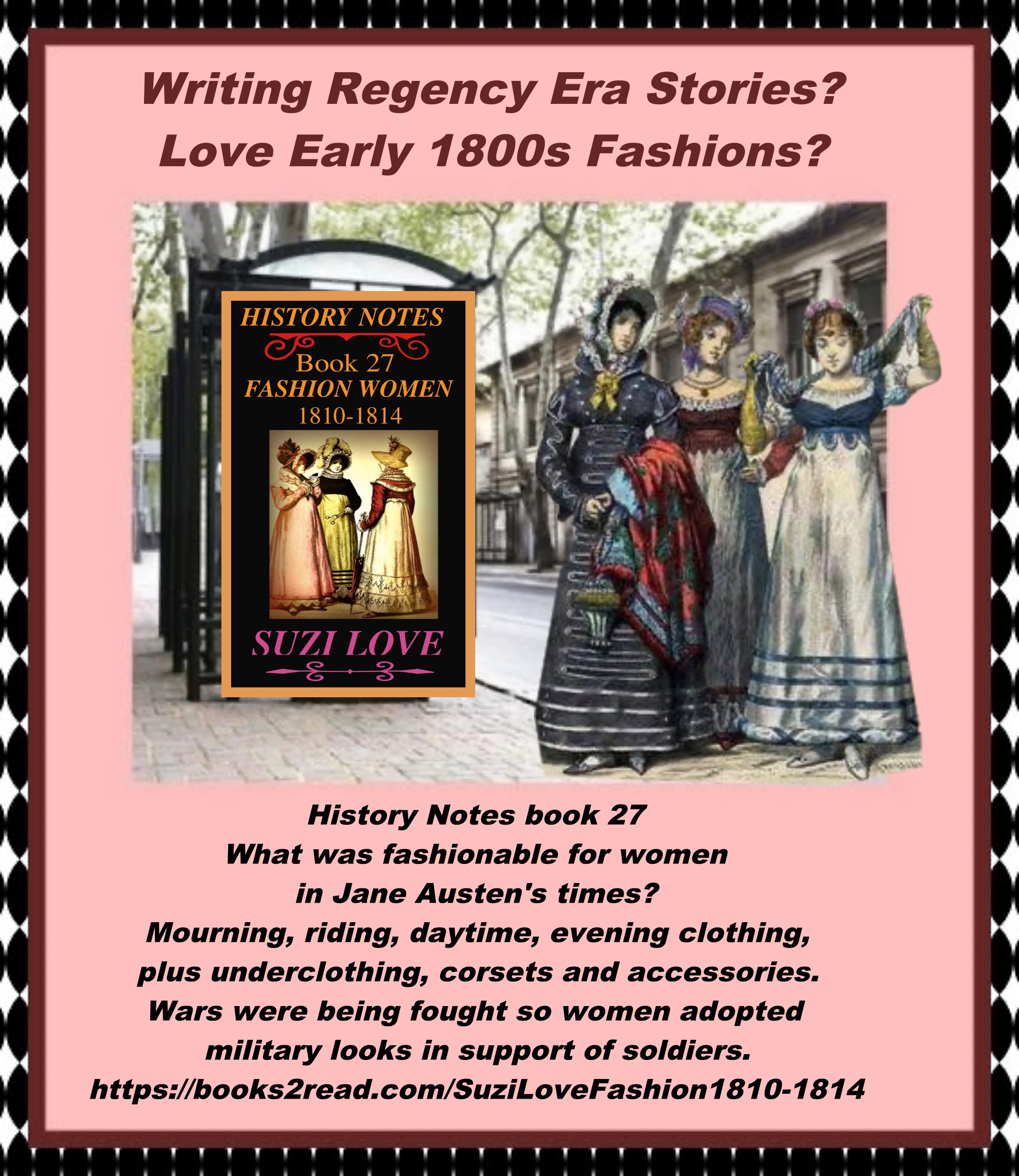
Are you a reader or writer of Regency Romance? Love Jane Austen and the Bridgertons? Want to know more about the mourning, riding, underclothing and other Regency Era women’s fashions in Regency romances? What was fashionable for women in Jane Austen’s times? Mourning, riding, daytime, evening clothing, plus underclothing, corsets and accessories. This book looks at what was fashionable for women in Jane Austen’s times, or the early 1800s, or the Regency Era in Britain. Wars were being fought around the globe so women’s fashion adopted a military look in support of soldiers. Fashions, like the lifestyle, became progressively more extravagant and accessories went from colorful to over-the-top. https://books2read.com/SuziLoveFashion1810-1814
The Lady’s Magazine said of the basis of women’s fashion that was popular for the first twenty years of the 1800s, ‘White is still the prevailing color for robes. For morning dresses, linen gowns, in large diamonds or squares, are fashionable. Indian muslins, plain or embroidered, are preferred to Florence and satins. The designs of embroidery for shawls are of infinite variety. Long gloves, which reach above the elbow, are not yet laid aside. Medallions are hung around the neck from crossed chains and some of these medallions are shaped like the bags, called ridicules. These reticules are of the lozenge or hexagon shape, with a small tassel at each angle. Reticules, or ridicules, are in lozenge or hexagon shapes with a small tassel at each angle. In capotes, or hats, and ribbands, the violet and dark green prevail over jonquil. Bracelets in hair, pear-shaped ear-rings, medallions on square plates, saltiers of colored stones, are still in fashion.’
History Notes book 27 What was fashionable for women in Jane Austen’s times? Mourning, riding, daytime, evening clothing, plus underclothing, corsets and accessories. Wars were being fought so women adopted military looks in support of soldiers. https://books2read.com/SuziLoveFashion1810-1814
1814 Long Dark Green Coat, Or Redingote, French. Horizontal front pockets, high white cravat, black top hat and high black boots. Fashion Plate via Journal des Dames et des Modes, or Costume Parisien.
Definition Redingote Or Coat: French word developed from English words, riding coat. Long fitted outdoor coat worn over other garments for warmth. Originally made with several capes and trimmed with large buttons. For women, the coat was often cut away in the front or left open to show off the dress underneath. French fashion plates call these coats Redingotes and they were worn by men, women, and children. English fashion plates call the coats a Pelisse, a walking dress, Promenade dress, or Carriage dress.
From 1700 until the early 1800s, pockets with waist ties were worn by women to keep essential items on their person. Generally of linen or some other cotton fabric, they were often quilted, or embroidered and gifted or handed down to others. In the 18th century, women’s pockets were not sewn into their gowns. Instead they were attached to a tape and tied around the waist as separate garments. Worn under the hoops and petticoats, they were accessed through openings in the gown and petticoat seams. By the early 1800s, round gowns were both flowing and almost transparent so pockets could no longer be worn under dresses, so ridicules, or bags, or reticules were carried instead. Jane Austen and her female friends and family would have worn pockets under their out layers.
From the Curator Victoria and Albert Museum, London: Quilting was a popular form of decoration for a variety of garments including pockets. However, hand-quilting was a time-consuming method of decoration. The increased demand for quilted petticoats, waistcoats and pockets led to the invention of woven quilting.
1700-1725 ca. Pair of Linen Twill Women’s Pockets With Crewel Embroidery and Waist Ties, British. Embroidered in yellow, green and pink worsted thread with chain and stem stitches, design of flower pot with flowering plant, bound with green worsted tape and sewn to linen tape tie. Designs are similar but not identical, suggesting both hand-drawn and possibly work of an amateur. Pockets may have been handed down to another person who found them too small as each pocket has been extended at top by 4 cms. via Victoria and Albert Museum, London, UK. collections.vam.ac.uk.
by 4 cms. via Victoria and Albert Museum, London, UK. collections.vam.ac.uk.
1750-1800 ca. Woman’s Pocket With Waist Ties, New England, America. Linen plain weave, cotton plain weave, wool embroidery. Dimensions 39.5 cm x 27.5 cm. Polychrome crewels on cotton and linen, vine with buds, flowers and leaves and initials M.W. in center. In 18th century, women’s pockets were tied around waist with tape as separate garments, worn under hoops and petticoats, accessed through openings in gown and petticoat seams. via Museum of Fine Arts, Boston, U.S.A. mfa.org
1750-1800 ca. Woman’s 1750-1800 ca. Woman’s Pocket With Waist Ties, New England, America. Linen plain weave, cotton plain weave, seams. via Museum of Fine Arts, Boston, U.S.A. mfa.orgHN_1 Fashion Women Late 1700s History Notes Book 1 by Suzi Love.
What was fashionable for women in the late 1700s? Extravagant colors and fabrics and outrageous styles were all seen in these flamboyant fashions.
books2read.com/suziloveFashWomen1700s