1800-1830 ca. Drawstring Bag, German. Basket-shaped, Ecru cotton knit embroidered with colored glass beads in design of grapevine on upper half, open work embroidered with weaving motif on lower half. Wired at center, cardboard at base. Green silk cord drawstring. The Elizabeth Day McCormick Collection via Museum of Fine Arts, Boston, U.S.A. mfa.org
Definition Reticule Or Ridicule Or Bag or Purse: Often with a drawstring to pull closed and usually made of cloth or covered cardboard and often decorated with beading or embroidery. A reticule, or purse, or handbag, was usually carried by a woman during the Regency period to carry all their daily necessities. Earlier, women used pockets that tied at the waistline and were hidden in the folds of their skirts. Empire style, or early 1800s, high-waisted dresses made it impossible to either sewn in a pocket or to tie on a pocket. So women began carrying small, decorated bags called Reticules, or ridicules, which generally pulled close at the top with a drawstring.
What was fashionable for outer wear in past centuries? Different names in different countries: Pelisse, Redingote, Coat, Or Walking Dress. The Bridgertons and Jane Austen and her contemporaries wore long coats like these to keep warm when out and about, visiting, shopping etc. The thin muslin dresses worn in the early 1800s were little protection against European winters. http://books2read.com/suzilovePelisse
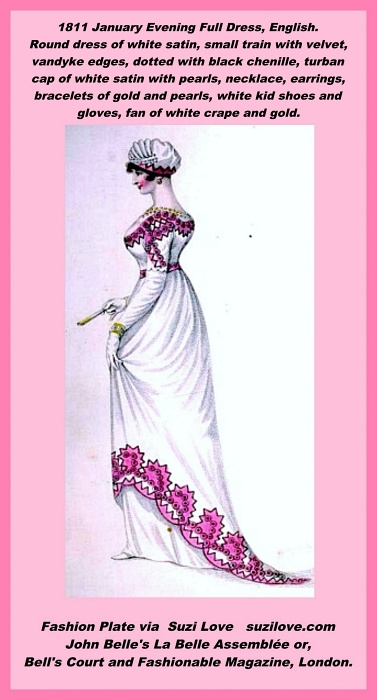
1816 July Opera Dress, English. Dress of white lace worn over a rich soft white satin slip. Skirt trimmed in a style of peculiar elegance, with lace festooned at regular distances, festoons edged by plain band of byas satin and finished by pearl ornaments of a very novel and pretty shape. Lace body is cut byas and richly ornamented round the bosom with pointed lace. Plain long sleeve, very full, except towards the wrist, which is nearly tight to the arm, and elegantly finished with lace. Hair ornamented with a wreath of French roses, parted in front, and simply dressed in loose curls, which fall very low on each side. Hind hair forms a tuft at the back of the head. Necklace, ear-rings, and bracelets of pearl. White satin slippers, and white kid gloves and a blush colored French silk scarf. Fashion Plate via Rudolph Ackermann’s ‘The Repository of Arts’.
Gorgeous Regency Era clothing came in a wide range of styles to suit every season and occasion. Ladies in the Bridgerton series and in Jane Austen’s times wore Empire style dresses which were usually made of light fabric and floaty in style. By the later 1810s, stripes were very popular and lace and frills were added to make the dress more individual.
19th Century Early Reticule, Or Bag, New England, England or U.S.A. Septagonal, or four sided, with embroidery and silk tassels. White satin embroidered with polychrome silks, silver threads, silver sequins. On front, in center of wreath of roses tied with blue bow, is written VALUE THE TRIFLE. On back, in similar wreath, is FRIENDSHIP. On sides are floral motifs, one of sweetpeas and the other of pansies. On all sides a border of silver threads in chain motif entwined with curling brown vine. Primarily worked in satin stitch. Thirteen silk tassels attached. White ribbon ties. via Museum of Fine Arts, Boston, U.S.A. mfa.org
Definition Reticule Or Ridicule Or Bag or Purse: Often with a drawstring to pull closed and usually made of cloth or covered cardboard and often decorated with beading or embroidery. A reticule, or purse, or handbag, was usually carried by a woman during the Regency period to carry all their daily necessities. Earlier, women used pockets that tied at the waistline and were hidden in the folds of their skirts. Empire style, or early 1800s, high-waisted dresses made it impossible to either sewn in a pocket or to tie on a pocket. So women began carrying small, decorated bags called Reticules, or ridicules, which generally pulled close at the top with a drawstring.
1820 ca. Silk Spencer, British. Made of silk and willow. Short length, long sleeves, extensive decoration on shoulders, sleeves and wrists. Military style braiding on the spencer in support of all the soldiers fighting wars across the world. The sort of jacket worn by fashionable Regency ladies over their light and flowing Empire dresses. Credit Line:Catharine Breyer Van Bomel Foundation Fund, 1987 via Metropolitan Museum New York City, U.S.A. metmuseum.org
Definition Spencer: Short jackets cut to match the high waistlines of Empire dresses. They often copied military styling, such as braiding, shoulder decoration, buttons and loop fasteners, and wrist adornments. They were generally of complex construction, often with a diamond shaped piece in the back. Said to have originated in an accident to Lord Spencer while hunting when his coat tails were torn off and he wore it as a short jacket.
1820 ca. Spencer, British. Silk and willow. Front View.1820 ca. Spencer, British. Silk and willow. Back View. 1820 ca. Spencer, British. Silk and willow. Sleeve View. 1820 ca. Spencer, British. Silk and willow. Sleeve Decoration View. 1820 ca. Spencer, British. Silk and willow. Braiding View. 1820 ca. Spencer, British. Silk and willow. Wrist View.
1820 ca. Military Style Silk Spencer With Braiding In the Style of the Bridgertons and Jane Austen. #Bridgerton #JaneAusten #RegencyFashion #BritishHistory books2read.com/suziloveSpencers
HN_4_Spencers, Or Jackets. #Regency #Georgian #Victorian #Fashion History Notes Book 4 By Suzi Love.
Reticule Or Bag: Purse, often with a drawstring to pull closed and usually made of cloth or covered cardboard and often decorated with beading or embroidery. Carried by a woman during the Regency period to carry all their daily necessities. in the place of pockets.
Spencer: Short jacket, cropped at the waist, worn over a dress, or gown. Delicate and regency dresses provided so little protection from the cold, so over garments were essential for warmth, modesty and good health.
Pelisse Or redingote Or Walking Dress: Coat worn over clothing of both sexes for warmth and protection from the elements.
I love Pinterest for keeping thousands of historical images in some sort of order.And I love using Pinterest Boards as inspiration for my romance books.What about you? Do you use Pinterest for planning something, or just for fun?Need more hints for what to do with your boards and pins? Take a look at these fascinating articles on Pinterest. if you want even more Pinterest information and tips for becoming a power user, check out my Suzi Love Pinterest Boards
1820 ca. Collection of Reticules, or Purses. Silk silver gauze, netting, fine crochet. Bags have drawstrings, chains and tassels. via Ruby Lane Auctions. #RegencyFashion #JaneAusten #British
Definition Of A Reticule; Bag or purse, often with a drawstring to pull closed and usually made of cloth or covered cardboard and often decorated with beading or embroidery. A reticule, or purse, or handbag, was usually carried by a woman during the Regency period to carry all their daily necessities. Earlier, women used pockets that tied at the waistline and were hidden in the folds of their skirts. Empire style, or early 1800s, high-waisted dresses made it impossible to either sewn in a pocket or to tie on a pocket, so women began carrying small, decorated bags called Reticules, or ridicules, which generally pulled close at the top with a drawstring. These Reticules, or bags, were the forerunners of our modern day purses.
19th Century Embroidered Silk Bag, Japan. Metal clasp and chain, embroidered with a beautiful bird and flowers. via Ruby Lane Antiques. rubylane.com
Definition Reticule: Bag or purse, often with a drawstring to pull closed and usually made of cloth or covered cardboard and often decorated with beading or embroidery. A reticule, or purse, or handbag, was usually carried by a woman during the Regency period to carry all their daily necessities. Earlier, women used pockets that tied at the waistline and were hidden in the folds of their skirts. Empire style, or early 1800s, high-waisted dresses made it impossible to either sewn in a pocket or to tie on a pocket. So women began carrying small, decorated bags called Reticules, or ridicules, which generally pulled close at the top with a drawstring.
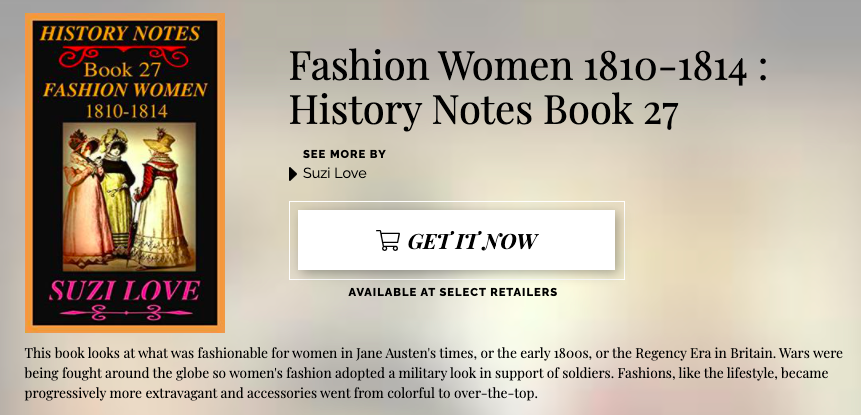
An overview of women’s fashions in the first twenty years of the 19th century. What was fashionable for women in Jane Austen’s times, or the early 1800s. Wars were being fought around the globe, so women’s fashion adopted a military look in support of soldiers. In Britain, the Prince Regent ruled instead of his father, King George III, so fashions, like the lifestyle, became more extravagant and accessories went from pretty to opulent. This set includes books 12, 25, 26, 27 and 28. https://books2read.com/SuziLoveFashionWomenBoxSet
Ladies clothing in the early 1800’s featured a high waist line called an Empire Line, or Empire style dress, with a waist line just under the natural bust line and much higher than the natural waist. The high-waisted, or short-bodied, Regency styles shifted focus away from the natural waist and so left the natural waist unconstricted, in direct contrast to previous and future styles. Britain took these simple European styles and progressively made them more elaborate by adding more and more complicated embroidery onto white fabrics to create the white on white look popular for many years.
The empire look of fine muslin dresses left women more exposed than in the Georgian Era when fabrics had been thicker and styles bulkier. Women, especially in England, preserved their modesty by adding lace, frills, flounces, ruches, and fabric plaits to dresses to adequately cover any parts that might inadvertently be exposed. Outer layers, such as Spencers, Redingotes or Pelisses or coats, and shawls, were also added for warmth and to brighten outfits.
This Empire fashion was totally dependent on a supply of fine, translucent cotton muslin – at first imported from India, then later, less exclusive imitations often woven and printed or embroidered in Britain. Fabrics were soft and lightweight and muslins and other cotton fabrics from India and other Asian countries were in high demand.