“Laugh as much as you choose, but you will not laugh me out of my opinion.” Jane Austen Pride and Prejudice Quote. (1813) #JaneAusten #Quote



“Laugh as much as you choose, but you will not laugh me out of my opinion.” Jane Austen Pride and Prejudice Quote. (1813) #JaneAusten #Quote
1860 New Hebrides, Pacific Ocean.
Nothing had prepared Lady Katharine Montgomery for the jumble of feelings overwhelming her when Alex worshipped her body, first with words and later with his hands and mouth. For years around this house, she’d been forced to appear dowdy, unintelligent, and totally self-effacing to never anger her father, or draw his wrath. Now, though, every degrading restriction was lifted from her mind, body, and life.
Her father was dead. Yesterday, she’d buried her hatred for the despicable man who’d given her life during the quarter hour it took to stand at his grave and, along with all the other hypocrites present, pretend to mourn as they buried his mortal remains. He’d cheated traders, beaten plantation workers, and horse-whipped her within an inch of her life. She and all the other mourners hoped he’d rot in hell.
Last night, she’d felt free to liberate the passionate nature she’d kept buried for six and twenty years for fear of her father’s explosive wrath. But one night with Lord Alexander St. John had changed everything. One night with a lover who was gentle and caring had her aching for more, more of Alex and more of life with him.

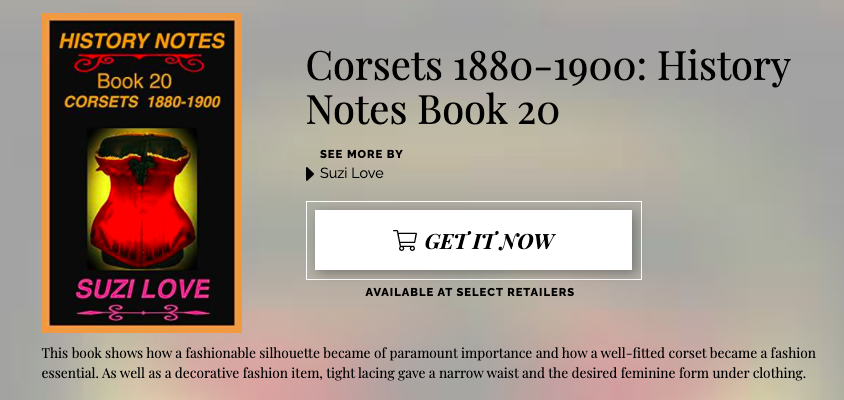
Corsets 1880-1900 History Notes Book 20. This book shows how a fashionable silhouette became of paramount importance and how a well-fitted corset became a fashion essential. As well as a decorative fashion item, tight lacing gave a narrow waist and the desired feminine form under clothing.
https://books2read.com/SuziLoveCorsetBook20

1860 New Hebrides, Pacific Ocean.
Katie woke sluggishly, unable to pinpoint what felt different. Outside, it was still dark and she guessed it was a couple of hours before the tropical dawn. Already the heat was oppressive and sweat dotted her body, the bed linen a crumpled tangle on the floor. She usually awoke with a jolt, fearful of what the day might bring and uncertain if she’d be alive to see tomorrow’s dawn. But today she felt alive. Even her body felt different, sort of enjoyable lassitude, but with a few puzzling tender areas.
She flinched and barely smothered her scream when a heavily muscled arm draped across her bare waist and languidly pulled her backwards. Memory flooded her. Alex was tugging her, gently but persistently, towards him again. Her inner struggle between mind and body lasted only a fleeting minute as she permitted her naked body to be lifted and draped across his, breast to breast, thighs meeting and his aroused flesh, hot and hard, enticing her once more.
‘Alex…’
Gentle fingers against her lips silenced her. ‘Shush, Katie. Shush!’
‘But we have an agreement.’
‘I promise to abide by your ridiculous rules, but we still have many hours before full tide and I want to love you, again and again. I need this! We both do. This may be all the time we have to be together for a long while.’

1826 January Promenade Dress, English. Green walking dress with wide lace hem, zigzag white collar edge, white buttons on front vertical, large fur muff with pink lining, large hat with pink ribbons and black bows on crown. Fashion Plate via Rudolph Ackermann’s ‘The Repository of Arts’, London, U.K.
Definition: Promenade Dress, Walking Dress, Pelisse Or Redingote. Woman’s long, fitted overdress or coat often worn open in front to show off the dress underneath. Sometimes cut away in front. Originally made with several capes and trimmed with large buttons. French word developed from English words, riding coat. reefer. Single- or double-breasted, fitted, tailored, over-all coat usually made from sturdy fabric. In England, this sort of coat was generally called a pelisse, walking dress, carriage dress or promenade dress. In France, these coats were called a Redingote.


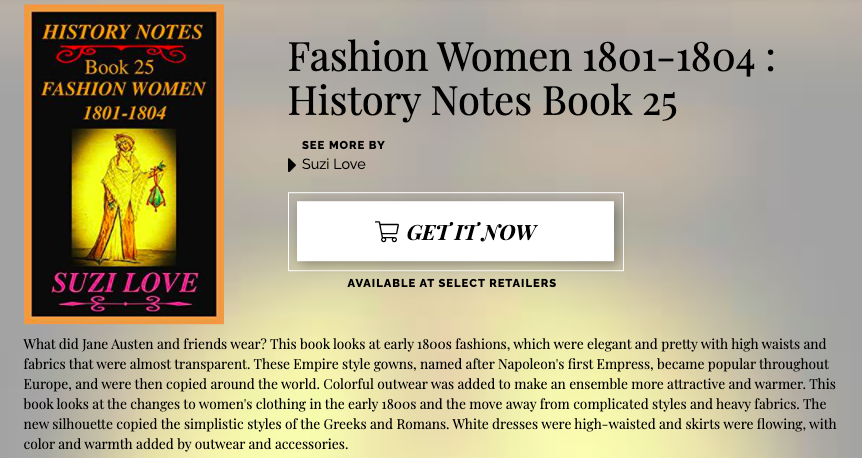
1802 Lavender Gown With Long Train and Decorative Trim, French. Short sleeved Empire style, or high-waisted, dress, long pale gloves, black straw hat with ribbon trim, necklace and fan. Fashion Plate via Journal des Dames et des Modes, or Costume Parisien. https://books2read.com/SuziLoveFashionWomen1801-1804
Definition Empire Style Dress: High-waisted white gown defined women’s fashion during the Regency Era. ‘Empire’ is the name given to the period when Napoleon Bonaparte built his French Empire. High-waisted, loose gowns were adopted by the aristocracy as a symbol of turning away from the fussy, elaborate and expensive clothing worn in the 1700s.
The type of dress worn across Europe in the early 1800s. This sort of high-waisted dress would have been worn by Jane Austen and her contemporaries in England. The Empire waist gown defined women’s fashion during the Regency Era. ‘Empire’ is the name given in France to the period when Napoleon built his French Empire. High-waisted, loose gowns were adopted by the aristocracy as a symbol of turning away from the fussy, elaborate and expensive clothing worn in the 1700s.

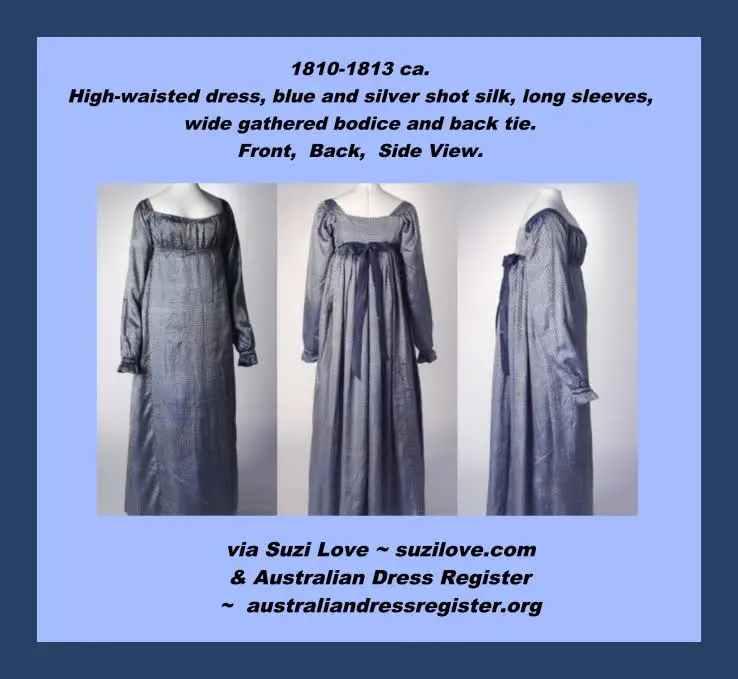
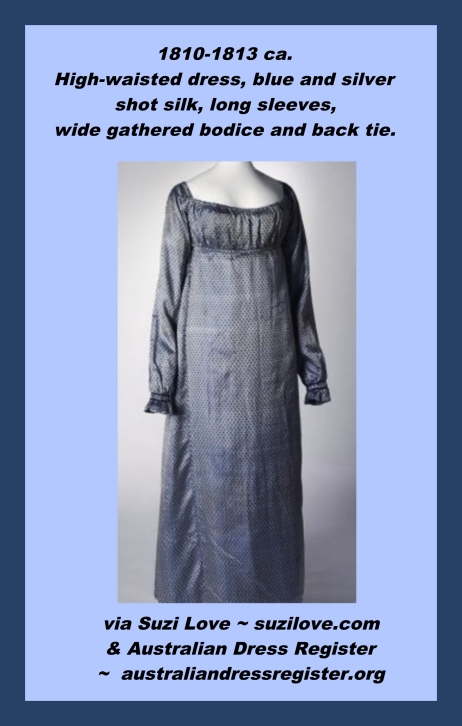
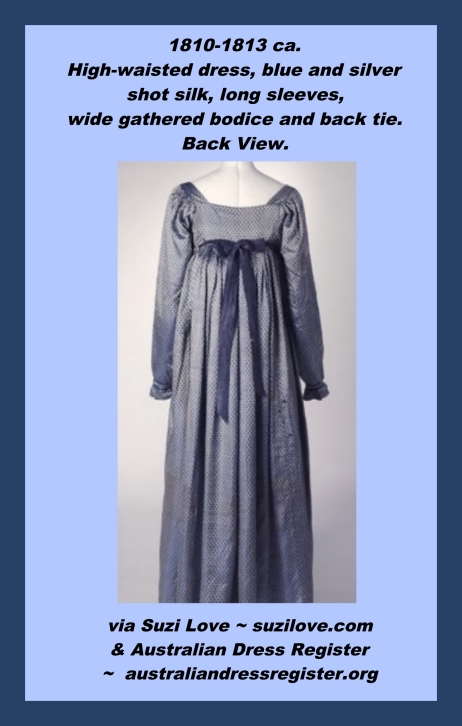
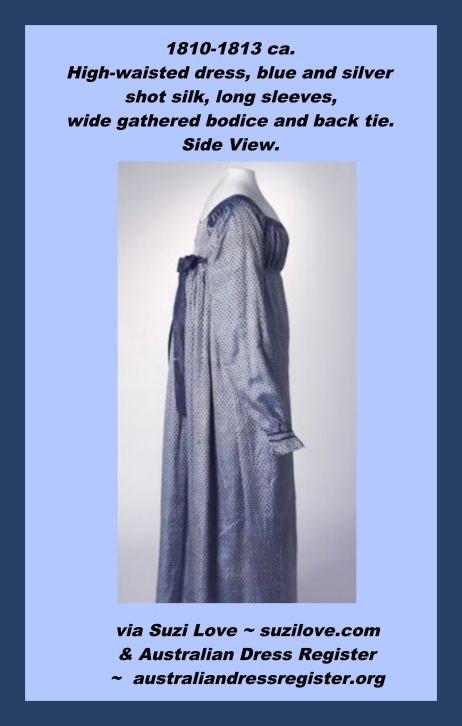
1810-1813 ca. Blue and Silver Shot Silk, Empire style dress, with long sleeves, British. One-piece dress in silver and blue shot silk with a pattern of dark blue flowers. High waist, square back neckline and dropdown bib-front. Bodice interior lined with cream cotton panels. Full-length sleeves have gathered sleeve head and extended cuffs over hands, with silk floss-corded trim at band. Five paneled skirt gathered at centre back and designed to be worn over a small back bustlepad. Cotton tape drawstring attached to interior of bodice and with blue silk ribbon ties at back. The high waist, bib-front and columnar skirt made this Empire dress less restrictive than many other 19th-century styles. Beneath this light, free flowing garment lay several layers of underwear. A shift and petticoat were worn, as well as a soft corset with a busk. Via australiandressregister.org
Probably belonged to Devonshire woman, Ann Deane (mother of Mary Deane, who married pastoralist and founder of Springfield sheep station, William Pitt Faithfull). Ann married Thomas Deane at Upton Pyne in Devon in 1807, and by 1813 had given birth to four of her six children. The dress travelled to Australia with Ann Deane when she and her son Robert, daughters Ann and Mary, and grandson Edgar migrated to New South Wales in early 1838. Ann Deane’s husband Thomas had died over a decade earlier, and her children had been receiving an annuity of 1000 pounds a year from their Uncle Robert Deane, a captain in the West India Company marines, who died in 1827.
When the Deane family embarked upon the three-month sea voyage to Australia they brought a range of objects and material from England, including sketches and paintings of English landscapes and seascapes (by daughters Ann and Mary), scrapbooks filled with newspaper clippings, recipes and poetry, books many of which were inscribed with affectionate messages from friends left behind and a number of eighteenth- and nineteenth-century dresses. After arriving in Sydney Ann’s daughters, Ann and Mary, established a private school for young ladies in Macquarie Place. The school operated until 1844, when Mary married Faithfull, and it was through this union that the dress found its way to Springfield sheep station in Goulburn. Mary and Faithfull had nine children between 1845 and 1859, and their eldest daughter Florence became the caretaker of the dress once her mother and aunt had passed away. Florence Faithfull became an avid collector, keeping hundreds of items left by family members when they moved away or died.
In the early 1950s Florence’s niece and namesake, Florence ‘Bobbie’ Maple-Brown, was faced with the momentous task of sorting through the remarkable collection of material that had accumulated for over 100 years at Springfield. During renovations of the main homestead Bobbie converted two rooms of the nine-bedroom mansion into what was to become known as the Faithfull Family Museum. The blue silk dress and many others collected during the nineteenth and twentieth centuries were hung in a wardrobe in the family museum, springing to life now and again when younger generations of the Maple-Brown family used them for dress-ups.


1815-1825 ca. Dark Green Leather Woman’s Slippers, French. The type of shoes worn by Jane Austen and her female friends and family. Made in France and worn in Boston, Massachusetts, USA. Worn by Mehetable Stoddard Sumner (Welles), American, 1784-1826. Green silk bows, lapped side seams, green silk bindings, black silk ribbon ties, plain linen drawstring at fronts, white leather insoles, white linen vamp linings; leather soles. Written in ink on insole was ‘Droit’, meaning right side, although both shoes may have been the same. via Museum of Fine Arts, Boston. mfa.org.
Shoes in the early 1800s were flat or low heeled and occasionally decorated with a bow or floral embellishments and it wasn’t until the 1820s that square, rather than rounded, toes became fashionable. Typical Regency Era women’s footwear were shoes that had low heels, slightly rounded toes, embellished with a bow and with ribbon ties for the ankles. Made of soft kid or cloth, these delicate shoes were flimsy and wore out quickly. Slippers were often bought in multiples at a time and with no difference between left or right foot so when one slipper had a hole it was easily replaced.


Want To Know More About Georgian Era Men’s Fashions? Try History Notes Book 2: Fashion Men 1700s Late. What was fashionable for men in the late 1700s? Extravagant colors and fabrics and outrageous styles. Take a look at their suits, hats, accessories and bedroom fashions.
Strictly speaking, the Georgian Era might include all the years that a ‘King George’ ruled in England, but for the purposes of this book the ‘Georgian Era’ is primarily the late 1700s when mad King George III ruled. His son became Prince Regent in the early 1800s, therefore creating the years known as the Regency, and became George IV on the death of his father.


This book depicts the often-frivolous life and fashions of a young lady in the early 1800’s, but also gives a glimpse into the more serious occupations a young lady may undertake. Through historic images, historical information, and funny anecdotes, it shows how a young lady fills her day, where she is permitted to go, and who she is allowed spend time with. These light-hearted looks at the longer Regency years are an easy to read overview of what people did and wore, and where they worked and played. There is plenty of information to interest history buffs, and lots of pictures to help readers and writers of historical fiction visualize the people and places from the last years of the 18th Century until Queen Victoria took the throne. Young Lady’s Day Regency Life Series Book 4 by Suzi Love. https://books2read.com/suziloveYLD

