1826 The Dinner Party. Social Life. From 1826 The English Spy By Robert Cruikshank. via Google Books (PD-180). https://books2read.com/suziloveOLD



1826 The Dinner Party. Social Life. From 1826 The English Spy By Robert Cruikshank. via Google Books (PD-180). https://books2read.com/suziloveOLD
1864 Silk corset, made to be worn over a chemise. Made in France or Britain. Aqua blue silk lined with linen, edged with machine-made lace, reinforced with whalebone, metal, lined with cotton twill. The front has fastenings and the back has lacings. The wearer of this corset could dress without help because the steel ‘split busk’ fastens in front. The front fastening was invented in 1829 but did not become common until the 1850s. The whalebones press into the waist to shape the hipline into an extravagant curve, to flatter and support the fashionable cage crinoline. In the 1860s women relied on voluminous skirts, in addition to corsets, to make their waists appear small.
Flossing, or embroidery, to stop bones poking through fabric, edged with machine-made lace, reinforced with whalebone, metal fasteners, V-shaped front for better fit & extra shaping. The front has fastenings and the back has lacings. There are fewer bones in the back of the corset than the front and none over the hips. Trimmed at the top edge with a narrow band of machine-made lace. Stiffened with whalebone and machine-stitched with an incised swivel latch to lock the busk fastening. Boned at the centre front, back and diagonally from the side to back and sides to front. The boning is hand-stitched into place. Metal eyelets. Lined with cotton twill. The corset reaches the top of the hips and is gored at the bust and hips.
During the 19th century, corsets were made from a variety of materials and shapes changed often. Sometimes breasts were pushed up and almost over the top and waists could be tiny and other curves were emphasized. By the end of the 19th century, corsets weren’t laced so tightly because wide crinolines created the illusion of tiny waists. There are fewer bones in the back of the corset than the front and none over the hips. From the late 1840s to the 1860s skirts were full and bell-shaped, at which point corsets were relatively short and not particularly tightly laced, since the massive skirts made all waists look proportionally small.
The corset was worn over the chemise and it moulded the figure of the wearer into the fashionable shape of the day. These shapes ranged from slender to curvaceous and everything in between during the 19th century. Like the chemise, the corset in the 19th century was made of a wider variety of materials, in this case blue silk lined with linen. It did not need to be very tightly laced, for the illusion of a small waist was created by the very wide circumference of the crinoline.
Credit : Given by the Burrows family. Museum number:T.169-1961. The donors of this corset linked it to a 1864 marriage in the family. Victoria and Albert Museum, London, U.K.



1817 February Pelisse, or Redingote, English. Carriage dress of white poplin with a deep blond flounce. Blue levantine pelisse or walking dress, or Redingote in France, shorter than the dress and edged with floss silk. Coburg cap of black velvet turns up on one side in front and is lined and edged with blue satin. The head-dress worn with it has a profusion of white ostrich feathers. Ruff is of plain blond, edged with narrow white satin ribbon, and a pink Indian scarf over the shoulders. An ermine muff, gloves and slippers of blue kid, complete the elegant dress. Fashion Plate via John Belle’s La Belle Assemblée or, Bell’s Court and Fashionable Magazine, London.
Definition Coat or Redingote Or Pelisse: Long fitted outdoor coat worn over other garments for warmth. French word developed from English words, riding coat.


1826 Bath Beau and His Lady. Photo Editing By Suzi Love. ~ suzilove.com
From: 1826 The English Spy By Robert Cruikshank via Google Books (PD-150)


1826 A Regency Gentleman’s Life In Jane Austen’s Times. #JaneAusten #RegencyEra #Cartoon #England. via 1826 The English Spy By Robert Cruikshank via Google Books (PD-150)
The young man’s friends may help him decide what activities they would engage in. Perhaps they would decide to watch a dogfight or a cockfight. Or perhaps go and see a mill, where two burly boxers would pummel each other’s faces until one was declared winner and bets could be settled. Later that night, the rowdy group would head to whatever gambling hell was in vogue where they would pass several hours drinking and playing cards. Dark and sordid rooms, smoky interiors, loud and drunken men, and losing your quarter’s allowance from your father were all willingly suffered if a young man had enticed a buxom wench to sit on his lap and make him forget his woes. And how angry his father would be when he learned his son had gambled away yet another three months of his allowance.
Having filled in their morning, the men wander into Town to meet their cronies for luncheon. Thank goodness it’s time for a few bottles of claret!! Just the thing for fixing a hang-over, plus, a great place to discuss how to eke out their never-enough allowances until the young men could beg their long-suffering fathers for a little more spending money.
Price Egan’s ‘Life In London in 1823 described a young man’s entertainment choices. ‘ …bit of a stroll,’ in order to get rid of an hour or two. A turn or two in Bond Street, a stroll through Piccadilly, a look in at Tattersall’s, a ramble through Pall Mall, and a strut on the Corinthian path, fully occupied the time until the hour for dinner arrived, when a few glasses of rich wine put them on the path for vice.’ A group of young men would then head to Vauxhall. ‘‘…if enjoyment is your motto, you may make the most of an evening at Vauxhall, more than at any other place in the metropolis. It is all free-and-easy. Stay as long as you like, and depart when you think proper.’


1807 Regency Couple, French.Dressed As In Jane Austen’s times.Back view of a lady’s white dress with a cute back bow, long draping scarf with knotted ends, and straw bonnet with a blue ribbon and bows. Gentleman in a long grey coat, orange vest, extremely high collar of a ruffled shirt, tight taupe pants tucked into topped boots, and with a fashionable short curly hairstyle. Fashion Plate via Costume Parisien.


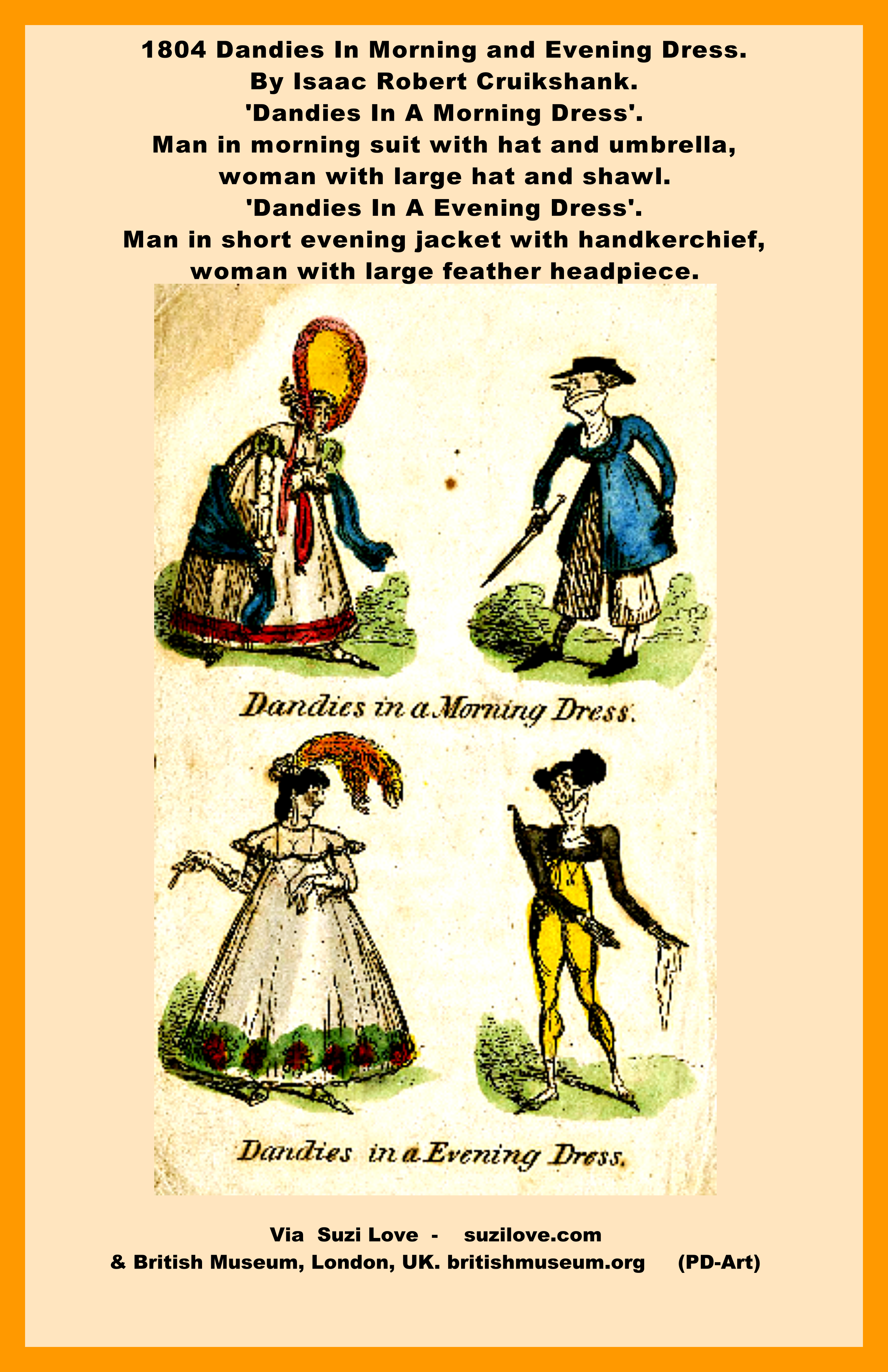
1804 Dandies In Morning and Evening Dress. By Isaac Robert Cruikshank. ‘Dandies In A Morning Dress’. Man in morning suit with hat and umbrella, woman with large hat and shawl. ‘Dandies In A Evening Dress’. Man in short evening jacket with handkerchief, woman with large feather headpiece. Via British Museum, London, UK. britishmuseum.org (PD-Art)

1900-1910 ca. Livingstone Medicine Chest, England. via Science Museum, London, U.K.
sciencemuseum.org.uk


1817 April Ladies’ Voucher for all the Wednesday balls at Almack’s Assembly Rooms, London, U.K. in April 1817. The voucher is for the Marchioness of Buckingham to attend the balls at Almack’s “on the Wednesdays in April 1817.” There are initials in the lower right hand corner marked, “MD”. These initials might be for Mary Marchioness of Downshire who may briefly have been a patroness ca. 1816-1817. The red wax seal is also intact on the front. “Pall Mall” is written on the back of the card.Via Huntington Museum, California, U.S.A. https://hdl.huntington.org/digital/collection/p15150coll7/id/10672/
Subscribers to Almack’s were allowed to bring a guest to a Ball, if they were approved first. They called at the Rooms in person and were either granted a Strangers Ticket of admission or were banned. Rooms were open for supper, gaming dancing lasting the night. At eleven o’clock, doors were closed and no one, not even celebrities were admitted. Once a young lady making her debut during the London Season had been granted a ticket to Almack’s, her social standing was assured. The Patronesses introduced the debutante to people of importance and selected her dance partners.


1808 Lady In A High-Waisted White Dress Reading A Book Outdoors, French. Dress has short puffed sleeves and is worn under a frilled Pelerine, or shoulder cape, long tan gloves, walking shoes and a white country style hat with a blue bow. The lady is leaning on a post and reading a book. Fashion Plate via Journal des Dames et des Modes, Costume Parisien.
Empire Style Dress: Named after the First Empire in France. Empire dresses had a low neckline and skirts started directly under the bust and flowed into the classical relaxed wide styles of Greece and Rome. This style of dress is associated with Jane Austen and her contemporaries as a high-waisted dress was worn most days. Cotton, silk or taffeta were the popular fabrics.
Definition Pelerine: Tippet or shoulder cape, usually waist-length, with long, pointed ends in front. Popular in England and colonial America.
