What shoes did the Bridgertons and Jane Austen wear? Gray Slippers, American, with long ankle ties.
Typical Regency Era women’s footwear as worn by Jane Austen and her contemporaries and by the Bridgerton family were shoes that had low heels, slightly rounded toes, embellished with a bow and with ribbon ties for the ankles. Shoe styles and shapes were generally very plain but then shoes began to be made in bright colors to match the colorful Empire style, or high-waisted, gowns. Plus, as gowns were lighter and floatier, glimpses could be had of these new pretty shoes. Ribbons, rosettes and other decorative. embellishments allowed ladies to personalize shoes.
Lady Laura Jamison believes her extraordinary olfactory senses will sniff out her perfect match, but will Richard St. Martin, the Earl of Winchester, prove her theory wrong? Scenting Scandal By Suzi Love Book 2 Scandalous Siblings Series. books2read.com/suziloveSS
EXCERPT
Laura concentrated on restful images. Brooks babbled, birds sang, white fluffy clouds floated. Colorful rainbows arced and…. Nothing, dammit. Her frazzled nerves refused to be soothed. Trying not to alert her aunt, whose over-emotional farewells had already delayed proceedings, Laura tugged on Winchester’s arm. His leather-gloved hand held fast. The Devil take the blasted Earl and his oversized anatomy, his overwhelming maleness and his…
She shivered. Everything overpowering about this man, including his unwanted invasion of her senses, ought to be declared illegal. A ticket tied to each limb reading: Danger. Avoid at all cost.
His cologne’s citrus tang, bergamot with an after-note of lemon, flooded her nose and made her sneeze. Another confirmation that the theory of natural selection being developed by scientists at the Royal Academe was correct. And an extra incentive to elude her keeper, ergot the enigmatic Earl, and pay another visit to her friends, Mr. Charles Darwin and his cousin, both men grandsons of Mr. Erasmus Darwin, famed researcher and theorist.
While she listed to herself the scientific reasons for avoiding the Earl, her herbalist and caring side, or more likely her feminine one, overruled. She reminded herself a few more drops of lemon should be added to the next batch of cologne she blended for Richard. Even as she mentally cursed her siblings for insisting she work closely with Winchester, Laura’s traitorous body responded in a physical way to his presence.
Imagining him, an expert financier, being granted full authority over not merely her ‘Change transactions, but also her daily household accounts, horrified her. Mortification would nail closed her coffin if he compared her scientific skills with those of her extraordinarily talented four siblings and found her wanting. Or, heaven save her, exposed her failures to the world.
1880’s Corset, French, silk satin, steel busk, and bone. Women used corsets to get closer to an ‘ideal physical form’. Until the beginning of the 20th century, women’s waists were tightened by corsets. via Kyoto Institute, Japan.
Corsets 1880-1900 History Notes Book 20 This book shows how a fashionable silhouette became of paramount importance and how a well-fitted corset became a fashion essential. As well as a decorative fashion item, tight lacing gave a narrow waist and the desired feminine form under clothing. https://books2read.com/SuziLoveCorsetBook20
1806 Short-Sleeved White Muslin Dress With Train. Bodice and sleeves have ribbon decoration, evening flowered headdress, half parure of necklace and ear bobs, and gorgeous Indian hand-loomed green shawl. Fashion Plate via Journal des Dames et des Modes, or Costume Parisien.
Definition Half Parure: A Parure is a matched set of jewelry, including a necklace, bracelet, earrings, pin etc. A half Parure didn’t include a jewelled headdress, or tiara.
Definition Shawls: The shawl started off in India as a fine wool garment for men that could be worn as a scarf, turban or as a mantle: the word comes from the Persian shäl. Originally imported from the East, European Kashmir shawls were made first in Norwich and Edinburgh in Britain in the late 18th century. Shawls were an essential item in the early 1800s to cover the thin gowns women wore. They were made of muslin, gauze, silk, wool, and velvet, though cashmere shawls were the softest and most prized.
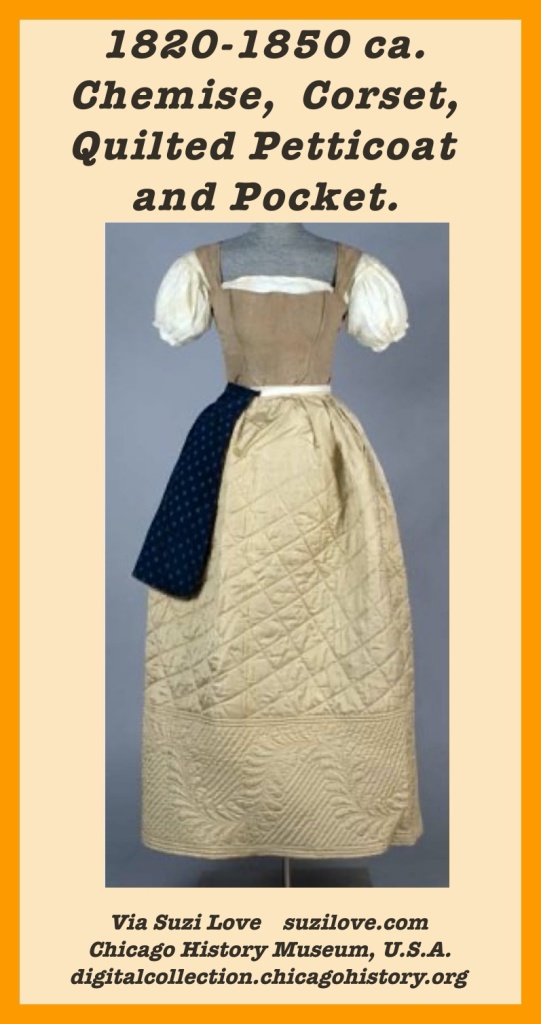
1820-1850 ca. Chemise, Corset, Quilted Petticoat and Pocket. Gift of Mary S. Belden. Corset About 1820-1830 ca. CHS Collection. Pocket About 1820-1840 ca. Chemise About 1839-1850 ca. via Chicago History Museum, U.S.A.
Chemise Or Shift: Sleeveless, mid-calf length garment of white cotton or muslin was worn next to the skin under stays or corset. Called ‘Shift’ from early Georgian (1700-1750) until Late Georgian (1750-1790) to replace ‘Smock’. By 1800, name shift was replaced by ‘Chemise’.
Corset: French term for stays. Structured bust supporting or body shaping foundation garment. Tightened by laces and often with reinforcing e.g. boning, cording and flossing.
From the Curator Victoria and Albert Museum, London: Quilting was a popular form of decoration for a variety of garments including pockets. However, hand-quilting was a time-consuming method of decoration. The increased demand for quilted petticoats, waistcoats and pockets led to the invention of woven quilting.
Love After Waterloo by Suzi Love. Despite Wellington’s victory over Napoleon four days earlier, soldiers, to use the term loosely, still lingered around Waterloo. They and deserters from both sides had joined local famers in picking through the remains of bodies, uniforms, and armory to pilfer anything of value. There’d been nowhere safe to hide her and her son, Daniel, so Lady Melton’s’ brothers had packed what remained of their equipment and taken them, along with a few wounded British soldiers, to the Captain’s quarters, knowing that his orders were to protect whoever remained of French stragglers and deserters.
Anne’s twin brothers hadn’t lingered, because Wellington and what was left of his British troops were marching back towards Brussels and Brendon’s skills as a physician were urgently needed. Benjamin, an aide to Wellington, had stayed to organize the repatriation of their soldiers and the departure of their sister and nephew. Neither twin had understood her reluctance to join Captain Belling and his group and had ignored her pleas to stay with them in Europe, stating firmly that it was time that she and Daniel returned to London.
They hoped that Anne could reopen their townhouse in London and prepare for when they could join her, optimistically within a few weeks. She wasn’t quite so optimistic. Napoleon was an egotist. He wasn’t the type to accept defeat easily, and she imagined he’d already be making plans for a triumphant return in the future, despite the carnage left behind at Waterloo when he and his remaining troops retreated. Her brothers had reported that the plains had been covered with the dead and the dying, both men and horses.
“There is a stubbornness about me that never can bear to be frightened at the will of others. My courage always rises at every attempt to intimidate me.” Jane Austen Pride and Prejudice (1813) #JaneAusten #RegencyEra #Quote https://books2read.com/SuziLoveFashion1810-1814
1756-1762 ca. Gold and Enamel Étui, French. Probably by Jean Ducrollay, 1756-62, Paris. via Metropolitan Museum New York City, U.S.A. metmuseum.org
books2read.com/SuziLoveWritingTools