1810 Sarcophagus Shaped Inkstand, British. Inkstand is made in the shape of a sarcophagus. Ink pots and a tray for the quill. In Jane Austen’s time, young gentlemen went on their “Grand Tour’ to gain education and experience and they sent, or brought back, unique and decorative items to represent their travels. Often, these decorative items were copied by British manufacturers to sell for the home market. via Museum of Fine Arts, Boston. mfa.org
1819 January ‘Going to White’s’. By Richard Dighton. Lord Alvanley walks on the pavement going to White’s Club for gentlemen in London wearing a top-hat, double-breasted coat, strapped trousers, and the high collar of a dandy. Via British Museum, London, UK. britishmuseum.org (PD-Art)
White’s was an exclusive Gentlemen’s Club on St. James Street, London, U.K where well-dressed men, or Dandies, gathered at a special table in front of the large bow window looking out at the street. This became known as a seat of privilege and was used by London’s most famous Dandy, Beau Brummell. Other well-known dandies were William Arden, Joshua Allen, Thomas Raikes and Ball Hughes. Cartoonists loved to ridicule these high-in-the-instep gentlemen who wore the most fashionable clothes and set the fashion trends for the Regency years, and the years when Jane Austen was writing her famous novels.
1800-1830 ca. Drawstring Bag, German. Basket-shaped, Ecru cotton knit embroidered with colored glass beads in design of grapevine on upper half, open work embroidered with weaving motif on lower half. Wired at center, cardboard at base. Green silk cord drawstring. The Elizabeth Day McCormick Collection via Museum of Fine Arts, Boston, U.S.A. mfa.org
Definition Reticule Or Ridicule Or Bag or Purse: Often with a drawstring to pull closed and usually made of cloth or covered cardboard and often decorated with beading or embroidery. A reticule, or purse, or handbag, was usually carried by a woman during the Regency period to carry all their daily necessities. Earlier, women used pockets that tied at the waistline and were hidden in the folds of their skirts. Empire style, or early 1800s, high-waisted dresses made it impossible to either sewn in a pocket or to tie on a pocket. So women began carrying small, decorated bags called Reticules, or ridicules, which generally pulled close at the top with a drawstring.
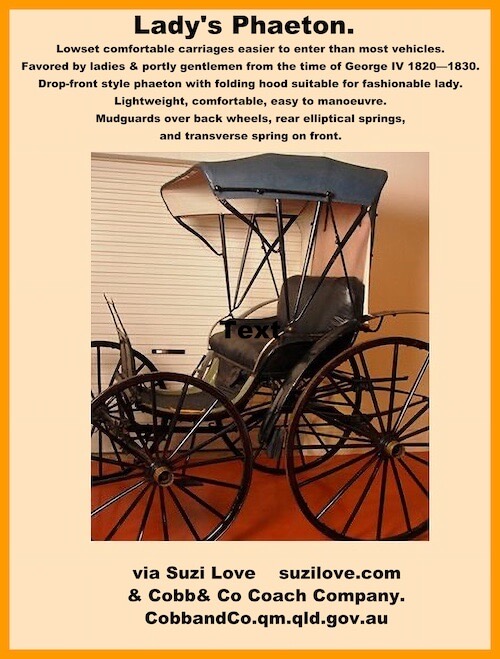
1800s Early A Lady’s Phaeton. Drop-front phaeton with folding hood suitable for a fashionable lady as lightweight, comfortable and easy to manoeuvre. Mudguards over the back wheels, rear elliptical springs and transverse elliptical spring fitted to the front. via Cobb and Co. Museum, Toowoomba, Australia.
Definition Carriage Lady’s Phaeton: Low set comfortable carriages easier to enter than most vehicles. Favored by ladies and portly gentlemen from the time of George IV 1820-1830.
Definition Phaeton: Open, four-wheeled, doorless carriage, popular in the 18th and 19th centuries. One or two seats, usually a folding or falling top, and owner-driven. The type of carriage liked by young ladies in Jane Austen’s times as the lady could drive herself, The most spectacular phaeton was the English four-wheeled high-flyer was the top phaeton, with body of a light seat for two resting on two sets of springs and reached by a ladder.
1801 Young Man’s Daily Outfit, French. Blue cutaway coat with extra high collar, brown knee breeches, chin high white cravat, an all-over curly hairstyle and a round-hat with a wide brim and a low crown which is flat on the top. The hats only decoration is a narrow ribbon and buckle. Fashion Plate via Journal des Dames et des Modes, or Costume Parisien. https://books2read.com/SuziLoveFashionMen1800-1819
I love when the same fashion plate is repeated with two ladies or a lady and a gentleman. 1808 Ladies In High Waisted Dresses, French. Green dress with short sleeves, white frill back bow and white lace headdress. White dress with short puffed sleeves, paisley shawl and red coral necklace. Fashion Plate via Journal des Dames et des Modes, or Costume Parisien. https://books2read.com/SuziLoveFashionWomen1805-1809. Gorgeous Regency Era clothing came in a wide range of styles to suit every season and occasion. Ladies in Jane Austen’s times wore Empire style dresses which were usually of light fabric and floaty in style so accessories were essential to keep women warm.
What was fashionable for outer wear in past centuries? Different names in different countries: Pelisse, Redingote, Coat, Or Walking Dress. The Bridgertons and Jane Austen and her contemporaries wore long coats like these to keep warm when out and about, visiting, shopping etc. The thin muslin dresses worn in the early 1800s were little protection against European winters. http://books2read.com/suzilovePelisse
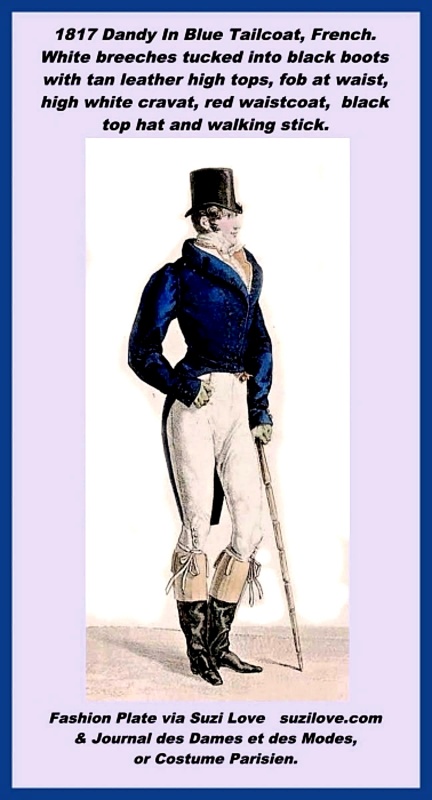
1817 Dandy In Blue Tailcoat, French. White breeches tucked into black boots with tan leather high tops, fob at waist, high white cravat, red waistcoat, black top hat and walking stick. Fashion Plate via Journal des Dames et des Modes, or Costume Parisien.
Dandy: The author of The Hermit in London, a series of sketches published in 1819—1820 observed: ‘A distinguished Exquisite is padded all over to-day; and all the other foplings are, on the morrow, mere walking pin-cushions. A fat prince, or a fat dandy, requires confinement in his limbs; and all his subjects are immediately restrained within the same limits. One day, the back is to be as broad as an Irish chairman’s, and the shoulders to be bolstered up to imitate a hod-man; and the next, the shoulders are to be flat, and a man is to be pinched in and laced up until he resembles an earwig. All these are Master Snip’s maneuvers, who continues to make his bill equally long, whether the spencer or the box-coat be in vogue.
Beau Brummell was one of the most celebrated dandies of all time. Cartoonists ridiculed these high-in-the-instep gentlemen who wore the most fashionable clothes and set the fashion trends for the Regency years, the years when Jane Austen was writing her famous novels and the years when the Bridgerton series is set.
Hessian Boots: In the 1790s, British Army officers wore boots called Hessians, named after German mercenaries who fought alongside the British in wars, including in the Irish Rebellion of 1798. The soldiers from the German state of Hesse were called Hessians and their boots took their name from Hesse, where they were made. The Hessian boot was made from soft, highly polished calfskin, knee high, curved top and with a V cut at the front and often had a decorative tassel.
They were shaped like a stirrup so the rider could easily insert their feet into the stirrups and the feet were kept securely in place. But tassels on Hessian boots were designed for wearing with breeches and didn’t suit tight fitting and fashionable new trousers that dandies like Beau Brummell wore in 1800s and so were replaced by Wellington Boots.
In 1823, the New Monthly Magazine had a comical story about tight pantaloons and Hessian boots being a perfect pairing. ‘…. tight pantaloons without Hessian boots were as preposterous as a haunch of venison without currant-jelly, or a leg of pork without peas-pudding.’ https://books2read.com/SuziLoveFashionMen1800-1819