Box Set combining Corset books 14-21 to give a complete picture of the progression of corset styles from 1700 through to the 1900s, including Jane Austen’s lifetime. https://books2read.com/SuziLoveCorsetBook22
This Box Set combines corset books 14-21 to give a complete picture of the progression of corset styles from 1700 through to the 1900s, including Jane Austen’s lifetime and the Bridgerton years. These books show how body wraps, stays, and corsets were worn through the centuries to create a variety of fashionable silhouettes through various historical eras. Corsets flattened breasts and accentuated rounded hips or pushed up breasts and showed off the bust line depending on the fashions of the time and the desired silhouette.
1816 August Back view of a lady in Evening Dress, English. White, high-waisted, dress with short bodice, long sleeves, frilled hem plus decoration above the frill, high plumed headdress, and reading music sheets. “A gown of white soft satin, cut low all round the back and bosom.The skirt gored, and a good deal of fullness thrown behind. The body, which is disposed in small plaits, displays the shape, as our readers perceive by print, to very great advantage; it is trimmed round bosom with a wreath of small white net roses, with a little tuft of pearl in the heart of each. Long loose sleeve, composed of white lace, and finished a la Parisienne with a rich double frill at the wrists.
The skirt is ornamented, in an exquisitely tasteful style, with a broad flounce of rich blond, surmounted by a wreath of roses and deep scallops of white net, the points of which are finished by bows of white satin ribbon. The effect of this trimming is uncommonly beautiful. Hair, cropped and curled full in the back of the neck, and dressed light, and much parted on the forehead: it is ornamented With a superb white ostrich-plume, at the base of which is an aigrette of diamonds. Neck-lace, ear. rings, and bracelets also of diamond. White satin slippers, and white kid gloves. We have to thank the condescension of a lady of much celebrity in the fashionable world, to whom we are indebted for a sight of the very elegant and tasteful dress from which our present print is designed.” Fashion Plate via Rudolph Ackermann’s ‘The Repository of Arts’.
In Jane Austen’s times craftsmen created boxes and containers of precious metals, leather, silks, and decorated them with jewels. Boxes, Cases, Etui, Necessaire and everything else that was used to carry essential items for travel, sewing, medicine, writing, and toiletries. Containers were engraved to make exquisite and expensive items as well as practical carrying cases. books2read.com/suziloveBoxesCases
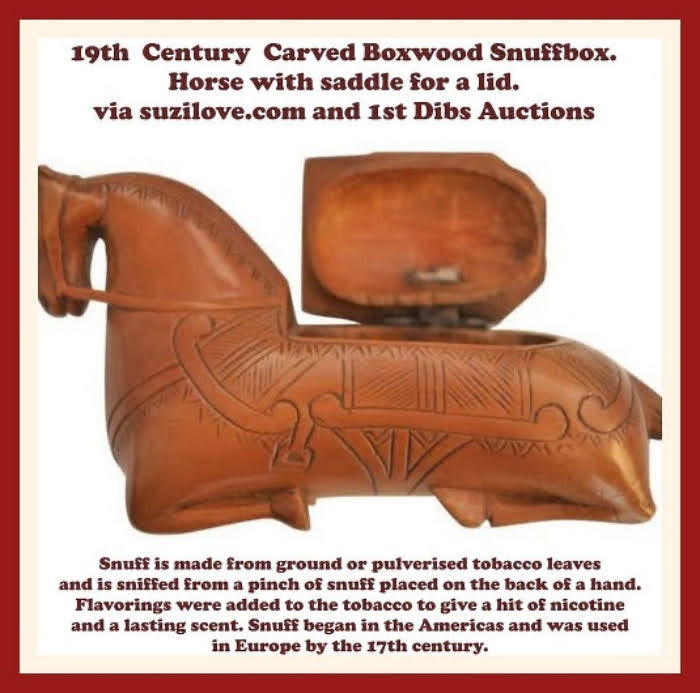
19th Century Snuff Boxes. Not only were boxes made to serve a purpose, but decorative boxes of all types were prized, especially in the 18th-19th Centuries when everything decorative and extravagant was in vogue and taking a pinch of snuff was fashionable. Snuff is made from ground or pulverized tobacco leaves and is sniffed from a pinch of snuff placed on the back of the hand.Flavorings were added to the tobacco to give a fast hit of nicotine and a lasting scent. Snuff began in the Americas and was used in Europe by the 17th Century.
Snuff became popular from the mid 1600s to the mid 1800s and was more popular than smoking. Inhaling snuff, or snuffing, was first seen by a European missionary in 1493 in Christopher Columbus’s new world within Haiti’s indigenous Taino. Until then, tobacco had been unknown to Europeans, but its use spread quickly throughout Europe during the 1500s. By the second half of the 17th century, ornate boxes started being produced to keep the precious powder dry and an entire industry making accessories blossomed around the fashion of taking snuff. Noblemen, and some women, carried extravagantly decorated snuff boxes with them at all times and would offer a pinch of their own particular blend to friends and family. Therefore, these boxes were always on display and so it became a competition to see who could have the most bejeweled or expensive box possible. By the mid 1800s, snuff taking was no longer popular so these exquisite and expensive snuff boxes became decorative, rather than functional.
19th Century Shoe Snuffbox. via 1st Dibs Auctions 1stdibs.com19th Century Engraved Horn Snuffbox. Heart surrounded by flowers and leaves, sides with dove, symbol of purity and peace, brass hinge and setting. via 1st Dibs Auctions19th Century Carved Boxwood Snuffbox. Horse with saddle for a lid. via 1st Dibs Auctions
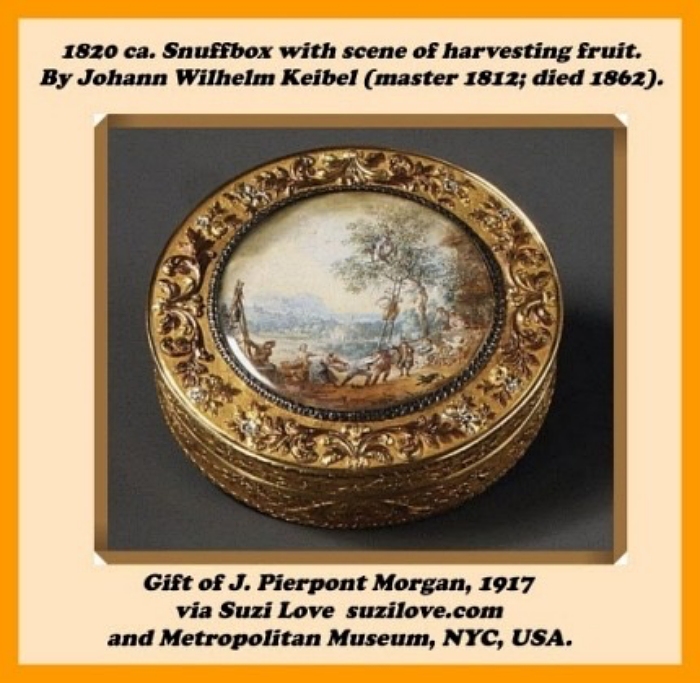
1804-1809 ca. Snuffbox in the Shape of A Lion, Moulinie, Bautte and Cie, Geneva, Switzerland.via Victoria and Albert Museum.1820 Snuffbox with scene of harvesting fruit. By Johann Wilhelm Keibel (master 1812; died 1862). via Metropolitan Museum New York City, U.S.A. metmuseum.org1810 ca. Jeweled Gold Snuff Box, Switzerland. Maker’s Mark Geneva. via Christie’s Auction Rooms. christies.com 19th Century Taking Snuff and Pretty Snuff Boxes In Bridgerton and Jane Austen Years. #bridgerton #RegencyEra #JaneAusten #Antiques https://www.books2read.com/suziloveBoxesCases Share on X
“I hate to hear you talk about all women as if they were fine ladies instead of rational creatures. None of us want to be in calm waters all our lives.” Jane Austen Persuasion (1817) #JaneAusten #Quote
Tired past the point of arguing, Gabe undid the buttons on his trousers and awkwardly sank to the floor. Thin though the mattress was, he groaned with relief to be seated and able to stretch out his aching leg. He bent and tugged at his boots, but Lady Melton swatted his hands away. “Lean back and let me take care of you.”
He blinked at her in surprise. His uncle’s housekeeper had filled the role of mother for him often enough, but other than Mrs. Green, no one had ever fussed over his physical well-being. The women he’d been intimate with had fretted over pleasing him sexually, but his role as the male and provider had been to ensure they were well-housed, fed, and clothed. Role reversal made him uncomfortable, and yet Anne’s caring was oddly reassuring.
His upcoming task wasn’t going to be easy. Eleven men, a lady, and a small boy had to be transported to England. Plus, Wellesley’s dispatches were sewn into the lining of his uniform, which not even the Lieutenant knew. Gabe carried the official summation of the battle, papers that he’d been ordered to personally deliver to the War Office in London. Messengers were adequate for shorter notes, but the War Office needed a full report from Wellington, plus observations from his trusted officers, which amounted to a hefty and valuable package for him to conceal.
If Anne could lessen his pain, even a little, his thinking would be clearer during their journey, and only an ungrateful idiot would refuse her offer.
1800 ca. Sleeveless Chemise or Nightgown of white cotton and lace. Length just below knee. Gathered back and front onto yoke of lace and gathered fabric inserts. Gathers around neck by tape in casing. ‘Blanche’ embroidered centre front. Waist up to 50 in or more. via National Trust Collections, UK. nationaltrustcollections.org.uk
Definition Chemise Or Shift: Sleeveless, mid-calf length garment of white cotton or muslin was worn next to the skin under stays or corset. Called ‘Shift’ from early Georgian (1700-1750) until Late Georgian (1750-1790) to replace ‘Smock’. By 1800, name replaced by ‘Chemise’. Sometimes doubled as a nightshift, or nightrail. From around 1700, women wore a long garment, like a man’s shirt, next to their skin, day and night. ‘Costume In England’ describes this as originally a shirt or smock and adopted by women as an undergarment.
This undergarment fell from their shoulders to calves, and was called a chemise, shift, or vest. During the day, it was worn under stays, or a corset, and at night it could be worn as a nightshirt. Wealthier women could afford specific bedroom attire, but lower and working class women wouldn’t have had this luxury and so wore a chemise as both an undergarment and as sleepwear. The rich and the upper classes wore embroidered and otherwise decorated versions of this simple linen or cotton shift. Other classes of women wore a very simple version with little or no decoration as they had no time for decorative embroidery and no money to buy silk threads.
1807-1817 ca. Man’s Leather Breeches, American. These are the sort of pants that the men Jane Austen knew would have worn for riding or in the country. Drop front buttoned flap at the waist, a drawstring at the back waist to adjust waist size, and drawstrings and buttons at the calves to keep the breeches secure when worn with high boots. via Metropolitan Museum New York City, U.S.A. metmuseum.org
19th Century Cross Letter or Cross Writing or Cross Hatching. The writer reached the bottom of the page, turned the paper sideways and adds a second layer of text. During the 19th century, paper was expensive and postal delivery was charged per page, or by the size of the paper. Cross-writing was a way to save paper and postage in Jane Austen and Bridgerton times, and many of Jane Austen’s letters were written this way. Once it becomes familiar, the mind adapts easily and cross-writing letters are surprisingly legible. Charles Darwin also favored this technique.
Rates of Postage of single Letters in Pence.
From any post-office in England or Wales, to any place not exceeding 15 miles from such office – – – 3
For any distance above 15, and not exceeding 30 miles — — 4
For any distance above 30, and not exceeding 50 miles — 5
For any distance above 50, and not exceeding 80 miles – 6
For any distance above 80, and not exceeding 12O miles — 7
For any distance above 120, and not exceeding 170 miles – 8
For any distance above 170, and not exceeding 230 miles — 9
For my distance above 230, and not exceeding 300 miles — — 10
For any distance above 300, and not exceeding 400 miles – 11
For any distance above 400, and nut exceeding 500 mites — 12
1802 Picture of London Printed for R. Phillips via Google Books (PD-180)
And so in proportion; the postage increasing progressively one penny for a single letter for every like excess ok distance of 100 miles. 1802 Picture of London Printed for R. Phillips via Google Books (PD-180)
The Twopenny Post- Office.
There are two principal offices, one in the General Post—office yard, Lombard—street and the other in Gerrard-street, Soho. There are also numerous receiving houses in both the town and country.
There are SI X collections and deliveries of letters in town daily, (Sundays excepted) and there are two dispatches from, and three deliveries at, most places in the country, within the limits of this office.
1802 Picture of London Printed for R. Phillips via Google Books (PD-180)
1810 Stockdale’s Peerage King George William Frederick III. From Stockdale’s Peerage of England, Scotland and Wales. Containing an Account of All the Peers of the United Kingdom . via Google Books Printed for John Stockdale, Piccadilly, London, U.K.
1804 King George III. via Kearsley’s Complete Peerage. Google Books (PD-180)
Our present Most Gracious Sovereign, was born May 24, 1738 and baptized June, 1738, at Norfolk House. Succeeded his father in the titles of Prince of Great Britain, Electoral Prince of Brunswick-Lunenburg, Duke of Edinburgh, Marquis of the Isle of Ely, Earl of Carrick and Eltham, Viscount Launceston, Baron of Renfrew and Snowdon, Lord of the Isles, and Steward of Scotland ; but the Duchy ot Cornwall was merged in the crown. He was, by letters patent, April zr, 1751, created Prince of Wales ; and on the death of his royal grandfather, George II. the crown of Great Britain devolved on his Royal Highness, Oct. z$, 1760, and he was proclaimed the next day with the usual solemnities. His Majesty married, Sept. 8, 1 76 1 , Sophia-Charlotte, Princess of Mecklenburg-Strelit, sister to the present and late Duke, and their Majesties were crowned the 22d of the same month.
By his royal Consort, who was born May 19, 174.4, his Majesty has issue :
1. GEORGE- AUGUSTUS- FREDERICK, Prince of Wales. See Prince of Wales.
2. Frederick, Bishop of Osnaburg, Duke of York ; see Duke of York.
3. William-Henry, Duke of Clarence; see Duke of Clarence,
4. Charlotte-Augusta- Matilda, born Sept. 29, 1766, Lady of the Russian Imperial Order of St. Catherine ; married, May 18, 1797, Frederick-Charles-William, King of Wirtemburg, brother to the Empress of Russia, and relict of the eldest daughter of the Duke of Brunswick, by Augusta, his Majesty King George the third’s eldest sister.
5. Edward, Duke of Kent and Strathern; see Duke of Kent.
6. Sophia-Augusta, born Nov. 8, 1768.
7. Elizabeth, born May 22, 1770.
8. Ernest-Augustus, Duke of Cumberland ; see Duke of Cumberland.
9. Augustus-Frederick, Duke of Sussex ; see Duke of Sussex.
10. Adolphus-Frederick, Duke of Cambridge; sec Duke of Cambridge.
11. Mary, born April 25, 177*.
I2. Sophia, born Nov. 3, 1777. 1
13. Octavius, born Feb. 23, 1779, and died May 3, 1783.
14 Alfred, born Sept 22, 1780, and died Aug. zo, 1782. .
15. Amelia, born Aug. 7, 1783.
PRINCE OF WALES.
GEORGE- AUGUSTUS -FREDERICK, Prince of Great Britain, Prince of Wales, Electoral Prince of Brunswick- Lunenburg, Duke of Cornwall and Rothesay, Earl of Chester and Carrick, Baron of Renfrew, Lord of the Isles, Hereditary Great Steward of Scotland, a Colonel in the Army, and Colonel ef the 10th Regiment of Light Dragoons, Captain-General of the Royal Artillery Company, High Steward o! Plymouth, Knight of the Garter, and F. R. S. Born Aug. 12,1762; and, on the 17th of the same month, his Majesty ordered letters patent for creating him Prince of Wales and Earl of Chester ; and Nov. 1783, his Royal Highness took his seat in the House of Peers ; in 1765, elected a Knight Companion of the Most Noble Order of the Garter, and installed at Windsor, July 25, 1771. Married, April 8, 1795, Caroline-Amelia- Elizabeth, second daughter of the late Duke of Brunswick (born May 17, 1768), by whom he has a daughter, Charlotte-Caroline-Augusta- born Jan 7, 1796. Edward, the Black Prince, was the first Duke of Cornwall, created 1337, in perpetuity to his heirs; by virtue of which the eldest son of the King of England is Duke of Cornwall. The Earldom of Chester is by creation by letters patent 3 1 Henry III. 1247, and has been invariably annexed to the eldest son of the King of England. The titles of Hereditary Steward of Scotland, Duke of Rothesay, Earl of Carrick, and Baron of Renfrew, were titles annexed by B’ belt III. King of Scotland, 1399, to the eldest to the eldest Prince of Scotland, on his birth, and have continued from that period. The title of Prince of Wales was first conferred on the infant son of Edward I 1284, and has never been bestowed but on the heir to the Throne.
DUKE OF YORK. PRINCE FREDERICK, Duka of YORK and ALBANY in Great Britain, and Earl of Ulster in Ireland, Bishop of Osnaburg, Knight of the Garter and Bath, D. C L. F. R. S. and a Field-Marshal, Colonel of trie First Regiment of Foot Guards, Colonel in Chief of the sixtieth (or. Royal American) Regiment of Foot, and of the Royal Dublin Regiment of in.fantiry, Lord Warden of Windsor Forest and Great Park, and Warden and Keeper of the New Forest, Hampshire ; second son of his Majesty. Born Aug. 16, 1763. Created as above Nov. 27, 1784. Married, Sept. 29, 1791, Frederica Charlotte- Ulrica-Catharina, Princess Royal of Prussia (born May 7, 1767), eldest daughter to the late King of Prussia, by his first consort, Elizabeth-Ulrica-Christiana, Princess of Brunswick- Wolfen- buttel, sister to the late Duke.
DUKE OF CLARENCE: PRINCE-WILLIAM-HENRY, Duke of CLARENCE and x ST. ANDREWS in Great Britain, and Earl of Munster in Ireland, Knight of the Garter and Thistle, Admiral of the Red, and Ranger of Bushy Park ; third son of his Majesty. Born Aug. 21, 1765. Created as above, May 16, 1785.
DUKE OF KENT: PRINCE EDWARD, Duke of KENT and STRATHERN Great Britain, Earl of Dublin in Ireland, fourth son of his Majesty, Knight of the Garter and of St. Patrick, Field-Marshal of the Forces, Governor of Gibraltar, Colonel of the First Regiment of Foot, Keeper and Paler 0/ Hampton Court Park. Born Nov. 2, 1767. Created as above, April 23, 1790. Arms.
DUKE OF CUMBERLAND. PRINCE ERNEST-AUGUSTUS, Duke of CUMBERLAND and TlVIOTDALE in Great Britain, Earl of Armagh in Ireland, fifth son of his Majesty, a Knight of the Garter, and D. C. L. Chancellor of the University of Dublin, a General in the Army, and Colonel of the 15th Regiment of Dragoons. Born June 5, 1771. Created as above, April 43, 1799. Arms.
DUKE OF SUSSEX: PRINCE AUGUSTUS-FREDERICK, Duke of SUSSEX, Earl of Inverness in North Britain, Baron Arklow in Ireland, Knight of the Garter. Born Jan. 27, 1773, sixth son of his Majesty. Created as above, Nov. 7, 1801. His Royal Highness married, April 3, 1793, Augusta Murray, second daughter of John Earl of Dunmore, by whom he had Augustus-Frederick, born Jan. 13, 1794; and was re-married Dec 5, 1793, at St. George’s church, Hanover Square, London. This marriage was declared null and void, being in violation of stat. 12 Geo. III. c. 11. which enacts that no descendant of the body of King George II. (other than the issue of princesses married into foreign countries) is capable of contracting. matrimony without the previous consent of the King, signified under the great seal ; and any marriage contracted without such consent is void. And the marriage was accordingly dissolved in August 1794. Arms. — See plate 3.
DUKE OF CAMBRIDGE. PRINCE ADOLPHUS- FREDERICK, Duke of CAMBRIDGE, Earl of Tipperary in Ireland, and Baron of Culloden in North Britain, seventh son of his Majesty. Born Feb. 24, 1 774. Knight of the Garter, a General in the Army, Colonel of the id or Coldstream Regiment of Foot Guards. Created as above, Nov. 27, 1801.
DUKE OF GLOUCESTER: PRINCE WILLIAM-FREDERICK, DUKE of GLOUCESTER and EDINBURGH in Great Britain, Earl of Connaught in Ireland, Knight of the Garter, a General in the Army, Colonel of the third- Regiment of Foot Guards, and Ranger of Bagshot Park and Walk. Born at Rome, Jan.-J5, 1776. Succeeded his father, Prince William-Henry, the, late Duke, Aug. 25,. 1805. His Royal Highness’s father, Prince William-Henry, Duke of Gloucester, was third son of his Royal Highness Frederick- Lewis, Prince of Wales, and brother to his Majesty ; born, Nov. 25, 1743, and by patent Nov. 14, 1764, created Duke of Gloucester and Edinburgh in Great Britain, Earl 0/ Connaught In Ireland, Knight of the Garter, Senior Field-Marshal of his Majesty’s Forces, Colonel of the first Regiment of Foot Guards, Chancellor of the University of Dublin, Ranger and Keeper of Cranbourne Chase, Ranger of Hampton Court Park, Lord Warden and Keeper of the New Forest, Hampshire. His Royal Highness married, Sept. 6, 1766, Maria, Countess Dowager of Waldegrave, widow of James, second Earl of Waldegrave, and daughter of Sir Edward Walpole, Knight of the Bath, and by her (who died Aug. 23, 1807) had issue: (• Sophia-Matilda, born May 29, 1773-; 2. Caroline- Augusta- Maria, born June 24, 1774, died March 14, 1775; 3.Wil liam-Frederick, the present Duke. His Royal Highness died Aug. 25, 1805, and was succeeded by his only son, Prince William-Frederick, the present and second Duke. Anms.
The King’s sons, brothers, uncles, and nephews are Styled Princes of the Blood Royal, and have precedency of all other Dukes, with the title of Royal Highness.