Quote Jane Austen: “Dress is at all times a frivolous distinction, and excessive solicitude about it often destroys its own aim.” Northanger Abbey (1817) #JaneAusten #Quote #RegencyEra https://books2read.com/SuziLoveFashionWomen1815-1819
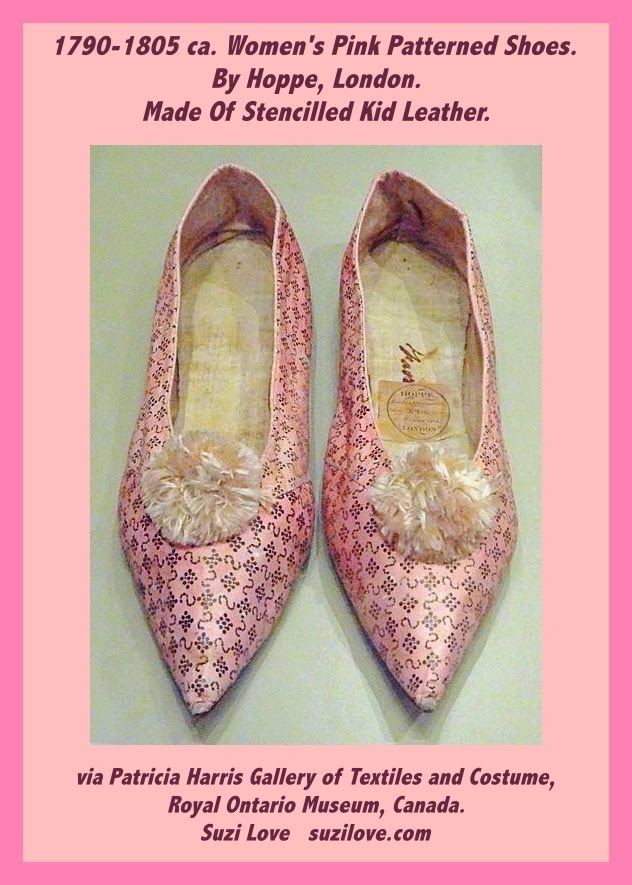
1790-1805 ca. Women’s pink patterned kid leather shoes as worn by Jane Austen and other ladies in her times. Made by Hoppe, London, of stencilled kid leather.
In Jane Austen’s years, fragile slippers were worn for balls and evening events but for walking sturdier shoes were needed, In the early 1800s, slippers were made of fabric such as satin or from leather, were flat or had a very small heel, slightly rounded toes and were laced up on the top. They were usually not made in right or left, but instead one shoe shape and in multiples so that when one slipper wore out, another was on hand to replace it.
1811 January Evening Dresses, English. Standing Figure: French frock with half train of black imperial gauze worn over a slip of white sarsnet or satin, ornamented with a Vandyke border of white velvet or thread lace. White velvet hat ornamented with two curled ostrich feathers, with a silver or beaded band. White kid gloves and shoes. Sitting Figure: Grecian robe of silver grey crape worn over a white satin under-dress, ornamented at the hem and each side with a light and tasteful border of black bugles. Stomacher edged with black beads, corresponding with those which finish the bosom and sleeves. Earrings, necklace, and bracelets of jet. Hair in waved curls on each side of the face, divided in front of the forehead with a full plait and barrel comb of jet. White satin slippers with black jet clasps or bugle rosettes. White kid gloves and a fan of silver-frosted crape. Back-ground figure: Dress of black Venetian velvet with short Circassian sleeve, gathered in a knot of white beads or pearl, bosom and stomacher to correspond, pearl necklace, ear-rings, and bracelets. Belt of white velvet with mother-of-pearl clasps. Convent veil of white cobweb net confined with a pearl crescent, à la Diana. Sandal slippers and gloves of white kid and fan of carved ivory. Fashion Plate via Rudolph Ackermann’s ‘The Repository’ of Arts.
Definition Evening Dress: Minute distinctions between ball, dinner, evening and opera gowns meant different quality of fabrics and designs. A Ball Gown differed from an evening dress as expensive silk fabrics were usually worn, light or heavy, decorated with lace, embroidery or beading, with low-cut bodice, short or no sleeves, and full skirts. In the early 1800s, white cotton dresses were considered suitable for many evening events, but not for balls. And definitely not for an evening event in a palace. White dresses with white embroidery for evening were considered fashionable and exclusive as only the wealthy could afford them.
1809 January Walking Dress, English. Polish bonnet, mantle of gold velvet with an invisible hood trimmed with ermine, antique collar fastened with a gold ornament in form of a shell. Morning dress, white muslin Brussels spot, with worked stomacher, trimmed down the front and at the bottom, worked along hanging sleeves, twisted and fastened at the wristband with small gold ornament to match mantle and cincture of the dress, gold sandals laced with brown cords and tassels and York tan gloves. Plate via Rudolph Ackermann’s ‘The Repository’ of Arts.
Fashion Women 1805-1809 History Notes Book 26 What did Jane Austen and friends wear? https://books2read.com/SuziLoveFashionWomen1805-1809
1809 Pink Evening Dress Of Levantine, French. V-neck bodice, decorated hem, long gloves and Toque hat with feathers, or aigrette. Fashion Plate via Journal des Dames et des Modes, or Costume Parisien.
Definition Fabric Levantine: Stout silk cloth in twill weave. First made in the Levant, a large area in the Eastern Mediterranean region of Western Asia.
Definition Aigret, aigrette, egret: Upright plume of feathers or jeweled ornament in shape of feathers worn on head or hats. 19th century favorite feathers osprey and heron.
Fashion Women 1805-1809 History Notes Book 26 What did Jane Austen and friends wear? https://books2read.com/SuziLoveFashionWomen1805-1809
1805-1810 ca. Dress With Train as worn in the time of Jane Austen, or the early 1800s. Ivory silk, plain weave with multicolored silk embroidery in padded satin, buttonhole, and whipped running stitches and French knots running down the dress in stripes, and around the sleeves, square neckline, and train. Philamuseum.org
What did Jane Austen and friends wear? This book looks at early 1800s fashions, which were elegant and pretty with high waists and fabrics that were almost transparent. These Empire style gowns, named after Napoleon’s first Empress, became popular throughout Europe, and were then copied around the world. Colorful outwear was added to make an ensemble more attractive and warmer.
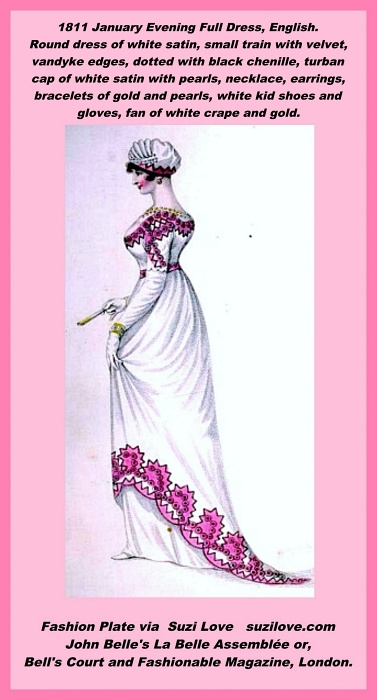
1811 January Evening Full Dress, English. Round dress of white satin, small train with pink velvet, vandyke edges, dotted with black chenille, turban cap of white satin with pearls, necklace, earrings, bracelets of gold and pearls, white kid shoes and gloves, fan of white crape and gold. Fashion Plate via John Belle’s La Belle Assemblée or, Bell’s Court and Fashionable Magazine, London.
Definition Van Dyke Points: V-shaped lace and trims named after a 17th Century Flemish painter, Sir Anthony Van Dyck, known for painting V-shaped lace collars and scalloped edges on sitters.
Definition Velvet or Velour: Silk with short, dense and smooth pile produced by pile warp raised in loops above ground weave through introduction of rods during the weaving.
1811 January Evening Full Dress, English. Round dress of white satin, small train with pink velvet, vandyke edges27_D2D_FashWomen1810-1814
1810 Three Piece Gentleman’s Purple Court Suit, French. Worn by a rich and fashionable gentleman after Napoleon Bonaparte revived court traditions when he crowned himself Emperor of France in 1804. Gentlemen were expected to wear extravagant court dress, but the working class despised these luxurious fashions and royal overspending. Wastage of France’s money spurred French peasants to rise up in revolt and create the French Revolution. via Metropolitan Museum, N.Y.C., U.S.A.metmuseum.org
1810 Front Of Three Piece Court Suit, French. 1810 Back Of Gentleman’s Court Suit, French. 1810 Front and Back Of Gentleman’s Court Suit, French. 1810 Fabric Of Gentleman’s Court Suit, French. 1810 Gentleman’s Court Suit, French. 1810 Black and White View Of Gentleman’s Court Suit, French. https://books2read.com/SuziLoveFashionMen1800-1819
1806 ca. Typical Silk and Straw Bonnet, French. Definition Bonnet: Soft form of hat with little brim at back and usually tied under the chin with ribbons. via Metropolitan Museum, N.Y.C., U.S.A. metmuseum.org
Hats were an essential item during the Regency Era for women, men and children. Nobody left their home without one, no matter what their social class. Jane Austen and her friends would have worn gorgeous bonnets or hats, tied under the chin like this.
Fashion Women 1805-1809 History Notes Book 26
What did Jane Austen and friends wear? This book looks at early 1800s fashions, which were elegant and pretty with high waists and fabrics that were almost transparent. These Empire style gowns, named after Napoleon’s first Empress, became popular throughout Europe, and were then copied around the world. Colorful outwear was added to make an ensemble more attractive and warmer.
https://books2read.com/SuziLoveFashionWomen1805-1809
An overview of women’s fashions in the first twenty years of the 19th century. What was fashionable for women in Jane Austen’s times, or the early 1800s. Wars were being fought around the globe so women’s fashion adopted a military look in support of soldiers. In Britain, the Prince Regent ruled instead of his father, King George III, so fashions, like the lifestyle, became more extravagant and accessories went from pretty to opulent. This set includes books 12, 25, 26, 27 and 28.
What was fashionable for women in Jane Austen’s times, or 1800s, or Regency Era. High-waisted dresses were extravagantly accessorized and hats, shoes, parasols and bags were added. Set includes History Notes Books 12, 25, 26, 27 and 28.
Fashion Women 1800-1819 Box Set History Notes Book 24 An overview of the first twenty years of the 19th century. These books look at what was fashionable for women in Jane Austen’s times, or the early 1800s. Wars were being fought around the globe so women’s fashion adopted a military look in support of soldiers. In Britain, the Prince Regent ruled instead of his father, King George III, so fashions, like the lifestyle, became more extravagant and accessories went from pretty to opulent. This set includes books 12, 25, 26, 27 and 28. https://books2read.com/SuziLoveFashionWomenBoxSet