1810 ca. Muslin, or Cotton, Bodiced Petticoat With Sleeves, British.The sort of petticoat Jane Austen wore beneath her dresses, for both modesty and warmth. via Killerton House. National Trust, U.K. nationaltrustcollections.org.uk
In Jane Austen’s years of the early nineteenth century, women often wore light-weight dresses under which was worn a range of underclothing to stop gowns appearing transparent and sticking to a lady’s body. To preserve modesty, underclothing included a chemise next to the skin, then a corset, and then petticoats to give shape to a dress and to keep it away from her body.
1804-1815 ca. Wedding Dress. Silk dress with square bodice and very small bodice, short puffed sleeves, beautiful train decorated in gold. via Palais Galliera, or Musée de la Mode de la Ville de Paris. City of Paris Fashion Museum, formerly Musée Galliera. https://books2read.com/SuziLoveFashionWomen1805-1809
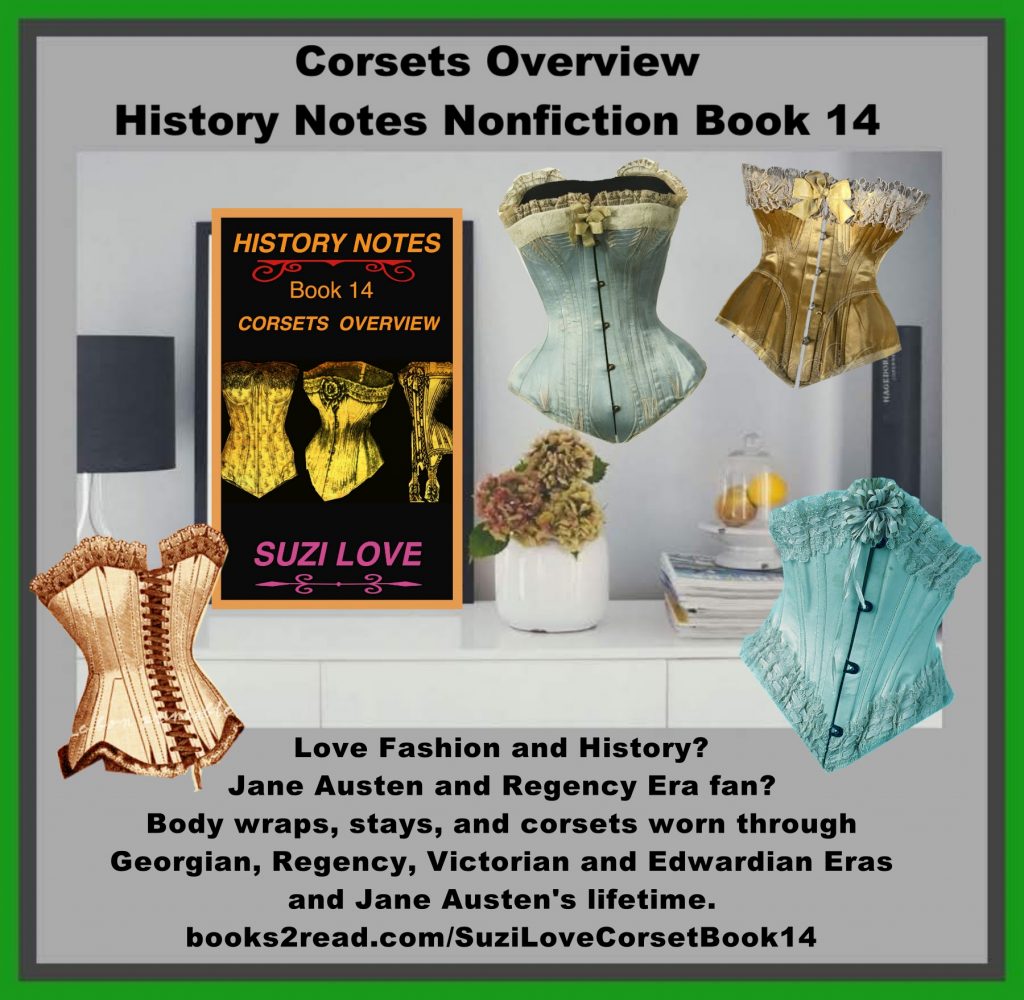
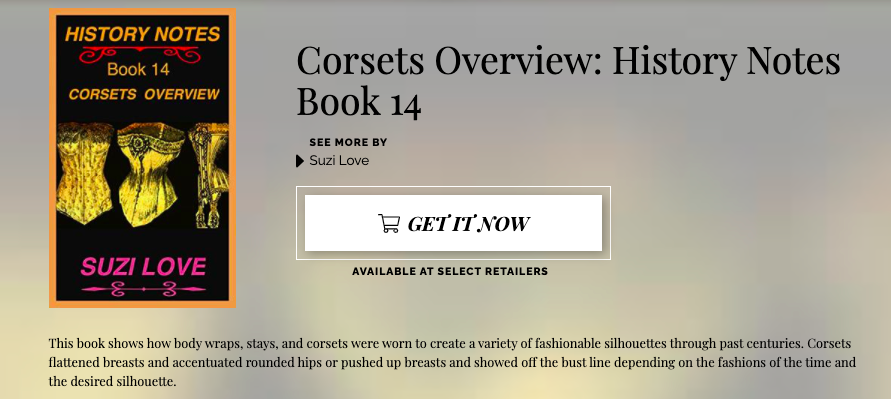
This book shows how body wraps, stays, and corsets were worn to create a variety of fashionable silhouettes through past centuries. Corsets flattened breasts and accentuated rounded hips or pushed up breasts and showed off the bust line depending on the fashions of the time and the desired silhouette. Overview of corsets through history, including the Georgian, Regency, Victorian and Edwardian Eras, and the Bridgerton and Jane Austen’ years. History Notes Book 14.
The name stays probably comes from the French estayer meaning to support. The word corset, which comes from the French word corps for body, had been in use centuries earlier, though often with not quite the same meaning. By the beginning of the 19th century when these undergarments took on more shape and form, the word corset was generally used instead of stays.
During the 1820s, fashions changed from the loose and flowing Regency Era or Empire style gowns and the waistline lowered back to almost the natural position. Towards the mid 1800s, breast cups were added to corsets to give more support and breast comfort. Corsets were lengthened to the hip and gussets added in both the bust area and over the hips. Therefore corsets had more shaping but with less boning.
From the 1820s onwards, menbegan to wear corsets and this continued through the Romantic Era, though the men who wore corsets usually claimed they needed them for back pain.
Queen Victoria ruled England from 1837 to 1901 and at the beginning of her reign, dress waists were around their natural line. But as the years of her reign progressed, fashionable waists became thinner and corsets were redesigned to give more of an hourglass figure.
Early Victorian Era corsets were cotton, boned with mainly whale bone, laced at the back and with tiny hooks and eyes up the front for front fastening. By the middle of the century, corsets were beginning to be more decorative with embroidery and ribbons and then later made of colorful silks and satins.
1801 Young Man’s Daily Outfit, French. Blue cutaway coat with extra high collar, brown knee breeches, chin high white cravat, an all-over curly hairstyle and a round-hat with a wide brim and a low crown which is flat on the top. The hats only decoration is a narrow ribbon and buckle. Fashion Plate via Journal des Dames et des Modes, or Costume Parisien. https://books2read.com/SuziLoveFashionMen1800-1819
1816 July Opera Dress, English. Dress of white lace worn over a rich soft white satin slip. Skirt trimmed in a style of peculiar elegance, with lace festooned at regular distances, festoons edged by plain band of byas satin and finished by pearl ornaments of a very novel and pretty shape. Lace body is cut byas and richly ornamented round the bosom with pointed lace. Plain long sleeve, very full, except towards the wrist, which is nearly tight to the arm, and elegantly finished with lace. Hair ornamented with a wreath of French roses, parted in front, and simply dressed in loose curls, which fall very low on each side. Hind hair forms a tuft at the back of the head. Necklace, ear-rings, and bracelets of pearl. White satin slippers, and white kid gloves and a blush colored French silk scarf. Fashion Plate via Rudolph Ackermann’s ‘The Repository of Arts’. https://books2read.com/SuziLoveFashionWomen1815-1819
Gorgeous Regency Era clothing came in a wide range of styles to suit every season and occasion. Ladies in the Bridgerton series and in Jane Austen’s times wore Empire style dresses which were usually made of light fabric and floaty in style. By the later 1810s, stripes were very popular and lace and frills were added to make the dress more individual.
Fashion Women 1815-1819 History Notes Book 28 What did Jane Austen wear? https://books2read.com/SuziLoveFashionWomen1815-1819
Reader or writer of the Regency Era? Love Jane Austen and Bridgerton fashions? This book covers corsets from late 1700s to early 1800s. #JaneAusten #Georgian #Regency #Corsets Corsets 1790-1810 History Notes Book 16
Corsets or stays transitioning from 1700s into 1800s and worn during Jane Austen’s lifetime. This book shows how supporting underclothing moved away from stomachers and tightly laced stays worn during the 1700s and transitioned into corsets that were less formed and far more comfortable. Wearing the correct underclothing was essential for keeping garments in place and giving the best fashion display. Corsets worn during Jane Austen’s lifetime.
In Jane Austen’s times craftsmen created boxes and containers of precious metals, leather, silks, and decorated them with jewels. Boxes, Cases, Etui, Necessaire and everything else that was used to carry essential items for travel, sewing, medicine, writing, and toiletries. Containers were engraved to make exquisite and expensive items as well as practical carrying cases. books2read.com/suziloveBoxesCases
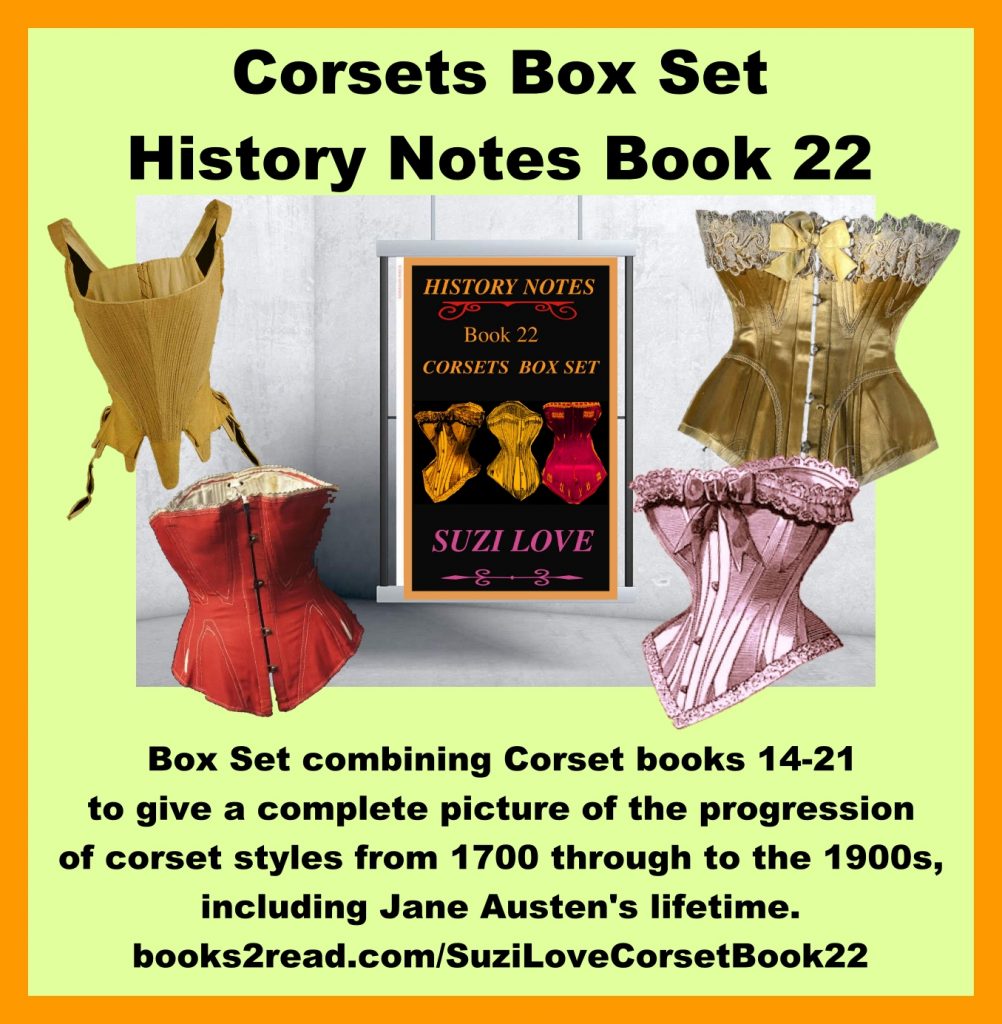
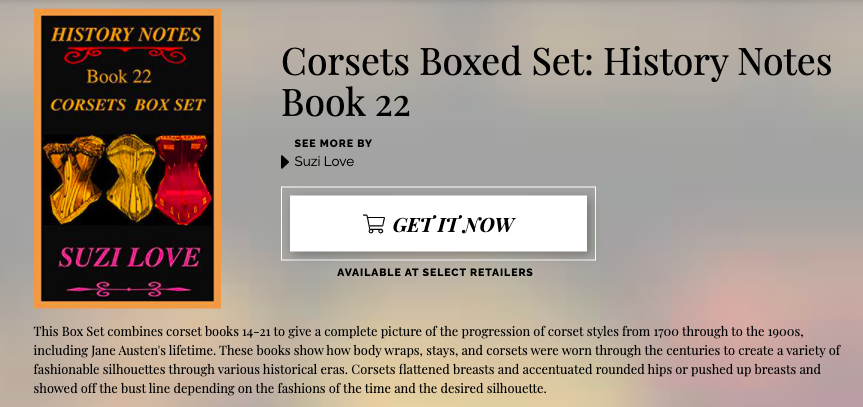
Fascinated with historical fashion? Treat yourself to a nonfiction Box Set on corsets, including Bridgerton and Jane Austen years. Corsets Box Set History Notes Book 22. This Box Set combines corset books 14-21 to give a complete picture of the progression of corset styles from 1700 through to the 1900s, including Jane Austen’s lifetime. These books show how body wraps, stays, and corsets were worn through the centuries to create a variety of fashionable silhouettes through various historical eras. Corsets flattened breasts and accentuated rounded hips or pushed up breasts and showed off the bust line depending on the fashions of the time and the desired silhouette. https://books2read.com/SuziLoveCorsetBook22
1800 White Muslin Dress, European. Empire style, high-waisted dress of light weight cotton, with softly falling gathered long skirt and with a train. via Los Angeles County Museum of Art, California, USA. collections.lacma.org books2read.com/SuziLoveFashionWomen1800
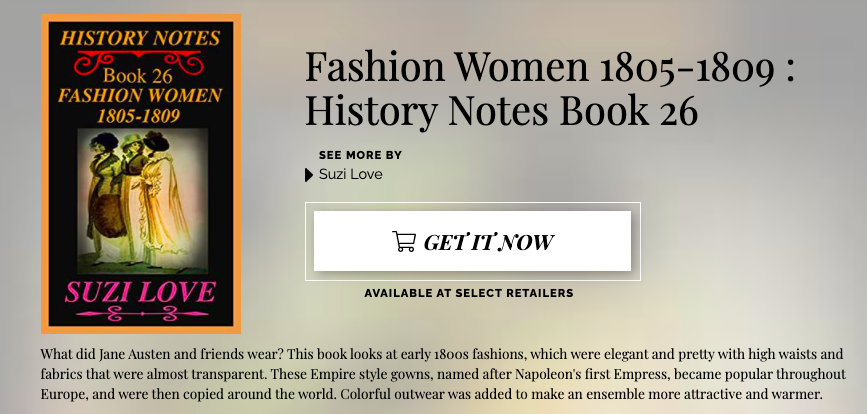
The type of dress worn across Europe in the early 1800s. This sort of high-waisted dress would have been worn by Jane Austen and her contemporaries in England. The Empire waist gown defined women’s fashion during the Regency Era. ‘Empire’ is the name given in France to the period when Napoleon built his French Empire. High-waisted, loose gowns were adopted by the aristocracy as a symbol of turning away from the fussy, elaborate and expensive clothing worn in the 1700s.
1800 White Muslin Dress, European. Empire style, high-waisted dress of light weight cotton, with softly falling gathered long skirt and with a train. via Suzi Love suzilove.com
& Los Angeles County Museum of Art, California, USA.
collections.lacma.org1800 White Muslin Dress, European. Empire style, high-waisted dress of light weight cotton, with softly falling gathered long skirt and with a train. via Suzi Love suzilove.com
& Los Angeles County Museum of Art, California, USA.
collections.lacma.org1800 White Muslin Dress, European. Empire style, high-waisted dress of light weight cotton, with softly falling gathered long skirt and with a train. via Suzi Love suzilove.com
& Los Angeles County Museum of Art, California, USA.
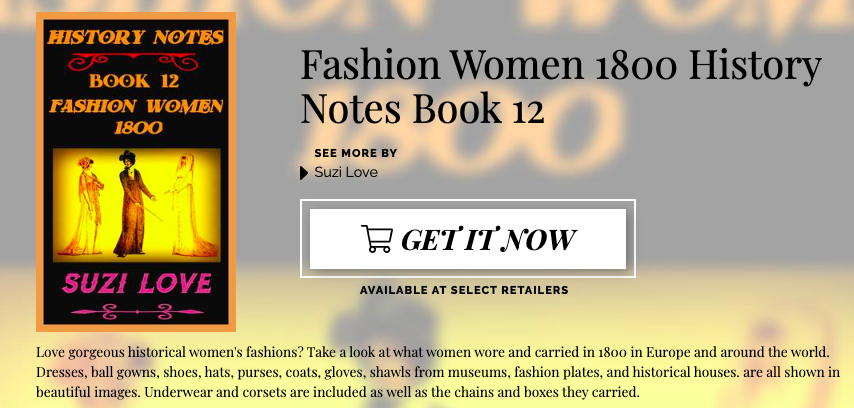
collections.lacma.orgHN_12 D2D_RetailerBuyLink_HN_12 books2read.com/SuziLoveFashionWomen1800