“Be warned, my lord,” the woman said. “I shall return. Tomorrow. Early. Very early. And if you refuse to speak with me, I’ll haunt your house until you are prepared to listen to me.”
Justin Tremayne, Viscount Hawkesbury, felt the air suck out of the room. Movements ceased, breaths held, no one spoke. Every person in the room, including the courtesans, was aware of the reason he’d spent four years debasing himself before the wealthiest members of the ton.
The reason he forced himself to get out of bed each day, to place one foot in front of the other and go through the rituals, the pretense of living a normal life. Why he arranged wild bedroom antics for women and men that he barely knew and certainly didn’t like or respect. His guilt festered like an open wound and the pain never lessened. His obsession was to locate his mother and two sisters, to bring them home, and try to make amends for his absence at the time his deranged father had evicted them.
Unable to reply, he shook his head, robbed of coherent thought, unable to believe her declaration. Unable to convince himself it wasn’t another misery-causing lie. Unable to gather the energy to conclude his night’s business. Nothing mattered above the bait she dangled before his nose, the thing he yearned for more than any other—to bring his family back to him. This tiny despot had forced him into negotiating with her.
“Bart, Thomas. I ask you to leave me to my visitor. Then I’m off to find my bed.”
1810 January 1st. West India Docks, London. By Thomas Rowlandson and Augustus Charles Pugin. Printed in 1810 By Rudolph Ackermann in Microcosm Of London, or London In Miniature. Volume 1. Aquatint showing warehouses at quayside and several West Indiamen moored alongside. Warehouses held thousands of tons of cargo, including sugar, rum, molasses, coffee, spices and hardwood. Docks were constructed by powerful group of businessmen led by Robert Milligan, wealthy merchant and ship-owner outraged at losses suffered due to theft and delay at riverside wharves. via National Maritime Museum, Greenwich, London, U.K. ~ collections.rmg.co.uk
East and West India Docks London’s Historic Places
The East India Docks was a group of docks in Blackwall, east London, north-east of the Isle of Dogs. In 1607, the East India Company decided to build its own ships and leased a yard in Deptford. In 1614 the East India Company ordered William Burrell to begin work on a bigger yard for repair, construction and loading of out-going ships. The site selected was at Blackwall, which was further down river and had deeper water, allowing laden ships to moor closer to the dock. During the early 17th century, the site was enlarged repeatedly. Later in the 17th century, the East India Company reverted to its practice of hiring vessels, although many owners who chartered their vessel to the East India Company had them built at Deptford and Blackwall.
Before 1800, the Thames river was overcrowded with ships. They carried cargoes of tea, china and cloth in their lower parts along with casks of water, salted meat, beer, wine and rum for their crews. Brandy, wine, and tobacco were also shipped and stored in the warehouses. In 1800, the London Dock Company was formed and the planned docks in Wapping went ahead in 1801. The first was the West India Dock. In 1806, the East India Company opened their own docks to the north-east of the West India Docks after deciding that the Brunswick Dock at Blackwall, where ships were fitted out, was unsuitable for storing cargo.
The Brunswick Dock, which had originally been connected directly to the Thames to the south, became the Export Dock. To the north the company built a larger 18-acre (7.3 ha) Import Dock. Both were connected to the Thames via an eastern entrance basin. The number of ships discharged in the docks rose from 354 in 1804, to 598 in 1808, and to 641 in 1810. In 1808, the warehouses were full, as blockades prevented the re-export of goods. The dock company calculated that the almost total prevention of theft made possible by the building of the docks was saving West India merchants almost £400,000, and the Exchequer about £150,000 each year. During the 1840s and early 1850s, shipping and tonnage handled at the East and West India docks increased so much that dividends of 5 and 6 per cent were paid.
The East India Docks didn’t have many warehouses because cargoes were taken straight to their warehouses in the City. So instead of building warehouses, the company built private toll roads like Commercial Road and East India Dock Road to carry traffic to and from the docks.
The company made large profits on tea, spices, indigo, silk and Persian carpets. The tea trade alone was worth £30m a year. Spice merchants and pepper grinders set up around the dock to process goods. Although the East India docks were smaller than the West India Docks, they handled up to 250 ships at one time and East Indiamen of 1000 tons but larger ships and steam power reduced the importance of the dock.
The West India Docks were a series of three docks, quaysides, and warehouses built to import goods from, and export goods and occasionally passengers to the British West Indies. In 1802, the first dock opened on the Isle Of Dogs. When they closed for commerce in 1980, the Canary Wharf development was built around the wet docks by narrowing some of their broadest tracts.
The docks were constructed in two phases. The two northern docks were constructed between 1800 and 1802 for the West India Dock Company and were the first commercial wet docks in London. For 21 years, all vessels in the West India trade using the Port Of London had to use the West India docks by a clause in the act of Parliament that had enabled their construction.
In 1838 the East and West India companies merged. The southern dock, the South West India Dock, later known as South Dock, was constructed in the 1860s and in 1909 the Port Of London Authority took over the West India Docks,
The docks played a key role in the Second World War as a location for constructing the floating Mulberry harbours used by the Allies to support the D-Day landings in France. Following the Second World War, in which all the docks were badly damaged, the East India Docks were confined to occasional Channel Islands traffic and to the maintenance of dredger equipment.
The docks were the first London docks to close, in 1967. Today the docks have been mostly filled in. Only the entrance basin remains, as a wildlife refuge and an attractive local amenity. The area is predominantly residential with several major developments around it.
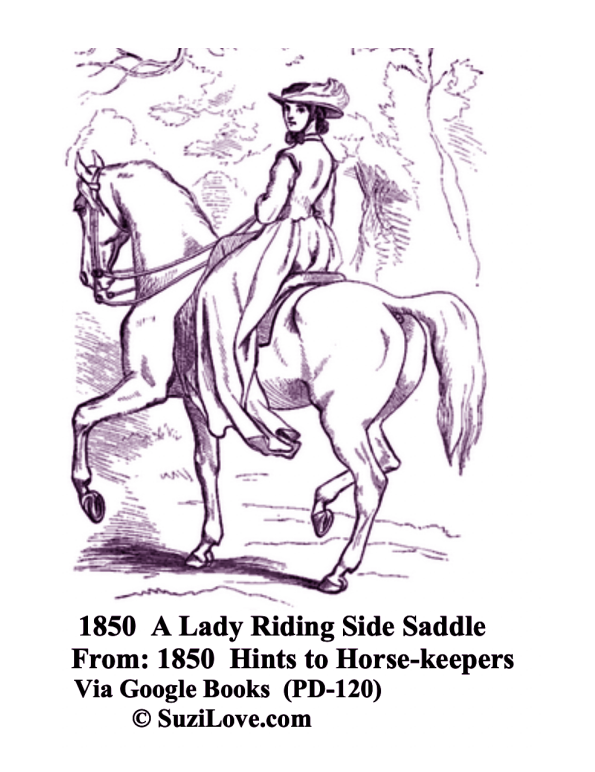
Riding For Ladies During the Regency and Early Victorian years. How did they ride sidesaddle? What did their saddles look like? What did they wear?
From 1850 Hints To Horsekeepers By Henry William Herbert via Google Books (PD150)
Why Every Lady should learn to ride: EVERY lady should learn to ride; not at a mature age, when her frame has become exhausted by a sedentary life and consequent ill health; nor even when, her school-days being over, she is thought to have leisure for wholesome exercise; but in childhood, when her will is strong and her body obedient to it. Particularly in our large cities, too little care is given to the physical culture of young girls. Their minds are engaged, not often with energetic mental work, but with idle thought for dress and show, while no other exercise is taken than a measured daily walk, and occasional dancing and waltzing.
‘Where household labor is disdained, and no opportunity can be afforded for floriculture or any other agreeable out-door occupation, there is no substitute so good as horseback riding. But for the country girl it becomes indispensable. Not her health, perhaps, but her happiness demands it. No woman ever rides so well as one who from childhood has loved her pet colt. She has chased him, perhaps, for hours around a ‘ten-acre lot:’ and when, his frisky mood over, she has been able to take him coaxingly by the inane and lead him to a mounting place, great was the triumph of her wild ride. And no training or care can give the freedom and skill of this youthful practise.
RIDING CLOTHING
Few ladies know how to dress for horse exercise. A head dress should shade form the sun but fit well enough that it needs no adjustment, as the hands are needed for the reins. The Whip, an essential element of the lady’s riding outfit, should be stiff and substantial, without being heavy.
The hair should be arranged in the firmest manner possible. If suited to the style of the lady, it may be plaited at the back and looped across, in a manner which will support the hat and present a very comely appearance. Or it may be found pleasanter to turn all of the back hair to the top of the head, where a high hat is used. All loose arrangements of the hair, except short curb, when they are natural, should be avoided. But few hair-pins should be used, and those long and firmly woven into the hair. The recent fashions of wearing the plumes or feathers of the ostrich, the cock, the pheasant, the peacock, and the kingfisher, in the riding hats of young ladies, are highly to be commended.
Ladies habits are usually made too long and become cumbersome. A foot longer than an ordinary skirt will be sufficient if the material is suitable. Light Cloth will be found the most appropriate for the skirt, if the color be becoming and sufficiently dark. The fashion of a waistcoat of light material for summer, revived from the fashion of the last century, is a decided improvement, and so is the over-jacket, of cloth or seal-skin, for rough weather. It is the duty of every woman to dress in as becoming and attractive a manner as possible; there is no reason why pretty young girls should not indulge in picturesque riding costume so long as it is appropriate.
Many ladies entirely spoil the set of the skirts by retaining the usual impedimenta of petticoats. The best dressed horsewomen wear nothing more than a flannel chemise with long, colored sleeves, under their trousers. If ladies prefer, a quilted skirt, not too full, may be worn. It should be lined with silk or glazed muslin, and will be found no impediment. Long boots are a great comfort and protection in riding long distances.
All ladies who desire that riding should be to them a healthful exercise, must take great care that their dress be perfectly easy in every part, particularly over the chest and around the ribs. Let the boots be easy, and their gloves, which should be leather gauntlets, large and soft, and all elastic bands very loose.
Ladies’ trousers should be of the same material and color as the habit, and if full, flowing like a Turk’s and fastened with an elastic band round the ankle, they will not be distinguished from the skirt. In this costume, which may be made amply warm by the folds of the trousers, plaited like a highlander’s kilt, fastened with an elastic band at the waist, a lady can sit down in a manner impossible for one encumbered by two or three short petticoats. It is the chest and back which require double folds of protection during, and after, strong exercise.
LADY MOUNTING A HORSE
The lady in mounting should be assisted by two persons, one to hold the horse, standing directly in front of him, and holding by the check pieces of the bridle, above the bit, and the other to assist her to her seat.
Having taken the reins and whip in the right hand, she will stand with her face towards the horse’s head, and with her right hand on the left pommel or the saddle. In the left hand she will hold her skirt, in such a manner as to enable her to raise it clear of the ground. The gentleman will stand, facing her, and opposite to the horse’s shoulder, with his left hand holding by his mane, this steadies the horse when the lady springs. The gentleman will now stoop and take the lady’s left foot, which has been raised fifteen inches from the ground, in his right hand, clasping it firmly under the instep. The skirt having been raised to clear the foot, is now dropped, and the lady places her left hand on the gentleman’s right shoulder, giving a spring to straighten the left knee.
During this spring the gentleman will simply keep his hand still, supporting the lady’s weight, but not raising her until the knee is fairly straightened, when he may lift her to the required height, but without trying to push her over on to the saddle. She will find her seat more easily without such assistance, which would often tend to throw her over the horse, rather than on his back. Being seated with her right hand still on the pommel, the lady will, with her left hand, adjust the folds of her skirt. She will then remove her hand from the pommel, and place her right knee over it; when the gentleman will place her foot in the stirrup, and then aid her in taking proper hold of the reins and whip. When this is accomplished, the attendant at the horse’s head steps out of the way, and the lady assumes the control. Fortunately, the operation is less tedious than its description.
LADY DISMOUNTING A HORSE
A lady dismounts with perfect ease. After the groom has taken his place in front of the horse and secured him, by releasing her hold upon the bridle and stirrup and lifting her right leg over the pommel, which she now holds with the right hand, while the left, on the shoulder, or in the hand of her gallant, affords her sufficient support in slipping to the ground.
THE SEAT IN THE SIDESADDLE.
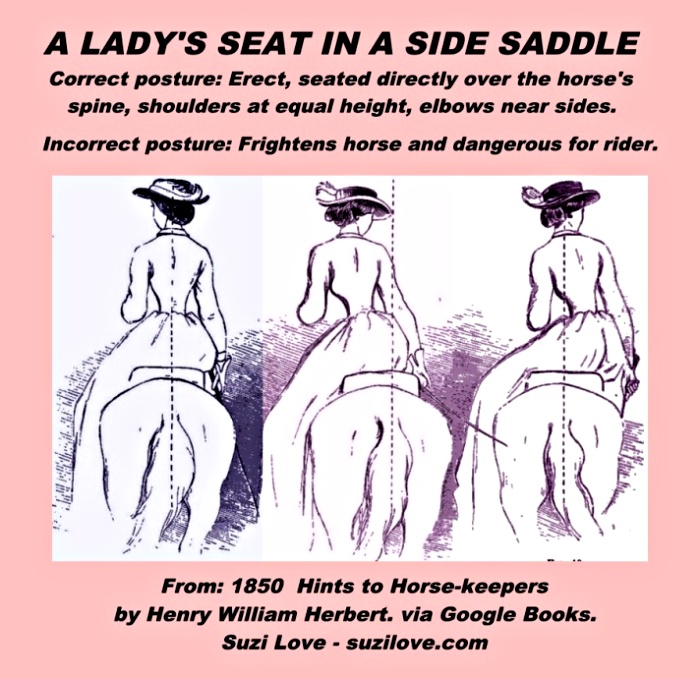
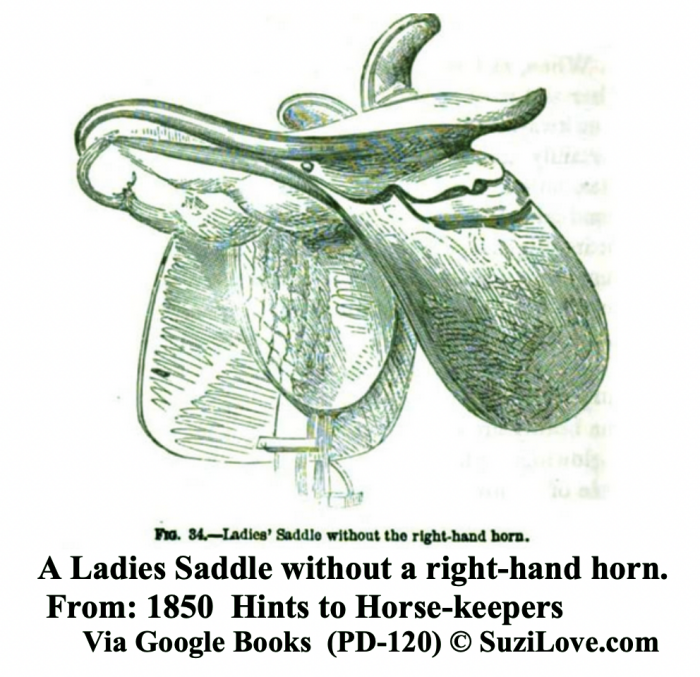
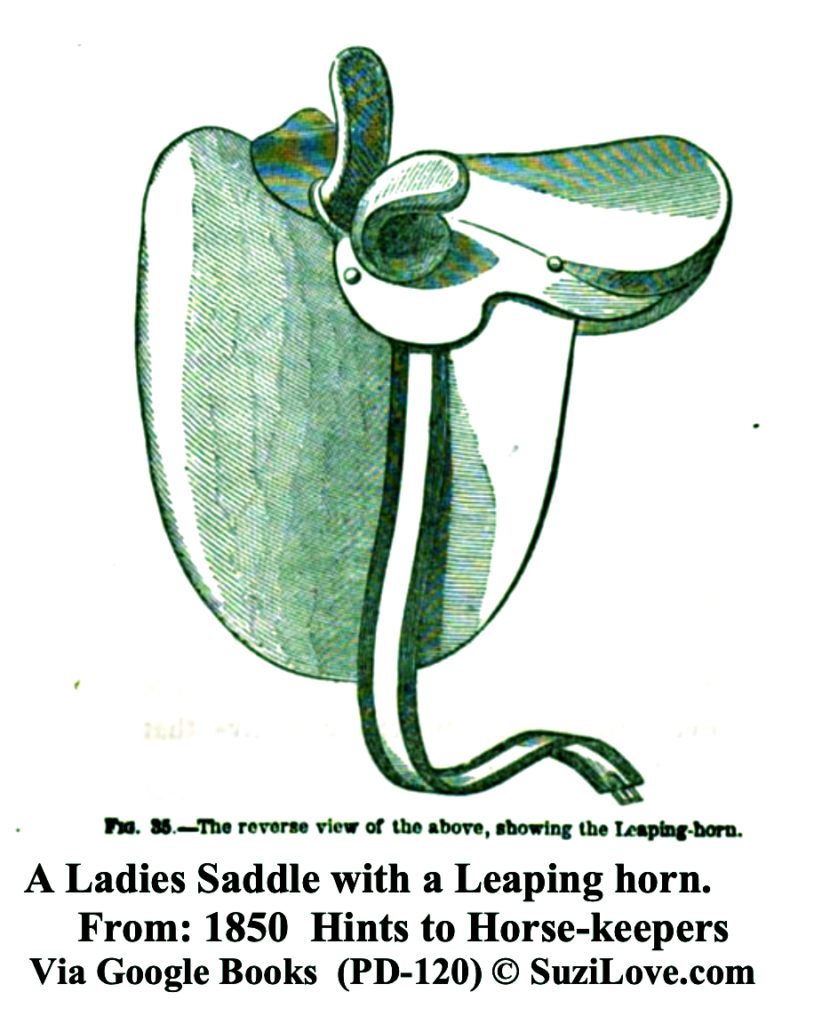
The lady should, by exercises similar to those recommended for gentlemen, endeavor to acquire a perfect independence of the rein-hold in the security of her seat She should be able to lean far to the right or to the left, or lie back on the horse’s haunches, or forward on his neck, and to regain her position without disturbing her seat in the saddle, and without holding by the reins. With the use of the leaping-horn it will be more easy for her to attain perfection, in this respect, than it will be for the man, who must depend in a great measure on the clip of his legs. The rider should be erect, directly over the horse’s spine, the shoulders at an equal height. and the elbows near the sides.
Ladies, particularly those with very small hands, will often find it burdensome to hold their reins both in one hand, as is universally taught in our riding-schools. The best way for a lady is, if her hand be light, to knot up the snaffle and let it rest within her reach, in case of accident to the other rein. Or, if her touch be not delicate enough for the curb, let her hold it lightly and depend on the snaffle. The Whip and the Left Heel are valuable aids to a lady in the saddle. By a proper use of them she is enabled to retain a much freer hold upon her reins. Particularly in stopping and turning they are invaluable. Also, in starting.
ACCIDENTS.
Ladies, of course, should never ride horses which are in any manner vicious. But the best animals are not faultless, nor the most sure-footed always reliable. The lady should therefore be prepared for critical situations. Remember that with a long skirt about her feet, and with little experience in such exercise, it is always unsafe for lady to leap from her saddle. She may disengage herself quickly, but carefully. In a runaway, her place is close down in the saddle, holding the four reins low on either side, and giving an alternate tension to the curb and snaffle, steadying her horse in the road and saving her strength to force him to run long after he would gladly stop.
1815 Arundel Fete Dress and Baronial Helmet, English. White dress with purple bodice and hem with matching shawl and plumed headdress. Skirt of white crape over white satin, a double row of novel and elegant trimmings on the bottom, two falls of the crape, set on full, are edged with silk. Body comes high on each side of the bosom and is shaped so as to display the neck and shoulders, and both body and sleeves are formed and trimmed in the most exquisitely tasteful manner. A superb cord and tassels confines the waist and ties in front. The Baronial Helmet is striking and made of white sarsnet or satin and white lace and superbly ornamented with feathers. Jewelry set, or Grand Parure, of necklace, bracelets. ear-rings, and small French locket of pearl. White kid slippers and gloves. Full Dress for evening would most likely be a dress of silk or satin, perhaps with a transparent overlay of netting, tulle etc., embellished with taffeta, ruffles and ribbons, and with a full range of accessories including a Grand Parure of tiara and other matching jewelry. https://books2read.com/SuziLoveFashionWomen1815-1819
La Belle Assemblee: Fashion Plate via John Belle’s La Belle Assemblée or, Bell’s Court and Fashionable Magazine, London. Many of the fashion plates seen in La Belle Assemblée and The Repository of Arts were designed by Mrs. Bell who had her dressmaking showroom in Bedford Square, London, and was related to John Bell who published La Belle Assemblée. It seems that she designed for at least two fashion magazines and so there is a cross-over of designs in different magazines.
Grand Parure: A Parure is a matched set of jewelry, including a necklace, bracelet, earrings, pin etc. and a Grand Parure often includes a tiara or other headdress.
Weird Historical Pants for Men. No wonder men needed valets! It wasn’t just women struggling into tight fitting clothing!
And no wonder it took both sexes so long to dress every day, often changing clothes four or five times a day!
Early on were Breeches – Short, close-fitting trousers that fastened just below the knees or above the ankles, with a horizontal front flap called the ‘fall’ and were worn with stockings. Boys of 3 – 6 years stopped wearing loose dress-type children’s garments and went into short pants instead, and were considered ‘breeched. In Regency times, breeches were worn tighter to show off a manly physique.
Then of course we had Pantaloons
By the late 1810s and beyond, these became popular and eventually they evolved into full length trousers. Originally pantaloons were made to suit shorter Hessian boots that fell below the typical knee-breech level and they were worn very form-fitting.
Buckskins – Fashionable trousers made from deer skin also showed off every curve of the man’s figure. How could ladies not want to peek? Oooh, what a display of fine, manly figure!! Swoon!
And so to more modern Trousers – The word Trouser came into usage in the late 1600?s, so we’ve had trousers around for a long time. But at first, they were mostly for lower classes. Revolutionary France started a trend for sans-culottes, which meant trousers or pantaloons instead of culottes, or knee breeches, which were associated with the aristocracy.
The styles of the revolution moved across to England and were taken up by those who either sided with revolutionary ideals or who took them up as part of a protest against the establishment set.
Early trousers looked strange because they were generally a bit looser than pantaloons or breeches, and ended at the ankles with slits on the side for foot access. They often needed under-the-foot straps to fix them in place.
Now here’s a couple of insider tips from a gentleman’s valet for you to remember –
– False calves can be created by padding so that a master’s calves fill out his stockings and make him look more muscular, especially when he is wearing knee-breeches. Every woman’s dream!
– For rotund gentlemen, tightly pulled corsets help keep the paunch to a minimum and enhance his figure.
– To keep trousers in place and prevent disgrace, braces( suspenders) can be worn under vests.
Even in cases of his master’s over-imbibing, or just plain clumsiness, a valet can ensure his lordship remains correctly clothes at all times when representing the household in public by taking a few early precautions.
Imagine the poor valet’s work if – a gentleman rode before breakfast – changed to join the family– spent the morning boxing with friends in looser attire – changed for lunch at his club with peers – changed for afternoon calls or a drive in the park with the women- changed for dinner with friends – changed into evening dress for a formal ball- arrived home just before daylight to change into his banyan( robe) to smoke his cheroot before bed – then rose 3 hours later expecting his clothes laid out so he could do it all over again.!!
No, I seriously do not want to go back in time and become either a lady’s maid or a gentleman’s valet
– although, if I had the choice…
Hmmmm….being in a gentleman’s bedroom…. does hold a certain appeal.
Suzi Love
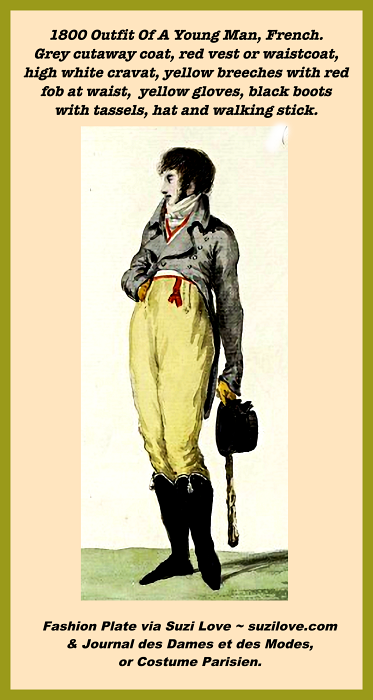
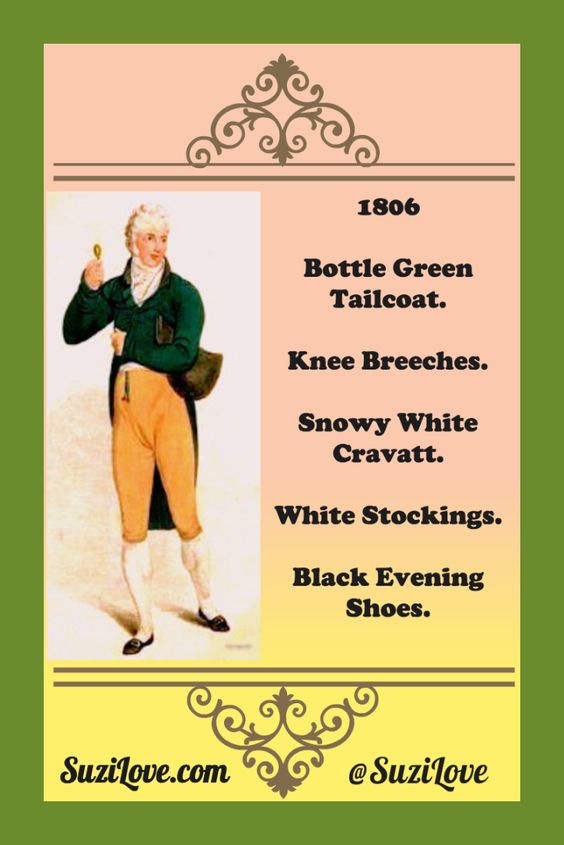
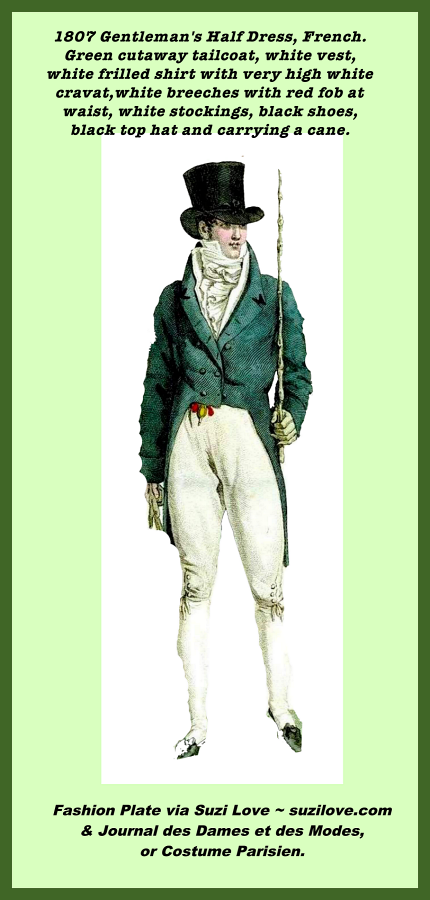
1775-1825 ca. Black Silk Breeches, American or European. via Metropolitan Museum, N.Y.C., U.S.A. metmuseum.org1806 Young French Gentleman. Short Brown Castorine Coat Over Blue Tailcoat, White Cashmere breeches, yellow gloves, black top Hat. Fashion Plate via Journal des Dames et des Modes, or Costume Parisien.1804-1814 ca. Collage View. Breeches, French. Cream silk and linen. Buttoned waist, drop down front flap, or fall, extra fullness in the back for ease of movement, ties at the knees to keep in place. via Suzi Love ~ suzilove.com & Metropolitan Museum, N.Y.C., U.S.A. metmuseum.org1812-1813 ca. A man with a hat shaped as a balloon, green coat, white breeches, colored cravat. Hand-colored etching. 1812-1813 Le Chapeau en Ballon Series: Le Bon Genre Plate 51. Via British Museum, London, UK. 1807-1817 ca. Man’s Leather Breeches, American. Drop front buttoned flap at the waist, a drawstring at the back waist to adjust waist size, and drawstrings and buttons at the calves to keep the breeches secure when worn with high boots. via Metropolitan Museum New York City, U.S.A. metmuseum.org 1807 Pale Blue Tailcoat, French. White frilled shirt with extra high collar and cravat, vest, white knee breeches, white stockings, black shoes, gloves, bicorn hat and a curly hairstyle. Fashion Plate via Journal des Dames et des Modes, or Costume Parisien. 1800 Outfit Of A Young Man, French. Grey cutaway coat, red vest or waistcoat, high white cravat, yellow breeches with red fob at waist, yellow gloves, black boots with tassels, hat and walking stick. Fashion Plate via Journal des Dames et des Modes, or Costume Parisien.1805 ca. Collage Leather Breeches, French. Buttoned and adjustable waist, back waist gusset for ease of movement, front fall flap, two tone fitted cuffs on legs with many buttons to fasten and hold in place on the legs. via Metropolitan Museum New York City, U.S.A. metmuseum.org 1790 British Consul’s Tan Leather Pants, Boston. Tan buckskin, fall front, brass and self covered buttons, breeches have leather ties at waist and at leg hems. via Augusta Auction 1806 Gentleman’s Daily Outfit, French. Bottle green tailcoat, knee breeches, snowy white cravat, white stockings, flat black shoes. Fashion Plate via Journal des Dames et des Modes, or Costume Parisien.1807 Gentleman’s Half Dress, French. Green cutaway tailcoat, white vest, white frilled shirt with very high white cravat, white breeches with red fob at waist, white stockings, black shoes, black top hat and carrying a cane. Fashion Plate via Journal des Dames et des Modes, or Costume Parisien. Weird Historical Pants for Men. #regencyera ##regencyfashion #breeches https://books2read.com/SuziLoveFashionMen1800-1819 Share on X https://books2read.com/SuziLoveFashionMen1800-1819
How many dukes were there in England in 1804? The number varied from year to year, depending on which titles became extinct etc. From: 1804 Kearsley’s Complete Peerage via Google Books (PD-200)
1804 Nine Princes of the Royal Blood, some of whom are Dukes.
Prince of Wales, Duke of York, Duke of Clarence, Duke of Kent, Duke of Cumberland,
Duke of Sussex, Duke of Cambridge, Duke of Gloucester, Prince William.
1804 Eighteen English Dukes, excluding the Prince Royals holding the title of ‘Duke’.
Norfolk, Somerset, Richmond, Grafton, Beaufort, St. Albans, Leeds,
Regency Life Series: Images, information, funny anecdotes give overview of Jane Austen’s and Bridgerton times. #bridgerton #RegencyEra #JaneAusten #BritishHistory https://books2read.com/suziloveROver
Disgust suddenly flooded Viscount Hawkesbury’s body and the heart Justin had assumed was frozen in his chest clenched, hard. Despite being forced into unseemly money-making ventures, the three of them had vowed to remain, at heart at least, gentlemen. They all needed to take their places in society, which was why Justin never usually entertained this sort of female at his house. Too many watching neighbors and too many wagging tongues in this respectable neighborhood.
Had he now passed the point of no return? Had the indecent acts he’d committed, all to either survive or earn his some of the ready, tainted his thinking to this extent? It terrified him that his morals were as lost as those idiots who assumed a title and riches gave a man leeway to be rude, arrogant, and even to inflict pain on those they considered inferior. He’d picked out this woman and had intended using her as an example, encouraging her to pass along his message to the long line of societal whores who would continue to plague him. He wanted to stand in the street and scream and yell, “The Virile Viscount is finished!”
Behavior such as his here showed the arrogance he’d always deplored. Rude attacks on a woman were despicable, and it was especially ill-bred of him to tease and taunt what he now suspected was a well-bred lady. But he’d underestimated the woman’s pluck, or perhaps her determination to make herself heard.
“Be warned, my lord, I shall return. Tomorrow. Early. Very early. And if you refuse to speak with me, I’ll haunt your house until you are prepared to listen to me.” Her ferocious expression made him burst out laughing again.
Bart wiggled his eyebrows in a suggestive manner and held out his hand to encourage the woman to take a seat on the thigh of the woman he still held.
“I like her, Justin. Can I have her?”
“Feel free, Bart. If you dare! Though I suspect Thomas is correct. I’ve come to the unwilling, and unfortunate, conclusion that she’s not here to audition for the Harem.”
“Certainly not.” Her tone was icy. “I’m offering you an exchange. Your skill in tutoring my friends in return for information.”
“Regrettably, my services are no longer for hire.”
She inhaled so sharply he swore her ribs vibrated. Then she made her announcement.
“If I leave this room, I’ll take with me what may be your last chance to see your mother. Alive, at any rate.”
1879-1885 ca. Linen Riding Corset, English. https://books2read.com/SuziLoveCorsetBook19 Woven linen corset, weighs 0.14kg, and worn for riding. Made on a loom with pockets for bones and busk, woven corsets were lightweight, flexible, washable and patented in France in 1832 by Jean Werly. Stitched corsets made from seamed pattern pieces provided more support when on horseback. Manufacturer: Charles Bayer. via Victoria and Albert Museum, London, UK.