1818 Blue Pelisse, Or Coat, English. Short puffed sleeves over long straight sleeves, military style braiding to decorate. matching shoes and high bonnet with feathers. Fashion Plate John Belle’s La Belle Assemblée or, Bell’s Court and Fashionable Magazine, London. The type of outfit young Regency Era ladies would have worn if they were out shopping on Bond Street, walking in a park, or taking a carriage ride through Hyde Park.
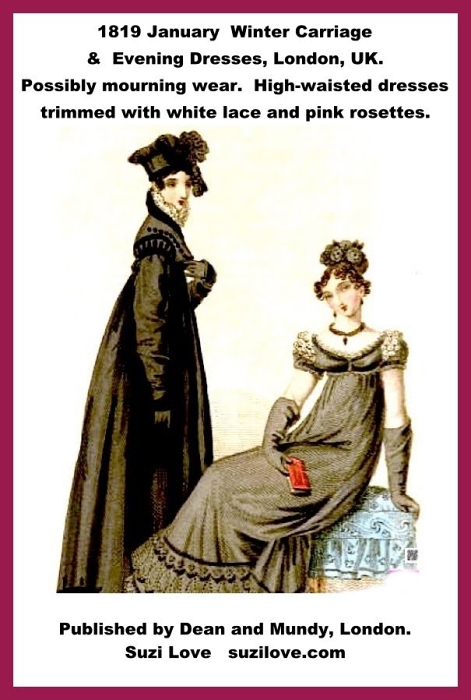
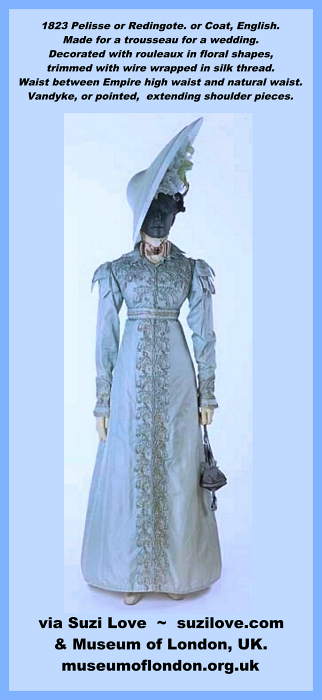
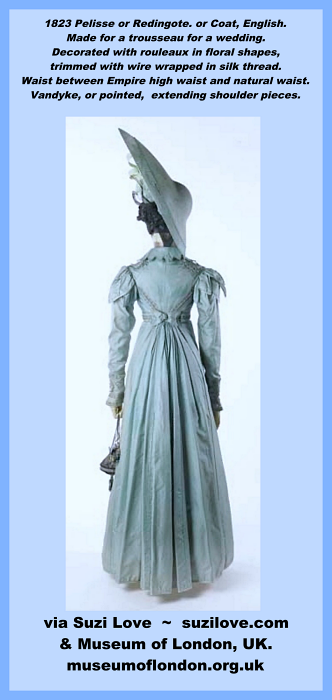
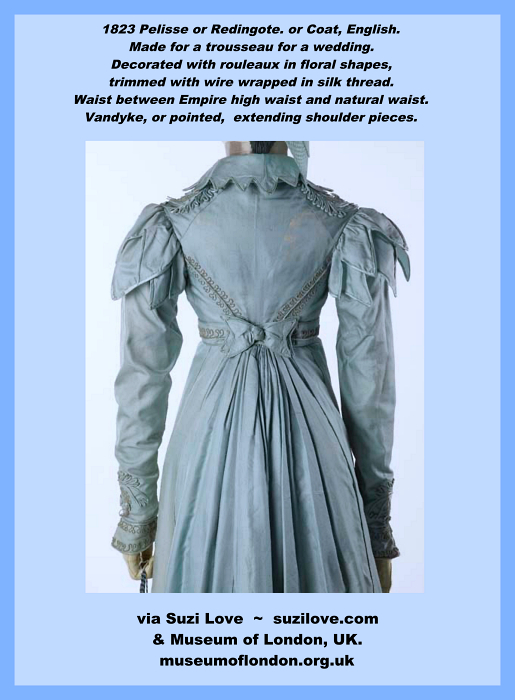
Definition Redingote Or Pelisse Or Walking Dress Or Coat: French word developed from English words, riding coat. Long fitted outdoor coat worn over other garments for warmth. Often left open at the front to show off the dress underneath. Sometimes cut away in front. Originally made with several capes and trimmed with large buttons. French fashion plates call these coats Redingotes and they are designed for women, men and children. English fashion plates call them a Pelisse, a walking dress, Promenade dress, or Carriage dress.
Richard St. Martin, the Earl of Winchester, explains his requirements for a placid bride while Lady Laura Jamison scoffs at his naivete. Scenting Scandal By Suzi Love Book 2 Scandalous Siblings Series. books2read.com/suziloveSS
EXCERPT
The Earl of Winchester, reiterated, “Your male relations understand my stance on marriage. I abhor marriages based on notions of romantic ideology, and I believe love matches create more unhappiness than joy. My convictions exclude me as a suitable suitor for you and make me the safest choice of escort, especially compared to the fortune hunters and rakes I’ve seen sniffing around your skirts recently.” Under her intense scrutiny, he shifted his feet. “For a woman as passionate and exciting as you, I’d prove very poor husband material.”
He realized how his words might be interpreted when Lady Laura said, “Are you complementing me for my passion? Or lamenting that I’m not the milk-pudding-miss you profess to require as your bride?”
He stiffened. “My countess will not be as bland as you imagine. She’ll be admired by everyone, including me of course, for her competency in running several large households.”
“Of course.” She rolled her eyes. “Because sewing and pianoforte and menu-planning and…reciting the bible…. are vital for any woman’s sanity. Mind you, your countess will need some distraction during the long boring months waiting to deliver your heir. And, of course, a possible spare or two. Stitching handkerchiefs may be the most excitement she experiences if her marriage to you is as boring as it sounds. I don’t believe you’re stupid enough to settle for a young girl who completely lacks wit.” Her gaze met his, confronting and demanding. “A chit with whom you’ve nothing in common, malleable enough to bend to your will and willing to be held at an emotional distance.”
He stared straight ahead, unable to meet her eyes. Laura, and this damnable conversation, would strip his long-held convictions regarding marriage from his bones.“It’s the way of our world, Laura. Men of rank list their requirements and choose the wife who best meets their needs. My countess needs to have enough spine to act as my hostess, yet be biddable and undemonstrative.”
“Poor, poor girl. Selected like a horse from Tattersall’s to carry on your breeding program, and then ignored for the remainder of her marriage. No doubt you’ll desert her in favor of your latest mistress.”
“You’ve no right to scoff at my rationale. Not after you’ve terrified every bachelor in London by scribbling notes about them in your little books. Only giving the poor sods a tick of approval if they have a pleasing aroma. You’re selecting your husband the same way I intend finding my wife. By examining their credentials. Your scientific theorizing degrades their worth as men far more than my plans for my countess. At least I’m choosing her for her … ah…gentler traits.”
When she scowled, he clasped a hand to his chest in a dramatic fashion and gave her a wide-eyed look. “Consider your lack of traditional female skills arts as providential. Instead of wasting your time testing me as a potential husband, you can treat me as an older and wiser financial advisor, as well as a loyal sentinel.”
She frowned. “Once again, I can’t decide if I should be insulted or relieved.”
18th Century Late – 19th Century Early Gloves as worn by women in Jane Austen’s and Bridgerton’s years, French. Silk embroidered with silk. via Museum of Fine Arts, Boston. mfa.org
1800s Typical Puddings and Pastries.These are the sort of puddings and pastries Jane Austen’s family would have eaten on a regular basis during the early 1800s, or Regency Era. Open Apple Tart, Galette, Apricot Fritters, Pancakes and Apricot Jam, Charlotte Russe, Macaroni Cheese, Cherry Tart, Mince Pies, Almond Puddings, Tartlets, Compote Of Fruit, Fruit Pudding, Fruit Tart, Christmas Plum Pudding, Milk Pudding and Roly Poly Jam Pudding. From: 1850s- 1860s Mrs. Beeton’s Books of Household Management. via Google Books (PD-150). 1800s Typical Puddings and Pastries Served In Households Like Jane Austen’s. https://books2read.com/suziloveOLD
1814 Jane Austen, Mansfield Park. “Give a girl an education and introduce her properly into the world, and ten to one but she has the means of settling well, without further expense to anybody.”
What shoes did the Bridgertons and Jane Austen wear? Gray Slippers, American, with long ankle ties.
Typical Regency Era women’s footwear as worn by Jane Austen and her contemporaries and by the Bridgerton family were shoes that had low heels, slightly rounded toes, embellished with a bow and with ribbon ties for the ankles. Shoe styles and shapes were generally very plain but then shoes began to be made in bright colors to match the colorful Empire style, or high-waisted, gowns. Plus, as gowns were lighter and floatier, glimpses could be had of these new pretty shoes. Ribbons, rosettes and other decorative. embellishments allowed ladies to personalize shoes.
Lady Laura Jamison believes her extraordinary olfactory senses will sniff out her perfect match, but will Richard St. Martin, the Earl of Winchester, prove her theory wrong? Scenting Scandal By Suzi Love Book 2 Scandalous Siblings Series. books2read.com/suziloveSS
EXCERPT
Laura concentrated on restful images. Brooks babbled, birds sang, white fluffy clouds floated. Colorful rainbows arced and…. Nothing, dammit. Her frazzled nerves refused to be soothed. Trying not to alert her aunt, whose over-emotional farewells had already delayed proceedings, Laura tugged on Winchester’s arm. His leather-gloved hand held fast. The Devil take the blasted Earl and his oversized anatomy, his overwhelming maleness and his…
She shivered. Everything overpowering about this man, including his unwanted invasion of her senses, ought to be declared illegal. A ticket tied to each limb reading: Danger. Avoid at all cost.
His cologne’s citrus tang, bergamot with an after-note of lemon, flooded her nose and made her sneeze. Another confirmation that the theory of natural selection being developed by scientists at the Royal Academe was correct. And an extra incentive to elude her keeper, ergot the enigmatic Earl, and pay another visit to her friends, Mr. Charles Darwin and his cousin, both men grandsons of Mr. Erasmus Darwin, famed researcher and theorist.
While she listed to herself the scientific reasons for avoiding the Earl, her herbalist and caring side, or more likely her feminine one, overruled. She reminded herself a few more drops of lemon should be added to the next batch of cologne she blended for Richard. Even as she mentally cursed her siblings for insisting she work closely with Winchester, Laura’s traitorous body responded in a physical way to his presence.
Imagining him, an expert financier, being granted full authority over not merely her ‘Change transactions, but also her daily household accounts, horrified her. Mortification would nail closed her coffin if he compared her scientific skills with those of her extraordinarily talented four siblings and found her wanting. Or, heaven save her, exposed her failures to the world.
1880’s Corset, French, silk satin, steel busk, and bone. Women used corsets to get closer to an ‘ideal physical form’. Until the beginning of the 20th century, women’s waists were tightened by corsets. via Kyoto Institute, Japan.
Corsets 1880-1900 History Notes Book 20 This book shows how a fashionable silhouette became of paramount importance and how a well-fitted corset became a fashion essential. As well as a decorative fashion item, tight lacing gave a narrow waist and the desired feminine form under clothing. https://books2read.com/SuziLoveCorsetBook20
1806 Short-Sleeved White Muslin Dress With Train. Bodice and sleeves have ribbon decoration, evening flowered headdress, half parure of necklace and ear bobs, and gorgeous Indian hand-loomed green shawl. Fashion Plate via Journal des Dames et des Modes, or Costume Parisien.
Definition Half Parure: A Parure is a matched set of jewelry, including a necklace, bracelet, earrings, pin etc. A half Parure didn’t include a jewelled headdress, or tiara.
Definition Shawls: The shawl started off in India as a fine wool garment for men that could be worn as a scarf, turban or as a mantle: the word comes from the Persian shäl. Originally imported from the East, European Kashmir shawls were made first in Norwich and Edinburgh in Britain in the late 18th century. Shawls were an essential item in the early 1800s to cover the thin gowns women wore. They were made of muslin, gauze, silk, wool, and velvet, though cashmere shawls were the softest and most prized.