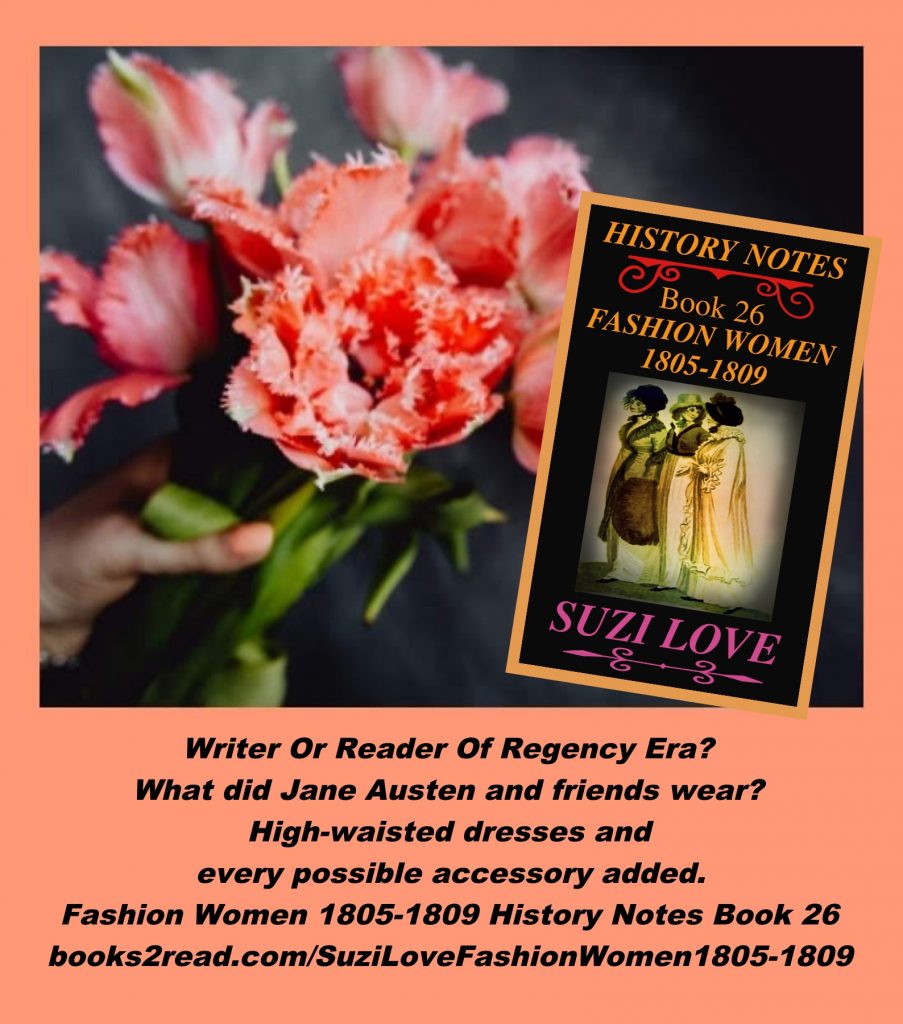
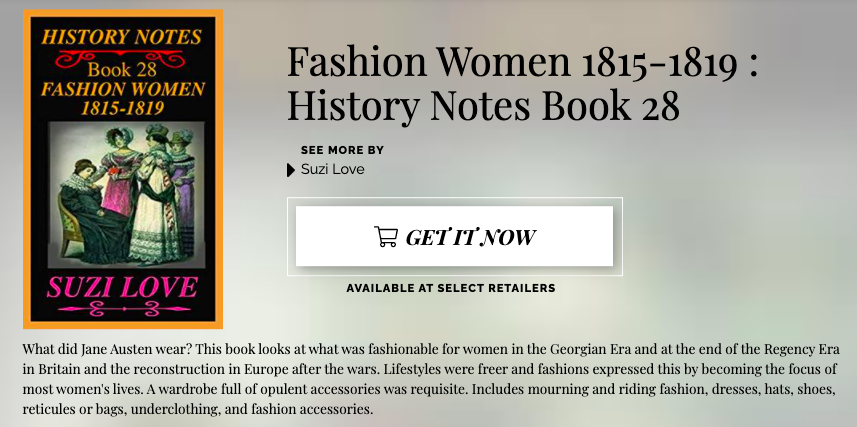
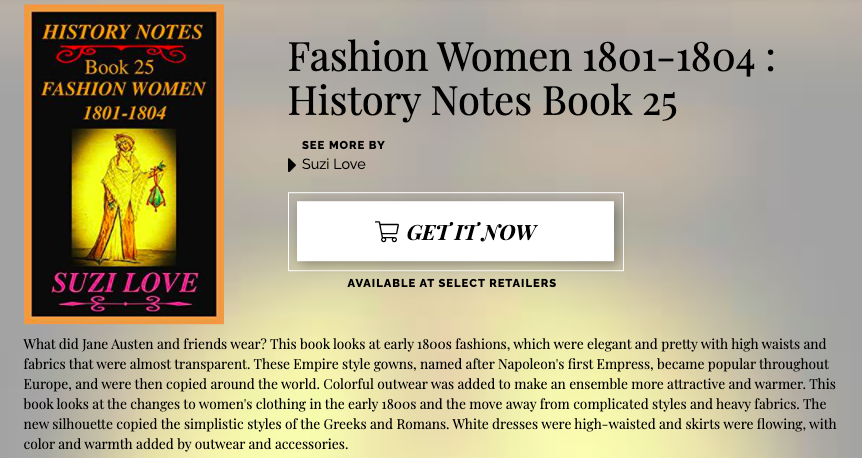
What did Jane Austen and friends wear? Early 1800s fashions were elegant and pretty with high waists and fabrics that were almost transparent. These Empire style gowns, named after Napoleon’s first Empress, became popular throughout Europe, and were then copied around the world. Colorful outwear was added to make an ensemble more attractive and warmer. History Notes Book 26 Fashion Women 1805-1809. https://books2read.com/SuziLoveFashionWomen1805-1809
The Empire waist gown defined women’s fashion during the Regency Era. ‘Empire’ is the name given in France to the period when Napoleon built his French Empire. High-waisted, loose gowns were adopted by the aristocracy as a symbol of turning away from the fussy, elaborate and expensive clothing worn in the 1700s. Jean-Jaques Rousseau advocated copying peasants and returning to a simpler life and more natural fashions. Unrestricting clothing was part of the new Democracy in France and these simpler and flowing fashions were adopted all over Europe, including Britain and despite the continual wars being fought against France during the early 1800s. Not even war stopped fashions from being copied everywhere.
1814 Gentleman’s Redingote, or Overcoat, French. Back View of coat with back pleats and metal buttons worn with high topped boots, top hat, and a cane. Fashion Plate via Journal des Dames et des Modes, or Costume Parisien.
Definition Redingote Or Coat: French word developed from English words, riding coat. Long fitted outdoor coat worn over other garments for warmth. Originally made with several capes and trimmed with large buttons. For women, the coat was often cut away in the front or left open to show off the dress underneath. French fashion plates call these coats Redingotes and they were worn by men, women, and children. English fashion plates call the coats a Pelisse, a walking dress, Promenade dress, or Carriage dress.
Chatelaines and Chains History Notes Book 9 By Suzi Love. What do you know about Chatelaines and Chains worn in Jane Austen’s and Bridgerton times? Women in charge of households carried important items with them. History Notes Book 9 Chatelaines and Chains. books2read.com/SuziLoveChatelaines
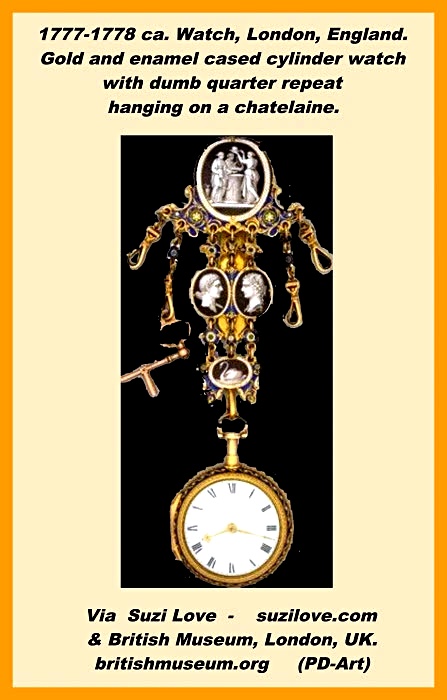
Personal Necessities, keys, or chatelaines was a set of useful items hung from waist by decorative chain. Chatelaines and Chains. History Notes Book 9 By Suzi Love. Women in charge of households dangled long chains from their waists to keep essentials within easy reach e.g. keys, notebook and pen, watch, sewing items, vinaigrette or perfume, or magnifying glass. Early chatelaine were simple essentials. Later chatelaine were decorative and expensive. http://books2read.com/SuziLoveChatelaines
Definition Chatelaine: The word Chatelaine is French and means the keeper of the keys. Chatelaine” derives from the Latin word for castle. In Medieval times, the chatelaine was in charge of the day-to-day running of the castle. Women in charge of households dangled long chains from their waists to keep essentials within easy reach e.g. keys, notebook and pen, watch, sewing items, vinaigrette or perfume, or magnifying glass. Early chatelaine were simple essentials. Later chatelaine were decorative and expensive.books2read.com/SuziLoveChatelaines
What did a chatelaine do? Most important task was keeper of the keys. Also ordered supplies, did bookkeeping, supervised servants, taught castle children, and organized guests.
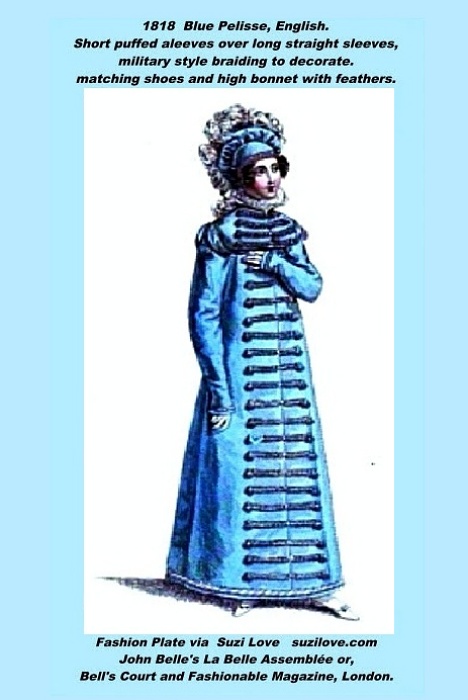
1818 Blue Pelisse, Or Coat, English. Short puffed sleeves over long straight sleeves, military style braiding to decorate. matching shoes and high bonnet with feathers. Fashion Plate John Belle’s La Belle Assemblée or, Bell’s Court and Fashionable Magazine, London. The type of outfit young Regency Era ladies would have worn if they were out shopping on Bond Street, walking in a park, or taking a carriage ride through Hyde Park.
Definition Redingote Or Pelisse Or Walking Dress Or Coat: French word developed from English words, riding coat. Long fitted outdoor coat worn over other garments for warmth. Often left open at the front to show off the dress underneath. Sometimes cut away in front. Originally made with several capes and trimmed with large buttons. French fashion plates call these coats Redingotes and they are designed for women, men and children. English fashion plates call them a Pelisse, a walking dress, Promenade dress, or Carriage dress.
1818 Blue Pelisse, Or Coat, English. Short puffed sleeves over long straight sleeves, military style braiding to decorate. matching shoes and high bonnet with feathers. Fashion Plate John Belle’s La Belle Assemblée or, Bell’s Court and Fashionable Magazine, London.
1777-1778 ca. Gold and enamel Cased Cylinder Watch with dumb quarter- repeat and en-suite Chatelaine, London, England. Via British Museum, London, UK. britishmuseum.org books2read.com/SuziLoveChatelaines
D2D_RetailerBuyLink_HN_9. Chatelaines and Chains History Notes Book 9 By Suzi Love. #regency Women in charge of houses wore long chains holding important household items around their waist e.g. keys, pen, notebook, sewing. books2read.com/SuziLoveChatelaines
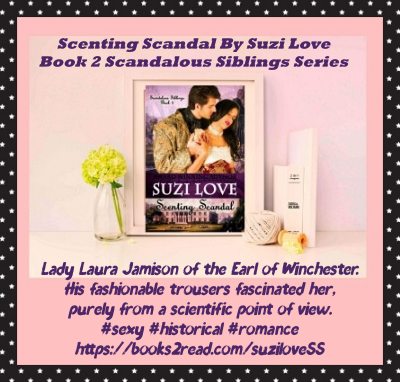
Richard St. Martin, the Earl of Winchester, explains his requirements for a placid bride while Lady Laura Jamison scoffs at his naivete. Scenting Scandal By Suzi Love Book 2 Scandalous Siblings Series. books2read.com/suziloveSS
EXCERPT
The Earl of Winchester, reiterated, “Your male relations understand my stance on marriage. I abhor marriages based on notions of romantic ideology, and I believe love matches create more unhappiness than joy. My convictions exclude me as a suitable suitor for you and make me the safest choice of escort, especially compared to the fortune hunters and rakes I’ve seen sniffing around your skirts recently.” Under her intense scrutiny, he shifted his feet. “For a woman as passionate and exciting as you, I’d prove very poor husband material.”
He realized how his words might be interpreted when Lady Laura said, “Are you complementing me for my passion? Or lamenting that I’m not the milk-pudding-miss you profess to require as your bride?”
He stiffened. “My countess will not be as bland as you imagine. She’ll be admired by everyone, including me of course, for her competency in running several large households.”
“Of course.” She rolled her eyes. “Because sewing and pianoforte and menu-planning and…reciting the bible…. are vital for any woman’s sanity. Mind you, your countess will need some distraction during the long boring months waiting to deliver your heir. And, of course, a possible spare or two. Stitching handkerchiefs may be the most excitement she experiences if her marriage to you is as boring as it sounds. I don’t believe you’re stupid enough to settle for a young girl who completely lacks wit.” Her gaze met his, confronting and demanding. “A chit with whom you’ve nothing in common, malleable enough to bend to your will and willing to be held at an emotional distance.”
He stared straight ahead, unable to meet her eyes. Laura, and this damnable conversation, would strip his long-held convictions regarding marriage from his bones.“It’s the way of our world, Laura. Men of rank list their requirements and choose the wife who best meets their needs. My countess needs to have enough spine to act as my hostess, yet be biddable and undemonstrative.”
“Poor, poor girl. Selected like a horse from Tattersall’s to carry on your breeding program, and then ignored for the remainder of her marriage. No doubt you’ll desert her in favor of your latest mistress.”
“You’ve no right to scoff at my rationale. Not after you’ve terrified every bachelor in London by scribbling notes about them in your little books. Only giving the poor sods a tick of approval if they have a pleasing aroma. You’re selecting your husband the same way I intend finding my wife. By examining their credentials. Your scientific theorizing degrades their worth as men far more than my plans for my countess. At least I’m choosing her for her … ah…gentler traits.”
When she scowled, he clasped a hand to his chest in a dramatic fashion and gave her a wide-eyed look. “Consider your lack of traditional female skills arts as providential. Instead of wasting your time testing me as a potential husband, you can treat me as an older and wiser financial advisor, as well as a loyal sentinel.”
She frowned. “Once again, I can’t decide if I should be insulted or relieved.”
Carina, Countess of Dorchester, glanced out at the square for the twentieth time and clutched the window casing for support when she saw that striding along the pavement towards her house was an exceedingly tall man, dressed in up-to-the minute fashion and wreathed in an aura of power and control. The Duke of Stirkton cut such a superior figure that men stepped aside and women turned to stare as he passed them on the footpath. The fact that he was oblivious to their attention and admiration made him more interesting, and for the first time in many years, Carina felt a glimmer of hope.
“Oh, Gertie, yes, yes,” she said, clapping her hands and spinning in a giddy circle before the window. “I think Georgie’s way out is about to present itself, and sooner than we thought.”
Gertie joined her at the window but groaned aloud. “Oh, no, no, no, Carina! Not him. The Duke of Stirkton is not the best person to help us introduce the girls to gentlemen.”
“Why not? He may not be a perfect solution but, with his influence in society, he may provide our best way forward.”
“You were only going to ask to see his grandfather’s papers. Look at whatever the Duke may have already found, whether it’s letters, directions, or anything else to help us work out the names and locations of those two men.”
1790-1820 ca. Fichus, Or Shoulder Shawls. Short and Long. Embroidered Cream Net Fichus as worn by ladies in the times of Jane Austen. via Whitaker Auction whitakerauction.smugmug.com
Definition Fichu: Triangular piece of lace, muslin, or other cloth worn about the neck and cleavage to fill in a low bodice or neckline and preserve a lady’s modesty. From the French ‘thrown over’. The Bridgerton family and Jane Austen and her female family and friends would have worn a Fichu over a light muslin dress for both warmth and modesty.
18th Century Late – 19th Century Early Gloves as worn by women in Jane Austen’s and Bridgerton’s years, French. Silk embroidered with silk. via Museum of Fine Arts, Boston. mfa.org
1800s Typical Puddings and Pastries.These are the sort of puddings and pastries Jane Austen’s family would have eaten on a regular basis during the early 1800s, or Regency Era. Open Apple Tart, Galette, Apricot Fritters, Pancakes and Apricot Jam, Charlotte Russe, Macaroni Cheese, Cherry Tart, Mince Pies, Almond Puddings, Tartlets, Compote Of Fruit, Fruit Pudding, Fruit Tart, Christmas Plum Pudding, Milk Pudding and Roly Poly Jam Pudding. From: 1850s- 1860s Mrs. Beeton’s Books of Household Management. via Google Books (PD-150). 1800s Typical Puddings and Pastries Served In Households Like Jane Austen’s. https://books2read.com/suziloveOLD