↓
 

Suzi Love

Making history fun, one year at a time.

Header_
  • Home
  • Newsletter
  • Pre order form
  • Shop
    • Cart
    • Checkout
    • My account
    • Refund and Returns Policy
  • Blog
  • BOOKS
    • History Events
    • Kelly’s Justice
    • Outback Arrival
    • Irresistible Aristocrats
    • History Notes
    • Scandalous Siblings
    • Love After Waterloo
    • Regency Life Series
  • Privacy Policy
  • EVENTS
Home » Archives for November 2026 » Page 4 << 1 2 3 4 5 >>

Monthly Archives: November 2026

Post navigation

← Previous Post
Next Post→

1798 White dress, shawl and hat with gold and black decoration, French. #GeorgianFashion #France #HistoricalDress

Suzi Love Posted on November 8, 2026 by Suzi LoveNovember 8, 2026

1798 White Dress, French. Gold and black back insert to match gold stripes on the hem, white shawl with gold stripes, gold hat with black decoration. Via Journal des Dames et des Modes or Costume Parisien.

Definition: 18th Century Late Women’s Fashions: A conical body shape was still fashionable while the shape of the skirts changed. The wide panniers which held the skirts out at the sides mostly disappeared by 1780 for all but the most formal court functions and false rumps, or bum-pads or hip-pads were worn for a time. A low-necked gown, usually called in French a robe, was worn over a petticoat and most gowns had skirts that opened in front to show the petticoat worn beneath. As part of the general simplification of dress, the open bodice with a separate stomacher was replaced by a bodice with edges that met center front. Strapless stays which still were cut high at the armpit, to encourage a woman to stand with her shoulders slightly back, a fashionable posture. The fashionable shape was a rather conical torso, with large hips. The waist was not particularly small. Stays were usually laced snugly, but comfortably. Shoes had high, curved heels (the origin of modern “louis heels”) and were made of fabric or leather. Shoe buckles remained fashionable until they were abandoned along with high-heeled footwear and other aristocratic fashions in the years after the French Revolution.

Fashion Women Late 1700s History Notes Book 1.
What was fashionable for women in the late 1700s? Extravagant colors and fabrics and outrageous styles were all seen in these flamboyant fashions. Take a look at their dresses, suits, hats, shoes and bedroom fashions. books2read.com/suziloveFashWomen1700s
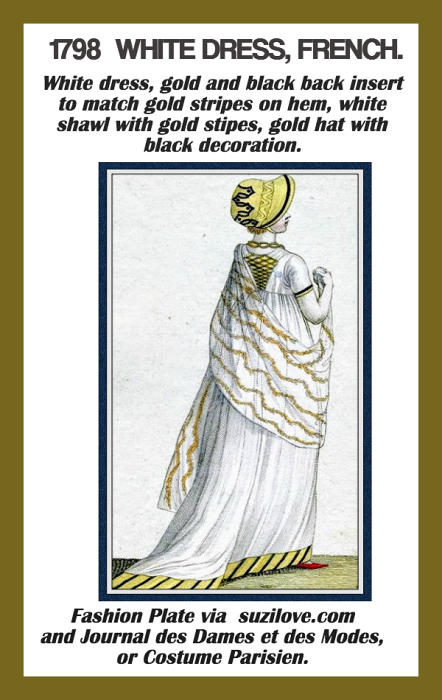
1798 White Dress, French. Gold and black back insert to match gold stripes on the hem, white shawl with gold stripes, gold hat with black decoration. Via Journal des Dames et des Modes or Costume Parisien.
What was fashionable for women in the late 1700s? Extravagant colors and fabrics and outrageous styles were all seen in these flamboyant fashions. #Georgian #nonfiction #amwriting books2read.com/suziloveFashWomen1700s

Posted in 1700s, 1700s Womens Fashion, Dress Or Robe, fashion accessories, France, Georgian Era, Georgian Fashion, hats, sewing, Suzi Love Images | Tagged 1700s Women's Fashion, Dress Or Gown, fashion accessories, Georgian Fashion, Hats And Hair, Journal des Dames et des Modes, sewing, shawls, Shoes

1805-1808 ca. Man’s Three Piece Court Suit As Worn In Jane Austen’s Years: Coat, Waistcoat, Breeches, French. #JaneAusten #RegencyEra #HistoricalFashion #Breeches

Suzi Love Posted on November 8, 2026 by Suzi LoveNovember 4, 2026

1805-1808 ca. Man’s three-part court suit of coat, waistcoat, and breeches, French. Wool broadcloth embroidered with silk and metallic threads, spangles, and glass. Plum colored broadcloth embroidered with plum colored and white silk and chenille, silver thread, spangles and brilliants. Supposed to have been worn by the Hon. James Bowdoin, U.S. Minister to Spain, 1805-1808, at a ball given by Napoleon at the Tuileries. Worn with 01.110 and 01.111. Said to have been worn by the Hon. James Bowdoin, U.S. Minister to Spain from 1805-1808; to his grand-nephew, James Bowdoin Winthrop by inheritance; to James Bowdoin Winthrop’s nephew, Robert C. Winthrop, Jr. by inheritance; gift of Robert C. Winthrop, Jr. to MFA, February 1, 1901.

DIMENSIONS Coat: center back (collar to bottom of coat): 106 cm (41 3/4 in.)
Waistcoat: center front: 55.2 cm (21.75 in.)
Breeches: center front: 67.9 cm (26.75 in.)

via Museum Of Fine Arts, Boston, U.S.A.

1805-1808 ca. Man's three-part court suit (coat, waistcoat, and breeches) Plum colored broadcloth embroidered with plum colored and white silk and chenille, silver thread, spangles and brilliants. Supposed to have been worn by the Hon. James Bowdoin, U.S. Minister to Spain, 1805-1808, at a ball given by Napoleon at the Tuileries.  via mfa.org

HN_23_D2D_Fashion Men 1800-1819
https://books2read.com/SuziLoveFashionMen1800-1819

Posted in 1800s, 1800s Mens Fashions, Coat or Pelisse Or Redingote, France, Jane Austen, pants, Regency Era, Regency Fashion, Royalty, sewing, Suit, Suzi Love Images, Vest or Waistcoat | Tagged 1800s men fashion, breeches, court clothing, France, Jane Austen, Museum Of Fine Arts, pants, Regency Fashion, sewing, Suit, Tailcoat, Vest or Waistcoat

1815 Pink Cashmere Dress With Diamond Pointed Hem as worn by Jane Austen and Bridgerton women. #Bridgerton #RegencyFashion #JaneAusten

Suzi Love Posted on November 8, 2026 by Suzi LoveNovember 7, 2026

1815 Pink Dress, French. Cashmere dress with white underdress showing the sleeves, decorated hem, turban of tulle and satin, diamond pointed hem, slippers and shawl. Fashion Plate via Journal des Dames et des Modes, or Costume Parisien. https://books2read.com/SuziLoveFashionWomen1815-1819

 Definition Aigret, aigrette, egret: Plume of feathers or jeweled ornament in shape of feathers worn on head or hats. During the early 19th century., or Jane Austen’s lifetime, the favorite feathers were osprey and heron.

Definition Empire Style:  Named after the First Empire in France, by 1800 Empire dresses had a very low décolleté, or neckline and a short narrow backed bodice attached to a separate skirt. Skirts started directly under the bust and flowed into the classical relaxed wide styles of Greece and Rome. This style of dress is associated with Jane Austen and her contemporaries as a simple cotton high-waisted dress was worn most days and accessorized according to the importance of the occasion.

1815 Pink Dress, French. Cashmere dress, white sleeves, decorated hem, turban of tulle and satin, diamond pointed hem, slippers and shawl. Fashion Plate via Journal des Dames et des Modes, or Costume Parisien.
HN_28_D2D_Fashion Women 1815-1819
https://books2read.com/SuziLoveFashionWomen1815-1819
Fashion Women 1815-1819 History Notes Book 28 What did Jane Austen wear? . D2D_HN_28_https://books2read.com/SuziLoveFashionWomen1815-1819
Posted in 1800s, 1800s women's fashion, Bridgerton, Dress Or Robe, France, hats, Jane Austen, Regency Era, Regency Fashion, shoes, Suzi Love Images | Tagged 1800s women's fashion, Bridgerton, Dress Or Gown, fashion accessories, Fashion Plate, gloves, Hats And Hair, Jane Austen, Journal des Dames et des Modes, Regency Fashion, shawls, Shoes

1700s Late Gorgeous Gentlemen’s Coats As Worn by Jane Austen’s male family and friends. #JaneAusten #GeorgianFashion #HistoricalFashion #Coat

Suzi Love Posted on November 7, 2026 by Suzi LoveNovember 7, 2026

1700s Late Gentlemen’s Coats.
A fitted coat was an essential part of a gentleman’s wardrobe in the late 1800s and were generally tailored and cut to fit tightly. Therefore, gentlemen needed a valet, or some other helper, to extricate himself and his shoulders from his glove-like coat. Breeches and a waistcoat in the same fabric usually completed the 18th century’s gentleman ensemble. Coats were generally worn long at the back and had elaborate decoration down the front openings, collars, and sleeve cuffs.

1700s Late Gentlemen's Coats. #Georgian #Fashion
HN_2_D2D_Fashion Men 1700s
HN_2_D2D_Fashion Men 1700s books2read.com/suziloveFashMen1700
Posted in 1700s, 1700s Mens fashion, Coat or Pelisse Or Redingote, England, Europe, Georgian Era, Georgian Fashion, Jane Austen, Suit, Suzi Love Images | Tagged 1700s Mens Fashion, Jane Austen, Redingote Or Pelisse Or Coat, sewing, Tailcoat, Vest or Waistcoat

19th Century Bridgerton Or Jane Austen Style Embroidered Silk Reticule, Or Bag, Japan. #Bridgerton #JaneAusten #RegencyFashion #Reticule

Suzi Love Posted on November 7, 2026 by Suzi LoveNovember 4, 2026

19th Century Embroidered Silk Bag, Japan. Metal clasp and chain, embroidered with a beautiful bird and flowers. via Ruby Lane Antiques. rubylane.com

Definition Reticule: Bag or purse, often with a drawstring to pull closed and usually made of cloth or covered cardboard and often decorated with beading or embroidery. A reticule, or purse, or handbag, was usually carried by a woman during the Regency period to carry all their daily necessities. Earlier, women used pockets that tied at the waistline and were hidden in the folds of their skirts. Empire style, or early 1800s, high-waisted dresses made it impossible to either sewn in a pocket or to tie on a pocket. So women began carrying small, decorated bags called Reticules, or ridicules, which generally pulled close at the top with a drawstring.

19th Century Embroidered Silk Bag, Japan.  Metal clasp and chain, embroidered with a beautiful bird and flowers. via  Ruby Lane Antiques. rubylane.com
HN _3_D2D_RetailerBuyLink
http://books2read.com/suziloveReticules
HN _3_D2D_RetailerBuyLink_HN_3
Posted in 1800s, 1800s women's fashion, Bridgerton, Decorative Item, fashion accessories, History, Jane Austen, Regency Era, Regency Fashion, Reticule or Bag, sewing, Suzi Love Images | Tagged 1800s women's fashion, Bridgerton, fashion accessories, Jane Austen, Japan, Regency Fashion, reticule or bag, Ruby Lane Antiques, sewing

1816 August Jane Austen Or Bridgerton Style Walking Costume With Blue Pelisse and Turned-Up White Satin Hat. #Bridgerton #RegencyFashion #JaneAusten #HistoricFashion

Suzi Love Posted on November 7, 2026 by Suzi LoveOctober 21, 2026

1816  August Walking Costume, or Pelisse, or Coat, English. Round dress, composed of cambric and trimmed with lace. The body is let in with a profusion of lace. Plain long sleeves, very full, except at the wrist where the fulness  is confined by small plaits, sleeve finished by double frill of lace. Over the dress is a Pelisse of blue and white shot sarcenet, lined with white sarcenet and trimmed with white satin. Pelisse sleeve is very full and finished at the wrist by a cuff and bows of ribbon. Pelisse is made half high and finished at neck with a triple fall of rich lace but the neck is bare. White satin hat is turned up in front and ornamented with flowers. Kid gloves, blue kid shoes and a parasol. We are indebted for this tasteful dress to Mrs. Gill of Cork Street, Burlington Garden, London. Fashion Plate via Rudolph Ackermann’s ‘The Repository of Arts’.

Definition: Pelisse Or Redingote: Woman’s long, fitted coat often worn open in front to show off the dress underneath. Sometimes cut away in front. Originally made with several capes and trimmed with large buttons. French word developed from English words, riding coat.  reefer. Single- or double-breasted, fitted, tailored, over-all coat usually made from sturdy fabric. Jane Austen and her contemporaries wore long coats like these to keep warm when out and about, visiting, shopping etc. The thin muslin dresses worn in the early 1800s were little protection against European winters. #Regency #Fashion #History

1816 August. Walking Costume, or Pelisse, or Coat, English. High waisted blue pelisse over a white dress, wide shawl collar with lace over layer, long sleeves, high flowered bonnet with ribbon ties, yellow gloves and a parasol. Fashion Plate via Rudolph Ackermann's 'The Repository of Arts'.
HN_28_D2D_Fashion Women 1815-1819
https://books2read.com/SuziLoveFashionWomen1815-1819
Fashion Women 1815-1819 History Notes Book 28 What did Jane Austen wear? . D2D_HN_28_https://books2read.com/SuziLoveFashionWomen1815-1819
Posted in 1800s, 1800s women's fashion, Bridgerton, Coat or Pelisse Or Redingote, Dress Or Robe, England, fashion accessories, hats, Jane Austen, London, Regency Era, Regency Fashion, shoes, Suzi Love Images | Tagged 1800s women's fashion, Bridgerton, Dress Or Gown, fashion accessories, Fashion Plate, gloves, Hats And Hair, Jane Austen, parasol, Redingote Or Pelisse Or Coat, Regency Fashion, Shoes, The Repository Of Arts

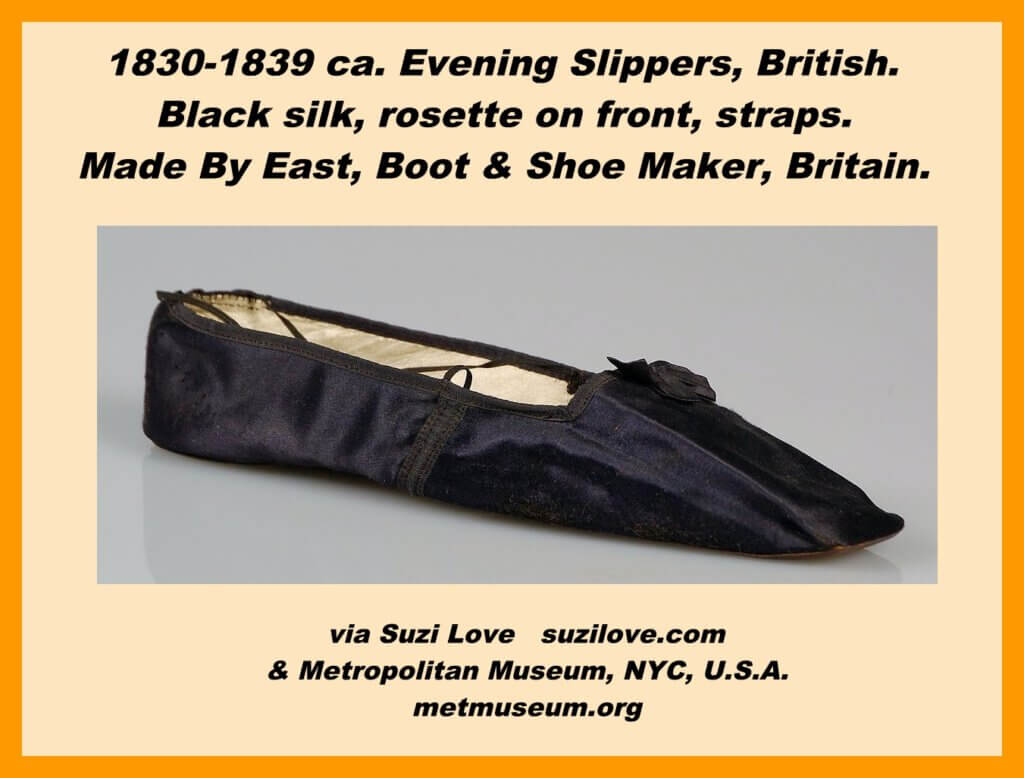
1830-1839 ca. Black Silk Evening Slippers Made By East Of London. #RomanticEra #Shoes #BritishHistory

Suzi Love Posted on November 6, 2026 by Suzi LoveOctober 21, 2026

1830-1839 ca. Black Evening Slippers, British. Black silk, rosette on front, straps. Made By East, Boot & Shoe Maker, Britain. via Metropolitan Museum, NYC, U.S.A.

1830s Shoes: Producing different shoes for right and left feet started around 1830 in France. In these first attempts, little paper labels on the insoles of the shoes indicated left and right. However, the shoes were still made on straight lasts with no differentiation between the left and right foot. By the end of the 19th century, producing left and right shoes had become common as shoemakers then worked with combinations of sole and vamp cuts tailored to fit either the right or the left foot. The first steps towards the mechanisation of shoemaking were taken during the Napoleonic Wars. In 1810, engineer Marc Brunel developed a machinery that could mass-produce nailed boots for the soldiers of the British Army. But after the end of the war in 1815, manual labour became cheap, and the demand for military shoes declined. The industrialization of shoemaking began around 1830.

1830-1839 ca. Evening Slippers, British. Black silk, rosette on front, straps. Made By East, Boot & Shoe Maker, Britain. via Suzi Love suzilove.com & Metropolitan Museum, NYC, U.S.A. metmuseum.org
Suzi Love Book Bub http://ow.ly/4mLSs9
Posted in 1800s, 1800s women's fashion, Romantic Era, shoes, Suzi Love Images | Tagged 1800s women's fashion, England, London, Metropolitan Museum NYC, Shoes | Leave a reply

1816 May Jane Austen and Bridgerton Style Full Evening Dress Of White Lace Dress Over a Satin Slip. #Bridgerton #RegencyEra #JaneAusten #HistoricFashion

Suzi Love Posted on November 6, 2026 by Suzi LoveNovember 4, 2026

1816  May Full Evening Dress, English. The type of evening dress the Bridgerton family and Jane Austen and her contemporaries would have worn to a formal evening event, such as a ball. A white satin slip, over which is a white lace dress, ornamented with three quillings of white lace on the skirt, intermixed with bows of white satin ribbon. The body and sleeve, both of which are richly ornamented with colored stones, are formed, as our readers will see by the print, in a very novel style. Head-dress, a cap composed of white satin, finished with a band edged with pearls, and a superb plume of white feathers. Necklace, ear-rings, and bracelets,’ colored stones intermixed with pearls. White satin slippers, and white kid gloves. We are indebted to the elegant invention Of Mrs. Gill, of Cork-street, Burlington-Gardens, for our dress this month. Fashion Plate via Rudolph Ackermann’s ‘The Repository of Arts’.

Definition Full Dress:  Most formal of outfits, day or night, with all possible accessories added.

1816  May Full Evening Dress, English. The type of evening dress Jane Austen and her contemporaries would have worn to formal evening event, such as a ball. A white satin slip, over which is a white lace dress, ornamented with three quillings of white lace on the skirt, intermixed with bows of white satin ribbon. The body and sleeve, both of which are richly ornamented with colored stones, are formed, as our readers will see by the print, in a very novel style. Head-dress, a cap composed of white satin, finished with a band edged with pearls, and a superb plume of white feathers. Necklace, ear-rings, and bracelets,' colored stones intermixed with pearls. White satin slippers, and white kid gloves. We are indebted to the elegant invention Of Mrs. Gill, of Cork-street, Burlington-Gardens, for our dress this month. Fashion Plate via Rudolph Ackermann's 'The Repository of Arts'.
HN_28_D2D_Fashion Women 1815-1819
https://books2read.com/SuziLoveFashionWomen1815-1819
Fashion Women 1815-1819 History Notes Book 28 What did Jane Austen wear? . D2D_HN_28_https://books2read.com/SuziLoveFashionWomen1815-1819
Posted in 1800s, 1800s women's fashion, Bridgerton, Dress Or Robe, England, fashion accessories, hats, Jane Austen, London, Regency Era, Regency Fashion, shoes, Suzi Love Images | Tagged 1800s women's fashion, Bridgerton, Dress Or Gown, fashion accessories, Fashion Plate, gloves, Hats And Hair, Jane Austen, jewelry, Regency Fashion, Shoes, Suzi Love Images, The Repository Of Arts

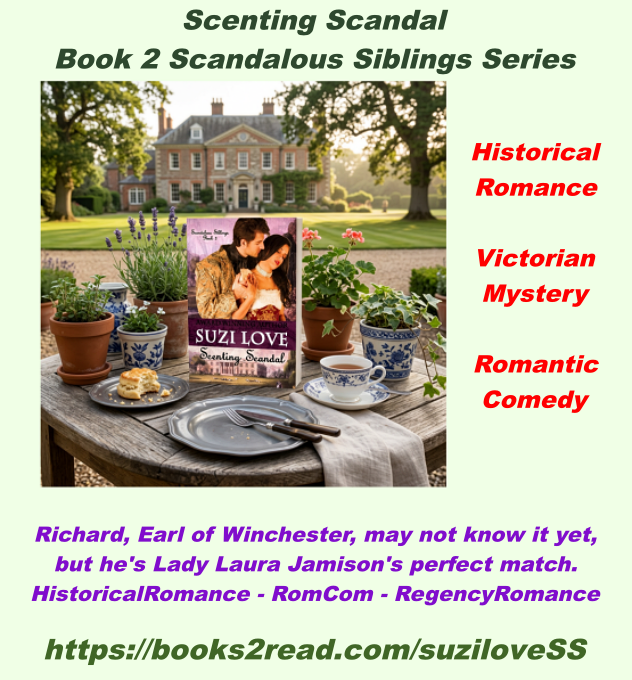
Scenting Scandal: Lady Laura Jamison believes her extraordinary olfactory senses will sniff out her perfect match, but will the Earl prove her wrong? #HistoricalRomance #RomCom #RegencyRomance

Suzi Love Posted on November 6, 2026 by Suzi LoveNovember 6, 2026

BLURB

Lady Laura Jamison believes her extraordinary olfactory senses will sniff out her perfect match, but will Richard St. Martin, the Earl of Winchester, prove her theory wrong? Scenting Scandal By Suzi Love Book 2 Scandalous Siblings Series. books2read.com/suziloveSS 

EXCERPT

Laura concentrated on restful images. Brooks babbled, birds sang, white fluffy clouds floated. Colorful rainbows arced and…. Nothing, dammit. Her frazzled nerves refused to be soothed. Trying not to alert her aunt, whose over-emotional farewells had already delayed proceedings, Laura tugged on Winchester’s arm. His leather-gloved hand held fast. The Devil take the blasted Earl and his oversized anatomy, his overwhelming maleness and his…

She shivered. Everything overpowering about this man, including his unwanted invasion of her senses, ought to be declared illegal. A ticket tied to each limb reading: Danger. Avoid at all cost.

His cologne’s citrus tang, bergamot with an after-note of lemon, flooded her nose and made her sneeze. Another confirmation that the theory of natural selection being developed by scientists at the Royal Academe was correct. And an extra incentive to elude her keeper, ergot the enigmatic Earl, and pay another visit to her friends, Mr. Charles Darwin and his cousin, both men grandsons of Mr. Erasmus Darwin, famed researcher and theorist.

While she listed to herself the scientific reasons for avoiding the Earl, her herbalist and caring side, or more likely her feminine one, overruled. She reminded herself a few more drops of lemon should be added to the next batch of cologne she blended for Richard. Even as she mentally cursed her siblings for insisting she work closely with Winchester, Laura’s traitorous body responded in a physical way to his presence.

Imagining him, an expert financier, being granted full authority over not merely her ‘Change transactions, but also her daily household accounts, horrified her. Mortification would nail closed her coffin if he compared her scientific skills with those of her extraordinarily talented four siblings and found her wanting. Or, heaven save her, exposed her failures to the world.

SS_Scenting Scandal For the sake of propriety
SS_D2D_ https://books2read.com/suziloveSS

Posted in 1800s, England, London, Regency Era, Romantic Era, Scandalous Siblings Series, Scenting Scandal, Suzi Love Books, Victorian Era | Tagged Book 2, Historical Mystery, historical romance, mystery, ReadARegency, Regency romance, Romantic Comedy, Scandalous Siblings Series, Scenting Scandal, Victorian Romance
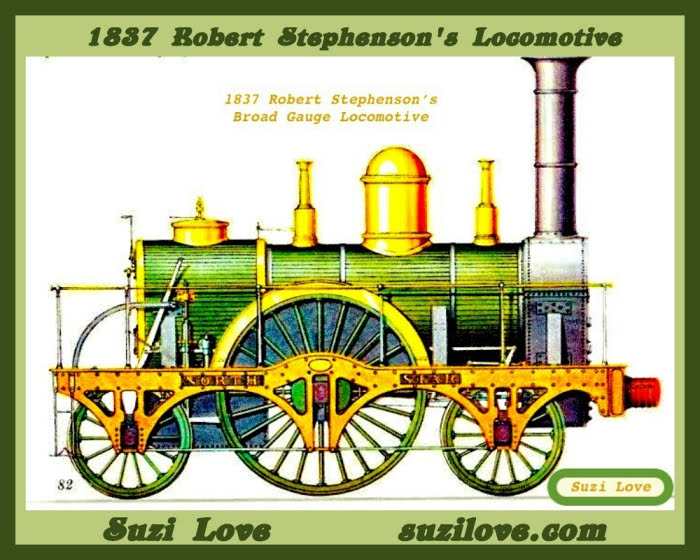
1837_RobertStephensonsLocomotive_Sml

1800s Early Robert Stephenson’s Innovative Steam Locomotives in Bridgerton and Jane Austen years. #Bridgerton #JaneAusten #Railway #BritishHistory

Suzi Love Posted on November 6, 2026 by Suzi LoveNovember 4, 2026

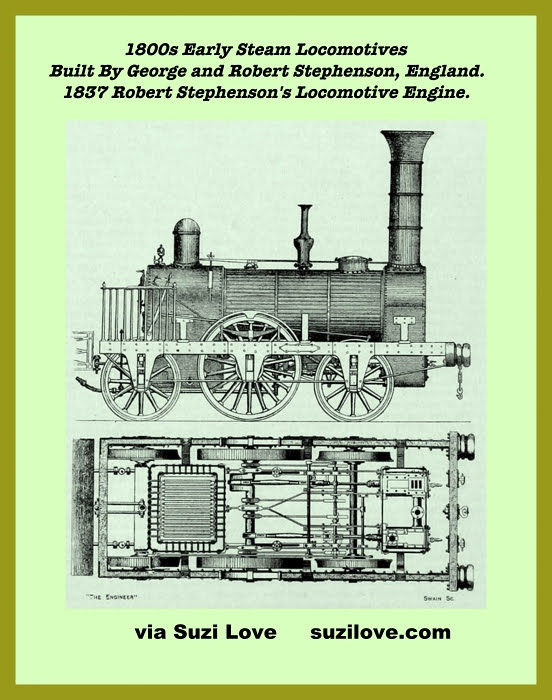
1800s Early Robert Stephenson’s Innovative Steam Locomotives.

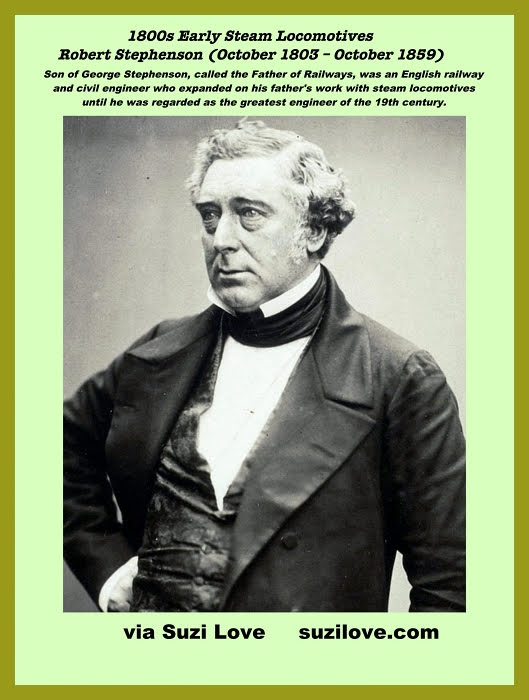
Robert Stephenson (16 October 1803 – 12 October 1859), son of George Stephenson, called the Father of Railways, was an English railway and civil engineer who expanded on his father’s work with locomotives until he was regarded as the greatest engineer of the 19th century. He helped his father survey the Stockton and Darlington Railway line and later assisted in the first surveys of the Liverpool & Manchester Railway.

How did people travel in Bridgerton’s and Jane Austen’s times? Treat yourself to a nonfiction book. History Notes Book 10. Travel and Luggage. books2read.com/SuziLoveTravel

1800s Early Steam Locomotives 
Robert Stephenson (October 1803 – October 1859)
Son of George Stephenson, called the Father of Railways, was 
an English railway and civil engineer who expanded on his 
father's work with steam locomotives until he was regarded
 as the greatest engineer of the 19th century.

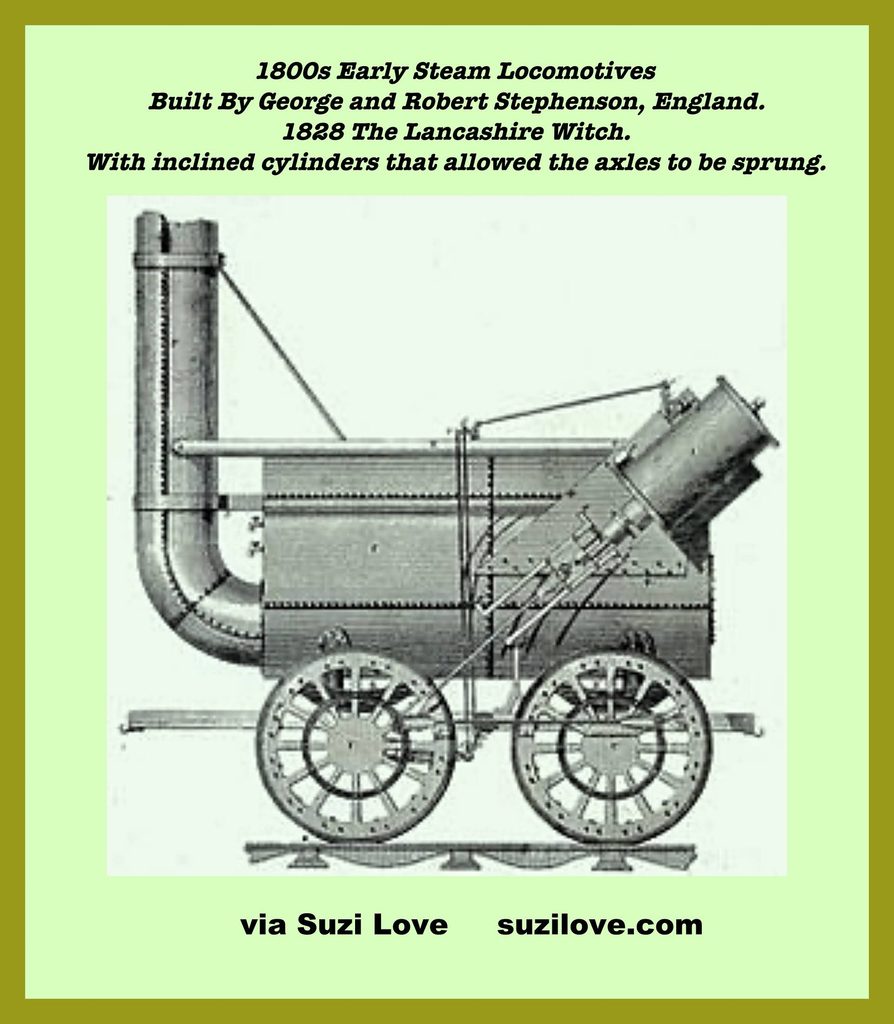
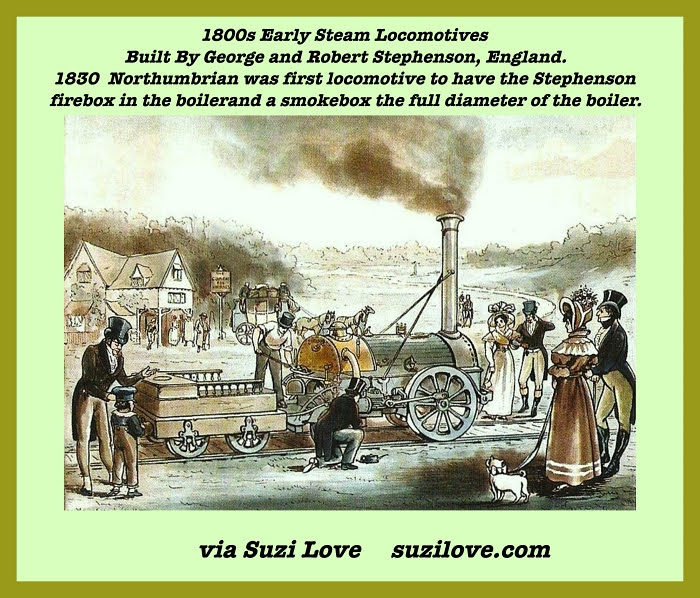
Stephenson’s Rocket was built for and won the Rainhill Trials of the Liverpool and Manchester Railway in October 1829 to show that improved locomotives would be more efficient than stationary steam engines. It was built at the Forth Street Works of Robert Stephenson’s company in Newcastle upon Tyne and was the most advanced locomotive of its day. The Rocket was based on earlier designs by George and Robert Stephenson, including the Killingworth locomotive Blücher in 1814, the Locomotion in 1825 and the Lancashire Witch in 1828.

1800s Early Steam Locomotives 
Robert Stephenson (October 1803 – October 1859)
Son of George Stephenson, called the Father of Railways, was 
an English railway and civil engineer who expanded on his 
father's work with steam locomotives until he was regarded
 as the greatest engineer of the 19th century.
1800s Early Steam Locomotives 
Robert Stephenson (October 1803 – October 1859)
Son of George Stephenson, called the Father of Railways, was 
an English railway and civil engineer who expanded on his 
father's work with steam locomotives until he was regarded
 as the greatest engineer of the 19th century. 
books2read.com/SuziLoveTravel
1800s Early Steam Locomotives 
Robert Stephenson (October 1803 – October 1859)
Son of George Stephenson, called the Father of Railways, was 
an English railway and civil engineer who expanded on his 
father's work with steam locomotives until he was regarded
 as the greatest engineer of the 19th century.

Timeline for Robert Stephenson and his steam locomotives.

  • 1821: Robert Stephenson assists his father George on surveying the Stockton and Darlington Railway.
  • 1822: Robert assists with the first survey of the Liverpool & Manchester Railway.
  • 1823: Robert becomes managing partner of locomotive builders Robert Stephenson & Co in Newcastle, the first locomotive company in the world.
  • 1825: September – Stockton & Darlington Railway opens using locomotives from Robert Stephenson & Co.
  • 1827: Robert assists his father George with construction of the Liverpool & Manchester Railway.
  • 1829: Robert Stephenson & Co’s locomotive Rocket wins the Rainhill Trials.
  • 1830: Robert appointed to survey a line between London and Birmingham.
  • 1833: Robert appointed chief engineer of The London & Birmingham Railway.
  • 1838: The London & Birmingham Railway is opened with Robert’s tunnels at Kilsby and Primrose Hill being major civil engineering works.
HN_10_D2D_RetailerBuyLink_HN_10.books2read.com/SuziLoveTravel
D2D_RetailerBuyLink_HN_10. books2read.com/SuziLoveTravel

Posted in 1800s, Bridgerton, History, Jane Austen, London, Regency Era, Romantic Era, travel, Victorian Era | Tagged Bridgerton, Jane Austen, railway, Regency Era, Romantic Era, VictorianEra

Post navigation

← Previous Post
Next Post→

SUBSCRIBE TO SUZI LOVE'S NEWSLETTER.

Recent Posts

  • History Notes Book 24 Box Set. Love the Bridgertons and Jane Austen? Mourning, riding, dresses, underclothing, accessories. #Bridgerton #JaneAusten #RegencyFashion
  • Scenting Scandal: If Lady Laura Jamison had inherited her great-grandmother’s ability to portend disaster… #HistoricalMystery #VictorianRomance #RomCom
  • How did people travel in Bridgerton and Jane Austen’s years? What did they take to make themselves comfortable? #Bridgerton #JaneAusten #GeorgianEra #RegencyEra #VictorianEra
  • Love After Waterloo: “Mama, why doesn’t that man like me?” Daniel asked. Love After Waterloo. #RegencyRomance #ReadARegency #Militaryromance #Waterloo
  • 19th Century Early Typical Jane Austen Or Bridgerton Era Men’s Pants With Drop Down Front Flap. #Bridgerton #RegencyEra #JaneAusten #HistoricalFashion

Recent Comments

  1. Suzi Love on Book Hooks: Petunia and the Pearl Diver. Petunia was too well spoken for a brothel worker. #Regencyromance #historicalromance #London #mfrw
  2. Bianca White on Book Hooks: Petunia and the Pearl Diver. Petunia was too well spoken for a brothel worker. #Regencyromance #historicalromance #London #mfrw
  3. Suzi Love on Book Hooks: Petunia and the Pearl Diver. Petunia was too well spoken for a brothel worker. #Regencyromance #historicalromance #London #mfrw
  4. Suzi Love on Book Hooks: Petunia and the Pearl Diver. Petunia was too well spoken for a brothel worker. #Regencyromance #historicalromance #London #mfrw
  5. Suzi Love on Book Hooks: Petunia and the Pearl Diver. Petunia was too well spoken for a brothel worker. #Regencyromance #historicalromance #London #mfrw

Login

  • Log in

Archives

  • November 2026
  • October 2026
  • September 2026
  • August 2026
  • July 2026
  • June 2026
  • May 2026
  • April 2026
  • March 2026
  • February 2026
  • January 2026
  • December 2025
  • November 2025
  • October 2025
  • September 2025
  • August 2025
  • July 2025
  • June 2025
  • May 2025
  • April 2025
  • March 2025
  • February 2025
  • January 2025
  • December 2024
  • November 2024
  • October 2024
  • September 2024
  • August 2024
  • July 2024
  • June 2024
  • May 2024
  • April 2024
  • March 2024
  • February 2024
  • January 2024
  • October 2023
  • September 2023
  • August 2023
  • June 2022
  • April 2022

Categories

  • 1700s
  • 1700s Mens fashion
  • 1700s Womens Fashion
  • 1800s
  • 1800s Mens Fashions
  • 1800s women's fashion
  • 1900s
  • art
  • Australia
  • Bath
  • bedroom fashion
  • Book Hooks
  • Box Or Container
  • Bridgerton
  • Bus Trips
  • Canada
  • Carriage
  • cartoon
  • Celebrity
  • Chatelaine
  • children
  • Children
  • Christmas
  • Coat or Pelisse Or Redingote
  • Contemporary
  • Corset
  • Couple
  • Customs & Manners
  • dancing
  • December Scandal
  • Decorative Item
  • Dress Or Robe
  • Easter
  • Edwardian Era
  • Embracing Scandal
  • England
  • Ester In Images
  • Europe
  • Events
  • Fashion
  • fashion accessories
  • Food and Drink
  • Four Times A Virgin
  • France
  • furniture
  • Georgian Era
  • Georgian Fashion
  • Google Books
  • Grand Tour
  • Group
  • hats
  • History
  • History Events
  • History Notes
  • History Of Christmases Past
  • household
  • Hygiene
  • Irresistible Aristocrats
  • Jane Austen
  • Keanu Reeves
  • Kellys Justice
  • Legal
  • London
  • Love After Waterloo
  • Loving Lady Katharine
  • medical
  • military
  • money
  • mourning
  • Music
  • Outback Arrival
  • pants
  • Pastimes
  • peerage
  • People
  • Petunia and Pearl Diver
  • Places
  • Pleasure House Ball
  • postal
  • Queensland
  • Quotations
  • Regency Era
  • Regency Fashion
  • Regency Life Series
  • Reticule or Bag
  • riding
  • Romantic Era
  • Royalty
  • Russia
  • Scandalous Siblings Series
  • Scenting Scandal
  • Self Publishing
  • sewing
  • Shirt
  • shoes
  • Shopping
  • South Pacific
  • Spencer
  • sports
  • Suit
  • Sunday Snippet
  • Suzi Love
  • Suzi Love Books
  • Suzi Love Images
  • Suzi Love Writing
  • Swain Cove
  • THe Viscount's Pleasure House
  • travel
  • U.S.A
  • underclothing
  • Vest or Waistcoat
  • Victorian Era
  • Victorian Fashion
  • weapons
  • weddings
  • Writing Tools

1800s men fashion 1800s women's fashion antiques Bridgerton British history Cartoons Corset cravat decorative Dress Or Gown England europe fashion accessories Fashion Plate France Georgian era Georgian Fashion gloves google books Hats And Hair historical romance History Notes household Jane Austen jewelry Journal des Dames et des Modes London Metropolitan Museum NYC pants Redingote Or Pelisse Or Coat Regency Era Regency Fashion Regency London reticule or bag riding Romantic Era sewing shawls Shoes Suzi Love Books Suzi Love Images Tailcoat The Repository Of Arts underclothing Vest or Waistcoat

©2026 - Suzi Love - Weaver Xtreme Theme Privacy Policy
↑