↓
 

Suzi Love

Making history fun, one year at a time.

Header_
  • Home
  • Newsletter
  • Pre order form
  • Shop
    • Cart
    • Checkout
    • My account
    • Refund and Returns Policy
  • Blog
  • BOOKS
    • History Events
    • Kelly’s Justice
    • Outback Arrival
    • Irresistible Aristocrats
    • History Notes
    • Scandalous Siblings
    • Love After Waterloo
    • Regency Life Series
  • Privacy Policy
  • EVENTS
Home » sewing » Page 8 << 1 2 … 6 7 8 9 10 … 17 18 >>

Tag Archives: sewing

Post navigation

← Previous Post
Next Post→

19th Century First Quarter Bridgerton and Jane Austen Style Red Mesh Reticule, Or Bag. #Bridgerton #JaneAusten #RegencyFashion #Reticule

Suzi Love Posted on August 20, 2025 by Suzi LoveAugust 17, 2025

19th Century First Quarter Red Mesh Reticule, British. Small mesh bags known as reticules were the must-have “it bags” of 1800-1825. Too small for carrying much more than a few coins, reticules were often shown in satirical prints as a fashionable foible of women’s attire. Knit into an elegant lantern-like shape, this example survives with its original ribbon trim making it a particularly lovely and rare example of a short-lived fashion trend. via Metropolitan Museum, N.Y.C., U.S.A. metmuseum.org

Definition Reticule: Bag or purse, often with a drawstring to pull closed and usually made of cloth or covered cardboard and often decorated with beading or embroidery. A reticule, or purse, or handbag, was usually carried by a woman during the Regency period to carry all their daily necessities. Earlier, women used pockets that tied at the waistline and were hidden in the folds of their skirts. Empire style, or early 1800s, high-waisted dresses made it impossible to either sewn in a pocket or to tie on a pocket. So women began carrying small, decorated bags called Reticules, or ridicules, which generally pulled close at the top with a drawstring.

19th Century First Quarter Red Mesh Reticule, British. Small mesh bags known as reticules were the must-have "it bags" of 1800-1825. Too small for carrying much more than a few coins, reticules were often shown in satirical prints as a fashionable foible of women's attire. Knit into an elegant lantern-like shape, this example survives with its original ribbon trim making it a particularly lovely and rare example of a short-lived fashion trend. via Metropolitan Museum, N.Y.C., U.S.A. metmuseum.org
HN _3_D2D_RetailerBuyLink
http://books2read.com/suziloveReticules
HN _3_D2D_RetailerBuyLink_HN_3
Posted in 1800s, 1800s women's fashion, Bridgerton, Decorative Item, England, fashion accessories, History, Jane Austen, London, Regency Era, Regency Fashion, Reticule or Bag, Suzi Love Images | Tagged 1800s women's fashion, Bridgerton, British history, Jane Austen, Metropolitan Museum NYC, Regency Fashion, reticule or bag, sewing
1817 Typical Women's Fashion. Collage By Suzi Love.

1817 February Bridgerton and Jane Austen Style Dress and Pelisse In Carriage Costume. #Bridgerton #RegencyFashion #JaneAusten #HistoricalFashion

Suzi Love Posted on August 18, 2025 by Suzi LoveAugust 12, 2025

1817 February Pelisse, or Redingote, English. Carriage dress of white poplin with a deep blond flounce. Blue levantine pelisse or walking dress, or Redingote in France, shorter than the dress and edged with floss silk. Coburg cap of black velvet turns up on one side in front and is lined and edged with blue satin. The head-dress worn with it has a profusion of white ostrich feathers. Ruff is of plain blond, edged with narrow white satin ribbon, and a pink Indian scarf over the shoulders. An ermine muff, gloves and slippers of blue kid, complete the elegant dress. Fashion Plate via John Belle’s La Belle Assemblée or, Bell’s Court and Fashionable Magazine, London.

Definition Coat or Redingote Or Pelisse: Long fitted outdoor coat worn over other garments for warmth. French word developed from English words, riding coat.

1817 February Pelisse, or Redingote, English. Carriage dress of white poplin with a deep blond flounce. Blue levantine pelisse or walking dress, or Redingote in France, edged with floss silk, blonde lace neck ruff, ermine ruff and a pink shawl. Fashion Plate via John Belle's La Belle Assemblée or, Bell's Court and Fashionable Magazine, London.
1817 February Pelisse, or Redingote, English. Carriage dress of white poplin with a deep blond flounce. Blue levantine pelisse or walking dress, or Redingote in France, edged with floss silk, blonde lace neck ruff, ermine ruff and a pink shawl. Fashion Plate via John Belle’s La Belle Assemblée or, Bell’s Court and Fashionable Magazine, London.

HN_28_D2D_Fashion Women 1815-1819
https://books2read.com/SuziLoveFashionWomen1815-1819
Fashion Women 1815-1819 History Notes Book 28 https://books2read.com/SuziLoveFashionWomen1815-1819
Posted in 1800s, 1800s women's fashion, Bridgerton, Coat or Pelisse Or Redingote, Dress Or Robe, England, fashion accessories, hats, Jane Austen, London, Regency Era, Regency Fashion, shoes, Suzi Love Images, travel | Tagged 1800s women's fashion, Bridgerton, Dress Or Gown, fashion accessories, Fashion Plate, Hats And Hair, Jane Austen, jewelry, La Belle Assemblee, muff, Redingote Or Pelisse Or Coat, Regency Fashion, sewing, shawls, Shoes

1805-1810 ca. Jane Austen Style, High-Waisted, White Muslin Evening Dress, Possibly French. #JaneAusten #RegencyFashion #sewing

Suzi Love Posted on August 12, 2025 by Suzi LoveAugust 11, 2025

1805-1810 ca. High-Waisted White Muslin Evening Dress, Possibly Made in France.  Embroidered in white cotton in French knots, with collars, border, and vertical stripe in chain stitch with a design down the front of vine tendrils and acorns. Low square neck with draw-cord, ‘stomacher’ front closing over inner lining flaps. Straight cut skirt gathers at back and fastens with tape tie. Long oval train, short sleeves with ‘vandyke’ trimming.  An evening ensemble typical of the early 19th century love of Neo-classical where this high-waisted dress with short sleeves copies Greek and Roman shape and dress as seen in sculptures from the time. White muslin fabric was usually imported from India but in the case, made in Europe to imitate Indian materials.  via  Victoria and Albert Museum, London, UK.  collections.vam.ac.uk. https://books2read.com/SuziLoveFashionWomen1805-1809

Definition Van Dyke Points: V-shaped lace and trims named after a 17th Century Flemish painter, Sir Anthony Van Dyck, known for painting V-shaped lace collars and scalloped edges on sitters.

Definition Empire Style:  Named after the First Empire in France, by 1800 Empire dresses had a very low décolleté, or neckline and a short narrow backed bodice attached to a separate skirt. Skirts started directly under the bust and flowed into the classical relaxed wide styles of Greece and Rome. This style of dress is associated with Jane Austen and her contemporaries as a simple cotton high-waisted dress was worn most days and accessorized according to the importance of the occasion.

1805-1810 ca. High-Waisted White Muslin Evening Dress, Possibly Made in France. #Regency #JaneAusten #Fashion https://books2read.com/SuziLoveFashionWomen1805-1809
HN_26_D2D Fashion Women 1805-1809
https://books2read.com/SuziLoveFashionWomen1805-1809
Fashion Women 1805-1809 History Notes Book 26 What did Jane Austen and friends wear? https://books2read.com/SuziLoveFashionWomen1805-1809

Posted in 1800s, 1800s women's fashion, Dress Or Robe, England, France, Jane Austen, Regency Era, Regency Fashion, Suzi Love Images | Tagged 1800s women's fashion, Dress Or Gown, fabrics, France, Hats And Hair, Jane Austen, Regency Fashion, sewing, shawls, Suzi Love Images, Victoria and Albert Museum

How did people travel in Bridgerton and Jane Austen’s years? What did they take to make themselves comfortable? #Bridgerton #JaneAusten #GeorgianEra #RegencyEra #VictorianEra

Suzi Love Posted on August 11, 2025 by Suzi LoveAugust 9, 2025

Travel and Luggage By Suzi Love History Notes Book 10. How did people travel in Bridgerton’s and Jane Austen’s times? What did they take with them to make their long journeys easier? Travel by road, ship, canal, or railway all took a long time and had dangers so people learned to prepare. And then, in the nineteenth century, road improvements, inventions, and scientific developments made travel more pleasurable. books2read.com/SuziLoveTravel

HN_10_Travel and Luggage By Suzi Love History Notes Book 10. How did people travel in Jane Austen's times. In past centuries? What did they take with them to make their long journeys easier? Travel by road, ship, canal, or railway all took a long time and had dangers so people learned to prepare. And then, in the nineteenth century, road improvements, inventions, and scientific developments made travel more pleasurable. books2read.com/SuziLoveTravel
HN_10_D2D_RetailerBuyLink_HN_10.books2read.com/SuziLoveTravel
D2D_RetailerBuyLink_HN_10. books2read.com/SuziLoveTravel
Posted in 1700s, 1800s, Australia, Box Or Container, Carriage, cartoon, Decorative Item, Edwardian Era, England, Europe, Food and Drink, Georgian Era, Grand Tour, History, History Notes, Jane Austen, medical, Regency Era, Romantic Era, sewing, Suzi Love Books, Suzi Love Images, travel, U.S.A, Victorian Era, Writing Tools | Tagged Book 10, Box Or Container, Bridgerton, carriages, drinks, fashion accessories, Food, Georgian era, History Notes, Jane Austen, medical, sewing, Suzi Love Books, travel, Writing Tools

1800 – 1820 ca.  Bag, Or Reticule, Dutch. Cotton, glass and with drawstring. #RegencyFashion #Holland #bag #sewing

Suzi Love Posted on August 10, 2025 by Suzi LoveAugust 9, 2025

1800 – 1820 ca.  Bag, Or Reticule, Dutch. Cotton, glass and with drawstring. via Metropolitan Museum New York City, U.S.A. metmuseum.org http://books2read.com/suziloveReticules Because reticules were so popular, Jane Austen and her family and friends and the Bridgerton family would have made reticules for each other for gifts and carried these small purses with them whenever they went out.

From Historic Dress In America: ‘Reticules were so universally carried during the first part of the nineteenth century that they were called Indispensables, and a few years later ridicules. Miss Southgate describes one in a letter in 1802, ‘Martha sent me a most elegant Indispensable, white lute-string spangled with silver…’

Definition Reticule Or Bag or Purse: Often with a drawstring to pull closed and usually made of cloth or covered cardboard and often decorated with beading or embroidery. A reticule, or purse, or handbag, was usually carried by a woman during the Regency period to carry all their daily necessities. Earlier, women used pockets that tied at the waistline and were hidden in the folds of their skirts. Empire style, or early 1800s, high-waisted dresses made it impossible to either sewn in a pocket or to tie on a pocket. So women began carrying small, decorated bags called Reticules, or ridicules, which generally pulled close at the top with a drawstring.

• Beadwork:  Attaching beads to one another by stringing with a needle and thread or thin wire, or sewing them to cloth.  Includes loom weaving, stringing, bead embroidery, bead crochet, and bead knitting.

• Embroidery:  Decorating fabrics with a needle and thread, or cloth, such as a needlepoint picture of a house or hand sewn initials. 

bag_1800 – 1820 ca.  Bag, Or Reticule, Dutch. Cotton, glass and with drawstring. via Suzi Love suzilove.com and Metropolitan Museum New York City, U.S.A. metmuseum.org

HN_3_D2D_RetailerBuyLink_HN_3 http://books2read.com/suziloveReticules
D2D_RetailerBuyLink_HN_3 http://books2read.com/suziloveReticules
Posted in 1800s, 1800s women's fashion, Decorative Item, England, Europe, fashion accessories, Jane Austen, London, money, Regency Era, Regency Fashion, Reticule or Bag, sewing, Suzi Love Images | Tagged 1800s women's fashion, Bridgerton, fashion accessories, Holland, Jane Austen, Metropolitan Museum NYC, Regency Fashion, reticule or bag, sewing
1804-1815 ca. Collage Fawn Cotton Dress with Bead Embroidery, Austrian.

1804-1815 ca. Fawn Cotton Dress With Embroidery Beading In Jane Austen Style. #RegencyEra #JaneAusten #HistoricalFashion

Suzi Love Posted on August 8, 2025 by Suzi LoveJuly 13, 2025

1804–1815 ca. Fawn Cotton Dress With Embroidery Beading, Austrian. Simple Empire style dress with A-line skirt from a high waistline and short bodice as Jane Austen and contemporaries across Europe would have worn. Fawn colored cotton with deep bead embroidered hem, embroidery on the wrists and around the wide scooped neckline. Transparent fabrics of the early were beginning to be replaced with fabrics with more weight that were less likely to tear. Plain silks in vivid colors were at first made up in the simple lines of muslin dresses but then plain gowns began to be decorated with intricate contrasting applications and beading. This dress was part of “The Fine Art of Costume” exhibition, 1954 October 15th at the Met Museum, N.Y.C. via Metropolitan Museum, NYC, U.S.A. metmuseum.org.

Empire Style Dress:  Named after the First Empire in France. Empire dresses had a low neckline and skirts started directly under the bust and flowed into the classical relaxed wide styles of Greece and Rome. This style of dress is associated with Jane Austen and her contemporaries as a high-waisted dress was worn most days. Cotton, silk or taffeta were the popular fabrics.

1804-1815 ca. Front Fawn Cotton Dress with Bead Embroidery, Austrian.
1804-1815 ca. Back Fawn Cotton Dress with Bead Embroidery, Austrian.
1804-1815 ca. Side Fawn Cotton Dress with Bead Embroidery, Austrian.
1804-1815 ca. Black and White. Fawn Cotton Dress with Bead Embroidery, Austrian.
1804-1815 ca. Black and White Group. Fawn Cotton Dress with Bead Embroidery, Austrian.
1804-1815 ca. Beading View. Fawn Cotton Dress with Bead Embroidery, Austrian.
HN_26_D2D Fashion Women 1805-1809
https://books2read.com/SuziLoveFashionWomen1805-1809
Fashion Women 1805-1809 History Notes Book 26 What did Jane Austen and friends wear? https://books2read.com/SuziLoveFashionWomen1805-1809
Posted in 1800s, 1800s women's fashion, Dress Or Robe, Europe, Jane Austen, Regency Era, Regency Fashion, Suzi Love Images | Tagged 1800s women's fashion, Dress Or Gown, europe, Jane Austen, Metropolitan Museum NYC, Regency Fashion, sewing, Suzi Love Images | Leave a reply

19th Century Early Women’s Lightweight Cotton Caps As Worn By Jane Austen Or Bridgerton Women. #Hats #Bridgerton #RegencyFashion #JaneAusten

Suzi Love Posted on August 5, 2025 by Suzi LoveJuly 13, 2025

19th Century Early Women’s Cotton Caps. Worn as morning caps, night caps, or under other hats. The proper 19th century woman wore various forms of headwear throughout the day and evening. Unstructured, finely decorated cotton caps were worn in the morning hours with the informal attire appropriate for the early part of the day. Jane Austen and her family and female friends, and the Bridgerton family, would have worn caps like these, sometimes during the morning at home, to bed to keep their long hair from becoming knotted, or under a bonnet to hold a hairstyle in place. via Museum of Fine Arts, Boston, U.S.A. mfa.org

Definition Boudoir Or Morning Cap: worn by women in the privacy of their ‘boudoir’ and was not a simple night-cap but a lightweight, decorated cap which covered the hair before it was dressed for daytime activities or for at-home pursuits. 

Definition Cornette or Morning Cap: Muslin or other lightweight material, worn to cover hair during at-home pursuits such as reading or sketching, tied under chin and sometimes worn under bonnet. 

Definition Lappets: Two long strips of material, often lace, hanging from top of head down back or over  shoulders. Sometimes extensions of a headdress and a requirement for court dress.

19th Century Early Women's Cotton Caps. Worn as morning caps, night caps, or under other hats. via Museum of Fine Arts, Boston, U.S.A. mfa.org
HN_25_D2D_fashwomen1801-1804
https://books2read.com/SuziLoveFashionWomen1801-1804
HN_25_D2D_fashwomen1801-1804 https://books2read.com/SuziLoveFashionWomen1801-1804

Posted in 1800s, 1800s women's fashion, Australia, bedroom fashion, Canada, England, Europe, fashion accessories, hats, Regency Era, Regency Fashion, Suzi Love Images, U.S.A | Tagged 1800s women's fashion, Hats And Hair, Jane Austen, Museum Of Fine Arts, Regency Fashion, sewing

1817 Couple In Jane Austen and Bridgerton style Walking Dress and Gentleman in Same Green Redingote. #bridgerton #janeausten #RegencyFashion

Suzi Love Posted on August 4, 2025 by Suzi LoveAugust 3, 2025

1817 Couple In Jane Austen and Bridgerton style Walking Dress and Gentleman in Same Green Redingote.

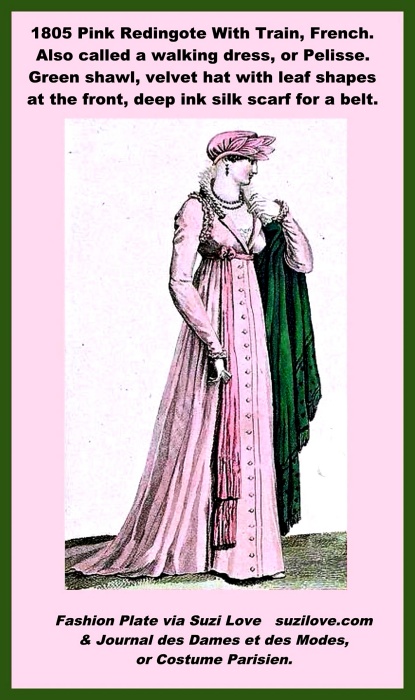
Lady: Blue satin Spencer over a white dress with puffed trimming around hem, pink bonnet, white ruff and tucker. Man: Long green Redingote, or overcoat, in the English style.  Long brown trousers, striped waistcoat or vest, top hat, gloves and boots. Fashion Plate via Journal des Dames et des Modes, or Costume Parisien. Definition Redingote Or Coat Or Pelisse: Long fitted outdoor coat worn over other garments for warmth. French word developed from English words, riding coat. French fashion plates call these coats a Redingote and English plates call them a Pelisse, Or Walking Dress, or Carriage Costume. These are the types of outfits worn by Jane Austen and contemporaries in English magazines, where French fashions were obsessively copied despite the two countries being at war for many years.

This same Fashion Plate is seen below for the gentleman.  

1817 Couple In Walking Dress, French. Lady in a blue satin Spencer over a white dress with puffed trimming around the hem, pink bonnet, white ruff and tucker around her neck. Man in a full length dark green Redingote, or overcoat, over loose, or Cossack style, brown trousers, striped waistcoat, black boots, and top hat.
1

1817 Long Green Straight Redingote, or Greatcoat, French. Gentleman wearing an English style overcoat, long brown trousers, striped waistcoat or vest, top hat, gloves and boots. Fashion Plate via Journal des Dames et des Modes, or Costume Parisien.https://books2read.com/SuziLoveFashionMen1800-1819
1817 Long Green Straight Redingote, or Greatcoat, French. Gentleman wearing an English style overcoat, long brown trousers, striped waistcoat or vest, top hat, gloves and boots. Fashion Plate via Journal des Dames et des Modes, or Costume Parisien.

HN_23_D2D_Fashion Men 1800-1819 History Notes Book 23 https://books2read.com/SuziLoveFashionMen1800-1819
Posted in 1800s, 1800s Mens Fashions, 1800s women's fashion, Bridgerton, Coat or Pelisse Or Redingote, Couple, Dress Or Robe, England, Europe, fashion accessories, France, hats, Jane Austen, London, pants, Regency Era, Regency Fashion, shoes, Spencer, Suit, Suzi Love Images, Vest or Waistcoat | Tagged 1800s men fashion, 1800s women's fashion, Bridgerton, cravat, Dress Or Gown, fashion accessories, Fashion Plate, gloves, Hats And Hair, Jane Austen, pants, Redingote Or Pelisse Or Coat, Regency Fashion, riding, sewing, Shoes, Spencer, The Repository Of Arts, Vest or Waistcoat

19th Century Early Silk Reticule, Or Bag, With Embroidered Flowers As Carried In Jane Austen Or Bridgerton Times. #Bridgerton #JaneAusten #RegencyFashion #Reticule

Suzi Love Posted on August 3, 2025 by Suzi LoveAugust 2, 2025

1800 ca. White Silk Reticule. Gathered into square top with filigree edge, piped with green satin. Embroidered with green velvet ivy sprays applied with gold couching. Lined with white silk. Handmade. bowesmuseum.org.uk http://books2read.com/suziloveReticules

1800 ca. White Silk Reticule. Gathered into square top with filigree edge, piped with green satin. Embroidered with green velvet ivy sprays applied with gold couching. Lined with white silk. Handmade. bowesmuseum.org.uk
http://books2read.com/suziloveReticules
1800 ca. White Silk Reticule. Gathered into square top with filigree edge, piped with green satin. Embroidered with green velvet ivy sprays applied with gold couching. Lined with white silk. Handmade. bowesmuseum.org.uk

The term ‘ridicule’ derived from the Latin ‘ridiculum’ and first used in France during the 17th century and meant subjecting something or someone to mockery. As women’s tiny bags were mocked, or ridiculed, for being a useless fashion accessory carried outside when they were first used in the late 1700s, it’s likely this is how the name ‘ridicule’ started. The later term ‘reticule’ derived from the Latin reticulum, meaning ‘netted bag’ and was applied when bags became larger and often made from netting. In the late 1700s and early 1800s, they were also known as indispensables as they carried all the personal items a lady needed upon her person every day. They were easily made by ladies, easy to carry and became an indispensable fashion accessory.

In the early nineteenth century, reticules started to look like future handbags as they were often made from rigid card or molded mâché or card into a variety of shapes. Early bags were circular and with a drawstring but as women wanted their reticules to look individual they could be made with two halves and a hinged metal closure or with concertina sides. Materials varied from silk, cotton and string and shapes were round, hexagonal or lozenge shapes with shell shaped bags becoming very popular during the Regency and Romantic Eras.

1800s magazines were written for well bred women who could read, so they gave plenty of ideas for how ladies could make and embellish reticules for their own use and as pretty gifts. Needlework was highly encouraged as a pastime for a lady so bags were frequently embroidered or decorated with beading. By the 1820s, reticules became more like our modern handbags using soft leather gathered at the top or hard leather with a rigid fastener and metal chain for carrying.

HN _3_D2D_RetailerBuyLink
http://books2read.com/suziloveReticules
HN _3_D2D_RetailerBuyLink_HN_3
Posted in 1800s, 1800s women's fashion, Bridgerton, Decorative Item, England, fashion accessories, History, Jane Austen, London, Regency Era, Regency Fashion, Reticule or Bag, sewing, Suzi Love Images | Tagged 1800s women's fashion, Bridgerton, British history, fashion accessories, France, Jane Austen, Regency Fashion, reticule or bag, sewing, The Bowes Museum

1800-1815 ca. Jane Austen and Bridgerton Era Man’s Vest, Or Waistcoat with Embroidery with spangles. #JaneAusten #Bridgerton #RegencyFashion

Suzi Love Posted on July 26, 2025 by Suzi LoveJuly 10, 2025

1800-1815 ca. Vest, Or Waistcoat, French. Embroidery with spangles and a standing collar. Vests gave a layer of protection from the elements and a fashion arena, as early 1800s coats were either cutaway or designed to be left open in the front. Typical Style of Early 1800s Vest: Standing collar, straight cut, front pockets,  heavily embroidered and with tiny spangles to accentuate. via Metropolitan Museum,  N.Y.C.,  U.S.A. metmuseum.org

Typical of a gentleman’s waistcoat, or vest, worn during the early 1800s, or Regency Era, or Jane Austen’s times with a standing collar, straight cut, front pockets, and heavily embroidered with tiny spangles to accentuate.

1800-1815 ca. Vest, Or Waistcoat. Embroidery with spangles and a standing collar.   Vests gave a layer of protection from the elements and a fashion arena, as early 1800s coats were either cutaway or designed to be left open in the front. via Metropolitan Museum, N.Y.C., U.S.A.  metmuseum.org
HN_23_D2D_Fashion Men 1800-1819
https://books2read.com/SuziLoveFashionMen1800-1819
Posted in 1800s, 1800s Mens Fashions, Bridgerton, France, Jane Austen, Regency Era, Regency Fashion, Suzi Love Images, Vest or Waistcoat | Tagged 1800s men fashion, Bridgerton, France, Jane Austen, Metropolitan Museum NYC, Regency Era, Regency Fashion, Regency Men, sewing, Vest or Waistcoat

Post navigation

← Previous Post
Next Post→

SUBSCRIBE TO SUZI LOVE'S NEWSLETTER.

Recent Posts

  • 1840-1880 ca. Burgundy and White Silk Jacket, Russian. #RomanticEra #Fashion #Russia
  • 1810 Pantaloons and Double-Breasted Cutaway Coat As Worn by Gentleman in Jane Austen years. #RegencyFashion #JaneAusten #pantaloons
  • 1820 ca. High-Waisted Cream Pelisse, Or Coat, as fashionable in Bridgerton times. #Bridgerton #RegencyFashion #Pelisse #Coat
  • 1812 Man’s Overcoat With Layered Capes as worn by men of Jane Austen’s acquaintance. #RegencyFashion #JaneAusten #HistoricalFashion
  • 1816 White short length dancing dress as worn by the Bridgertons and Jane Austen. Multiple frills above hem and a black bodice. #Bridgerton #RegencyEra #JaneAusten #HistoricalFashion

Recent Comments

  1. Suzi Love on Book Hooks: Brent looked at Lillian. ‘Is she correct? You’ve been lonely.’#RegencyRomance #HistRom #ReadARegency #EroticRomance
  2. Jana Richards on Book Hooks: Brent looked at Lillian. ‘Is she correct? You’ve been lonely.’#RegencyRomance #HistRom #ReadARegency #EroticRomance
  3. Lisabet Sarai on Book Hooks: Brent looked at Lillian. ‘Is she correct? You’ve been lonely.’#RegencyRomance #HistRom #ReadARegency #EroticRomance
  4. James DiBenedetto on Book Hooks: Brent looked at Lillian. ‘Is she correct? You’ve been lonely.’#RegencyRomance #HistRom #ReadARegency #EroticRomance
  5. Suzi Love on Book Hooks: ‘Why are you eager for me to risk a repeat of my miserable marriage?’ Lady Lillian asked. #RegencyRomance #HistRom #ReadARegency #EroticRomance

Login

  • Log in

Archives

  • July 2026
  • June 2026
  • May 2026
  • April 2026
  • March 2026
  • February 2026
  • January 2026
  • December 2025
  • November 2025
  • October 2025
  • September 2025
  • August 2025
  • July 2025
  • June 2025
  • May 2025
  • April 2025
  • March 2025
  • February 2025
  • January 2025
  • December 2024
  • November 2024
  • October 2024
  • September 2024
  • August 2024
  • July 2024
  • June 2024
  • May 2024
  • April 2024
  • March 2024
  • February 2024
  • January 2024
  • November 2023
  • October 2023
  • September 2023
  • August 2023
  • July 2023
  • April 2023
  • March 2023
  • February 2023
  • June 2022
  • April 2022

Categories

  • 1700s
  • 1700s Mens fashion
  • 1700s Womens Fashion
  • 1800s
  • 1800s Mens Fashions
  • 1800s women's fashion
  • 1900s
  • art
  • Australia
  • Bath
  • bedroom fashion
  • Book Hooks
  • Box Or Container
  • Bridgerton
  • Bus Trips
  • Canada
  • Carriage
  • cartoon
  • Celebrity
  • Chatelaine
  • children
  • Children
  • Christmas
  • Coat or Pelisse Or Redingote
  • Contemporary
  • Corset
  • Couple
  • Customs & Manners
  • dancing
  • December Scandal
  • Decorative Item
  • Dress Or Robe
  • Easter
  • Edwardian Era
  • Embracing Scandal
  • England
  • Ester In Images
  • Europe
  • Events
  • Fashion
  • fashion accessories
  • Food and Drink
  • Four Times A Virgin
  • France
  • furniture
  • Georgian Era
  • Georgian Fashion
  • Google Books
  • Grand Tour
  • Group
  • hats
  • History
  • History Events
  • History Notes
  • History Of Christmases Past
  • household
  • Hygiene
  • Irresistible Aristocrats
  • Jane Austen
  • Keanu Reeves
  • Kellys Justice
  • Legal
  • London
  • Love After Waterloo
  • Loving Lady Katharine
  • medical
  • military
  • money
  • mourning
  • Music
  • Outback Arrival
  • pants
  • Pastimes
  • peerage
  • People
  • Petunia and Pearl Diver
  • Places
  • Pleasure House Ball
  • postal
  • Queensland
  • Quotations
  • Regency Era
  • Regency Fashion
  • Regency Life Series
  • Reticule or Bag
  • riding
  • Romantic Era
  • Royalty
  • Russia
  • Scandalous Siblings Series
  • Scenting Scandal
  • Self Publishing
  • sewing
  • Shirt
  • shoes
  • Shopping
  • South Pacific
  • Spencer
  • sports
  • Suit
  • Sunday Snippet
  • Suzi Love
  • Suzi Love Books
  • Suzi Love Images
  • Suzi Love Writing
  • Swain Cove
  • THe Viscount's Pleasure House
  • travel
  • U.S.A
  • underclothing
  • Vest or Waistcoat
  • Victorian Era
  • Victorian Fashion
  • weapons
  • weddings
  • Writing Tools

1800s men fashion 1800s women's fashion antiques Bridgerton British history Cartoons Corset cravat decorative Dress Or Gown England europe fashion accessories Fashion Plate France Georgian era Georgian Fashion gloves google books Hats And Hair historical romance History Notes household Jane Austen jewelry Journal des Dames et des Modes London Metropolitan Museum NYC pants Redingote Or Pelisse Or Coat Regency Era Regency Fashion Regency London reticule or bag riding sewing shawls Shoes Suzi Love Books Suzi Love Images Tailcoat The Repository Of Arts underclothing Vest or Waistcoat Writing Tools

©2026 - Suzi Love - Weaver Xtreme Theme Privacy Policy
↑