Craftsmen created containers of precious metals, leather, and silks and decorated them with jewels and engraving. Jane Austen and her contemporaries would have used writing boxes, linen boxes when travelling, boxes to hold their food and drink supplies while traveling by carriage, and decorative boxes to keep letters, ribbons, gloves, hairpins etc. Boxes, Cases, and Necessaires By Suzi Love, History Notes Book 11. books2read.com/suziloveBoxesCases.
Jane Austen, the Bridgerton family, and contemporaries used jeweled boxes of metal, leather, or silks. #Bridgerton #Travel #JaneAusten #RegencyEra #Antiques books2read.com/suziloveBoxesCases
How did people travel in Jane Austen and Bridgerton years? What did they take with them to make their long journeys easier? Travel by road, ship, canal, or railway all took a long time and had dangers so people learned to prepare. And then, in the nineteenth century, road improvements, inventions, and scientific developments made travel more pleasurable. Travel and Luggage By Suzi Love History Notes Book 10 books2read.com/SuziLoveTravel
Horse Power To Steam. Various alternatives to horse power were tested in London’s streets during the 19th century. Steam powered road engines and trams proved too heavy and damaged the roads. Stationary steam engines were used to haul trams attached to a cable but these were only really effective on hills that we too steep for horses. There were also experiments with trams driven gas engines and battery electric power. but was successfully developed. Petrol engines were still primitive and unreliable in the 1890s. In 1900 the reliable horse still dominated the streets of London but new technology was to revolutionize road transport.
Travel and Luggage By Suzi Love History Notes Book 10. How did people travel in Jane Austen’s times. In past centuries? What did they take with them to make their long journeys easier? Travel by road, ship, canal, or railway all took a long time and had dangers so people learned to prepare. And then, in the nineteenth century, road improvements, inventions, and scientific developments made travel more pleasurable. books2read.com/SuziLoveTravel HN_10_D2D_RetailerBuyLink_Travel and Luggage By Suzi Love History Notes Book 10 #History #travel How did people travel in past centuries? What did they take with them to make their long journeys easier? books2read.com/SuziLoveTravel
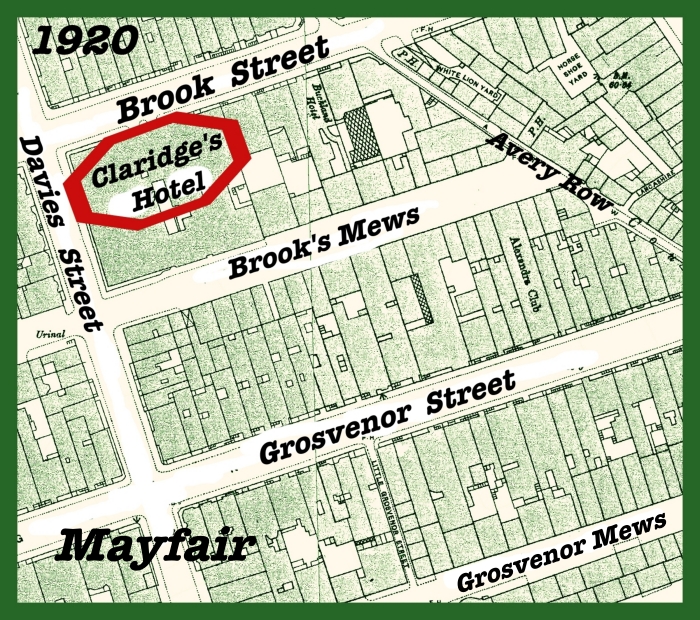
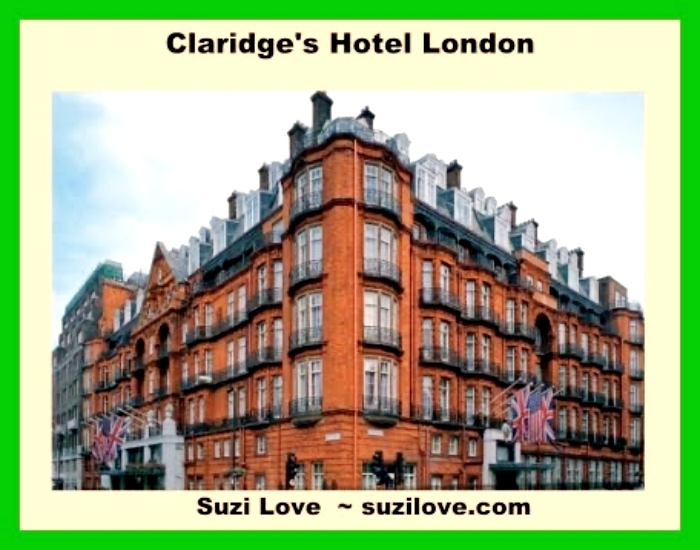
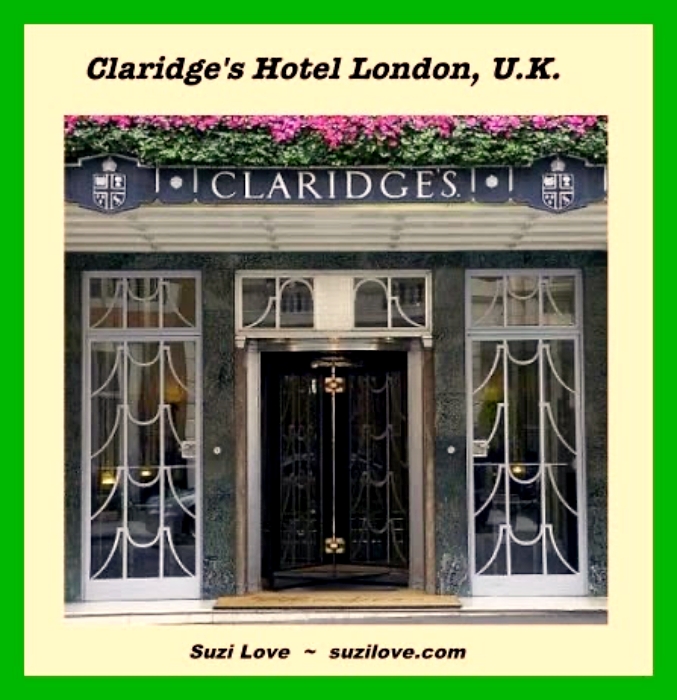
Claridge’s Hotel – London’s Historic Places Claridge’s was founded in 1812, during the Regency Era, as Mivart’s Hotel at 51 Brook Street, Mayfair, London, UK.
Lord William Beauclerk leased the terrace house from the Grosvenor Estate with permission to turn it into a hotel run by James Edward Mivart, the anglicized name for French chef Jacques Mivart. By 1838, the hotel grew to buy five consecutive houses along Brook Street, knocking down the walls to create one large hotel and Mivart prospered by introducing English county families to subtle French cooking to replace their traditional stodgy fare. Mivart designed the hotel for guests who wished to stay longer, so apartments were let by the month to foreign royalty and nobility who enjoyed the ambiance of the well-run hotel yet had the privacy of their own suites. The Prince Regent, who succeeded to the throne as King George IV in 1820, had a suite of rooms permanently reserved for him so he could discreetly carry on his playboy lifestyle.
In 1827, The Morning Post noted that Mivart’s was the fashionable rendezvous for the high Corps Diplomatique. In 1854, the hotel was sold to Mr and Mrs Claridge who ran a separate hotel at 49 Brook Street. They combined the two operations to trade as “Mivart’s at Claridge’s” until, after Mivart’s death, the hotel changed its name to Claridge’s in 1856, adding “late Mivart’s” underneath.
In 1860, Queen Victoria and Prince Albert visited the Empress Eugènie of France, who had made Claridge’s her winter quarters, and Queen Victoria was so impressed that she wrote to her uncle, Leopold I, King of the Belgians, in glowing terms of Claridge’s. The hotel became so connected to royalty it was called an “extension to Buckingham Palace”.including the Grand Duke Alexander of Russia and King William III of the Netherlands, until by 1853, The Times decided London had just three first-class hotels- Mivart’s, The Clarendon in Bond Street and Thomas’s in Berkeley Square.
In 1881, William Claridge’s failing health forced them to sell to a consortium, but the hotel consisted of several private houses and couldn’t be upgraded to compete with purpose built hotels cropping up all over London. The Savoy for example, built in 1889, offered lifts to all floors, electricity, en suite bathrooms and the best chef in Europe, Auguste Escoffier. So in 1894, Richard D’ Oyly Carte, founder of the rival Savoy Hotel, purchased Claridge’s and commissioned CW Stephens, designer of Harrods, to rebuild the hotel from the ground up. The new Claridge’s opened in November 1898.
1897 Claridge’s Hotel, Mayfair, London, U.K. A perspective view of the new building showing the front entrance in Brook Street and the return front in Davies Street. Drawn by C. W. Stephens, architect.
After World War I, Claridge’s flourished due to demand from aristocrats who no longer maintained a London house and Carte’s son, Rupert D’ Oyly Carte, added a new extension. During World War II, Peter II of Yugoslavia and his wife spent their exile at Claridge’s until on 17th June 1945, suite 212 was ceded by the UK to Yugoslavia for a single day to allow their heir, Crown Prince Alexander, to be born on Yugoslav soil.
Claridge’s Hotel, Mayfair, London, during Bridgerton and Jane Austen years. #Bridgerton #janeausten #London #BritishHistory #ClaridgesHotel #travel https://books2read.com/suziloveROver
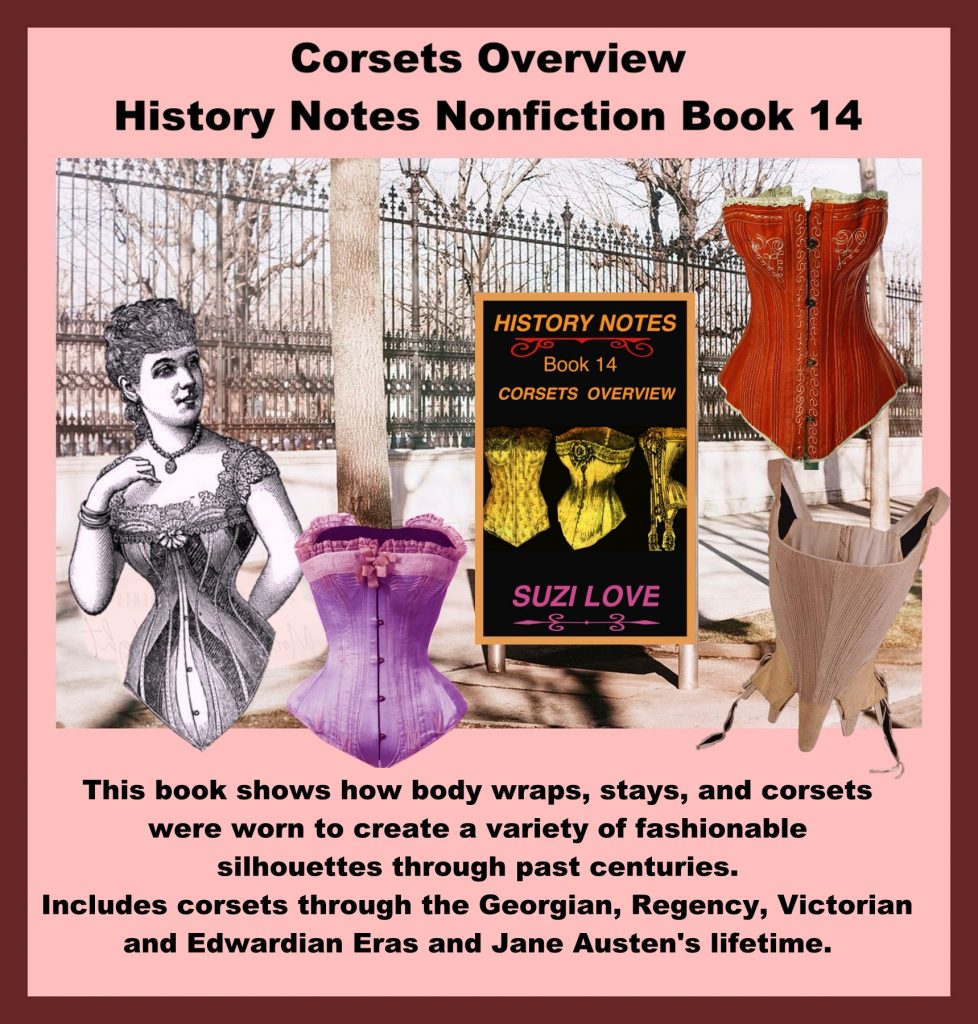
This book shows how body wraps, stays, and corsets were worn to create a variety of fashionable silhouettes through past centuries. Corsets flattened breasts and accentuated rounded hips or pushed up breasts and showed off the bust line depending on the fashions of the time and the desired silhouette. Includes corsets through the Georgian, Regency, Victorian and Edwardian Eras and Jane Austen’s lifetime. Overview of corsets through history, including the Georgian, Regency, Victorian and Edwardian Eras and Jane Austen’s lifetime. History Notes Book 14.
Do you read or write Historical Romance? Want a glimpse under dresses worn during the Bridgerton and Jane Austen years? Overview of corsets. #Bridgerton #JaneAusten #GeorgianFashion #RegencyFashion #Corset https://books2read.com/SuziLoveCorsetBook14
1821 December Green Promenade Dress, English. High waisted coat over white dress with ruffled collar, vertical front bows, short puffed sleeves over long straight sleeves, matching ruffled bonnet and yellow gloves. Fashion Plate via Rudolph Ackermann’s ‘The Repository of Arts’, London, U.K.
What did the lady of the house use to pen notes in Bridgerton and Jane Austen’s years? What sat on the desk of Jane Austen’s male contemporaries when they managed household and estate accounts? books2read.com/SuziLoveWritingTools. Writing Tools, History Notes Book 13.
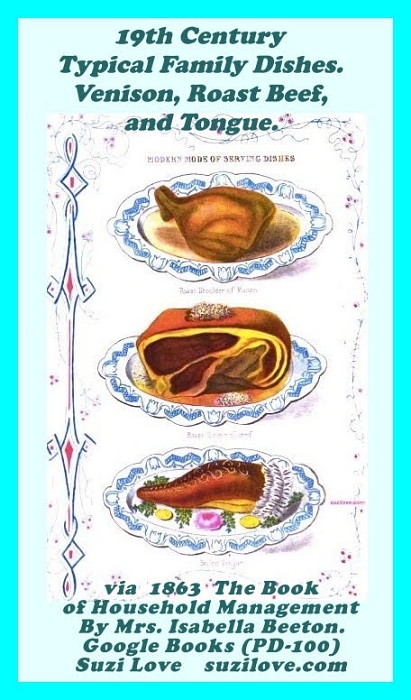
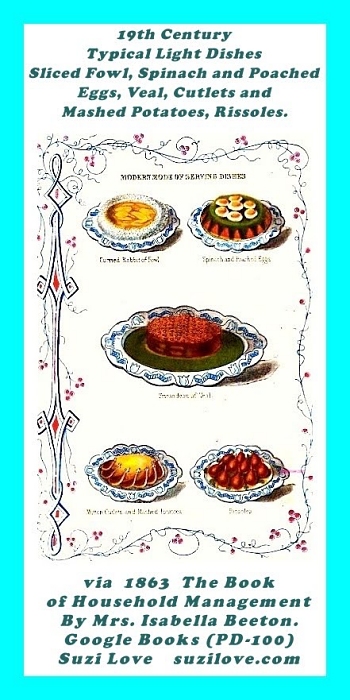
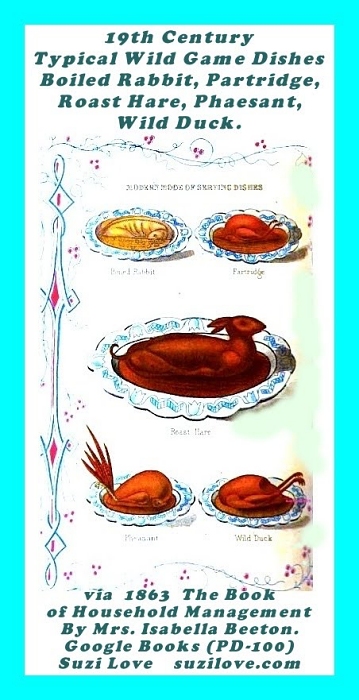
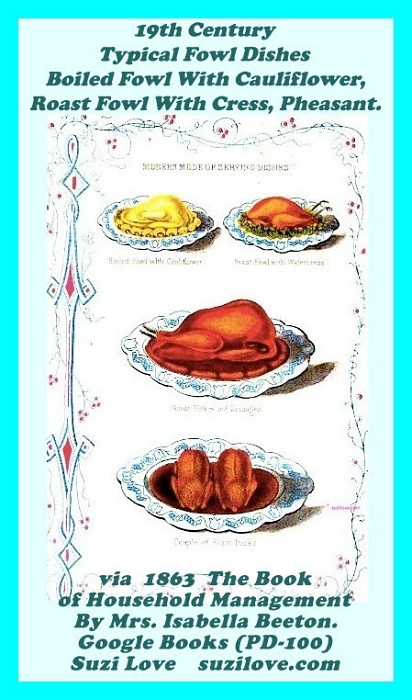
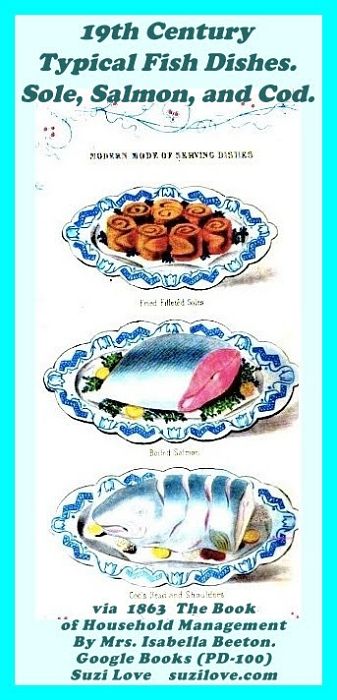
19th Century Food For The Upper Classes In Bridgerton and Jane Austen Times.
Typical Meals Served for the upper classes in the Georgian and Regency Eras. For the Upper classes in the 18th and through to the end of the 19th century, meals were elaborate affairs. and served by well-trained staff anticipated their every need. Women prided themselves on hosting dinners for 50-60 people which often consisted of numerous courses, and all served with the best wines and followed, for the men at least, by expensive port.
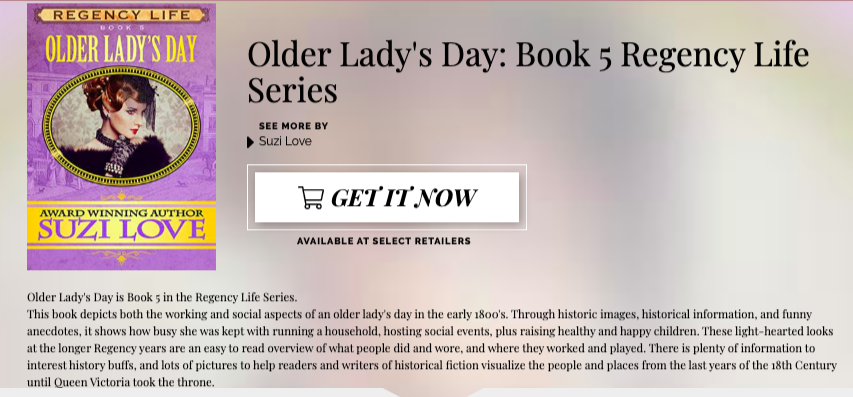
An older lady usually controlled the servants and the serving of meals. For more about this, take a look at Older Lady’s Day Regency Life Series Book 5 by Suzi Love. Overview of what an older lady did, wore, and how she lived in the early 19th Century. Information for history buffs and pictures for readers and writers of historical fiction. books2read.com/suziloveOLD
1800s Typical Puddings and Pastries.These are the sort of puddings and pastries Jane Austen’s family would have eaten on a regular basis during the early 1800s, or Regency Era. Open Apple Tart, Galette, Apricot Fritters, Pancakes and Apricot Jam, Charlotte Russe, Macaroni Cheese, Cherry Tart, Mince Pies, Almond Puddings, Tartlets, Compote Of Fruit, Fruit Pudding, Fruit Tart, Christmas Plum Pudding, Milk Pudding and Roly Poly Jam Pudding. From: 1850s- 1860s Mrs. Beeton’s Books of Household Management. via Google Books (PD-150). 1800s Typical Puddings and Pastries Served In Households Like Jane Austen’s. https://books2read.com/suziloveOLD
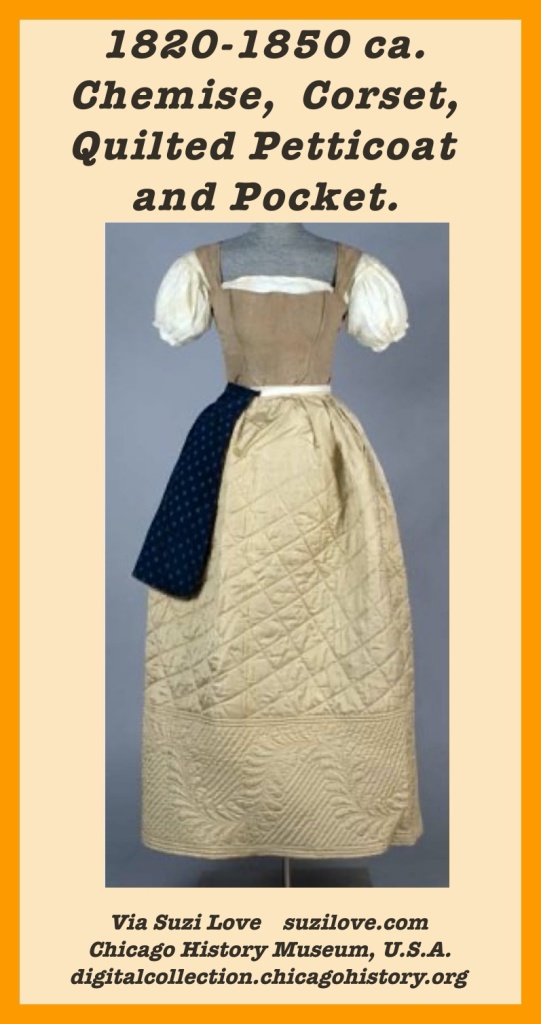
1820-1850 ca. Chemise, Corset, Quilted Petticoat and Pocket. Gift of Mary S. Belden. Corset About 1820-1830 ca. CHS Collection. Pocket About 1820-1840 ca. Chemise About 1839-1850 ca. via Chicago History Museum, U.S.A.
Chemise Or Shift: Sleeveless, mid-calf length garment of white cotton or muslin was worn next to the skin under stays or corset. Called ‘Shift’ from early Georgian (1700-1750) until Late Georgian (1750-1790) to replace ‘Smock’. By 1800, name shift was replaced by ‘Chemise’.
Corset: French term for stays. Structured bust supporting or body shaping foundation garment. Tightened by laces and often with reinforcing e.g. boning, cording and flossing.
From the Curator Victoria and Albert Museum, London: Quilting was a popular form of decoration for a variety of garments including pockets. However, hand-quilting was a time-consuming method of decoration. The increased demand for quilted petticoats, waistcoats and pockets led to the invention of woven quilting.
1840 Group In An Outdoor Setting, French. Two men in top hats. Modes de Longchamps’. Men’s outfits, a woman’s riding habit and a small boy, all tailored by Robin of 21 Rue Saint Marc, Paris. via Le Bon Ton. via Victoria and Albert Museum, London, UK. collections.vam.ac.uk.